What Can You Customize on a Nepal Trek, and What Has Limits?
Field-reviewed by Hari Kumar Shrestha
Most parts of a Nepal trek can be adjusted before booking, including route, dates, rest days, pace, accommodation level, food and sightseeing. The limits are weather, permits, availability and safety. Changes that shorten acclimatization time are generally not advisable. They might be looking at a standard itinerary and wondering about an extra rest day, a different start date, a side trip to a lake or a room with a private bathroom. The honest answer is usually yes, to a point. Most parts of a trek can be discussed. Each one comes with practical limits, and knowing those limits before you write to us makes the whole conversation easier.
This article walks through the parts of a Nepal trek that travelers commonly ask to change. For each one, we explain what is usually open for discussion and where the boundaries sit. You will also find an options-and-limits table you can scan in a minute, and a section on why a shorter holiday often needs a different route and cannot simply lose a few days from a longer one.
If you already have a trek in mind and want to adjust it, you can customize your chosen trek by telling us what you like about it and what you would like to change.
How customization works on a Nepal trek
A standard trekking itinerary is a carefully balanced sequence. Each day links one village to the next, and each village has a limited number of lodges. Daily walking times are set so that most people can finish before afternoon weather rolls in. Altitude gain is spread out so the body has time to adjust. Permits are tied to specific areas and dates. Flights or drives are timed to connect with all of this.
Because everything is connected, a change to one element often moves several others. Add a rest day and your arrival date at a pass shifts. Move your departure forward and the lodges you planned to use may already be full. Swap a drive for a flight and the cost, the timing and the luggage rules all change.
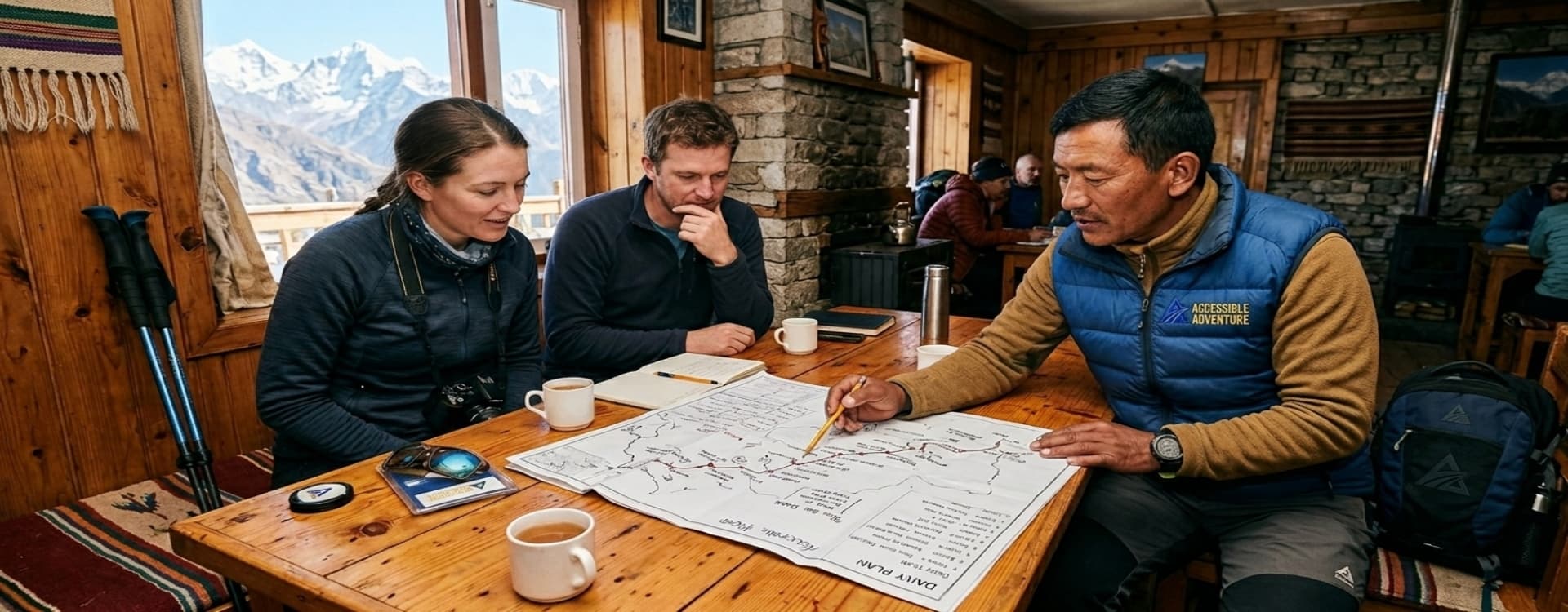
That does not mean changes are difficult. It means they work best when we look at the whole plan together. Think of a standard itinerary as a strong starting point. We keep what works for you, adjust what does not and check that the final plan still holds together on the ground.
Route selection
The biggest decision is which trek to do, and this is where customization has the most room. We can discuss routes based on your interests, your experience and the number of days you have.
If you love big mountain views and have some trekking behind you, one region might suit you well. If you prefer villages, forests and cultural stops at a gentler elevation, another will probably fit better. If you want a quieter trail, we can talk about which routes tend to see fewer visitors in your travel season. The Annapurna regions and Everest regions are well-known names, and several other areas are worth asking about too.
The limits here are practical. Restricted areas such as Upper Mustang, Manaslu and Upper Dolpo need extra permits, and a licensed guide arranged through a registered agency is part of the requirement. In March 2026, Nepal removed the requirement that two foreign trekkers share a restricted-area permit (source: [https://immigration.gov.np/trekking-permit], checked [8 June, 2026, Monday]). In practice, this means a solo traveler or couple can now consider Manaslu or Upper Mustang without finding a partner]. A licensed guide arranged through a registered agency is still required. We confirm the current rules before every booking because they have changed several times in recent years. Some routes suit only certain seasons, and others need more days than most holidays allow. When your first-choice route does not match your dates or experience, we will say so and suggest alternatives that keep the spirit of what you are after.
Conditions can also change a route. On 26 August 2026, a flash flood in Rasuwa district damaged the road to Syabrubesi, the usual starting point for the Langtang Valley, and trekking departures there paused while access was repaired. We treat this as a reminder to check current conditions before confirming any plan. Our region-by-region assessment is available in Is Nepal Safe to Travel After the 2026 Floods?. Because access can change quickly, please ask us for the latest status before you decide on Langtang. For any route, we check the current situation before we confirm a plan.
It also helps to remember that route choice sets the frame for every other option below. Settle it first and the rest become much easier to shape.
Departure dates
Start dates are usually flexible within a season. If a standard itinerary lists certain dates, those are often a convenience rather than a rule, and we can talk about the dates that suit your calendar.
The limits come from availability and conditions. Spring and autumn are the busiest trekking seasons, and popular lodges and domestic flights fill up. Dashain and Tihar, Nepal's biggest festivals, fall in autumn and shift each year. Dashain and Tihar, Nepal’s biggest festivals, fall in autumn and shift each year. In 2026, Dashain ran from 11 to 25 October and Tihar runs from 7 to 11 November. Government offices close on the main festival days, so permits and extensions are best arranged beforehand. Trails and tourism businesses stay open, though some teahouse staff take leave and transport becomes crowded around the start of the holiday. If your dates overlap with either festival, please tell us early so we can plan around it. You can read more in our guide to festivals in Nepal. Government offices close for the main festival days, so permits and extensions are best arranged before they begin. Trails and tourism businesses stay open, though some teahouse staff take leave and transport is crowded around the start of the holiday. Weather also shapes what is sensible. Heavy monsoon rain, which usually arrives between June and September, makes some trails slow and uncomfortable, and deep winter snow can close high passes.
If your dates are fixed, tell us at the start. We can then check the route, the season and the logistics against them instead of discovering a clash later. If your dates have some give, tell us how much. A shift of even a few days sometimes opens up better flight options or quieter lodges.
Daily walking stages and preferred pace
Most treks follow a typical pattern of daily stages, with some days long and others short. We can often talk about changing that rhythm. If you prefer shorter days with more time to enjoy villages and photography, we can look at splitting a long stage in two. If your group is fit and wants to cover more ground, some routes allow longer days or combined stages.
The main limit is where you can sleep. On many trails, villages with lodges are spaced a certain distance apart. If the next place to stay is four hours away, a shorter day may simply not exist. In remote sections, the only sensible stopping points are the ones already used in the standard plan.
There is also the altitude to think about. Moving faster than a standard itinerary suggests, even if you feel strong, reduces the time your body has to adjust. A brisk pace can make for a pleasant day and a rough night. We will talk through the trade-offs with you, and our guides can adjust the day-to-day rhythm on the trail based on how everyone is feeling.
Rest days and acclimatization
Extra rest days are one of the most useful adjustments you can make, and they are usually easy to discuss. Many travelers like to add a spare day at a scenic village, both to rest and to explore nearby trails without carrying a full pack.
Medical guidance on altitude gives a useful frame. The Wilderness Medical Society advice, as summarized by the US Centers for Disease Control and Prevention, says to raise your sleeping altitude by no more than about 500 metres per night once you are above 3,000 metres, and to add an extra night for every 1,000 metres of sleeping altitude gained. Other travel health guidance suggests a rest day every three or four days at height. People respond differently, so we treat these figures as a baseline when we build an itinerary.
This is the area where adding days is simple and removing days is not. A planner can often lengthen the schedule with extra rest. Shortening the schedule by cutting those days is a different matter, because the body needs that adjustment time whether or not the calendar is tight. We cover this in more detail in the section on shorter holidays below.
If you have trouble with altitude, or have not been high before, tell us so we can build in more flexibility from the start. Please also speak with your own doctor before you travel.
Side trips and additional activities
Many treks offer optional side trips, and most can be added when they fit into a rest day or a shorter walking day.
A typical example that works: a short walk to a nearby viewpoint or monastery on an acclimatization day. It keeps the group active without adding a large altitude gain.
A typical example we would advise against: adding a high side trip the day after a large altitude gain. It would reduce adjustment time, so we would suggest a lower alternative or an extra rest day instead.
We assess every side trip against your acclimatization plan before confirming it.
Additional activities before or after the trek are another popular request. Travelers ask about rafting, paragliding in Pokhara, cycling, cooking classes or a wildlife stop. These are usually possible, and they depend on the season, availability and how much time you have.
The limits come from time and energy. Every side trip uses part of a day, and a trek schedule that is already full may have no spare space. High-altitude side trips also change your acclimatization pattern, so we look at them carefully. Some activities have seasonal operating periods, and some rely on equipment or operators with limited capacity.
A good question to ask yourself is which one or two extras matter most to you. Choosing a few well keeps the trip relaxed. Piling on everything tends to turn a holiday into a checklist.
Accommodation preferences
On most routes you will stay in family-run teahouses. In the lower valleys, some lodges offer attached bathrooms and hot showers. Higher up, rooms are basic, toilets are shared and the heated dining room is often the only warm space. We can often arrange a private room or a quieter lodge, depending on what each village offers and how busy the season is. You can read more in our guide to accommodation in Nepal. For food, teahouse menus include rice, lentils, vegetables, noodles, eggs and soups. Vegetarian travelers are usually well served. Please share any allergies or medical dietary needs at booking so we can confirm what each route can provide.
Lower valleys tend to offer more comfortable options, and some lodges there have attached bathrooms and hot showers. As you climb, choices narrow. A high village may have only a few lodges with basic rooms, shared toilets and a heated dining room as the only warm spot. No amount of planning will build a hotel where there is none.
Season matters too. During busy periods, the best lodges fill early. Booking ahead helps, and flexibility about which lodge you use helps even more.
In Kathmandu and Pokhara the picture changes. City hotels cover a wide range, from simple guesthouses to boutique and international options, and we can match the level to your preference. Many travelers like to keep the trek simple and treat themselves to a comfortable hotel at either end.
Food preferences and special requests
Teahouse menus tend to be similar across routes, with rice, lentils, vegetables, noodles, eggs, potatoes, soups and simple snacks. Vegetarian travelers are usually well served. Vegan, gluten-free and other dietary needs can often be accommodated, and these are best confirmed with us in advance.
The key limit is supply. Everything a mountain kitchen cooks has to be carried up, so the range of ingredients shrinks with distance and altitude. A request that is easy in a lowland village may be hard five days up the trail. For serious allergies or medical dietary needs, we recommend a private conversation so we can be honest about what a particular route can and cannot offer.
Bringing a small stock of snacks you enjoy is a sensible backup. Many travelers carry a few favorites to keep energy up between meals.
Transport arrangements
Transport is another area with plenty of room for discussion. Depending on the route, you might choose between a long overland drive and a domestic flight, between a shared vehicle and a private one, or between different start and finish points.
The limits come from roads, weather and flight schedules. Mountain flights depend on clear weather, and delays are a normal part of trekking in Nepal. In the peak spring and autumn seasons, most flights to Lukla leave from Manthali Airport in Ramechhap, about 130 kilometres east of Kathmandu. This usually means a pre-dawn drive of four to five hours before a flight of roughly 15 to 20 minutes. Flights from Kathmandu are more common outside those months. Arrangements can change from season to season, so we confirm the current setup with the Civil Aviation Authority of Nepal and airline schedules when planning your trip. Because mountain flights depend on clear weather, we recommend a spare day around any trek that relies on one. See our guide to flight delays and cancellations. That usually means a pre-dawn drive of four to five hours before a flight of roughly 15 to 20 minutes, while flights from Kathmandu are more common outside those months. Seats on popular flights fill up in peak months, and arrangements can change from season to season, so we confirm the current setup when planning your trip.
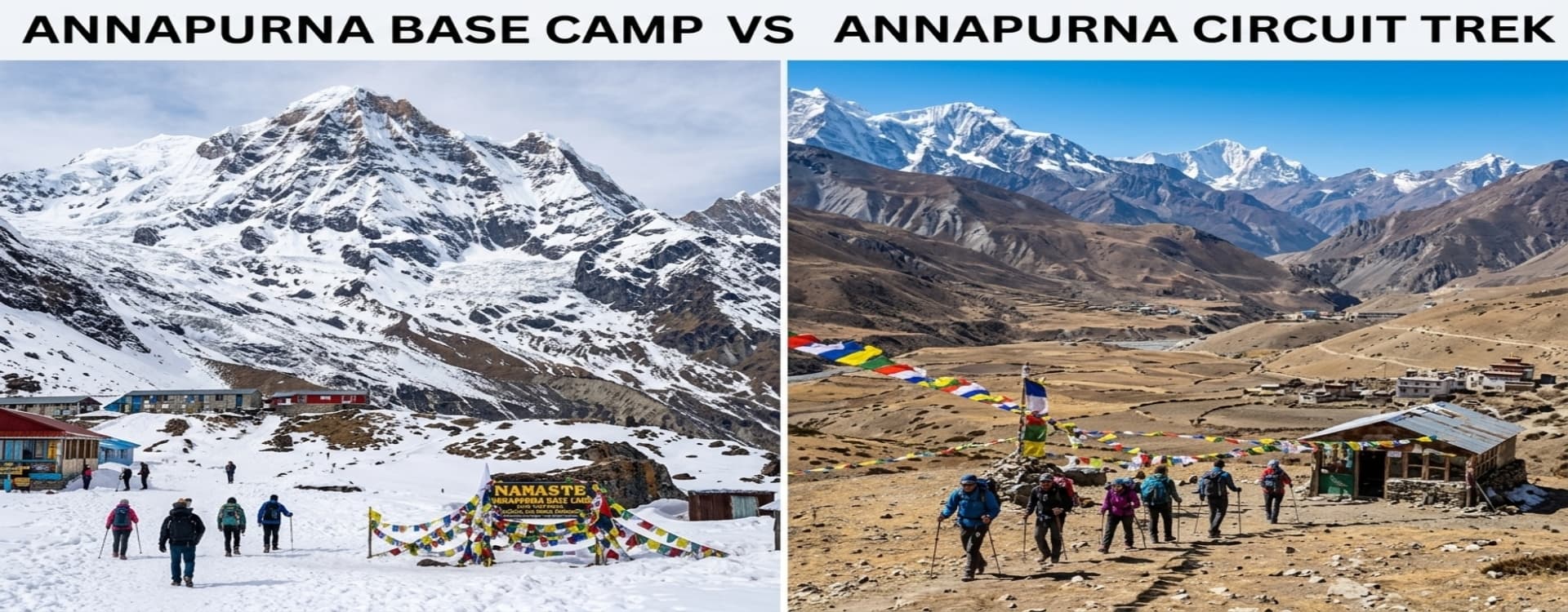
Roads shape some routes too. A jeep road now reaches Manang and Muktinath on the Annapurna Circuit, so many travelers ride a section by jeep to save time, while others follow the alternative trails the Annapurna Conservation Area Project promotes to stay off the road. It is a choice worth discussing with us.
Because of this, we usually suggest a spare day around any trek that depends on a mountain flight. It costs a little time and protects your onward connections.
Sightseeing before or after the trek
Adding sightseeing at either end is among the easiest and most popular customizations. Kathmandu has several UNESCO World Heritage sites, and Pokhara offers lakeside relaxation. Many travelers like a day or two in the city before heading to the mountains and another few days afterward to rest.
The limit is simply the calendar. Every extra city day comes out of your total number of days, so you may need to shorten the trek or choose a different route to fit it all in. Sightseeing after a trek is often the better choice, since tired legs enjoy a slower pace and a comfortable bed. A day at the start is useful for permits, a briefing and gear checks.
If you want to combine many experiences, we have separate planning advice for that in another article. For now, it is enough to know that sightseeing is flexible and usually easy to adjust.
Changes before booking and changes during the trek
There is a big difference between changing a plan before you book and changing it once you are on the trail.
Before booking, nearly everything on this list is open for discussion. We can compare routes, move dates, add rest days, adjust the comfort level and shape the plan until it feels right. This is the best time to ask for changes because lodges, permits and transport have not yet been arranged.
Once the trek is underway, flexibility is more limited. Lodges may already be reserved, porters and guides are working to a schedule and permits are tied to a set route and dates.
Small adjustments are usually fine, and our guides can handle them on the trail.
An illustrative example: if one member of a group feels the effects of altitude, the guide may recommend an extra rest night. We then check the lodges ahead and adjust the remaining stages where possible, so the group can continue at a comfortable pace.
Larger changes, such as switching to another valley or adding several days, depend on availability and may not be possible once the trek has started.
Larger changes, like switching to another valley or adding several days, depend on what is available at the time and may not be possible.
The practical advice is to raise your wishes early and be clear about the ones that matter most.
The limits behind every option
Four factors sit behind nearly every limit mentioned above.
Weather. Mountain weather can change quickly. Clouds, rain, snow and wind affect flights, trail conditions and how safe a pass is to cross on a given day. Our guides watch conditions closely and may change plans to keep everyone safe.
Permits. National parks, conservation areas and restricted areas each have their own permits, and foreign trekkers need a licensed guide arranged through a registered agency on most routes. Restricted areas add extra requirements, and under the rules updated in March 2026 a single guide can lead up to seven trekkers there. Permit rules have changed several times in recent years, so we confirm the current requirements for your trip before we plan around them.
Availability. Lodges, flights and vehicles have limited capacity. In peak seasons, popular options fill early.
Safety. This one overrides the rest. If conditions, health or timing make a plan unsafe, the plan changes. Our guides have the authority to adjust the route or turn back, and we ask every traveler to respect that decision.
Every customization we agree on has to hold up against these four. When something falls short, we tell you why and suggest an alternative that works.
Options and limits at a glance
A quick reference for the main areas travelers ask about:
|
What you may want to change |
What is often possible |
Where the limits are |
|
Route |
Choose by interest, experience and days available |
Season, special permits and guide rules, route closures, total trip length |
|
Departure dates |
Shift within a season to suit your calendar |
Peak-season availability, festivals, weather |
|
Daily stages and pace |
Shorter or longer days on many routes |
Distance between lodges, altitude gain |
|
Rest days |
Extra days at scenic villages |
Total days available, flight connections |
|
Side trips |
Viewpoints, lakes, monasteries, extra activities |
Time, energy, effect on acclimatization |
|
Accommodation |
Private rooms, quieter lodges, city hotel level |
What each village offers, peak-season demand |
|
Food |
Vegetarian and many dietary needs, confirmed in advance |
Ingredient supply at altitude, remote kitchens |
|
Transport |
Drive or fly, shared or private, varied start and end points |
Road and flight conditions, seat availability, peak-season Lukla departures from Ramechhap |
|
Sightseeing |
Days before or after the trek |
Every extra day reduces trek or buffer time |
|
Changes on the trail |
Small adjustments by guides on the spot |
Booked lodges, permits, safety, weather |
Why a shorter holiday may need a different route
This is one of the most common situations we see.
A traveler loves a particular trek, but the standard itinerary needs two weeks and they only have ten days. The tempting solution is to cut a few days from the middle.
An illustrative example: rather than removing acclimatization days from a longer high-altitude route, we would suggest a shorter trek with a lower maximum altitude. It delivers much of the same experience at a safe, comfortable pace. The CDC Yellow Book likewise advises that extra days improve safety and enjoyment. For a practical example of a shorter route, see our Annapurna Base Camp cost breakdown.
The tempting solution is to cut a few days from the middle.
The trouble is that the days in the middle are often the acclimatization days. They are in the plan because the body needs time to adjust to thinner air. Squeezing the climb into fewer days raises the chance of altitude problems and can spoil the trip. A trek that feels hurried at a high elevation is also less enjoyable.
A better answer is usually a different route. A trek in a similar region with a lower maximum altitude, or one that is shorter by design, can deliver much of what you wanted while keeping a safe and comfortable pace. Sometimes a well-chosen shorter trek combined with sightseeing is a better holiday than a rushed version of a longer one.
If your time is limited, tell us the days you have and what you most want to see. We will suggest options that fit, and we will explain the trade-offs honestly.
How to ask for changes
A few habits make requests smoother.
• Tell us your total days, your dates and your priorities first. Everything else builds on these.
• Share your trekking experience and your preferred pace. We use them to judge which changes make sense.
• Mention any requirements that need advance confirmation, such as dietary needs or accommodation preferences.
• Rank your wishes. When two of them cannot both fit, we know which one to protect.
• Ask early. The sooner we hear from you, the more room we have to arrange things.
When you are ready, write to us at info@accessibleadventure.com or message us on WhatsApp at +977 9851352707. Send us the trek you are considering, what you would like to adjust and any dates you are working with. Our team in Kathmandu will review your request and give you a clear picture of what is possible. Changes before booking are made without pressure under our No-risk Booking Policy. You can also contact us here.
Send us the trek you are considering, what you would like to adjust and any dates you are working with. We will look at what is possible and give you a clear picture of the options.
About the author: Himal Shrestha
Government-licensed trekking guide & travel writer · Accessible Adventure
Himal Shrestha is a government-licensed trekking guide and travel writer with 10 years and counting in the mountains. Trained in first aid and hospitality, he brings firsthand trekking experience to his articles on Nepal, itinerary planning, and travel preparation for Accessible Adventure.
Meet Himal ShresthaRelated Articles
Explore more stories and guides from the Traveler Information & Planning collection