Annapurna Base Camp vs Annapurna Circuit: Key Differences Explained
Field-reviewed by Hari Kumar Shrestha
Table of Contents
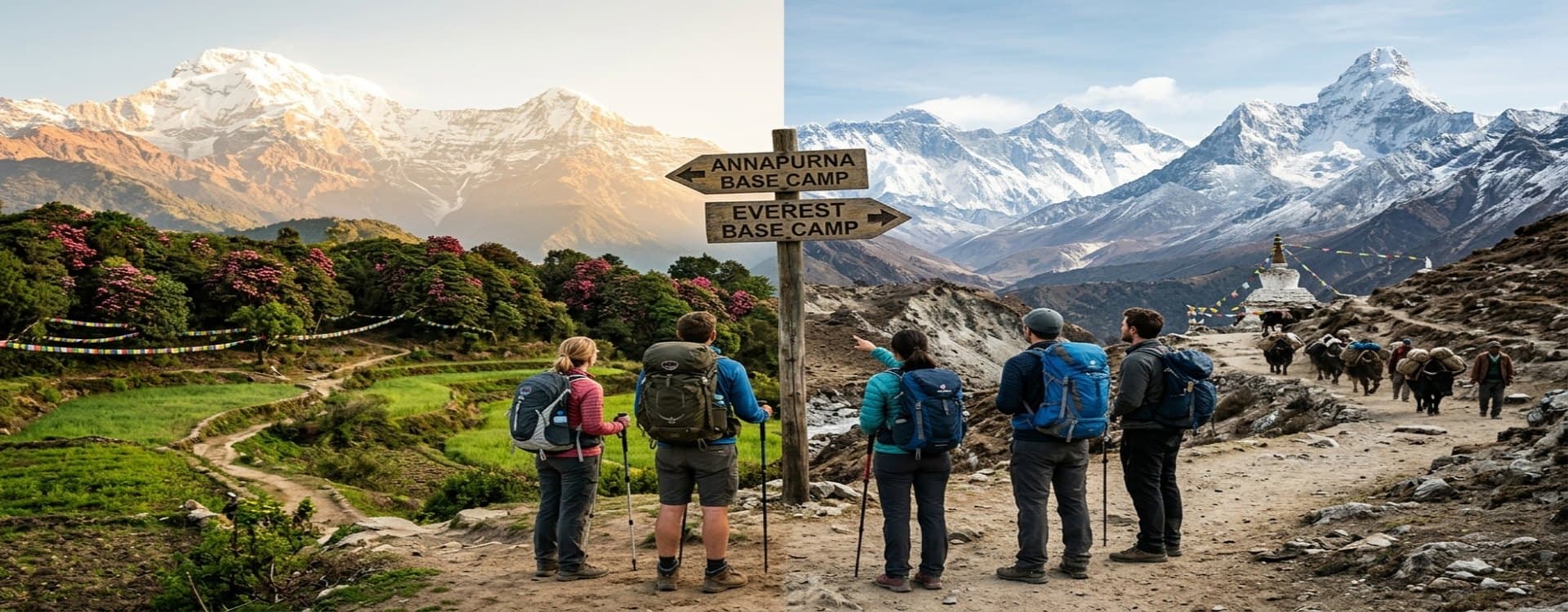
Annapurna Base Camp and the Annapurna Circuit are two of Nepal's most walked and most written-about routes. Both sit inside the Annapurna Conservation Area, share the same permit requirements, and draw trekkers from every continent. But they offer completely different trips. If you've narrowed your Nepal plans down to these two options, you're already asking the right question: which one fits your available days, your fitness, and what you actually want to walk toward?
At Accessible Adventure, our licensed guides have led 500+ Annapurna departures since 2012, and the comparisons below draw on that first-hand experience.
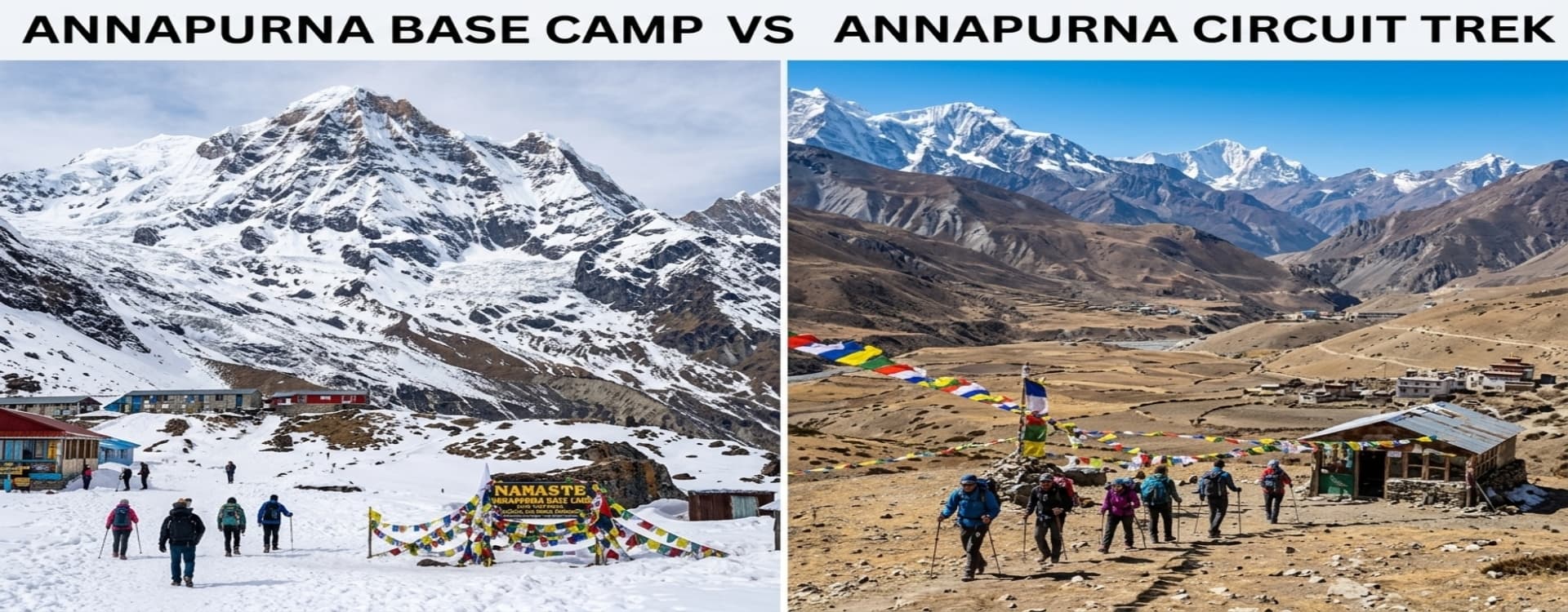
Annapurna Base Camp (ABC) is a shorter, focused out-and-back journey. The trail climbs through rhododendron forest and Gurung villages to a 360-degree mountain sanctuary surrounded by Annapurna I (8,091m), Machhapuchhre (6,993m), Hiunchuli, and Annapurna South. It's a single destination with one dramatic payoff, and it fits inside 7 to 12 days.
The Annapurna Circuit is something else. A full loop around the massif covering 160 to 230 kilometres on the classic route, crossing three distinct valley systems and the 5,416-metre Thorong La pass. The terrain changes from subtropical lowland to high-altitude desert as you move from one side of the Annapurna massif to the other. The payoff isn't a single moment; it's the accumulation of two weeks of genuinely varied landscape, culture, and altitude.
Neither is objectively better. By the end of this guide, you'll have a clear sense of which one is better for you.
At a Glance
|
|
Annapurna Base Camp |
Annapurna Circuit |
|
Duration |
7 to 12 days |
12 to 18 days |
|
Max Altitude |
4,130m |
5,416m (Thorong La) |
|
Best For |
Shorter trips, first high-altitude trek, single dramatic finish |
Cultural variety, high-pass challenge, longer loop experience |
2. Annapurna Base Camp vs Annapurna Circuit at a Glance
The core difference between Annapurna Base Camp and the Annapurna Circuit is trip length and altitude. ABC is a shorter out-and-back trek capped at 4,130 metres, while the Circuit is a longer loop that crosses the 5,416-metre Thorong La pass. The table below covers the key numbers side by side.
|
Feature |
Annapurna Base Camp |
Annapurna Circuit |
|
Duration |
7 to 12 days |
12 to 18 days (10 to 14 days with jeep shortcuts) |
|
Round-trip Distance |
70 to 120km |
160 to 230km classic; 100 to 120km with jeep access |
|
Max Altitude |
4,130m (Annapurna Base Camp) |
5,416m (Thorong La Pass) |
|
Difficulty |
Moderate |
|
|
Avg. Guided Cost |
USD 650 to 1,300 per person |
USD 900 to 1,600 per person |
|
Accommodation |
Teahouses throughout; basic to comfortable |
Teahouses throughout; more variety at lower elevations |
|
Best For |
Shorter trips, first-time high-altitude trekkers, single dramatic finish |
Longer trips, cultural variety, high-mountain-pass challenge |
Note: permit fees and guided package costs are reviewed periodically. Verify current rates against agency pricing before booking.
3. Trek Length, Distance and Daily Itinerary
Annapurna Base Camp is roughly half the trip the Annapurna Circuit is. Most ABC itineraries run 7 to 12 days over 70 to 120 kilometres, while Circuit itineraries typically run 12 to 18 days over 160 to 230 kilometres on the classic route. The numbers tell most of the story here, but the daily experience underneath them is worth understanding separately.
How Many Days Does Each Trek Take?
ABC: 7 to 12 days is the standard range. At the shorter end, express itineraries of 7 to 8 days exist for trekkers with limited vacation time, though they compress the acclimatization window above Chhomrong. The full classic route with the Poon Hill sunrise extension runs closer to 10 to 12 days.
Annapurna Circuit: 12 to 18 days on the classic full loop from Besisahar. Modern jeep access from Chame or Dharapani can cut this to 10 to 14 days by eliminating the lower valley walking, though that's also the section that most fully immerses you in the traditional village rhythm of the route.
How Far Do You Actually Walk?
ABC covers roughly 70 kilometres on the shorter Jhinu Danda return route and up to 110 to 120 kilometres if you include the full classic Nayapul to Ghorepani approach with Poon Hill. The Circuit's full classic loop from Besisahar runs 160 to 230 kilometres depending on which sections are walked versus driven. On a jeep-shortened version starting the walk at Chame, the trekking distance drops to around 100 to 120 kilometres.
What Does a Typical Day Look Like?
On ABC, daily walking runs 5 to 13 kilometres over 5 to 7 hours. The defining physical feature of the lower section is stone steps: the famous staircases at Ulleri and the long sustained climbs around Chhomrong ask more of your legs than your lungs at the altitudes involved. The terrain isn't technical, but it's relentless.
On the Circuit, daily distances range from 10 to 30 kilometres over 3 to 8 hours depending on the day. Most days are gentler than ABC's step-heavy approach, but the Thorong La crossing from Thorong Phedi to Muktinath runs around 8 hours door to door with roughly 1,000 metres of ascent followed by 1,600 metres of descent. That single day is categorically harder than anything on the ABC route.
Daily Distance and Elevation at a Glance
|
|
Annapurna Base Camp |
Annapurna Circuit |
|
Typical daily distance |
5 to 13km |
10 to 30km |
|
Typical daily walking time |
5 to 7 hours |
3 to 8 hours |
|
Toughest single day |
Deurali to ABC via Machhapuchhre Base Camp |
Thorong Phedi to Thorong La to Muktinath (1,000m ascent, 1,600m descent) |
4. Difficulty, Altitude and Fitness Requirements
The Annapurna Circuit is the more physically demanding trek, and the reason is almost entirely altitude. Thorong La sits at 5,416 metres, about 1,300 metres higher than ABC's 4,130-metre ceiling, and the cumulative ascent across the full Circuit is considerably greater than on ABC, because of the longer route and the climb to Thorong La. ABC's shorter altitude exposure window and lower maximum height make it the gentler introduction of the two.
Which Trek Carries More Altitude Sickness Risk?
The Circuit carries meaningfully more risk at its upper end. At 5,416 metres, Thorong La sits high enough that oxygen availability drops to roughly half of sea-level concentration. The standard Circuit itinerary builds in a dedicated acclimatization day in Manang (3,540m) specifically to prepare the body before the pass crossing. ABC's 4,130-metre ceiling still requires care above 3,000 metres, and altitude sickness (AMS) is a real consideration on the upper approach, but the high-altitude exposure window is shorter, and the stakes of getting it wrong are lower.
On both routes, standard AMS prevention applies: ascend gradually, stay well hydrated, eat even when appetite is reduced, and report any headache that does not clear with water and rest. This approach is consistent with guidance from the CDC and the Himalayan Rescue Association. On our departures, guides check each trekker’s oxygen saturation and symptoms every evening with a pulse oximeter. A trekker whose symptoms worsen is escorted down immediately, and the guide makes the final decision. Our emergency evacuation arrangements include helicopter evacuation process [insurance requirement].
How Fit Do You Need to Be?
Both treks are rated moderate, but the Circuit leans toward moderate to strenuous simply due to distance and duration. Walking up to 30 kilometres per day across 12 or more consecutive days asks more of cardiovascular endurance than ABC's shorter window and gentler daily distances. If you're training for either route, A sample 12-week plan, reviewed by Mr.Hari Kumar Shrestha/Himal Shrestha: Weeks 1 to 4: three 45 to 60 minute cardio sessions weekly plus one 2 to 3 hour hike. Weeks 5 to 8: add stair or incline work and a weekly hike with a 6 to 8 kg pack. Weeks 9 to 12: build to 5 to 6 hour hikes with a 8 to 10 kg pack, including back-to-back days for the Circuit, then ease off in the final week.; for the Circuit, extend the training period and include longer back-to-back training days.
Is the Terrain Different?
ABC is defined by sustained stone-step climbs and descents, particularly around Ulleri and Chhomrong, and the undulating 'Nepali flat' trail that locals use as a term for what visitors discover is far less flat than it sounds. There's no single extreme day; the difficulty accumulates across successive climbs rather than peaking on one pass.
The Circuit's defining terrain is the Thorong La crossing: steep ascent in thin air, altitude effects that make the pace feel slower than the gradient warrants, and a knee-testing descent to Muktinath on the far side. The days on either side of the pass are comparatively gentle valley walking, which is partly why Thorong La comes as a shock to some trekkers who felt fine up to that point.
Elevation Snapshot
|
|
Annapurna Base Camp |
Annapurna Circuit |
|
Max altitude |
4,130m |
5,416m |
|
Starting altitude |
~1,070m (Nayapul) |
~760m (Besisahar) |
|
Total elevation gain |
Lower overall; single high point |
~7,200m across the full route |
|
Acclimatization |
Built into the pacing above Chhomrong |
Dedicated rest day in Manang (3,540m) |
5. Scenery, Culture and On-Trail Experience
Annapurna Base Camp delivers one unforgettable payoff. The Annapurna Circuit delivers a changing story. These are genuinely different things, and which matters more to you is one of the clearest ways to make the choice between the two routes.
What Kind of Scenery Will You See?
On ABC, the approach builds through lowland subtropical forest that transitions through bamboo and rhododendron forest above Ghorepani. The optional dawn hike to Poon Hill (3,210m) is one of the finest sunrise viewpoints in Nepal: Dhaulagiri (8,167m), the entire Annapurna range, and Machhapuchhre lit gold above the valley at first light. Above Chhomrong, the vegetation strips back, the views open, and the sanctuary itself arrives like something from a different scale entirely. Standing at ABC with Annapurna I (8,091m) filling the northern wall of the amphitheatre, Machhapuchhre immediately to the south, and Hiunchuli and Annapurna South completing the circle is a moment that justifies the whole approach.
On the Circuit, the terrain never settles into one register for long. The lower Marsyangdi valley is lush and green. Above Chame, the landscape opens dramatically as the Annapurna range reveals itself across the valley. Manang at 3,540 metres sits in a high bowl surrounded by peaks on three sides, with Gangapurna Glacier visible above the village. The high-altitude desert beyond Manang before Thorong La is unmistakably Tibetan-influenced: sparse, brown, wind-carved, and empty in a way that feels genuinely remote. After crossing the pass, Marpha's apple orchards and whitewashed Thakali houses are the most welcome visual shift of the entire trek. The Kali Gandaki gorge, the world's deepest river canyon between Dhaulagiri and Annapurna, runs through the lower return section.
How Much Cultural Diversity Is There?
The Circuit generally wins on cultural variety, and the reason is straightforward: it passes through genuinely different ethnic zones. The Gurung villages of the lower Marsyangdi, the Manangi community of the upper valley (whose trading heritage connects to Tibet), and the Thakali culture of Marpha and Jomsom below the pass are three distinct cultural expressions within a single trek. The Buddhist monasteries above Manang, the ancient monastery at Muktinath (3,800m), and the flat-roofed stone architecture of the high Mustang-adjacent zone all reflect the Tibetan plateau influence that doesn't appear at all on the ABC route.
ABC's cultural trail passes through the Gurung and Magar villages of Ghandruk and Chhomrong. These are genuine, well-maintained communities with active gompa and a warm teahouse culture; the cultural engagement is authentic rather than staged. The concentration within a single valley means less variety by definition, not less quality.
Which Trail Feels More Remote?
The Circuit's high-desert stretch above Manang and the approach to Thorong La feel more genuinely remote than anything on ABC. The terrain, the altitude, and the sense of being on the northern side of the Annapurna watershed in a landscape that reads as Central Asian rather than Nepali all contribute. Below Muktinath on the descent toward Jomsom, the trail is busy with jeeps and motorbikes; that transition is jarring but expected.
ABC's final approach through Machhapuchhre Base Camp (MBC) and into the sanctuary feels less remote than the Circuit's high-desert section but arguably more dramatic. The mountains close in from all sides as you gain the final 300 metres to the camp. The sanctuary isn't remote in the sense of being far from civilization, but it's enclosed in a way that feels complete: a natural arena of rock and ice with nothing beyond it.
6. Cost, Permits and Logistics Compared
Both treks require the exact same permits, and both have required a licensed guide since April 2023. The cost gap between them comes almost entirely from trip length: more days means more teahouse nights, more guide and porter days, and more food costs on the trail. The per-day cost structure is comparable.
How Much Does Each Trek Cost?
Guided ABC packages typically run USD 650 to 1,300 per person for 7 to 12 days, depending on group size, accommodation standard, and inclusions. Guided Circuit packages typically run USD 900 to 1,600 per person for 12 to 18 days. The USD 250 to 300 gap between comparable packages reflects extra trekking days and nights rather than any meaningful difference in per-day cost.
Budget trekkers handling their own logistics (food, teahouse, and personal transport, hiring guide and porter independently) can reduce costs on both routes, but the mandatory guide requirement since April 2023 sets a floor on what independent trekking actually costs. There's no legal pathway to either route without a licensed guide booked through a registered agency.
What Permits Do You Need?
Both routes require the same two permits. The ACAP (Annapurna Conservation Area Permit) costs NPR 3,000 per person (approximately USD 23). The TIMS card (Trekkers' Information Management System) costs NPR 2,000 per person (approximately USD 15 to 20). Total permit cost is roughly NPR 5,000 (about USD 38) per person for either route. Both permits are typically arranged by the trekking agency and are verified at checkpoints on the trail.
Since April 2023, all foreign trekkers in the Annapurna Conservation Area must trek with a licensed guide booked through a registered agency. Independent solo trekking is no longer permitted on either route. Beyond the regulation, a licensed guide provides altitude monitoring, cultural context, teahouse coordination, and emergency response that meaningfully change the quality of both experiences.
Getting To and From the Trailhead
ABC starts with a 1 to 1.5 hour drive from Pokhara to Nayapul (1,070m), which is one of the more straightforward trailhead logistics of any major Nepal trek. No domestic flights, no long overland travel. Most teams depart Pokhara early morning and are walking by midday.
The Circuit starts with a longer drive from Pokhara to Besisahar (760m), approximately 2 to 3 hours depending on road conditions and the vehicle. Trekkers using jeep access to shorten the walking distance continue by jeep to Chame (2,670m) or Dharapani (1,940m), adding another 2 to 4 hours of road travel before the trail begins. The trailhead logistics are manageable but more involved than ABC's straightforward Pokhara-to-Nayapul run.
7. Which One Should You Choose?
The decision between these two routes comes down to five variables: how many days you have, where your altitude comfort sits, whether you want cultural variety or a single concentrated finish, your photography priorities, and your budget. Here's how each scenario maps to a recommendation.
1. Limited vacation days: Choose Annapurna Base Camp. At 7 to 12 days versus the Circuit's 12 to 18, ABC fits inside a standard two-week trip with enough room for travel days and a night in Pokhara on either end.
2. First-time high-altitude trekker: Choose Annapurna Base Camp. Its 4,130m ceiling and shorter high-altitude exposure window make it a gentler introduction to Himalayan trekking than the Circuit's 5,416m Thorong La. If you want to know what you can handle at altitude before committing to a longer and higher route, ABC answers that question well.
3. Culture and variety seeker: Choose the Annapurna Circuit. Crossing Gurung, Manangi, and Thakali village zones through genuinely different valley systems gives the Circuit more cultural depth and variety than ABC's single-valley approach.
4. Photography-focused traveler: Choose the Annapurna Circuit for a more varied portfolio: high-altitude desert, gorge terrain, Buddhist monastery architecture, and Thorong La pass shots alongside classic peak views. If you want one guaranteed, repeatable epic panorama rather than photographic variety, ABC's sanctuary at sunrise is the stronger single composition.
5. Budget-conscious trekker: Choose Annapurna Base Camp. Shorter duration means fewer teahouse nights and fewer guide and porter days. ABC packages typically land USD 250 to 300 lower than a comparable Circuit package, which is a meaningful saving on a Nepal trekking budget.
6. High-mountain-pass challenge: Choose the Annapurna Circuit. Thorong La (5,416m) is the only high-altitude pass crossing between the two routes, and it's the kind of day that most trekkers remember for years.
7. Already done ABC, want more: Choose the Annapurna Circuit. The Circuit shows you the other side of the massif, different cultural zones, and a higher altitude challenge. It's the most natural progression from ABC for returning Nepal trekkers.
One note on combining both: it's possible to link ABC and the Circuit into an 18 to 21 day itinerary, typically via Ghandruk or a Pokhara transfer between the two routes. It's a serious undertaking and best suited to experienced, well-acclimatized trekkers who have the time and the fitness to follow a proper altitude schedule across three weeks of consecutive trekking.
8. Conclusion
There's genuinely no wrong answer here. Annapurna Base Camp and the Annapurna Circuit are both real Himalayan experiences; they're just different ones. ABC gives you a focused, achievable journey to one of the most dramatic mountain sanctuaries in the world, in a timeframe that fits most international visitors. The Circuit gives you two weeks of constantly shifting landscape, culture, and altitude, with a high-mountain pass crossing that's hard to match anywhere in Nepal.
Both routes are operated regularly and the guides who know them best know the difference between a group that needs the sanctuary finish and a group that will thrive on the variety of the loop. If you're still not sure which one fits, reach out. The right route depends on the right conversation, and that's exactly what a custom quote is for.
Get a custom Annapurna Base Camp quote | Get a custom Annapurna Circuit quote
Frequently Asked Questions
What is the main difference between Annapurna Base Camp and Annapurna Circuit?
The main difference is scale and shape. Annapurna Base Camp is a shorter out-and-back trek to a 4,130m mountain sanctuary. The Annapurna Circuit is a longer loop crossing the 5,416m Thorong La pass through more varied terrain and villages.
Which is easier, Annapurna Base Camp or Annapurna Circuit?
ABC is generally easier. It tops out at 4,130m over 7 to 12 days, versus the Circuit's 5,416m Thorong La pass over 12 to 18 days. Both are moderate treks, but the Circuit demands more altitude acclimatization and covers more total distance.
Is Annapurna Circuit harder than Annapurna Base Camp?
Yes. The Annapurna Circuit reaches 5,416m at Thorong La, nearly 1,300m higher than ABC's 4,130m ceiling, and covers more total distance and elevation gain across a longer itinerary. Duration and altitude together make it the more demanding of the two routes.
How many days do I need for Annapurna Base Camp?
Annapurna Base Camp typically takes 7 to 12 days round trip from Pokhara, covering roughly 70 to 120km depending on the route: the classic Poon Hill approach or the shorter Jhinu Danda return.
How many days do I need for the Annapurna Circuit?
The Annapurna Circuit typically takes 12 to 18 days, though jeep-assisted itineraries can shorten this to 10 to 14 days. Distance ranges from about 100km with jeep shortcuts up to 230km on the classic full loop from Besisahar.
Which trek has better mountain views, ABC or Annapurna Circuit?
Both offer world-class views, but differently. ABC delivers one dramatic 360-degree amphitheatre of peaks at Base Camp. The Annapurna Circuit offers constantly changing panoramas across valleys, high-altitude desert, and the Thorong La pass.
Can beginners do Annapurna Base Camp?
Yes. Annapurna Base Camp is considered accessible for reasonably fit first-time trekkers. Its moderate altitude (4,130m max), established teahouse trail, and flexible 7 to 12 day itineraries make it one of the most common beginner-friendly Himalayan routes.
Do I need a guide for Annapurna Base Camp or Annapurna Circuit?
Yes. Both treks require a licensed guide booked through a registered agency, a rule enforced since April 2023. Independent, unguided trekking is no longer permitted anywhere in the Annapurna Conservation Area on either route.
What permits do I need for Annapurna Base Camp and Annapurna Circuit?
Both treks require the same two permits: the ACAP (NPR 3,000) and a TIMS card (NPR 2,000), plus a licensed guide. Total permit cost is roughly NPR 5,000 (about USD 38) per person for either route.
Which trek is cheaper, Annapurna Base Camp or Annapurna Circuit?
ABC is usually cheaper. Guided packages typically run USD 650 to 1,300 for 7 to 12 days, while Annapurna Circuit packages run roughly USD 900 to 1,600 for 12 to 18 days, mainly reflecting extra trekking days and teahouse nights.
Can I do both Annapurna Base Camp and Annapurna Circuit?
Yes. Some trekkers combine both routes into an 18 to 21 day itinerary, often linking them via Ghandruk or a Pokhara transfer. It's a serious undertaking best suited to experienced, well-acclimatized trekkers with the time and fitness to sustain three weeks of consecutive trekking.
What is the best season for Annapurna Base Camp vs Annapurna Circuit?
Both routes share the same best seasons: spring (March to May) for rhododendron blooms and autumn (September to November) for the clearest mountain visibility. The Circuit's Thorong La pass is weather-dependent and can close briefly after heavy snowfall.
Is altitude sickness a bigger risk on the Annapurna Circuit?
Yes. The Circuit carries higher altitude sickness (AMS) risk. Thorong La sits at 5,416m, where oxygen availability is roughly half of sea-level concentration, compared to ABC's 4,130m max. Acclimatization planning matters more on the Circuit.
Which trek has more cultural villages, Annapurna Base Camp or Annapurna Circuit?
The Annapurna Circuit generally offers more cultural variety, passing through Gurung, Manangi, and Thakali villages across different valleys. ABC also passes Gurung and Magar villages, but within a shorter, single-valley approach.
Which Annapurna trek should first-time trekkers choose?
First-time high-altitude trekkers with limited vacation time often do best with Annapurna Base Camp. Its 7 to 12 day window and 4,130m ceiling still deliver a genuine Himalayan sanctuary experience without the Circuit's higher altitude demands.
About the author: Himal Shrestha
Government-licensed trekking guide & travel writer · Accessible Adventure
Himal Shrestha is a government-licensed trekking guide and travel writer with 10 years and counting in the mountains. Trained in first aid and hospitality, he brings firsthand trekking experience to his articles on Nepal, itinerary planning, and travel preparation for Accessible Adventure.
Meet Himal ShresthaRelated Articles
Explore more stories and guides from the Comparisons Guides collection