Best Mera Peak Climbing Company: 6,000 m+ Guides
Field-reviewed by Hari Kumar Shrestha
Table of Contents
Quick answer. Accessible Adventure runs a 16-day Mera Peak climb to the 6,476 m summit with two climbers per guide, five of six guides who have summited Manaslu (8,163 m), a 100% record among climbers who reached Khare since September 2012, and a TripAdvisor profile you can check yourself. The limits of each claim are stated below.
Gear choices for Mera Peak come easily: layers, crampons, an ice axe. Choosing an operator takes more thought, and that choice decides whether you reach the summit or turn around below it. Mera Peak involves glacier travel, crevasse crossings and long hours above 6,000 m. The gap between a great trip and a risky one comes down to who holds the rope in front of you.
That is our case for climbers who have finished their research and are now comparing operators. It rests on four pillars you can check yourself: an experienced guide team with Manaslu, Ama Dablam and Himlung summits, a Mera Peak record with its limits stated openly, reviews you can open and read, and a client experience designed around safety margin.
How this article was written: figures about our guides, trips and records come from Accessible Adventure’s own team and trip records. Facts about the mountain, altitude medicine and regulations link to their sources in the Sources section at the end.
Mera Peak at a Glance
|
Item |
Detail |
|---|---|
|
Main summit |
Mera North, 6,476 m, Nepal’s highest trekking peak. Mera Central is 6,461 m. |
|
Location |
Hinku Valley, Makalu Barun National Park, Solukhumbu district, eastern Nepal |
|
Difficulty |
Non-technical glacier climb, commonly graded PD (Peu Difficile) on the Alpine scale. Strong cardiovascular fitness matters most. |
|
Key points on the standard route |
Zatrwa La (about 4,600 m), Khare (5,045 m), Mera La (5,415 m), High Camp (5,780 m) |
|
Permit authority |
Nepal Mountaineering Association (NMA), which issues the climbing permit; fees change with the season |
|
Best seasons |
April to May and October to November |
|
Our program |
16 days: one acclimatization day, one summit day and one contingency day |
Mera Peak Guides: Experience and Day-One Support
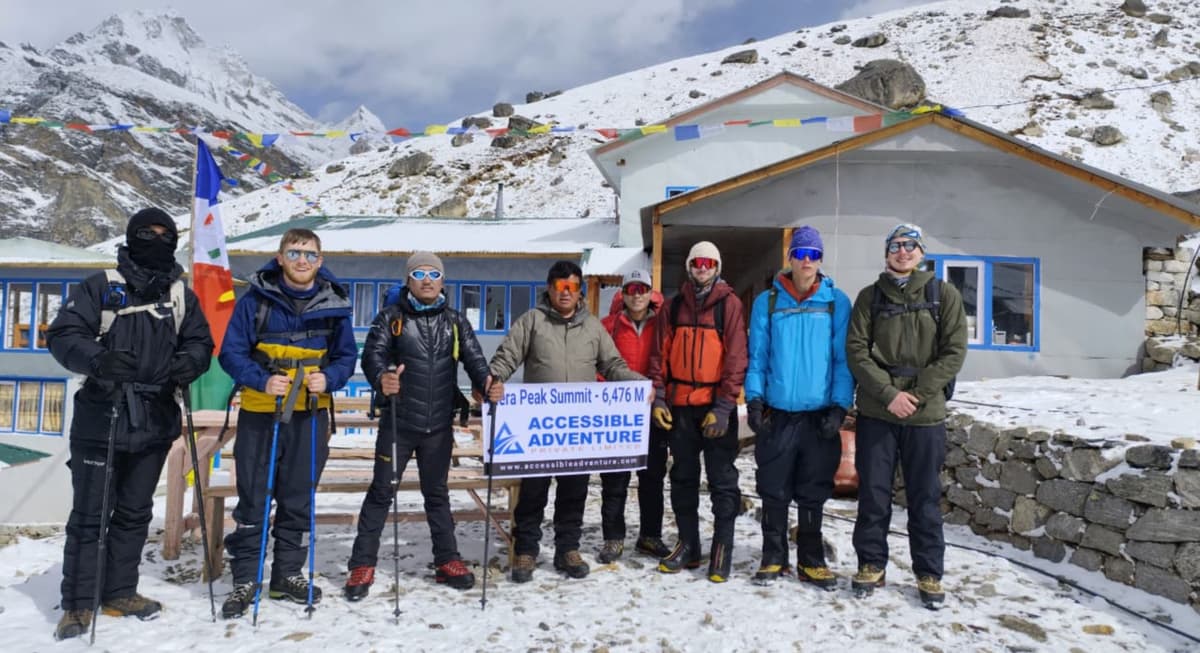
On most Mera Peak trips, a certified climbing guide leads your group from the start of the trek. Five of our six Mera Peak guides have summited Manaslu (8,163 m), and all six hold the credentials Nepal requires.
When Does Your Mera Peak Guide Join the Trek?
On most trips, the same climbing guide stays with your group from the first trekking day through to the summit. Your guide usually meets you in Kathmandu. In high season, the first meeting sometimes happens at Lukla. Either way, the person who greets you is with the group long before it reaches Khare.
One detail deserves honesty. During the busiest weeks of peak season, two guides occasionally switch over mid-trip. That happens on a minority of departures, which is why we say most trips and stand behind that wording.
How Do Our Guides Manage Altitude Illness?
Acclimatization monitoring starts on day one. Our guides check how each climber feels every day: headache, appetite, sleep, breathing, energy and overall condition. The checks tighten as the altitude climbs, and guides use a pulse oximeter for regular oxygen checks.
When symptoms are mild, the group slows down, drinks more water and rests while the guide keeps watching. When symptoms persist, worsen or point to serious altitude sickness, ascent stops and the guide arranges a rest day or a descent. We take no chances with altitude.
This follows established medical guidance:
- Once above 3,000 m, the CDC Yellow Book (citing the Wilderness Medical Society) advises raising your sleeping altitude by no more than about 500 m per day, with an extra acclimatization day for every 1,000 m gained.
- Altitude illness has three forms: acute mountain sickness (AMS), high-altitude cerebral edema (HACE) and high-altitude pulmonary edema (HAPE).
- TravelHealthPro advises treating symptoms at altitude as altitude illness until proven otherwise.
- The International Society of Travel Medicine notes that being physically fit does not remove the risk, which is why daily checks apply to every climber.
This section is general information, not medical advice. Please discuss altitude, prevention medication and any health conditions with your own doctor before you travel.
What Qualifications Do Mera Peak Guides Need in Nepal?
Every guide who leads a Mera Peak group holds the credentials Nepal requires: a government issued license, NMA guide credentials and a NATHM trekking guide certification. Many operators work with guides who hold a basic NMA certificate, a standard that carries no personal high-altitude summit requirement.
Our team goes further. Five of our six Mera Peak guides have summited Manaslu (8,163 m), and Ongchhu Sherpa has also summited Himlung (7,126 m). Both peaks are well above 7,000 m. Five of the six have also summited Ama Dablam (6,812 m), a steep technical peak.
Meet the Guides
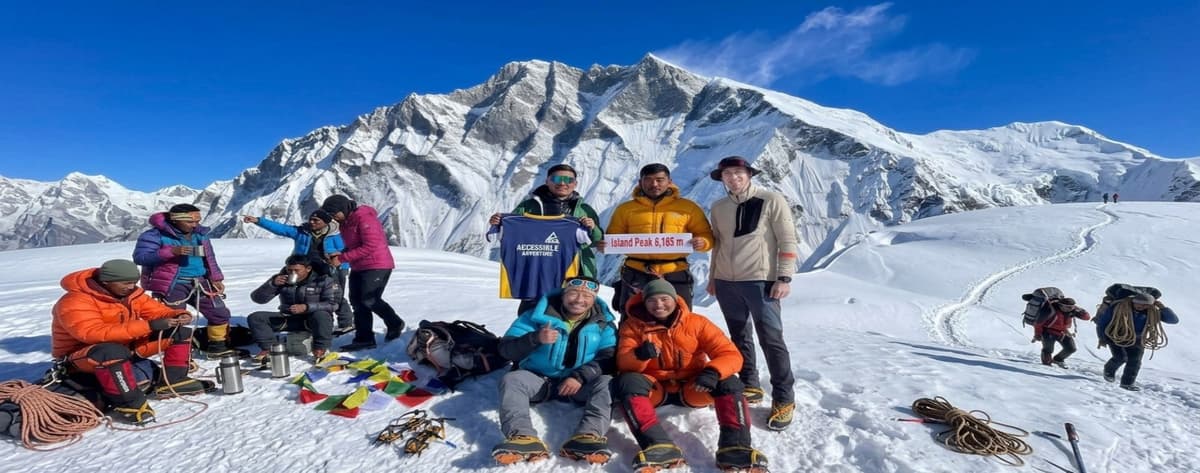
Six guides lead or support our Mera Peak climbs. Four are profiled below, and you can see the wider team on our Our Team page.
|
Guide |
Mera Peak summits |
Other major summits |
Highest summit |
|---|---|---|---|
|
35 |
Manaslu, Ama Dablam |
Manaslu, 8,163 m |
|
|
30 |
Himlung, Manaslu, Ama Dablam |
Manaslu, 8,163 m |
|
|
Pasang Gurung |
20 |
Manaslu, Ama Dablam |
Manaslu, 8,163 m |
|
15 |
Ama Dablam |
Ama Dablam, 6,812 m |
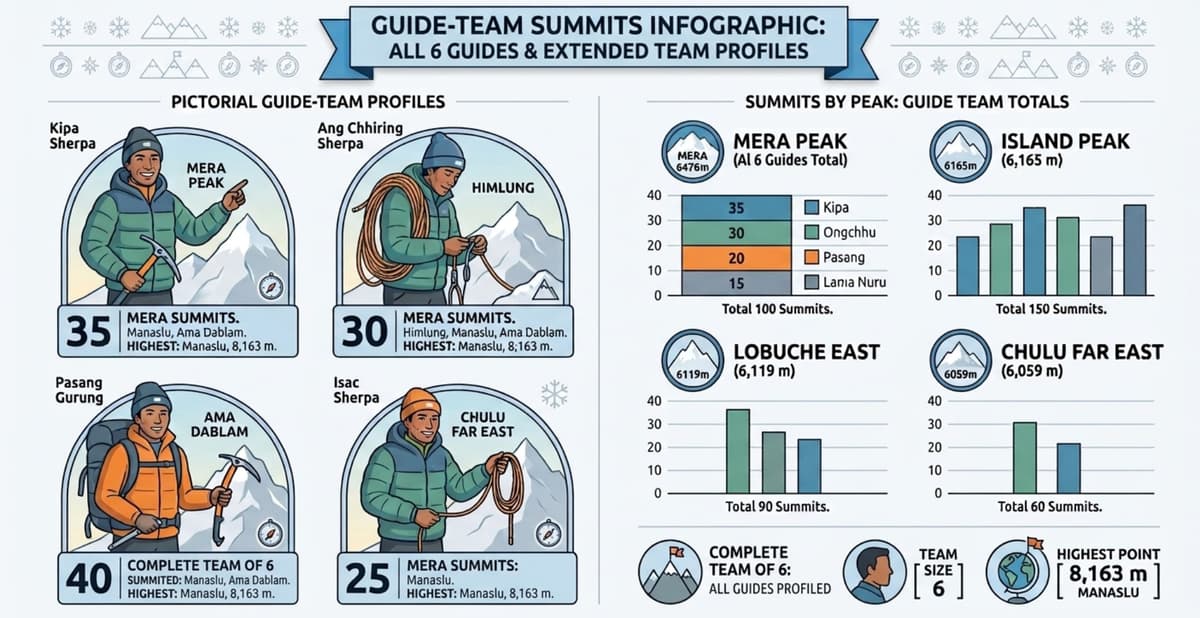
Isac Sherpa and Ang Chhiring Sherpa complete the team of six. Both have summited Manaslu, and Ang Chhiring Sherpa has also climbed Ama Dablam.
Which of Our Guides Have Summited Manaslu or Ama Dablam?
Five of our six Mera Peak guides have summited Manaslu, and five have summited Ama Dablam. Both mountains ask more of a climber than Mera Peak does, one through sheer altitude and the other through steep technical climbing.
- Manaslu (8,163 m): Kipa Sherpa, Ongchhu Sherpa, Pasang Gurung, Isac Sherpa and Ang Chhiring Sherpa.
- Ama Dablam (6,812 m): Kipa Sherpa, Ongchhu Sherpa, Pasang Gurung, Lama Nuru Sherpa and Ang Chhiring Sherpa.
How Are Our Guides Selected and Vetted?
Selection starts with experience, training and a government issued license. Hiring is only the first step in the process.
Before each major trekking season, our guides refresh their safety and technical skills. The training covers first aid, altitude sickness, rescue procedures, emergency communication, weather awareness and risk management. Experienced senior guides, certified trainers and the relevant Nepal authorities run the sessions.
Every expedition ends with a proper debrief and a review of client feedback. We look at safety, communication, professionalism, leadership and the overall client experience, and our senior team talks through any issue directly with the guide. When a guide receives poor feedback, we investigate the reason, provide coaching or extra training and, if needed, assign a more experienced guide before that person leads another trip. Client trust comes first.
What Does the Mera Peak Climb Involve?
The standard route flies from Kathmandu to Lukla, crosses the Zatrwa La into the quiet Hinku Valley, and follows the valley to Khare (5,045 m), the last village before base camp. At Khare, guides teach crampon and ice axe technique. The route then crosses the Mera La (5,415 m) to High Camp (5,780 m), the launch point for the summit.
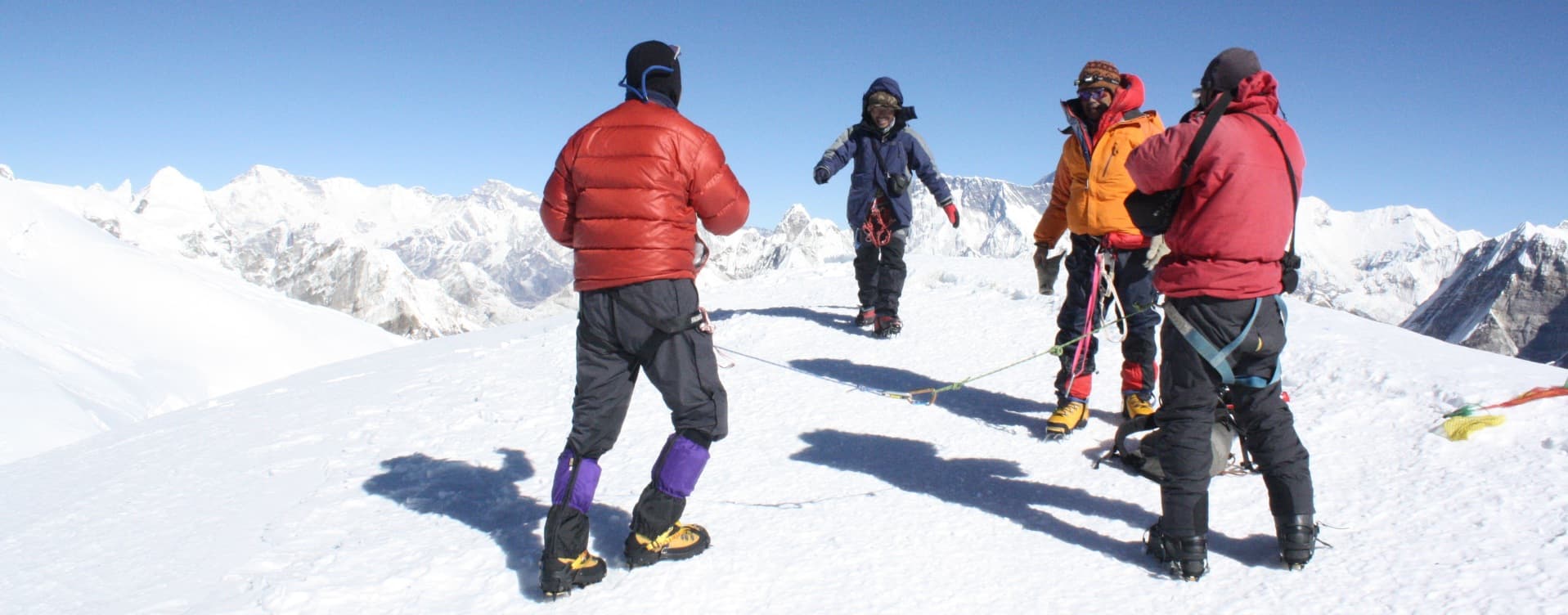
On summit day, the group leaves High Camp early, travels roped across the glacier and returns to Khare the same day. Published itineraries commonly put the round trip at roughly 8 to 12 hours, depending on conditions and the group’s pace. Clearance for the push rests with the guide team, and staying attentive to the guide’s instructions is the one requirement we place on every climber.
Is Mera Peak right for you? Mera Peak needs no previous technical mountaineering, but it is a serious high-altitude objective. Weather, altitude and crevasses are real risks, and no operator can guarantee a summit. Strong cardiovascular fitness, a gradual itinerary and a guide willing to turn the group around are what protect your chances.
Mera Peak Summit Success Rate: Our Record Explained
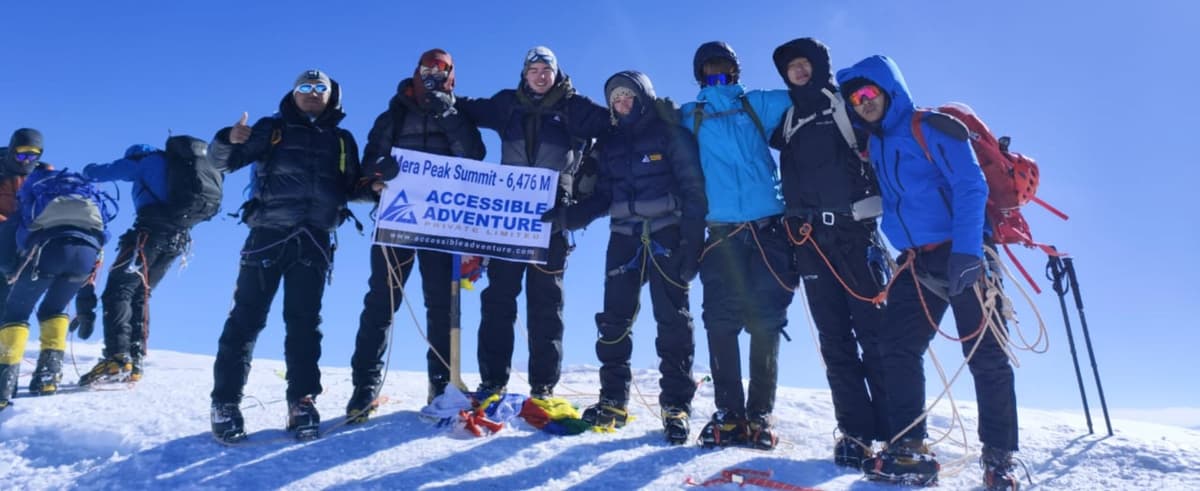
Across every spring and autumn season since September 2012, no climber who reached Khare on one of our Mera Peak trips has had to turn back. We report this as a record for climbers who reached Khare, not as a rate across all bookings.
What Is Our Mera Peak Summit Success Rate?
Climbers on our standard trip reach Mera North at 6,476 m, the highest point of the mountain. A “summit” here means reaching Mera North. The 100% figure covers the period from September 2012 to the date of this article and counts climbers who reached Khare.
Our records show one weather case. Five climbers from a single group went down from Kothe in bad weather, below Khare, so they sit outside the figure. We state this openly because a summit record with its limits shown tells you more than a bare 100%.
How Many Combined Summits Does the Guide Team Have?
Our guide team has taken clients to the summit of four popular Nepal peaks more than 1,050 times.
|
Peak |
Elevation |
Guide team summits with clients |
|---|---|---|
|
Mera Peak |
6,476 m |
400+ |
|
Island Peak |
6,189 m |
300+ |
|
Lobuche East |
6,119 m |
250+ |
|
Chulu Far East |
6,060 m |
100+ |
|
Combined |
|
1,050+ |
Every figure counts summits made with clients across the whole guide team.
Mera Peak Reviews: What Climbers Say
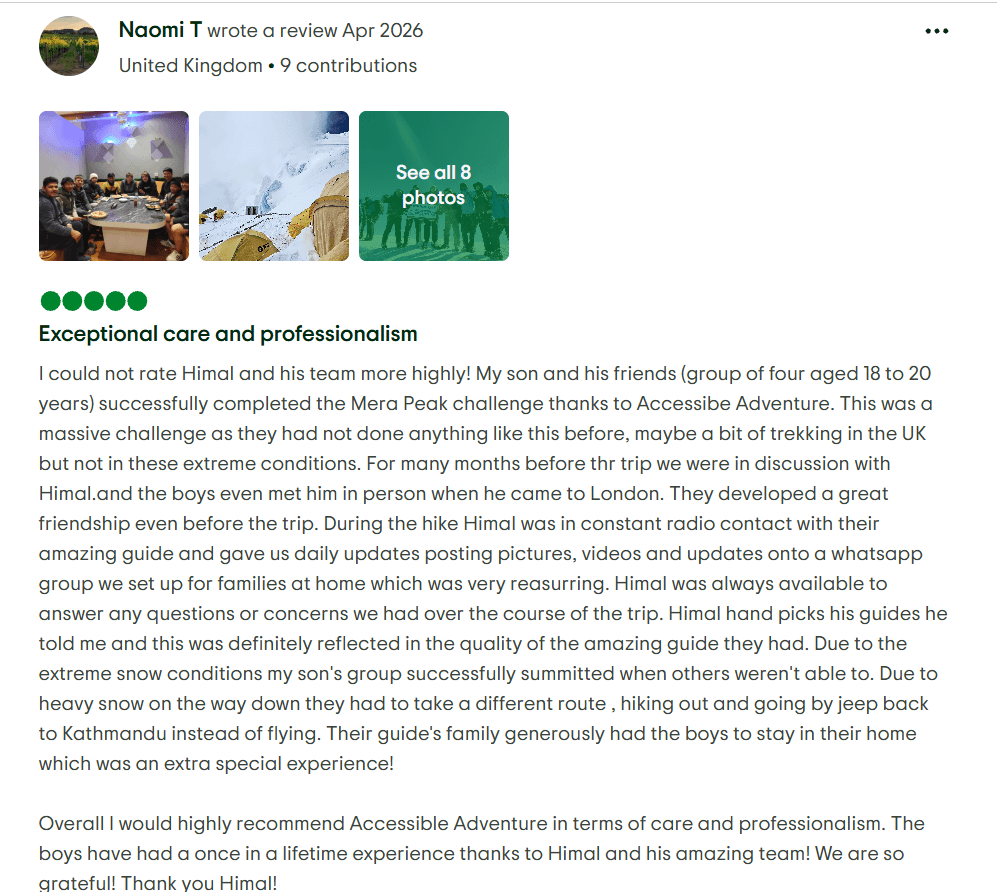
We hold a 100% five-star record on TripAdvisor, as shown on our profile at the time of writing. Open the Accessible Adventure profile on TripAdvisor and check it yourself.
Are Our TripAdvisor Reviews Really 100% Five-Star?
Open the profile and look. Check the review count and the dates when you visit, since both change as new climbers post. We invite that scrutiny because a claim you can verify carries more weight than one you have to take on trust.
What Do Climbers Consistently Say About Their Trip?
Four themes come up again and again: personal care, the experience of our guides, clear communication from the team, and flexibility when plans needed to change. Many describe being treated like family from the first message to the final airport transfer. Those themes match how we work. Our guides explain what is happening and why, and the plan bends to the climber’s pace, health and the weather.
How Should You Read Operator Reviews Critically?
A few habits make any operator’s reviews far more useful, ours included.
- Look at the date spread. Reviews across many seasons say more than a burst from one month.
- Look for specifics. Guide names, itinerary details and mentions of particular days carry more weight than general praise.
- Look at how the operator replies to critical reviews.
- Compare more than one platform before you decide.
How to Choose a Mera Peak Operator: Eight Questions to Ask
- Does every guide hold a government issued license, NMA credentials and NATHM certification?
- What high-altitude peaks have the guides personally summited?
- How many climbers does each guide look after?
- Does the itinerary include an acclimatization day and a contingency day?
- Who checks your insurance, and what altitude and evacuation cover does it need?
- What happens, step by step, if a climber becomes seriously ill?
- Which permits and fees does the price include?
- Can you read dated reviews from several seasons?
We answer each of these in this article.
The Full Client Experience, Beyond the Summit Push
Small groups, permits handled for you, insurance verified before departure and an evacuation plan agreed in Kathmandu: we design the trip around safety margin as much as the summit photo.
How Small Are Our Mera Peak Groups?
We keep the ratio at two climbers per guide. Climbing guides and assistant guides together make that possible, so a typical group of four travels with two guides. The maximum group is 12, and a trip can run with a single climber. Private departures keep the same ratio. Our own team runs the Mera Peak trip from start to finish.
Who Handles Permits, Insurance and Emergency Evacuation?
We arrange these permits and fees, and the price includes them:
- Mera Peak climbing permit (issued by the NMA; the fee varies by season)
- Makalu Barun National Park entry fee
- Local or municipality trekking and entry fees, where they apply
- Garbage deposit fee
- SPCC report fee
Travel insurance is mandatory. Your policy needs to cover high-altitude mountaineering up to at least 6,500 m, emergency helicopter evacuation and mountain rescue, emergency medical treatment and hospitalization including altitude illness, and medical repatriation. We recommend at least USD 25,000 of rescue and evacuation cover. Read the policy’s altitude cap carefully, because some inexpensive policies stop at 4,500 m or 6,000 m, below the Mera summit. See our travel insurance guide.
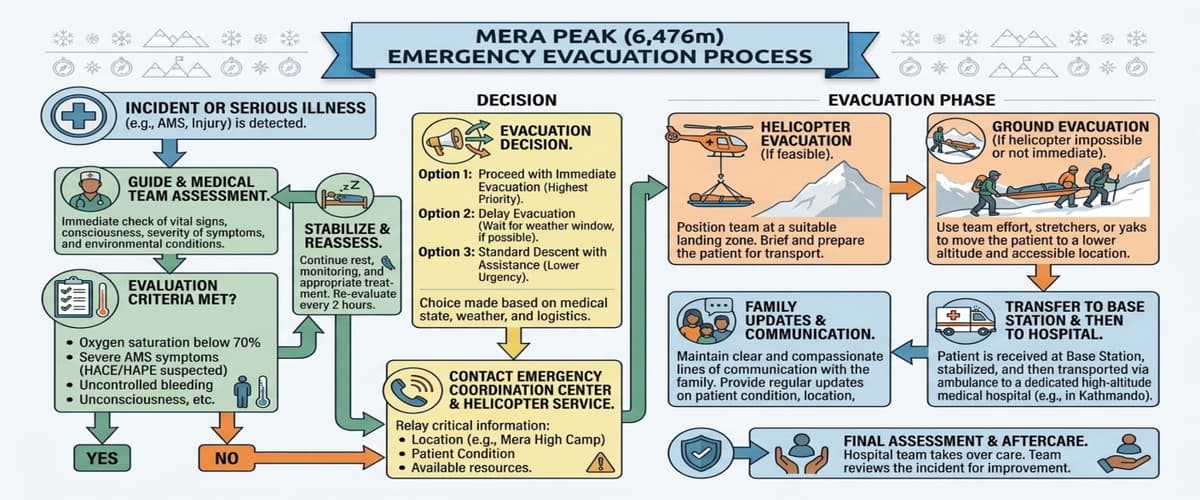
Before you leave Kathmandu, we run a safety and evacuation briefing that covers altitude risks, evacuation procedures, insurance requirements, emergency contacts and who makes decisions. We verify your insurance and emergency details and record the key arrangements in your trip file.
If a climber becomes seriously ill, this is what happens:
- The guide assesses the climber immediately, stops the ascent and gives first aid.
- The guide and our senior team decide whether rest, descent or evacuation fits the climber’s condition.
- If evacuation is needed, we contact the helicopter or rescue provider and the climber’s insurance assistance company, and we coordinate with the relevant local authorities. We work with helicopter operators across Nepal and help with the insurance side.
- We arrange the transfer to the nearest appropriate hospital.
- Our team stays with the climber and keeps the family and insurer informed until hospital handover.
On every Mera Peak trip, our guides carry a first aid and emergency medical kit, a pulse oximeter for regular oxygen checks, emergency medicines for common trekking and altitude conditions, supplemental oxygen when the climbing plan calls for it, and mobile or radio communication, with satellite communication available for remote sections. Headlamps and other essential emergency gear complete the kit.
What Does Our Mera Peak Price Cover?
The price covers permits, guides, porters, accommodation and group climbing equipment, including ropes, ice screws, snow and technical climbing gear and other group safety gear. You sleep in teahouses along the trail and in a tented camp higher on the mountain. Personal climbing gear, travel insurance and tips stay separate. See our peak climbing trips for the full list of inclusions and exclusions.
An Itinerary Built Around Acclimatization
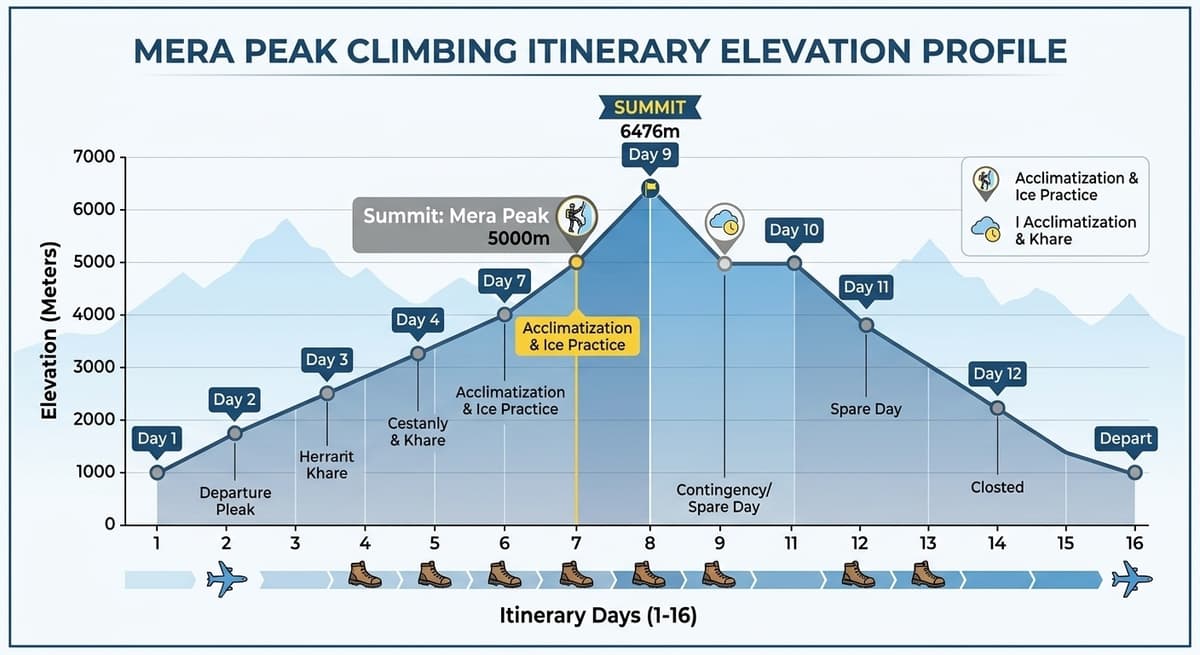
Our Mera Peak program runs 16 days. Altitude gain stays gradual, and the schedule holds one dedicated acclimatization day, one summit day and one contingency day. The remaining days are paced to let the body adapt naturally.
Compared with shorter standard schedules, we build in more time for acclimatization, flexible pacing and adjustments for weather or health. Shorter schedules leave less room for any of those.
What Happens If Lukla Flights Are Delayed?
One dedicated buffer day sits inside the itinerary for Lukla flight delays and weather disruptions. When flights slip, our team monitors the situation and works with the airline to reschedule. If needed, we can arrange a helicopter to Lukla or an alternative routing through another airstrip, depending on weather and availability. Your guide and our office team coordinate the logistics, so you never manage a delay alone. See our guide to flight delays and cancellations.
Gear Support Before the Climb
Before departure, our team runs a pre-trip gear check in Kathmandu and advises on anything missing. For technical climbing equipment, we recommend renting at Khare, where suitable high-altitude gear is available and can be checked before the climb. We supply the group climbing equipment, and our guides inspect every climber’s equipment before the group heads toward High Camp and the summit. See our equipment guide.
Support After the Trek
After the climb, we arrange your Kathmandu hotel, airport transfers and a comfortable recovery period before the international flight. We build in a buffer day where possible to protect the itinerary from weather, flight delays and changing mountain conditions. Our team stays reachable until your final airport transfer.
How Do We Look After Porters and Staff?
Our porters receive fair, agreed wages and work within safe weight limits. We provide clothing and trekking equipment suited to the route and conditions, along with accommodation, meals and the necessary insurance and medical support. Read more on our Our Commitments page.
What Makes Our Mera Peak Climbs Different?
We keep our operation small on purpose. That choice lets us build long relationships with climbers and stay involved before, during and after every trek. Our guide team pairs veteran local expertise with young, responsive energy. Decisions on the mountain rest on safety, and we adapt the program to each climber’s pace, health and conditions.
Mera Peak Operators Compared: What to Look For
Operators vary widely. The right-hand column reflects our general experience of the category and is not a statement about any named company.
|
Factor |
Our Mera Peak climbs |
In our experience, other operators |
|---|---|---|
|
Guide qualification |
Government license, NMA and NATHM credentials; five of six guides have summited Manaslu (8,163 m) |
Often a basic NMA certificate; personal summit records vary |
|
Guide presence |
On most trips, the same climbing guide from Day 1 |
Some bring the guide in at Base Camp or Khare |
|
Mera Peak summit record |
100% of climbers who reached Khare since September 2012, with the definition stated |
We have seen few operators publish theirs |
|
Group size |
Two climbers per guide; typical group of four, maximum 12 |
Ratios can be less consistent |
|
Review record |
100% five-star on TripAdvisor, open to check |
Review records vary; check dates and details |
Plan Your Mera Peak Climb With Us
Four pillars carry our case: an experienced guide team that starts with you early in the trip, a summit record with its limits shown, reviews you can read for yourself, and a client experience built around safety margin. See our peak climbing trips for departure dates, or talk directly with one of our guides before you book.
Frequently Asked Questions
Who is the best Mera Peak climbing company?
We believe we are a strong choice for climbers comparing operators. Five of our six Mera Peak guides have summited Manaslu (8,163 m), and our TripAdvisor profile shows a 100% five-star record at the time of writing. Read the reviews yourself.
Do your guides join the trek from Day 1?
On most trips, yes. Your climbing guide starts with the group in Kathmandu or at Lukla, runs daily acclimatization checks and leads the summit push. In peak season, two guides occasionally switch over mid-trip.
What is the minimum qualification for your guides?
Every guide holds a government issued license, NMA guide credentials and a NATHM trekking guide certification. Five of our six Mera Peak guides have also summited at least one peak above 7,000 m, such as Himlung or Manaslu.
What is your Mera Peak summit success rate?
Since September 2012, across spring and autumn seasons, no climber who reached Khare has turned back. Five climbers from one group descended from Kothe in bad weather and sit outside that figure.
Have your guides summited Manaslu or Ama Dablam?
Yes. Five of our six Mera Peak guides have summited Manaslu (8,163 m), and five have summited Ama Dablam (6,812 m). Both peaks ask more of a climber than Mera Peak does.
How many combined summits does your guide team have?
Our guide team has taken clients to the summit more than 1,050 times across Mera Peak, Island Peak, Lobuche East and Chulu Far East, including 400+ summits of Mera Peak itself.
Are your TripAdvisor reviews genuine?
You can check them yourself on our TripAdvisor profile. Look at the review dates, the specific details climbers mention and how we reply before you decide.
How big are your Mera Peak groups?
A typical group has four climbers and two guides, a ratio of two climbers per guide. Groups run up to 12, and a single climber can join. Private departures keep the same ratio.
Do you handle Mera Peak permits?
Yes. We arrange the Mera Peak climbing permit and the Makalu Barun National Park entry fee, along with local fees, the garbage deposit and the SPCC report fee. The price includes all of them.
What happens in a medical emergency on Mera Peak?
Your guide assesses you, stops the ascent and gives first aid. Our team then arranges rest, descent or evacuation, contacts the helicopter provider and your insurer, and stays with you until hospital handover.
What does your Mera Peak price cover?
The price covers permits, guides, porters, accommodation and group climbing equipment. Personal climbing gear, travel insurance and tips stay separate.
How hard is Mera Peak, and is it suitable for beginners?
Mera Peak is non-technical and commonly graded PD on the Alpine scale, so it suits climbers without prior mountaineering experience. It is still a demanding high-altitude climb, so cardiovascular fitness and a gradual itinerary matter. Guides teach crampon and ice axe technique at Khare.
How does Mera Peak compare to Island Peak in difficulty?
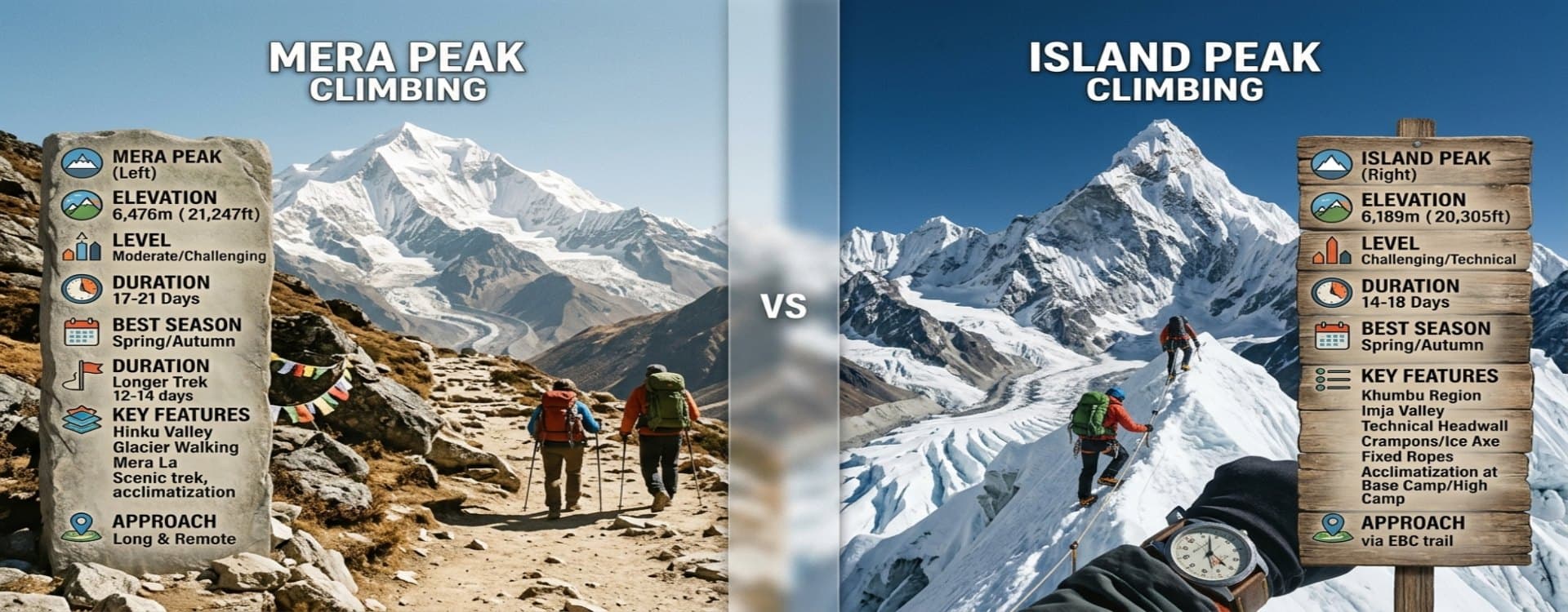
Mera Peak (6,476 m) is higher but less technical, mostly a glacier walk with a short steep finish. Island Peak (6,189 m) is lower yet more technical, with a steep fixed-rope headwall below the summit. See our Island Peak vs Mera Peak comparison: https://www.accessibleadventure.com/blog/island-peak-vs-mera-peak-which-climb-should-you-choose
How serious is altitude sickness on Mera Peak?
It is the main medical risk. Altitude illness can affect any climber above about 2,500 m, regardless of fitness. Gradual ascent, daily checks and a willingness to rest or descend are the standard protections. See our guide to altitude sickness during a trek-https://www.accessibleadventure.com/travel-guide/altitude-sickness-during-trek
What insurance do I need for Mera Peak?
A policy covering high-altitude mountaineering up to at least 6,500 m, emergency helicopter evacuation, rescue, medical treatment and repatriation. We recommend at least USD 25,000 of rescue and evacuation cover and verify your policy before departure.
What is the elevation of Mera Peak?
Mera North, the main summit, stands at 6,476 m, making it Nepal’s highest trekking peak. Mera Central sits at 6,461 m. Our clients climb Mera North.
When is the best season to climb Mera Peak?
Spring (April to May) and autumn (October to November) offer the most stable weather windows for a Mera Peak summit push. We run climbs in both seasons. See our guide to the best time for climbing peaks in Nepal-https://www.accessibleadventure.com/travel-guide/best-time-for-climbing-peaks-in-nepal
About the author: Himal Shrestha
Government-licensed trekking guide & travel writer · Accessible Adventure
Himal Shrestha is a government-licensed trekking guide and travel writer with 10 years and counting in the mountains. Trained in first aid and hospitality, he brings firsthand trekking experience to his articles on Nepal, itinerary planning, and travel preparation for Accessible Adventure.
Meet Himal ShresthaRelated Articles
Explore more stories and guides from the Comparisons Guides collection