
Peak Climbing Guide
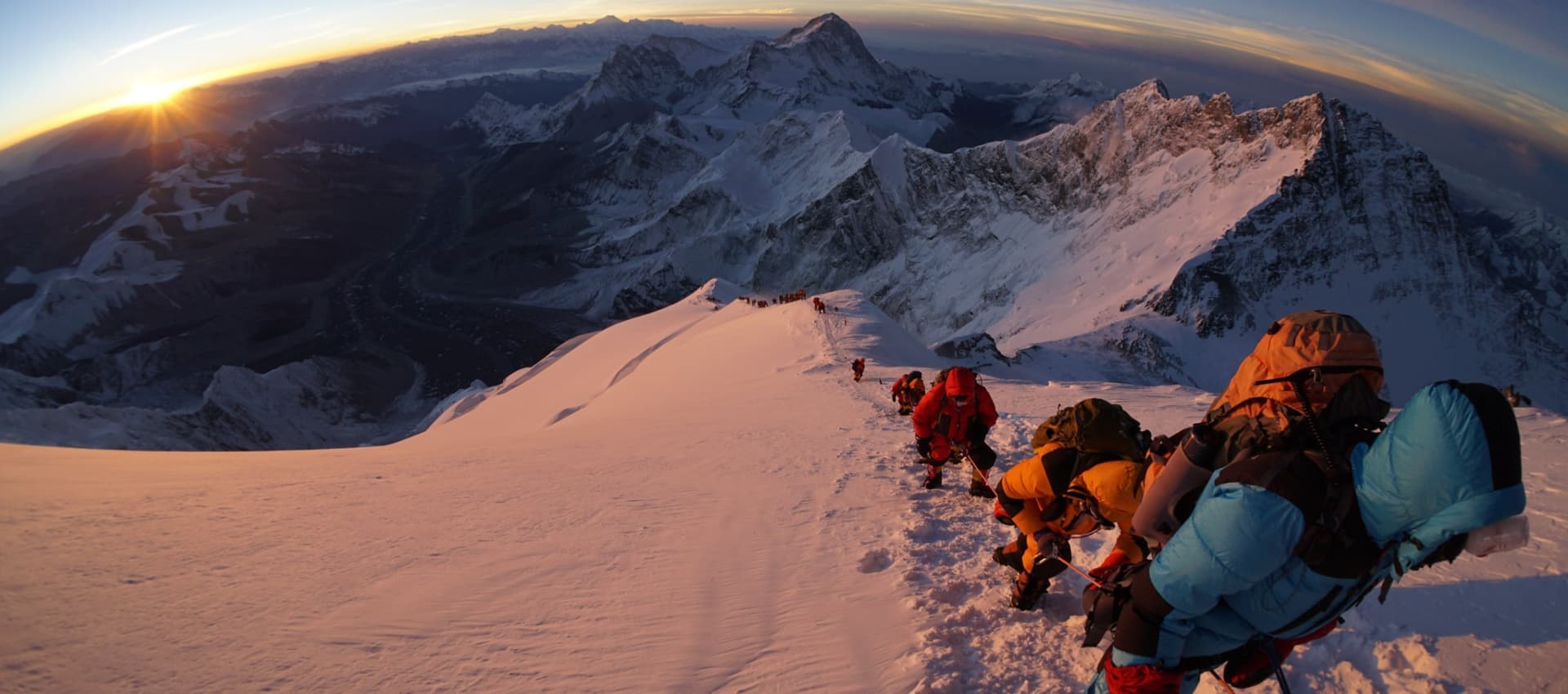
Peak Climbing in Nepal: A Complete Guide to Your First Himalayan Summit
Nepal holds 8 of the world's 14 peaks above 8,000 meters, and among these giants stands a second tier of mountains that rarely makes international headlines but arguably offers the more accessible, more honest, and in many ways more complete mountaineering experience. These are Nepal's trekking peaks: 27 summits regulated by the Nepal Mountaineering Association (NMA), ranging from around 5,500 meters to just above 6,500 meters, that form a middle ground between high-altitude trekking and full expedition mountaineering. They are the peaks that working professionals with six weeks of leave can realistically aspire to summit, that first-time Himalayan climbers use to learn whether they want to spend a career on bigger mountains, and that experienced alpinists treat as warm-up objectives before Ama Dablam or Manaslu.
Understanding what peak climbing in Nepal actually involves, as opposed to what the brochures suggest, requires a serious look at the full picture: the permit system that governs access, the physical preparation required, the technical skills you need to develop before arrival, the cultural context of the Sherpa communities who make the mountains accessible, what you eat and where you sleep, and how the whole logistics chain holds together. This guide covers all of that. The peaks themselves are mentioned where they illustrate specific points, but the focus throughout is on helping you understand the system and prepare properly for it.
How Nepal's Peak Climbing System Works
The Nepal Mountaineering Association was established in 1973 with a mandate to promote mountaineering in Nepal and regulate the climbing of peaks below the threshold handled by the Ministry of Tourism's Department of Tourism. The NMA currently manages permits for 27 peaks that are classified as trekking peaks, though this terminology is historically misleading. Many of these peaks require technical mountaineering skills, glacier travel experience, the ability to use crampons and an ice axe competently, and an understanding of fixed rope systems. The 'trekking' designation simply means they sit below the permit threshold of the DoT's expedition peaks; it says nothing specific about their technical difficulty.
Within the 27 NMA peaks, there are two categories. Group A covers the more technical peaks at or around 6,500 meters, including Singu Chuli (6,501 meters), Chulu East (6,584 meters), and Hiunchuli (6,441 meters) in the Annapurna region. Group B covers the more popular and generally more accessible peaks under 6,500 meters, including Island Peak at 6,189 meters, Mera Peak at 6,476 meters, and Lobuche East at 6,119 meters in the Everest region, as well as Tent Peak (Tharpu Chuli) at 5,663 meters in the Annapurna Sanctuary. Six peaks below 5,800 meters have been fully exempted from royalty fees under a Ministry of Tourism decision to promote them as entry-level objectives for new climbers.
Above the NMA's jurisdiction, the Department of Tourism manages permits for the higher and more serious peaks including Ama Dablam (6,812 meters), Mera Peak's taller neighbors, and all 8,000-meter peaks. An Everest permit alone now costs USD 15,000 per foreign climber as of 2026. These are expedition mountains in every meaningful sense of the word, requiring months of preparation, high-altitude porters, oxygen systems, and team logistics that go well beyond the scope of this guide. The focus here is on the NMA-regulated peaks that represent the sensible starting point for most people approaching Himalayan climbing for the first time.
Permits, Fees, and the Paperwork Reality
Obtaining a climbing permit for an NMA peak involves more documentation than a standard trekking permit but considerably less than the expedition permits required for the higher mountains. The process is managed through a registered Nepalese trekking and climbing agency, since individual foreign climbers cannot apply directly to the NMA without going through an accredited operator. This is not merely a regulatory formality; the agency is responsible for the logistics of the entire climb, including staff insurance, garbage deposit management, and liaison with park authorities along the approach route.
Permit fees as of September 2025 are structured by season and peak category. For Group A and Group B peaks, the standard fee for foreign nationals runs approximately USD 350 in spring (the most popular and most expensive window), dropping to USD 175 in autumn, winter, and the remaining seasons. These fees represent an increase from the previous spring rate of approximately USD 250 for Group B peaks. Additionally, a garbage deposit of USD 500 per team is required from the NMA for all 27 peaks; this is refundable upon submission of evidence that all waste was carried out of the climbing area. The NMA also charges a service fee of NPR 2,000 per foreign climber, effective from March 2025.
On top of the NMA permit, climbers need the entry permit for whichever national park or conservation area the approach route passes through. Most popular peak climbs in the Everest region require the Sagarmatha National Park entry permit (approximately NPR 3,390 including VAT) and the Khumbu Pasang Lhamu Rural Municipality fee (NPR 2,000). Peaks in the Annapurna region require the ACAP. The approach trekking permit requirements depend on the specific route and region.
|
Fee Type |
Spring (Mar-May) |
Autumn (Sep-Nov) |
Winter/Summer |
Notes |
|
NMA Group A Peak Permit (foreign) |
USD 350 per person |
USD 175 per person |
USD 175 per person |
Peaks ~6,500 m; effective Sep 2025 |
|
NMA Group B Peak Permit (foreign) |
USD 350 per person |
USD 175 per person |
USD 175 per person |
Peaks under 6,500 m; effective Sep 2025 |
|
NMA Service Charge |
NPR 2,000 per person |
NPR 2,000 per person |
NPR 2,000 per person |
All foreign climbers; from Mar 2025 |
|
Garbage Deposit (per team) |
USD 500 |
USD 500 |
USD 500 |
Refundable on submission of waste evidence |
|
Sagarmatha National Park Permit |
NPR 3,390 incl. VAT |
NPR 3,390 incl. VAT |
NPR 3,390 incl. VAT |
Required for all Everest region peaks |
|
Peaks under 5,800 m (royalty-free) |
No royalty fee |
No royalty fee |
No royalty fee |
Six peaks designated by Ministry of Tourism |
Permit applications are submitted through the agency and require each climber's passport details, passport-format photographs, and evidence of appropriate travel insurance. The insurance requirement is not optional: the NMA and the Department of Tourism require all climbers to carry policies covering high-altitude rescue by helicopter to a minimum of USD 15,000, and many peak-specific agencies require evidence of this before they will file the permit application. Carry printed copies of all permits throughout the climb; there are multiple checkpoints on the approach routes where original documents are inspected.
The Main Trekking Peaks: What You Are Getting Into
Island Peak, officially named Imja Tse, sits at 6,189 meters in the Khumbu region and was first summited in 1953 by a team including Tenzing Norgay, who had been preparing for Everest. It is now Nepal's most climbed trekking peak and serves as the standard introduction to Himalayan mountaineering for thousands of climbers each year. The approach follows the classic Everest Base Camp route through Lukla, Namche Bazaar, and Tengboche before diverting into the Imja valley to the base camp at roughly 5,100 meters. The summit day involves a glacier crossing, a steep headwall of approximately 150 meters requiring fixed rope technique and confident crampon work, and a final ridge walk to the summit. In Himalayan grading terms, it is generally rated Alpine PD+ (Peu Difficile, meaning slightly more than moderately difficult). On a clear day from the top, Lhotse's south face fills the northern horizon and Ama Dablam's characteristic profile appears to the southwest.
Mera Peak, at 6,476 meters, is the highest trekking peak in Nepal and the one that most reliably delivers the experience of standing at altitude with five 8,000-meter peaks visible simultaneously: Everest, Lhotse, Makalu, Cho Oyu, and Kanchenjunga can all appear on the same horizon from the summit on a clear October morning. The approach goes through the Hinku valley, a less-visited corridor south of the main Khumbu region that offers a genuinely quiet, forested approach compared to the busy Everest trail. Technically, Mera is more approachable than Island Peak: the summit involves glacier travel with crampons and ice axe on slopes that are mostly gradual, without the dramatic headwall that defines the Island Peak summit day. For this reason, Mera is often recommended as the better choice for true first-time high-altitude climbers.
Lobuche East at 6,119 meters sits directly on the Everest approach trail near Lobuche village, making it accessible as a natural addition to an Everest Base Camp trek. The climb involves more mixed terrain than Island Peak or Mera, with sections of rock, ice, and snow requiring confident use of an ice axe, crampons, and fixed rope systems on a final ridge that is genuinely steep and exposed. It was first climbed by Laurence Nielson and Ang Gyalzen Sherpa in 1984 and is generally rated slightly more technical than the other two popular Khumbu peaks. From the summit, Everest and Lhotse appear at close range, and the Khumbu glacier spreads below in one of the more dramatic high-altitude perspectives available to non-expedition climbers.
In the Annapurna region, Tent Peak (Tharpu Chuli) at 5,663 meters offers a shorter and lower alternative for those combining a peak with the Annapurna Base Camp trek. The approach goes through the Annapurna Sanctuary, and the climb involves glacier travel and ridge work above the sanctuary floor. At 5,663 meters, it sits below the threshold where altitude effects become severe for most well-acclimatized climbers and is considered among the more approachable options on the NMA list. Pisang Peak at 6,091 meters in the Manang district, on the Annapurna Circuit route, offers another regional option with spectacular views of Annapurna II and the surrounding massif.
Physical Preparation: What Your Body Actually Needs
The most persistent misconception about NMA trekking peaks is that a reasonable level of general fitness is sufficient preparation. It is not, and the guides who work on these mountains report that inadequate physical conditioning is the most common reason for failed summits among clients who arrived with the right technical knowledge and appropriate gear. At 6,000 meters, your body operates at roughly 50 percent of the oxygen partial pressure available at sea level. Every step on the summit day requires more physiological work than a comparable step at home, and the summit day itself typically involves eight to twelve hours of sustained physical output starting well before dawn.
The preparation framework that works best for most first-time high-altitude climbers involves a minimum of three to four months of consistent training before departure, with four distinct components. The first is cardiovascular base: extended aerobic exercise at moderate intensity, building to the point where you can sustain six to eight hours of hiking with a loaded pack without significant distress. Running, cycling, and swimming all contribute to this base, but hiking on hilly terrain with a daypack is the most specific preparation and should constitute the majority of your training time. The second component is load-bearing leg strength, specifically the ability to descend long distances under pack weight without the knee fatigue that causes most summit-day problems to appear not on the ascent but on the way down. Weighted step-downs, stair climbing with a loaded pack, and eccentric strengthening exercises for the quads and hip flexors address this directly.
The third component is general mountaineering fitness, which means getting your cardiovascular system used to sustained output at reduced oxygen levels if possible. An altitude training camp, a course on a glaciated peak in your home country or region, or a preparatory trek to 4,500 to 5,000 meters in Nepal before the climb all serve this purpose. Many climbers who have experience at high altitude on previous treks, such as Everest Base Camp at 5,364 meters or Gokyo Ri at 5,357 meters, arrive at Island Peak base camp with a more accurate sense of their own acclimatization response than those who are attempting their first significant altitude experience. The fourth component is technical skill practice, which is covered separately below.
Age alone is not a disqualifying factor. Our guides have taken clients in their sixties and early seventies to successful summits on Island Peak and Mera Peak. Physical conditioning and honest self-assessment are more meaningful predictors of success than any age-based threshold. Anyone with cardiovascular, pulmonary, or orthopedic conditions should obtain specific medical clearance for high-altitude exertion before booking. The altitude at which these peaks are climbed puts meaningful demands on the circulatory and respiratory systems, and pre-existing conditions in either area carry real risk at elevation.
Technical Skills: What You Need to Know Before You Arrive
The technical skills required for Nepal's popular trekking peaks cluster around three core competencies: crampon technique, ice axe use including self-arrest, and fixed rope systems. None of these is impossible to learn from scratch, but learning them for the first time at 5,500 meters in cold, thin air while your body is already managing the demands of altitude is not the right way to approach them. Developing these skills in a lower-stakes environment before the expedition is essential.
Crampon technique means more than strapping metal points to your boots and walking carefully. It means understanding how to walk efficiently on different types of snow and ice, how to front-point on steep terrain, how to manage the additional fatigue that comes from the modified gait crampon use requires, and how to recognize when the snow or ice conditions change in ways that require different footwork. This is best learned on an actual glaciated mountain in your home region or on a structured mountaineering course. Organizations offering courses on glaciated peaks in Europe, North America, New Zealand, and parts of South America provide this foundation. Even a three-day course on a local glaciated peak gives you the muscle memory and confidence that makes crampon use second nature rather than anxiety-inducing on a Himalayan summit day.
Ice axe technique covers self-arrest (stopping a fall on steep snow by driving the pick into the surface), the use of the axe as a balance aid on moderate slopes, and the basics of cutting steps in hard snow. Self-arrest in particular is a non-negotiable safety skill for anyone attempting a peak with snow slopes above 40 degrees, which includes the summit headwall of Island Peak and sections of Lobuche East. Ascender or jumar use involves moving efficiently on fixed ropes using a mechanical ascender device, clipping in and out correctly, managing the transition around anchor points, and descending safely on the same fixed lines. Agency guides conduct a climbing training session at base camp for all clients before summit day, but that session is meant to refresh and apply existing skills, not to teach them from the beginning.
None of the popular NMA trekking peaks requires the sort of advanced technical competence needed for waterfall ice climbing, mixed routes, or big-wall climbing. What they do require is solid, confident command of the fundamental glacier and snow skills listed above. If these feel completely unfamiliar, consider booking a mountaineering course before the Nepal expedition. The Nepal Mountaineering Association also runs structured climbing courses in Nepal itself, typically based in the Khumbu region, that combine skills instruction with acclimatization and can serve as a practical warm-up for a first summit attempt.
Essential Gear for Peak Climbing
The gear required for Nepal's trekking peaks divides into three categories: personal technical climbing equipment, cold-weather clothing and sleeping system, and general trekking kit for the approach. The approach kit is essentially the same as any serious Himalayan trek: broken-in waterproof boots for the lower sections, layered clothing, trekking poles, and a well-fitted daypack. The specific items below relate to what changes for the climb itself.
Mountaineering boots: Double-layered or insulated single-layer boots rated for temperatures well below freezing and compatible with your crampon system. This is the most important and most expensive single item in your kit. Boots that do not fit correctly, or that are not broken in before the climb, cause blisters and cold injury at a rate that accounts for many summit failures. Try rental boots thoroughly in Kathmandu before committing to them for summit day.
Crampons: Twelve-point crampons compatible with your boot sole. Semi-rigid or rigid models are appropriate for the mixed terrain of the Khumbu peaks. Flexible strap-on crampons designed for hiking boots are not sufficient for steep ice or hard snow.
Ice axe: A standard 60 to 70 centimeter mountaineering ice axe. The length depends on your height; your guide can advise on fit. Learn to use it before you leave home.
Harness and ascender: A sit harness, a mechanical ascender (jumar), locking and non-locking carabiners, a belay device, and slings. Most reputable agencies provide group rope systems; you are responsible for your personal hardware.
Helmet: A climbing helmet protects against falling ice and rock, both of which are real hazards on the summit sections of Island Peak and Lobuche East particularly.
Sleeping bag: Rated to at least -20 degrees Celsius for use at base camp and high camp. A bag that is warm enough at sea level will be inadequate at 5,000 meters in October temperatures.
Down jacket and insulated layers: A high-quality down or synthetic insulated jacket worn over fleece mid-layers, under a waterproof shell. The summit starts before dawn when temperatures on the Khumbu peaks regularly drop to -20 or below.
Waterproof shell: Full waterproof and windproof outer layer, jacket and trousers. Mountain weather changes fast, and summit days are often windy even when skies are clear.
Gaiters and gloves: Gaiters prevent snow from entering boots; insulated waterproof gloves or mitts with liner gloves underneath protect hands on pre-dawn summit pushes.
All technical climbing gear can be rented in Kathmandu, primarily in the Thamel district shops that cater specifically to the climbing market. Quality varies, and the advice is to inspect rented boots, crampons, and sleeping bags carefully before accepting them. Check crampon points for wear, test sleeping bag loft, and confirm that boots fit correctly with the sock combination you intend to use. Bringing your own boots if possible is preferable; rented boots add an element of uncertainty to an experience that already carries enough unknowns.
The Role of Sherpa Guides and the Climbing Team
The word 'Sherpa' is used in two overlapping ways in the Nepal climbing world. It refers, first, to an ethnic group: the Sherpa people of the Khumbu region, descendants of Tibetan migrants who arrived in the area approximately 500 years ago and who have developed a physiological adaptation to high altitude over generations that gives them a documented genetic advantage in processing oxygen at elevation. It refers, second, to a professional role: the high-altitude guides and climbing support staff who are the operational backbone of every commercial peak climb in Nepal, who may or may not be ethnic Sherpas.
The role a climbing Sherpa plays on a trekking peak is difficult to overstate. Before the client's team arrives at base camp, the Sherpa team has already been at work: establishing the route on the mountain, fixing ropes on technical sections, setting up high camp tents, and stocking them with fuel, food, and equipment. On summit day, they lead the way, set the pace, manage the rope systems, carry supplemental oxygen if the climb includes it, and make real-time weather and safety assessments based on experience that no amount of reading or course-taking can replicate. For most foreign clients, the assigned climbing Sherpa is the person whose judgment and mountain awareness will be most directly responsible for whether they reach the summit safely.
The ethical dimension of the Sherpa relationship deserves direct attention. The wages paid to Sherpa guides and high-altitude porters vary considerably between agencies, and the standards for safety equipment, insurance, and working conditions are not uniformly enforced across the industry. Our company adheres to the International Porter Protection Group's guidelines for all support staff, provides insurance coverage for every team member including high-altitude rescue and death benefits, and pays wages at or above the industry standard rates for the relevant work categories. Tips are customary in the Nepal climbing industry and constitute a meaningful portion of Sherpa income; the standard is approximately USD 10 to 15 per day for the lead guide and USD 7 to 10 for support staff, with an additional summit bonus for successful ascents.
The spiritual and cultural relationship the Sherpa community maintains with the mountains they work on is genuine and not performative. Before most climbs, the team conducts a puja ceremony at base camp: a Buddhist ritual conducted by a lama or, more commonly, by the senior Sherpa, involving offerings of rice, juniper smoke, and prayer flags tied above the camp, asking the mountain deity for permission to ascend and protection for the team. Foreign climbers are welcome to participate and are encouraged to do so with genuine respect rather than anthropological curiosity. Many climbers describe the puja as one of the more moving experiences of the entire expedition.
Food and Accommodation on Climbing Expeditions
The food and shelter situation on a Nepal peak climb divides clearly into two phases: the approach trek, where tea house infrastructure applies, and the climb itself, where tents and expedition cooking take over.
During the approach, which for most Khumbu peaks follows the Everest trail through Lukla, Namche Bazaar, and the upper Khumbu valley, the accommodation and food situation mirrors that of any serious Himalayan trek. Tea houses in the lower Khumbu are now well-developed, with some lodges in Namche Bazaar offering attached bathrooms, proper beds, and menus that include pizza, pasta, and apple pie alongside the standard Dal Bhat. The quality drops as you gain elevation, and by Lobuche (4,900 meters) and Gorak Shep (5,170 meters), the lodges are more basic and the menus narrower. The standard trekking diet of Dal Bhat, fried rice, noodle soups, eggs, and porridge applies throughout.
At base camp, the setup changes. Most agency-organized climbs include a cook and kitchen tent at base camp, where hot meals are prepared for the climbing team. The food at base camp is generally better than most first-timers expect: soup, stews, rice and lentil dishes, pasta, and hot drinks are standard, and a good Sherpa cook will manage reasonable variety even at 5,000 meters. The kitchen operates on gas burners using compressed gas cylinders brought up from the valley, which is also why the garbage deposit system matters: those cylinders need to come back down. Hydration management remains critical at base camp; the altitude and dry air increase fluid loss, and the goal of three to four liters of water daily should be maintained even when appetite and thirst signals are suppressed by altitude.
High camp, if the peak involves one, is a different matter. At high camps above 5,500 meters, the cooking and shelter situation becomes purely functional. A two-person mountaineering tent, a gas burner, and the ability to melt snow for water are the core requirements. Meals at high camp are designed for caloric density and simplicity: instant noodles, energy bars, chocolate, and hot drinks. Eating well at high camp is genuinely difficult because altitude suppresses appetite severely and the digestive system works less efficiently at low oxygen levels. Forcing yourself to eat before summit day is not optional; the energy demands of a ten-hour summit push are enormous and cannot be met on willpower alone.
Acclimatization and the Physiology of Going High
High-altitude physiology is the underlying science that controls everything about how peak climbing works in Nepal. At 6,000 meters, atmospheric pressure is approximately half that at sea level, meaning each breath contains the same percentage of oxygen but delivers half the total oxygen molecules of a breath taken at 1,500 meters. The body responds to this deprivation through a cascade of adaptations: increased respiratory rate, increased heart rate, elevated erythropoietin production leading to higher red blood cell counts over days to weeks, and a shift in the oxygen-hemoglobin dissociation curve that allows more efficient oxygen offloading to muscle tissue. These adaptations are not instant; they require time at altitude to develop, which is why every serious approach itinerary for Nepal's trekking peaks includes multiple acclimatization days.
The standard acclimatization principle above 3,000 meters is to limit sleeping elevation gain to approximately 300 to 500 meters per night, with a rest day for every 1,000 meters of elevation gained. The classic application of this on the Khumbu peaks is the acclimatization rotation out of Namche Bazaar: after the first night at 3,440 meters, climbers hike to Everest View Hotel at 3,900 meters for the day before descending to sleep in Namche again. This walk-high-sleep-low pattern builds adaptation faster than simply ascending and staying at each elevation. Multiple itineraries include further rotations higher up the valley before the actual summit push, all of which builds the physiological foundation that makes summit day possible.
The symptoms of Acute Mountain Sickness (AMS) are worth knowing precisely because misidentifying them leads to dangerous decisions. Early AMS manifests as headache that worsens with effort, fatigue disproportionate to the day's output, nausea, poor appetite, and disrupted sleep. These symptoms are common and manageable below 4,500 meters with rest, hydration, and no further ascent until they resolve. The serious and potentially fatal progressions are High Altitude Pulmonary Edema (HAPE), characterized by breathlessness at rest, a persistent cough producing frothy or pink sputum, and progressive inability to function, and High Altitude Cerebral Edema (HACE), marked by severe unremitting headache, loss of coordination, confusion, and deteriorating consciousness. Both HAPE and HACE require immediate descent and, where available, evacuation by helicopter. All guides carry pulse oximeters on our expeditions; if your blood oxygen saturation drops below 80 percent and you are symptomatic, descent is not a discussion.
Acetazolamide, marketed as Diamox, is the standard prophylactic medication for AMS and works by stimulating increased respiration, which raises blood oxygen levels during the acclimatization process. A typical prophylactic dose is 125 mg twice daily, beginning one or two days before significant elevation gain. Side effects include increased urination (which actually reinforces the hydration imperative) and tingling in the fingers and toes. Anyone considering Diamox should consult a physician before travel, as it is contraindicated for people with sulfonamide antibiotic allergies and certain other conditions.
The Culture of Peak Climbing: What It Means in Practice
Understanding peak climbing in Nepal as purely a physical and logistical challenge misses something important about what the experience actually is. The mountains that climbers come to ascend are not recreational infrastructure; they are sacred in the religious worldview of the communities that have lived around them for centuries. Langtang Lirung is a protector deity for the Langtangpa. Khumbi Yul Lha protects the Khumbu valley in Sherpa cosmology. Every significant peak in Nepal has some form of spiritual identity within the surrounding culture, and the climbing community that interacts with these mountains does so in the context of that belief system whether or not individual climbers are consciously aware of it.
The puja ceremony conducted at base camp before every climb is the most concrete expression of this cultural reality that foreign climbers encounter. The ceremony involves burning juniper offerings, arranging prayer flags above the camp in the cardinal directions, preparing a stone altar with food and alcohol offerings, and chanting prayers that ask the mountain deity for permission to ascend and protection for everyone on the team. The ceremony typically takes an hour and is conducted by the senior Sherpa or, for larger expeditions, by an invited lama from a nearby monastery. It is not a tourist performance. It is a sincere religious act that the Sherpa team takes seriously, and it deserves the same respect that any religious ceremony in any cultural context would receive.
The broader cultural environment of the approach trek through Sherpa country also rewards genuine engagement. The villages of Namche Bazaar, Tengboche, Khumjung, and Khunde have monasteries, cultural festivals, and community structures that have been shaped by the specific circumstances of living at altitude near some of the world's most visited mountains. The Tengboche Monastery, rebuilt after a 1989 fire, is an active religious institution whose monks conduct daily prayers and whose annual Mani Rimdu festival in October draws communities from across the Khumbu. Engaging with this cultural environment thoughtfully rather than treating it as a scenic backdrop to the climbing objective is both more respectful and more genuinely interesting.
When to Go and How to Plan the Timeline
Spring and autumn are the primary windows for peak climbing in Nepal, for the same reasons that govern trekking season choices: the monsoon brings heavy precipitation and avalanche risk from June through mid-September, and the winter months from December through February bring extreme cold and unstable conditions at altitude. Within those parameters, there are meaningful distinctions between the two windows.
October is widely considered the single best month for climbing the Khumbu trekking peaks. The monsoon has cleared, the air is dry and clear, temperatures are cold but predictable, and the mountain conditions are generally stable. Island Peak sees its heaviest traffic in October, which means the summit headwall fixed ropes are well-maintained and the trail up to base camp is clearly defined. Mera Peak in October offers the combination of excellent visibility for the summit panorama and stable weather windows that make planning the summit day more reliable.
Spring, specifically April and May, is the second window and the one that large expedition teams prefer for the 8,000-meter peaks including Everest. For trekking peaks, the spring window is slightly complicated by pre-monsoon cloud that builds in the afternoons from late April onward, potentially reducing summit visibility. The mountain conditions in spring can include more variable snow, and the approach trails through the lower Khumbu have the rhododendron bloom adding visual interest to the walk. May is the warmest and most humid of the spring months, and by its final weeks the monsoon's advance becomes a factor in planning summit windows.
The lead time required for a peak climbing expedition to Nepal is longer than most first-timers expect. Permit applications through the agency, travel insurance that meets the altitude coverage requirements, fitness preparation of at least three to four months, skills training if needed, gear acquisition and testing, and flight booking during peak season all require time. For an October departure, beginning serious planning in May or June of the same year is not too early. For spring, the equivalent preparation window runs from October through December of the preceding year. Our team is available from the first planning conversation through the final descent to Kathmandu, and we strongly recommend making contact early enough to work through the preparation properly.
Travel Insurance, Safety, and the Honest Risk Assessment
Peak climbing in Nepal involves real risk. The mountains are high, the weather is variable, the terrain requires technical skill, and the altitude creates physiological vulnerabilities that do not exist at sea level. This does not mean that the NMA trekking peaks are unreasonably dangerous for well-prepared climbers working with competent guides; it means that preparation and honesty about your own capabilities are the primary safety measures available to you.
Travel insurance for peak climbing must cover high-altitude mountaineering specifically. A standard travel insurance policy will exclude anything described as 'mountaineering,' 'climbing,' or 'technical ascent.' The policy you need explicitly states that it covers high-altitude trekking and mountaineering to a defined altitude limit that exceeds the summit elevation of your intended peak. For Island Peak at 6,189 meters, coverage to at least 6,500 meters provides a reasonable margin. For Mera Peak at 6,476 meters, coverage to 7,000 meters is appropriate. The NMA and most reputable agencies require evidence of minimum helicopter rescue coverage of USD 15,000 before they will process the climbing permit. Emergency helicopter evacuation from the Khumbu can cost USD 5,000 to USD 10,000 depending on location, conditions, and who is organizing it; without insurance, that cost falls entirely on the individual climber or their family.
The honest risk assessment for the popular NMA trekking peaks with a good agency and appropriate preparation is that most physically fit, properly trained climbers succeed without serious incident. The summit success rate on Island Peak runs somewhere between 70 and 85 percent across all visiting climbers in a typical season, with the primary causes of failure being inadequate fitness, weather, and altitude sickness. Serious accidents occur at a rate that is meaningful but not high. The people who have the best outcomes are those who prepared physically, learned the technical skills, hired a reputable agency, chose appropriate insurance, and made honest decisions about their own readiness rather than allowing sunk costs or ego to override their body's signals on the mountain.
Peak climbing in Nepal is one of the more demanding and genuinely rewarding things a person with moderate mountaineering experience can do with two to three weeks of commitment. The combination of extraordinary mountain scenery, authentic cultural encounter with Sherpa communities, real physical and technical challenge, and the precise clarity that comes from standing at 6,000 meters with the Himalayan horizon spread around you is not replicated anywhere else in the world at comparable access levels. If you are considering it seriously, start the conversation with our team early, be honest about your current fitness and experience, and give yourself the preparation time the mountains deserve.
