No cancellation fees. No hassle. Book Now, Cancellation Terms
Trekking RegionsPeak Climbing+44
32 min readIsland Peak with Everest Base Camp: Is the Combination Worth It?
September 21, 2026
32 min
1 views
A practical look at pairing a genuine Himalayan summit with the world's most famous trek, and whether that pairing makes sense for you
Once climbers commit to attempting Island Peak, a second question tends to follow almost immediately. Since the approach trail runs so close to Everest Base Camp anyway, should the itinerary just include both? On paper it looks like an obvious yes. Two of the Khumbu region's most sought-after objectives, folded into one trip, without having to fly home and come back for the second one later.
The real answer is more nuanced than the marketing on most trekking company websites suggests. Combining Island Peak with Everest Base Camp is absolutely worth it for a specific kind of climber, and a genuinely poor decision for another kind. The difference usually comes down to available time, existing fitness, and how much appetite someone has for a longer, more demanding trip rather than a tighter, more focused one.
There is also a version of this question that gets asked less often but matters just as much. Even if the combination is logistically sound, does it actually make the trip better, or does it just make it longer? That distinction is worth sitting with before booking anything, since a longer itinerary is only an improvement if the extra days genuinely add something you value, rather than simply extending time on the trail for its own sake.
This guide walks through exactly what the combined itinerary involves, why the acclimatization logic behind it is sound, what it costs compared to doing each trip separately, and who should think twice before signing up for the full package.
The Short Answer
Yes, for most climbers, combining Island Peak with Everest Base Camp is worth it, and it is also the itinerary structure we recommend by default rather than as an upsell. The reason is practical rather than promotional. Because Island Peak already requires a solid acclimatization schedule up through Dingboche before branching toward Chhukung, adding the short extension to Everest Base Camp and Kala Patthar costs relatively little in extra time while adding a genuinely iconic destination and further improving your altitude adaptation before the technical climb.
The exceptions are climbers working with a tight schedule who cannot add the extra three to four days the combination typically requires, and climbers who are already at the edge of their fitness or budget with the standalone Island Peak trip. For everyone else, the combination tends to make the whole trip better rather than simply longer.
Why the Combination Makes Sense Geographically
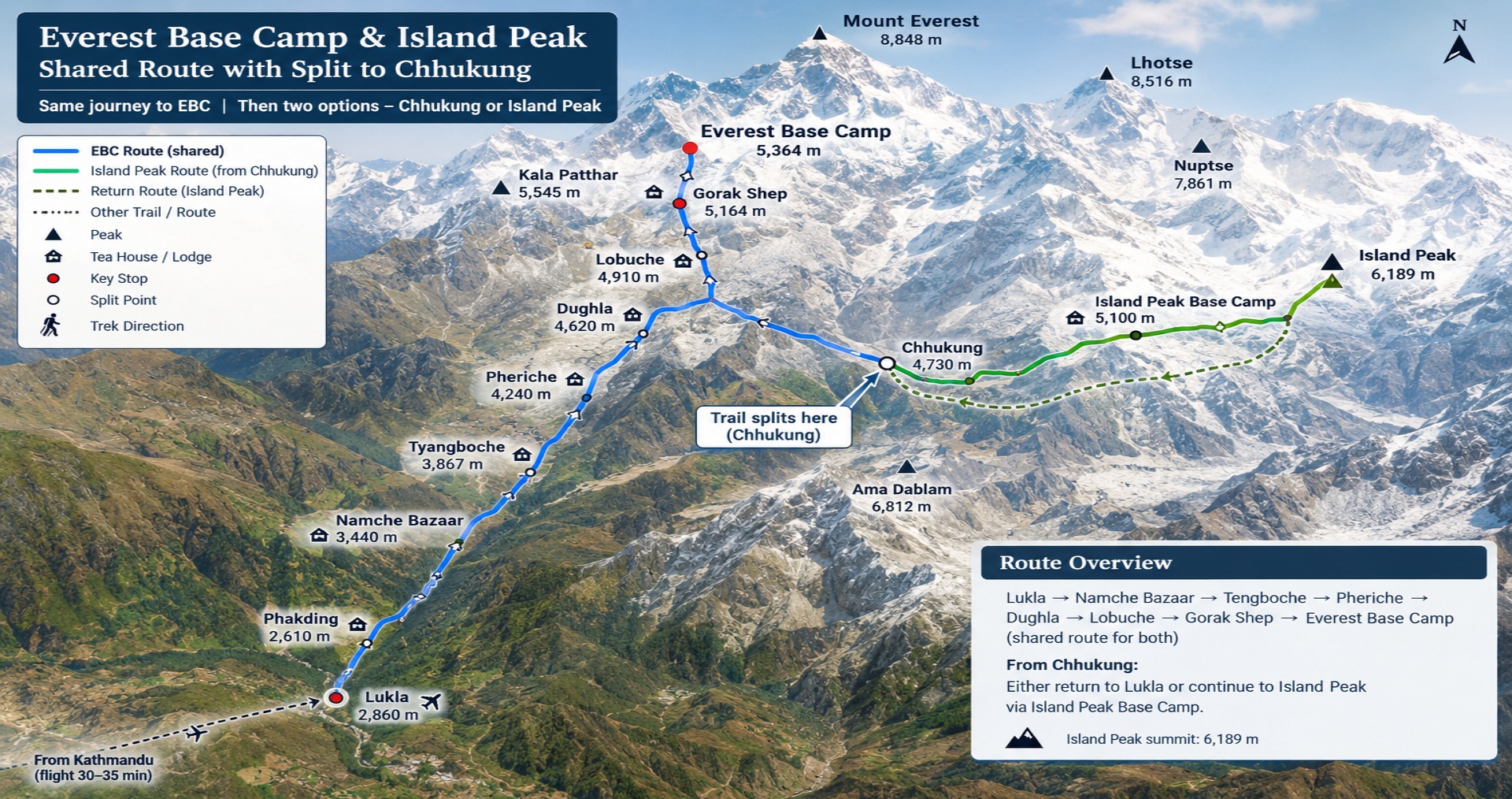
The main reason this pairing works so well is not marketing convenience. It comes down to the actual geography of the Khumbu region. Both Everest Base Camp and Island Peak Base Camp are reached from the same trailhead in Lukla, and the two routes overlap almost entirely for the first eight to nine days of trekking.
From Lukla, both itineraries follow the identical trail through Phakding, Namche Bazaar, Tengboche, and up to Dingboche at 4,410 metres. It is only at Dingboche that the paths genuinely split. The standard Everest Base Camp route continues north through Lobuche and Gorak Shep to reach base camp at 5,364 metres and the Kala Patthar viewpoint at 5,644 metres. The Island Peak route instead turns southeast from Dingboche into the Chhukung Valley, climbing toward Chhukung village and then Island Peak Base Camp at roughly 5,087 to 5,200 metres.
Because of this shared trailhead, adding the EBC and Kala Patthar segment to an Island Peak itinerary does not require a separate flight, a different region, or backtracking through already covered ground in the way that, for example, combining Island Peak with Mera Peak would. It simply means detouring north from Dingboche before circling back down to pick up the Chhukung branch, which most itineraries manage in a loop that never doubles back on itself unnecessarily.
The Acclimatization Case for Combining the Two
This is the part of the decision that matters most for safety, and it is where the combined itinerary genuinely outperforms a standalone Island Peak trip rather than simply adding sightseeing.
Island Peak's summit sits at 6,189 metres, and the base camp itself is already above 5,000 metres. Getting a climbing team safely to that altitude, ready for a technical summit push, depends entirely on how gradually the itinerary gains elevation in the days before. A rushed itinerary that heads straight for Chhukung without adequate time at Namche and Dingboche is one of the most common reasons climbers underperform or turn back on Island Peak, and it has nothing to do with fitness or technical skill.
Extending the route to include Everest Base Camp and Kala Patthar adds meaningful extra altitude exposure in the days before the technical climb, without adding technical difficulty itself. Kala Patthar, at 5,644 metres, actually sits higher than Island Peak Base Camp, which means climbers following the EBC extension have already spent time above their eventual base camp altitude before they ever reach Chhukung. That prior exposure tends to translate into a smoother, more confident approach to the summit push, since the body has already had a preview of what thinner air at that elevation feels like.
This is not a minor side benefit. Several operators, including groups running longer, safety-focused itineraries, build in a visit to Everest Base Camp specifically as part of the acclimatization plan rather than purely as a bonus destination, precisely because the altitude profile works in the climber's favor.
How the Combined Route Actually Runs
A typical combined itinerary runs somewhere between 17 and 21 days from Kathmandu to Kathmandu, compared to roughly 14 to 16 days for a standalone Island Peak trip. The extra three to five days are almost entirely accounted for by the EBC and Kala Patthar detour and an additional acclimatization day or two that a longer itinerary comfortably allows.
The Shared Approach: Lukla to Dingboche
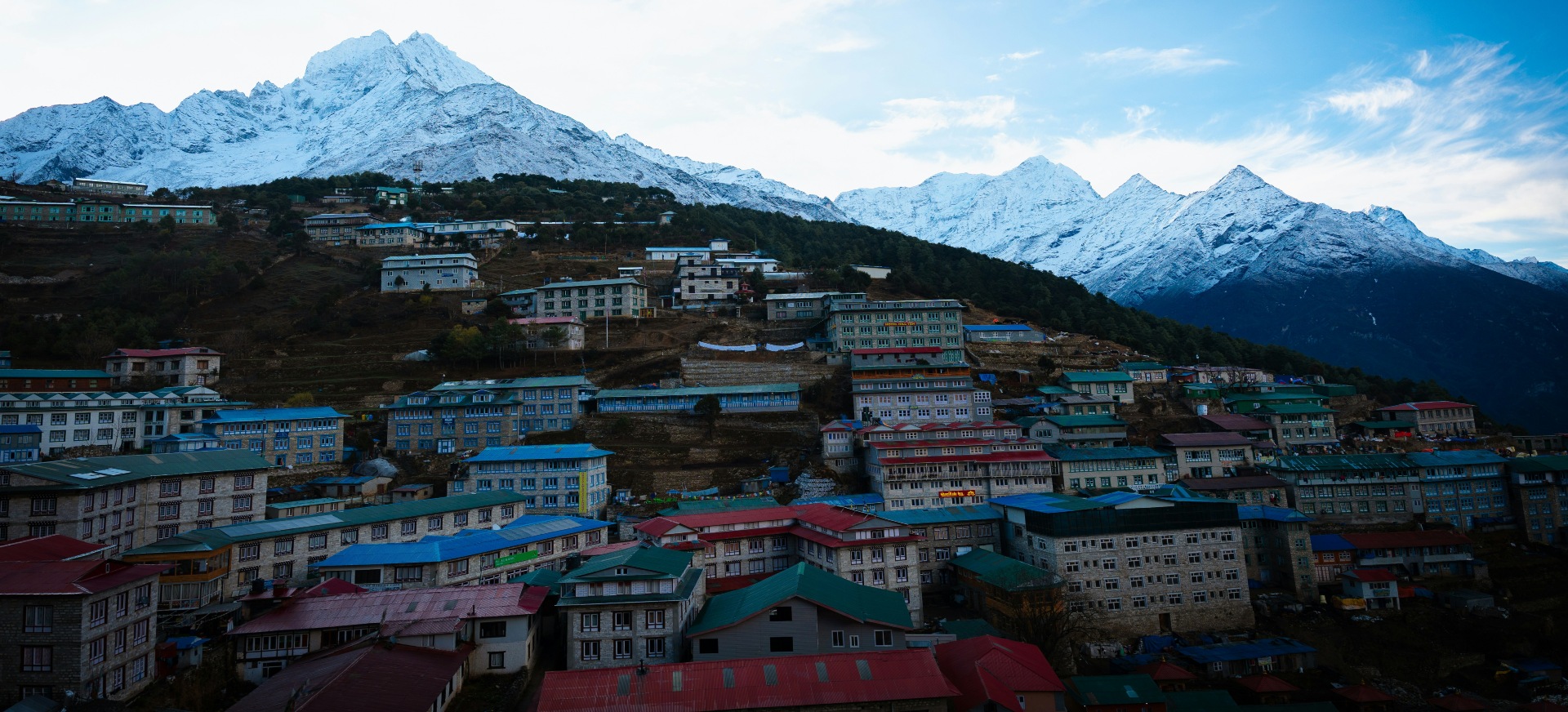
Both trips begin identically. A flight from Kathmandu, usually routed through Ramechhap, lands in Lukla, followed by a gentle first trekking day to Phakding. From there the trail climbs steadily to Namche Bazaar, where most itineraries build in a full acclimatization day, often including a side hike to the Everest View Hotel for a first distant look at the mountain itself. The trail continues through Tengboche, home to the region's most significant monastery, and on to Dingboche, where a second acclimatization day is standard before the route splits.
The Detour North: Dingboche to Everest Base Camp
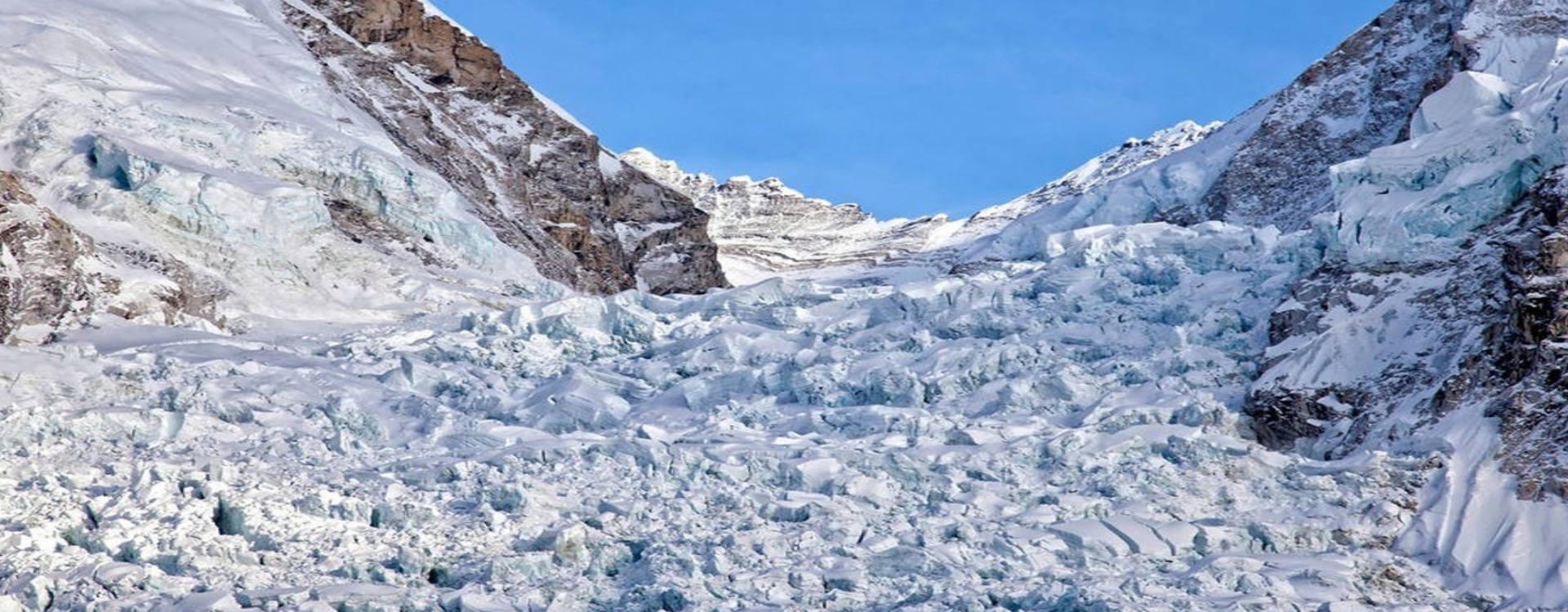
From Dingboche, the combined itinerary heads north through Lobuche to Gorak Shep, the last settlement before base camp. From Gorak Shep, climbers make the walk out to Everest Base Camp itself, a relatively flat but long day across the Khumbu Glacier's rocky moraine, before returning to Gorak Shep. Most itineraries schedule the pre-dawn hike up Kala Patthar the following morning, since this viewpoint offers a far better direct view of Everest's summit pyramid than base camp itself does, which is famously more impressive to have stood at than to photograph.
The Return South: Back to Dingboche and Onward to Chhukung
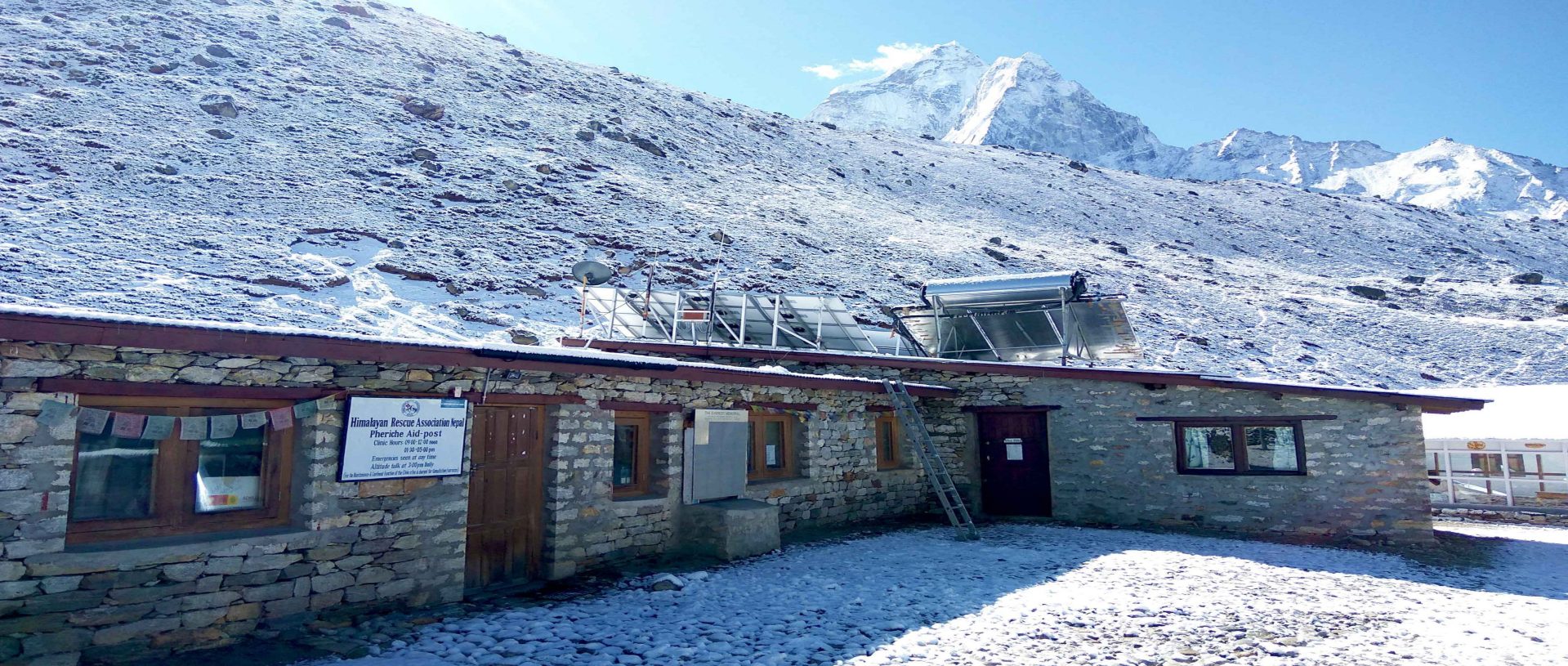
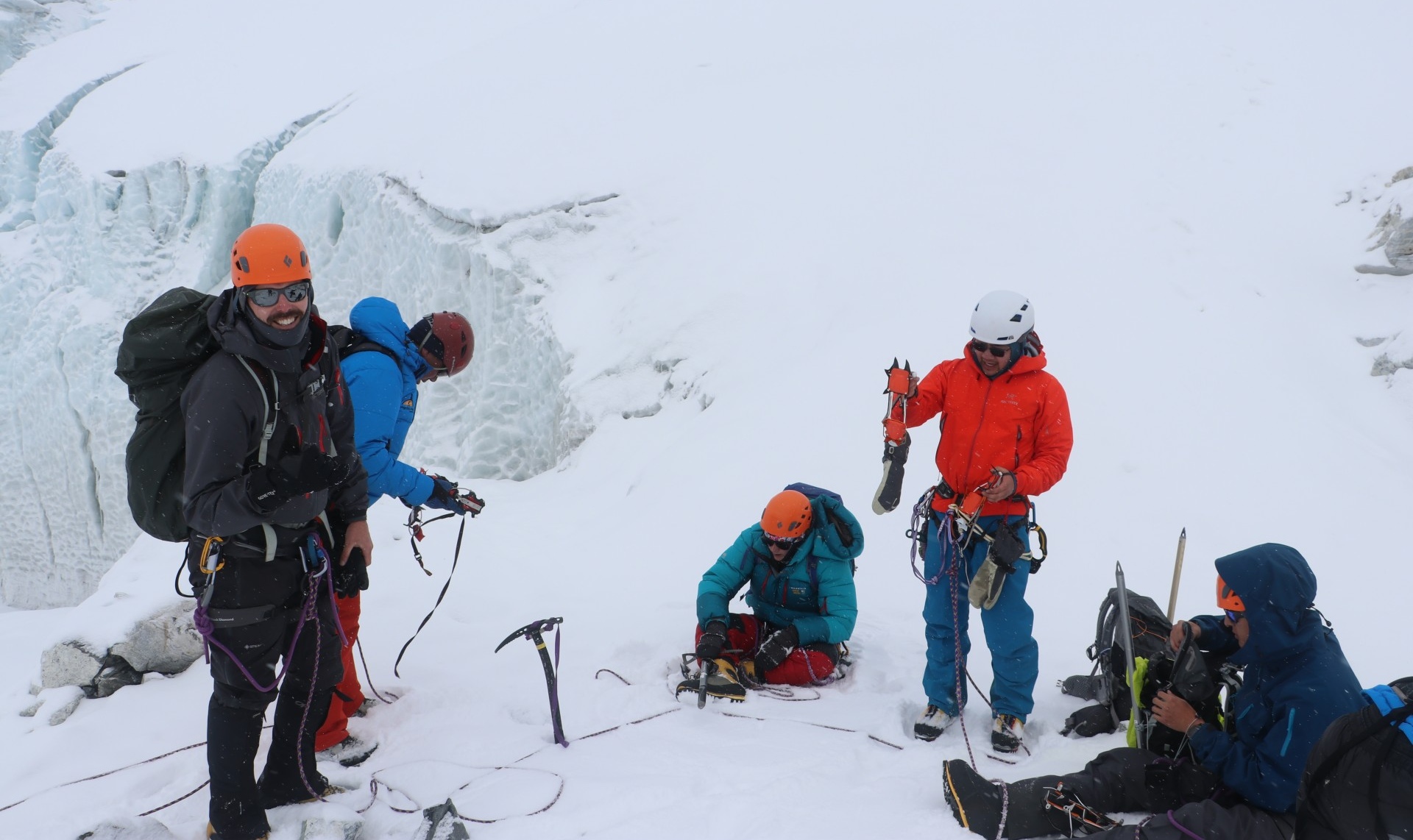
After Kala Patthar, the route returns south through Pheriche or directly back to Dingboche, then branches east into the Chhukung Valley, a shorter and quieter trail than the main EBC corridor. From Chhukung, climbers push on to Island Peak Base Camp, where the standard pre-summit training day covers crampon, ice axe, and jumar technique before the summit attempt itself.
The Summit Push and Descent
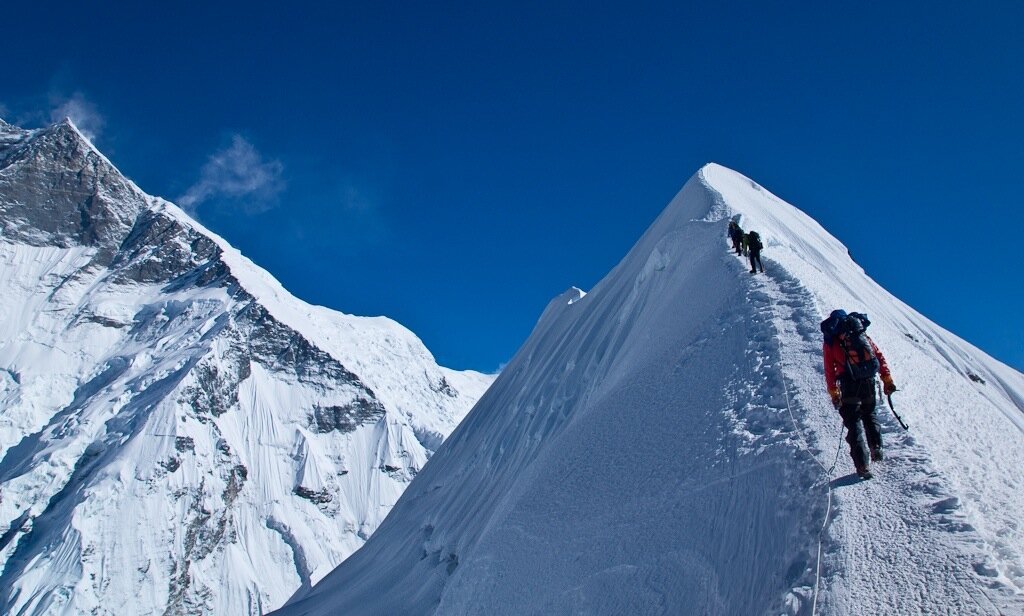
Summit day follows the same structure as a standalone Island Peak climb regardless of whether EBC was included earlier in the trip. Climbers leave base camp in the early hours, cross the glacier roped together, ascend the fixed rope headwall using a jumar, and reach the narrow summit ridge before descending the same route back to base camp or onward to Chhukung. From there, the itinerary retraces the trail back down through Dingboche, Tengboche, and Namche to Lukla for the return flight to Kathmandu.
........
Combined Trip vs Standalone Island Peak at a Glance
|
Category |
Island Peak Only |
Island Peak with EBC |
|
Typical duration |
14 to 16 days |
17 to 21 days |
|
Route structure |
Direct via Dingboche to Chhukung |
Detour to EBC and Kala Patthar, then Chhukung |
|
Acclimatization exposure |
Good, two standard rest days |
Stronger, includes time above 5,600 metres pre-summit |
|
Highest point before summit push |
Around 5,200 metres at base camp |
5,644 metres at Kala Patthar |
|
Extra cost versus standalone |
Baseline |
Roughly 300 to 700 US dollars more |
|
Best suited for |
Time limited climbers focused purely on the summit |
Climbers wanting both iconic destinations in one trip |
What the Combination Costs Compared to Doing Both Separately
Cost is usually the second question after acclimatization, and the numbers work clearly in favor of combining the two trips rather than doing them as separate expeditions.
A standalone Island Peak package with us typically runs between 1,600 and 3,800 US dollars per person, depending on season, group size, and service level. A standalone Everest Base Camp trek without any climbing component typically runs somewhere between 1,200 and 1,800 US dollars for a comparable service tier. Booked as two completely separate trips, a climber would be looking at a combined cost somewhere in the range of 2,800 to 5,600 US dollars, plus the added expense of two separate sets of international flights to Nepal, two visa fees, and twice the total time away from work or other commitments.
Booked as a single combined itinerary, the extra cost of adding Everest Base Camp and Kala Patthar onto an Island Peak trip generally adds only 300 to 700 US dollars to the base Island Peak price, since the Lukla flight, much of the guide and porter cost, and a large share of the teahouse nights are already shared between the two objectives. The savings come from that overlap. You are not paying for two separate trekking crews, two separate sets of permits for the approach trail, or two separate rounds of Lukla flights.
The one fixed cost that does not change either way is the Island Peak climbing permit itself, issued through the Nepal Mountaineering Association, along with the Sagarmatha National Park entry fee and the local municipality fee, all of which apply whether or not Everest Base Camp is included in the itinerary.
The Time and Fitness Commitment
The honest tradeoff of combining the two trips is not cost. It is time and cumulative physical demand. An extra three to five days on the trail before the technical climb even begins means more days of walking, more nights at altitude, and a longer stretch away from normal life, which matters more for some climbers than others depending on work schedules, family commitments, or simply how much time off is realistically available.
Fatigue is worth taking seriously here too, though it cuts in a less obvious direction than people often assume. A longer itinerary with proper rest days generally produces a climber who arrives at Island Peak Base Camp better rested and better acclimatized than one who rushed a shorter, more compressed schedule, even though the total number of trekking days is higher. The risk is not the extra days themselves. It is a poorly paced itinerary that piles on distance without corresponding rest, which is a design problem rather than an inherent flaw in combining the two destinations.
Climbers with limited trekking experience benefit particularly from the combined itinerary's more generous pacing, since the extra days naturally slow the average rate of ascent per day even while covering more total ground. Climbers who already know they handle altitude well and simply want the shortest possible path to the Island Peak summit may reasonably prefer the standalone option instead.
Who Should Combine the Two, and Who Should Not
Combine Island Peak with Everest Base Camp If
• You have 17 to 21 days available and are not working against a tight return flight deadline
• You want to see Kala Patthar and stand at Everest Base Camp regardless of whether the climb succeeds
• You are relatively new to high altitude trekking and would benefit from the extra acclimatization days built into the longer route
• You want the most cost efficient way to experience both destinations rather than booking two separate trips in different years
• You are comfortable with a longer, more physically demanding trip in exchange for a more complete Khumbu experience
Consider the Standalone Island Peak Trip Instead If
• Your available time is genuinely limited to two weeks or less
• You have already visited Everest Base Camp on a previous trip and specifically want to focus on the climb this time
• You are an experienced high altitude trekker who does not need the additional acclimatization buffer
• Budget constraints make even the modest additional cost of the extension a genuine obstacle
Does Adding Everest Base Camp Make the Trip Harder?
In terms of overall distance and days on the trail, yes, the combined itinerary is a longer undertaking. In terms of the specific difficulty that actually determines whether you summit Island Peak, the honest answer is that it tends to make the technical portion of the trip easier rather than harder, for the acclimatization reasons already covered.
The trek out to Everest Base Camp and up Kala Patthar is physically demanding in its own right, involving long days on rocky moraine at altitudes most climbers have not experienced before, but it is not technical. No ropes, no crampons, no exposure beyond ordinary trail walking. The genuine technical difficulty of the whole trip remains concentrated entirely in Island Peak's summit day, specifically the glacier crossing and the fixed rope headwall, regardless of whether EBC was included earlier in the itinerary.
What changes with the combined route is stamina demand and total trip length, not technical complexity. A climber capable of handling the standalone Island Peak trek and climb is very likely capable of handling the extended version too, provided the extra days are paced sensibly rather than treated as bonus distance to rush through.
What the Detour Actually Adds to the Experience
Beyond the acclimatization argument, it is worth being honest about what the EBC and Kala Patthar section actually feels like, since this is ultimately an experiential decision as much as a logistical one.
Everest Base Camp itself, at 5,364 metres, is a somewhat anticlimactic destination in purely visual terms. It sits on the Khumbu Glacier's rocky moraine, surrounded by ice towers and crevasses, but Everest's summit is not actually visible from the base camp site, hidden behind the shoulder of Nuptse. What makes standing there meaningful is less the view and more the significance of the location itself, the staging ground for every attempt on the world's highest mountain.
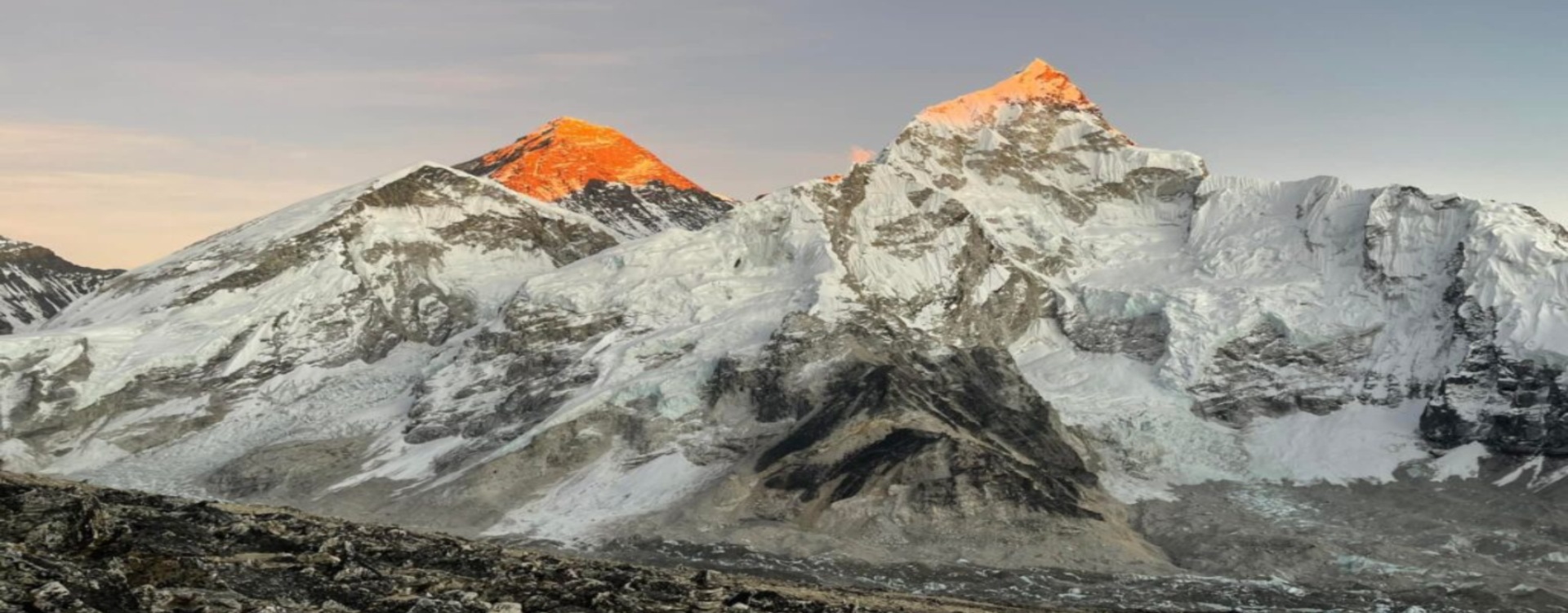
Kala Patthar solves the view problem entirely. From its summit at 5,644 metres, climbers get an unobstructed line of sight to Everest's full pyramid, along with Nuptse, Lhotse, and Pumori close at hand. Most itineraries schedule this hike for pre-dawn, timed to catch first light hitting the summit, which is widely regarded as one of the finest sunrise views anywhere in the Himalayas. This is the payoff moment that most climbers who add the EBC extension are actually chasing, more so than base camp itself.
Island Peak's own summit, by contrast, offers a completely different visual experience. Rather than a distant panorama, climbers stand close enough to Lhotse's south face and Ama Dablam's distinctive profile to feel genuinely small next to them, with a tighter, more dramatic sense of scale than the wider Everest views from Kala Patthar. The two summit experiences complement rather than duplicate each other, which is part of why climbers who do both often describe the combined trip as feeling like two distinct adventures rather than one long slog.
Best Season for the Combined Trip
The combined itinerary follows the same two climbing windows as standalone Island Peak, spring from roughly March through May and autumn from September through November. Both seasons offer generally stable weather and established fixed lines on the headwall, though the extended EBC and Kala Patthar segment benefits particularly from clear autumn skies, since the payoff of that detour is largely the view itself. A hazy or clouded-in Kala Patthar morning is a real disappointment on a trip where seeing Everest clearly was part of the point of adding those extra days.
Autumn, immediately after the monsoon clears, tends to offer the crispest visibility for the EBC portion of the trip, while spring brings slightly warmer temperatures on the lower sections of trail and the NMA's higher permit fee for the climbing portion specifically. Neither season is a wrong choice for the combined itinerary, but if the Everest Base Camp views are a significant part of why you are adding the extension, autumn is worth weighting more heavily in your planning.
A Sample Day by Day Structure
Exact itineraries vary between operators, but the shape below reflects how most well built combined trips are sequenced, and it is close to how we structure ours.
• Days 1 to 2: Arrive in Kathmandu, permit paperwork, gear check and any last minute rental
• Day 3: Fly Kathmandu to Lukla via Ramechhap, trek to Phakding
• Days 4 to 5: Trek to Namche Bazaar, with an acclimatization day including a side hike toward the Everest View Hotel
• Days 6 to 7: Trek through Tengboche to Dingboche, with a second acclimatization day
• Days 8 to 9: Trek north through Lobuche to Gorak Shep, visit Everest Base Camp
• Day 10: Pre-dawn hike up Kala Patthar for sunrise views of Everest, descend to Pheriche or back toward Dingboche
• Day 11: Trek east into the Chhukung Valley
• Day 12: Trek to Island Peak Base Camp, with technical training on ropes, crampons, and jumar technique
• Day 13: Move to High Camp and rest before an overnight summit attempt
• Day 14: Summit push and descent back to Chhukung or Pangboche
• Days 15 to 17: Trek back toward Lukla and fly to Kathmandu, with a buffer day for potential weather delays
Some operators extend this further with an additional rest day at Dingboche or a slower pace through the Chhukung Valley, which pushes the total closer to 19 to 21 days. Longer is not automatically better here, but a rushed version of this itinerary that compresses the EBC detour into fewer days than shown above tends to undercut the entire acclimatization argument for combining the two trips in the first place.
What You Gain and What You Give Up
It helps to be specific about the actual tradeoff rather than treating this as an obviously correct decision for everyone.
What the Combined Trip Adds
• A direct view of Everest's summit pyramid from Kala Patthar, which Island Peak's own summit does not provide as clearly since Everest sits partially behind Lhotse and Nuptse from that angle
• Time standing at the actual Everest Base Camp location, a milestone many climbers want to experience regardless of the technical climb
• Meaningfully improved altitude conditioning heading into the technical summit push
• Better overall value than booking the two trips separately in different seasons or years
What the Combined Trip Costs You
• Three to five additional days away from home, work, or other commitments
• More cumulative walking distance and days at altitude before the technical climb even begins
• A longer trip to plan around in terms of flights, time off, and travel insurance duration
Neither list is longer than the other in any meaningful sense. What matters is which items on each side carry more weight for your specific circumstances.
Training for the Combined Itinerary
Physical preparation for the combined trip overlaps heavily with standalone Island Peak training, but the extra days at altitude before the technical climb mean cardiovascular endurance deserves slightly more emphasis than it might otherwise. A climber who trains purely for a single demanding summit day can find the cumulative effect of nine or ten consecutive trekking days before that summit day surprisingly taxing if their conditioning was built around a shorter effort.
In the two to three months before departure, multi-hour hikes on consecutive weekend days, carrying a daypack similar in weight to what you will actually carry on trail, do more to prepare you for the combined itinerary's cumulative demand than any single long training hike would. Upper body and core strength work remains just as important for the jumar ascent on Island Peak's headwall regardless of which itinerary version you choose, since that specific technical demand does not change based on whether EBC was included earlier in the trip.
Common Mistakes Climbers Make With the Combined Itinerary
Having guided both the standalone and combined versions of this trip repeatedly, a handful of planning mistakes show up more often than others, and most of them are avoidable with a bit of foresight.
Compressing the Itinerary Too Much
The single most common mistake is trying to fit both destinations into a schedule better suited to Island Peak alone. Cutting the EBC detour down to the bare minimum, skipping Kala Patthar to save a day, or reducing acclimatization days to compensate for the extra distance defeats much of the purpose of combining the trips in the first place. If your available time genuinely only supports 14 to 15 days, the standalone Island Peak trip, done properly with full acclimatization days intact, is a better choice than a rushed combined version.
Underestimating the Cumulative Fatigue
Climbers sometimes plan their physical training around the Island Peak summit push specifically and treat the EBC portion as an easy warm-up. In reality, the days to and from Everest Base Camp and Kala Patthar involve long hours on rocky, uneven moraine at significant altitude, and arriving at Chhukung already tired from underestimating that section is a real risk. Training should account for the full trip length, not just the technical climbing day.
Not Adjusting Gear Planning for the Longer Trip
A longer itinerary means more days in cold, high altitude conditions before the technical gear even comes into play. Climbers who pack precisely for a 14 day Island Peak trip sometimes find their clothing system wearing thin, literally and figuratively, by the time they reach Chhukung on the extended version. Packing for the full 17 to 21 days rather than just the climbing section avoids this.
Assuming the Order Does Not Matter
Some itineraries route through Chhukung and attempt Island Peak before heading north to Everest Base Camp afterward. This ordering loses the acclimatization advantage that makes the combination worthwhile in the first place, since climbers reach their highest technical challenge before having had the extra altitude exposure Kala Patthar provides. If a proposed itinerary has Island Peak scheduled before the EBC detour, it is worth asking the operator directly why that order was chosen.
Making the Decision With Confidence
The combined Island Peak and Everest Base Camp itinerary is not a marketing upsell dressed up as a recommendation. The geography genuinely supports it, the acclimatization logic genuinely improves summit conditioning, and the cost genuinely comes in well below booking the two trips separately. For most climbers with the time to spare, it is simply the better version of the trip.
The cases where a standalone Island Peak climb makes more sense are real too, mostly centered on time constraints or climbers who have already stood at Everest Base Camp before and want a tighter, more focused expedition this time around. Neither choice is wrong. What matters is being honest about your available time, your prior trekking experience, and whether the extra days serve your goals or simply extend a trip you would rather keep short.
When you are ready to talk through your dates and decide whether the combined itinerary or the standalone climb fits your plans better, we can walk you through both options, permit by permit and day by day, so you know exactly what each version involves before committing.
Whichever version you choose, the fundamentals stay the same. A gradual acclimatization schedule, an experienced guide team, and honest preparation matter more to your outcome than whether your itinerary runs 14 days or 21. The combination is a genuinely strong option for most climbers, but it is a tool for building a better trip, not a requirement for a successful one.
Frequently Asked Questions
For most climbers, yes. The two routes share the same trailhead and overlap for most of the approach, so adding Everest Base Camp and Kala Patthar to an Island Peak itinerary costs relatively little extra time and money while improving acclimatization before the technical summit push.
Typically three to five additional days compared to a standalone Island Peak itinerary, bringing the total trip length to roughly 17 to 21 days rather than 14 to 16.
Yes. Kala Patthar sits at 5,644 metres, higher than Island Peak Base Camp itself, so climbers who include the EBC detour arrive at Chhukung already acclimatized to an altitude above their eventual base camp elevation, which tends to improve summit conditioning.
Generally 300 to 700 US dollars more than a standalone Island Peak package, since the Lukla flight, guide costs, and much of the teahouse accommodation are already shared between the two objectives rather than duplicated.
It is longer and more physically demanding in terms of total days and distance, but the extra section to Everest Base Camp and Kala Patthar is non-technical trekking. The genuine technical difficulty of the whole trip remains concentrated in Island Peak's summit day regardless of whether EBC is included.
Most itineraries route through Dingboche toward Everest Base Camp before branching to Chhukung, since this order supports better acclimatization ahead of the technical climb. Doing EBC after the Island Peak summit is possible but less common, since climbers are usually more fatigued by that point and the acclimatization benefit is lost.
The Sagarmatha National Park entry fee and the local municipality fee cover the approach trail generally and apply regardless of whether you visit Everest Base Camp specifically. The Island Peak climbing permit through the Nepal Mountaineering Association is a separate fee tied to the climb itself, not the trekking route.
Spring, from March through May, and autumn, from September through November, are both suitable, matching the standard Island Peak climbing windows. Autumn tends to offer clearer skies for the Everest Base Camp and Kala Patthar views specifically.
It can be, provided you have a reasonable fitness base and take the acclimatization schedule seriously. The longer itinerary actually paces altitude gain more gradually than a compressed standalone Island Peak trip, which can make it a more forgiving option for someone newer to high altitude trekking, though the Island Peak summit itself still demands genuine physical readiness.
It tends to raise them modestly, largely due to the additional acclimatization exposure gained during the Everest Base Camp and Kala Patthar segment. Summit success still depends heavily on weather, fitness, and conditions on the headwall during your specific attempt, but arriving well acclimatized removes one significant variable.
Yes, this is possible, though most itineraries include both since they are typically done on consecutive mornings from Gorak Shep and Kala Patthar offers a considerably better direct view of Everest's summit than base camp itself provides.
Some operators offer compressed 15 to 16 day versions that include a shorter EBC visit without the full Kala Patthar side trip, though this reduces both the acclimatization benefit and the sightseeing payoff. We generally recommend the fuller 17 to 21 day version when time allows.
You still complete the Everest Base Camp and Kala Patthar section of the trip regardless of how the Island Peak summit attempt goes, since these occur earlier in the itinerary. A missed summit does not undo the value of having reached Everest Base Camp.
Your insurance needs to cover the highest altitude reached during the entire itinerary, which for the combined trip means coverage rated for Island Peak's 6,189 metre summit and helicopter rescue capability, the same requirement as a standalone Island Peak climb. The Everest Base Camp and Kala Patthar portion does not require different coverage since it falls under that same altitude threshold.
Everest Base Camp and Kala Patthar first, followed by the Island Peak climb, is the standard and recommended order. This sequencing uses the EBC detour as additional acclimatization before the technical summit push, rather than adding a long non-technical trek onto already fatigued legs after the climb.
About Accessible Adventure
Bringing unforgettable Himalayan adventures to everyone. Our expert guides and carefully curated experiences ensure that everyone can explore the beauty of Nepal, Tibet, and Bhutan.
Learn More