Best Time to Trek Annapurna Base Camp: Month-by-Month Breakdown
Field-reviewed by Hari Kumar Shrestha
Table of Contents
Introduction: What Is the Best Time to Trek Annapurna Base Camp?
Spring (March to May) and autumn (September to November) are generally the strongest periods for overall Annapurna Base Camp trekking conditions. Dry trails, manageable temperatures, and reliable mountain views come together most consistently in these windows. Winter (December to February) and monsoon (June to August) are both possible for the right traveler, but they each carry significant trade-offs in terms of trail conditions, visibility, and comfort. The right month for you depends on what you're prioritising: flowers, views, solitude, snow, or simply having the most predictable conditions possible.
There are a few things worth understanding before you settle on a departure month. Weather on the Annapurna Base Camp route is not uniform across the trail: a clear morning in Pokhara does not tell you much about conditions at 4,130 metres in the sanctuary. The lower forested sections of the approach behave very differently from the high alpine terrain above 3,500 metres. Mountain visibility is not guaranteed in any month, and snowfall amounts vary from year to year. The month that works perfectly for one trekker may not be the best fit for another. Our Kathmandu-based trekking team treats the seasonal calendar as a useful guide rather than a guarantee, because conditions on the Annapurna Base Camp route vary from year to year.
Our Kathmandu-based trekking team treats the seasonal calendar as a useful guide rather than a guarantee, because conditions on the Annapurna Base Camp route vary from year to year. A late monsoon can push wet conditions into October. An unusually early snowfall can change the character of a November trek in the Annapurna Sanctuary. A warm, cloud-free week in February can make a winter trek more comfortable than expected. Understanding the general seasonal pattern gives you a good starting point. Understanding the trade-offs within each season gives you a realistic one.
October vs April: The Two Strongest Months for Annapurna Base Camp
At Accessible Adventure, we recommend October and April as the two strongest months for the Annapurna Base Camp route, thanks to dry trails, comfortable temperatures, and reliable morning mountain views. October sits at the sweet spot of the post-monsoon autumn: the rain is finished, the air is clear, and the mountain views from the sanctuary are as sharp as they get. April offers reliable weather with slightly fewer trekkers than October and the specific bonus of the rhododendron bloom across the middle-elevation forest sections of the trail.
Both months have trade-offs. October is the busiest month on the route; teahouses along popular sections fill quickly, and some trekkers find the trail traffic at its most noticeable during the first two weeks. April brings afternoon cloud build-up as the pre-monsoon moisture builds from mid-month, which means early morning is the most reliable window for clear views. Neither issue is serious enough to argue against either month for most trekkers. They are simply things to know.
Beyond October and April, the broader spring season from late March through May and the autumn window from late September through November give you a range of options. September is a transition month: the monsoon typically eases through September, with the last week or two of the month often producing genuinely good conditions. November extends the autumn into colder but still clear and quiet territory. March is early spring, with flowering starting at lower elevations but conditions at altitude still feeling wintry at the start.
Which Season Suits Which Type of Trekker?
|
Trekker Priority |
Recommended Period |
Why |
Main Trade-off |
|
Best overall conditions |
Oct to Nov / Mar to May |
Stable weather, clear skies, dry trail |
October is busiest; spring has afternoon clou d build-up |
|
Mountain views |
October to November |
Post-monsoon clarity, sharp atmospheric visibility |
Colder; November nights especially cold at altitude |
|
Late March to April |
Peak bloom in the middle-elevation forest sections |
Afternoon cloud builds from late April |
|
|
Snow experience |
December to February |
Snow on trail above 3,000m; peak-snow landscapes |
Hard cold; some sections icy; fewer teahouse options |
|
Fewer crowds |
Nov to Feb / Monsoon |
Less traffic than Oct and Apr; more personal pace |
Colder or wet; trade-off against conditions |
|
Photography |
October for peaks; April for flowers |
October: clean air, sharp light; April: bloom + peaks |
No single month covers every photographic priority |
|
First-time trekker |
October or April |
Reliable conditions, well-stocked teahouses, clear routes |
Peak-season crowds; book teahouses early |
|
Winter experience |
December to February |
Quiet trail, dramatic snow landscapes, clear skies |
Serious cold; some teahouses closed; crampons may be needed |
Annapurna Base Camp Seasons Compared: Pros and Cons
|
Season |
Main Advantage |
Main Drawback |
Best Suited To |
|
Spring (Mar-May) |
Rhododendron bloom, warming temperatures, good visibility |
Afternoon cloud build-up; late May is pre-monsoon hazy |
First-timers, flower photographers, returning trekkers wanting something different from autumn |
|
Autumn (Sep-Nov) |
Clearest mountain views of the year, dry trails, stable weather |
Busiest season; October teahouses fill fast |
Peak-condition seekers, mountain view photographers, first-timers |
|
Winter (Dec-Feb) |
Quieter trails, dramatic snow landscapes, clear morning skies |
Serious cold above 3,000m; some teahouses reduce hours or close |
Experienced trekkers, those specifically seeking snow, photographers shooting winter light |
|
Monsoon (Jun-Aug) |
Lush green forests, very quiet trails, no teahouse pressure |
Heavy rain, slippery trail, limited mountain visibility, leeches on lower sections |
Flexible experienced trekkers who accept visibility trade-off for solitude |
Annapurna Base Camp Weather by Month (January to December)
Every month on the ABC route has a distinct character. The table below gives you a quick-read overview; the detailed descriptions that follow explain what conditions actually feel like at different points on the trail for each month.
Weather conditions vary year to year and cannot be guaranteed. Seasonal patterns described here reflect typical conditions rather than any specific year.
|
Month |
Weather |
Rain/Snow |
Visibility |
Crowds |
Flowers |
Trail |
Good For |
|
Jan |
Cold, clear |
Snow above 3,000m |
Often excellent |
Very low |
None |
Icy above 3k |
Snow seekers |
|
Feb |
Cold, some warmth |
Snow possible |
Good to excellent |
Low |
None |
Snow/ice risk |
Winter trekkers |
|
Mar |
Warming |
Low |
Good |
Building |
Starting low |
Improving |
Early spring |
|
Apr |
Spring, warm lower |
Very low |
Good, afternoon cloud |
Peak spring |
Peak bloom |
Good |
Flowers/views |
|
May |
Warm, pre-monsoon |
Some showers |
Morning good |
Moderate |
Late bloom |
Good to variable |
Warm trekkers |
|
Jun |
Humid, rain begins |
Increasing rain |
Often poor |
Low |
Lush green |
Slippery lower |
Solitude seekers |
|
Jul |
Monsoon, wet |
Heavy rain |
Rarely clear |
Very low |
Vibrant green |
Slippery, leeches |
Flexible/exp. |
|
Aug |
Monsoon, easing |
Rain, tapering |
Occasional clear |
Very low |
Rich green |
Variable |
Off-season exp. |
|
Sep |
Transition month |
Early: rain; Late: clearing |
Improving late Sep |
Low to moderate |
Green landscape |
Improves late |
Shoulder/exp. |
|
Oct |
Dry, stable |
Very little |
Excellent |
Peak |
None |
Excellent |
Everyone |
|
Nov |
Cool, clear |
Very little |
Very good |
Lower than Oct |
None |
Very good |
Clear views, quiet |
|
Dec |
Cold, clear |
Snow possible above 3k |
Good to excellent |
Very low |
None |
Icy risk at altitude |
Winter trekkers |
Annapurna Base Camp in January: Snow, Cold and Trail Conditions.
January is the coldest month on the route and the quietest for trekking traffic. The trail above 3,000 metres carries snow for most of the month, and the approach to Machhapuchhre Base Camp and Annapurna Base Camp itself can involve icy sections that require careful footing or microspikes. Daytime temperatures at base camp in January are typically well below freezing, with nights pushing to -10C or colder in the sanctuary. The lower forested sections of the trail around Ghandruk and Chhomrong remain walkable and feel comparatively mild by contrast.
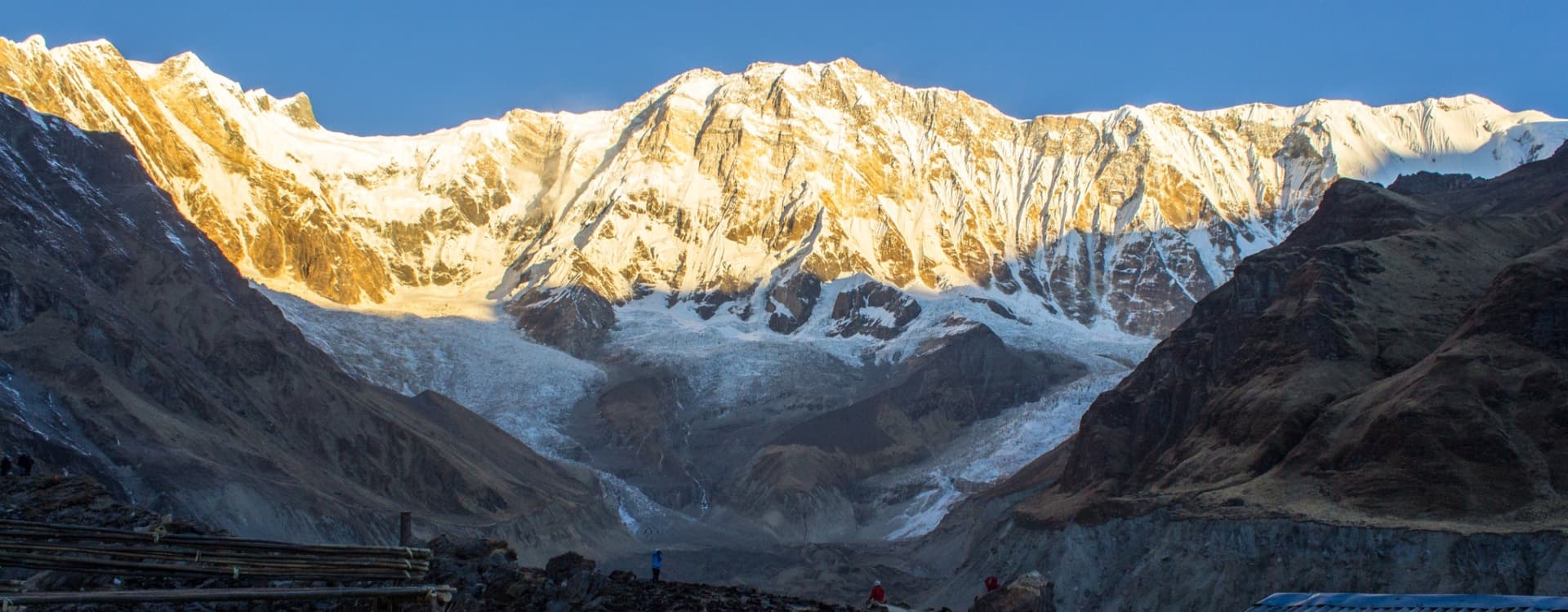
Mountain visibility in January can be excellent when conditions are settled. The atmosphere above the valley is dry and clear, and on calm days the views of Annapurna I (8,091m), Machhapuchhre (6,993m), and Hiunchuli from the sanctuary are among the sharpest you'll find in any season. The practical challenge is getting there comfortably. Some teahouses in the upper section reduce their hours or operate with a single staff member in January; confirm accommodation above Dovan well in advance if you're trekking in this month.
January suits experienced trekkers who specifically want a winter trail experience and are comfortable with cold, icy conditions, lighter teahouse services, and the possibility of needing to turn back at altitude if snowfall closes sections of the upper approach. It's not a month for first-time high-altitude trekkers. Those who do choose January often describe the absolute quiet of the sanctuary in winter as unlike anything they've experienced on any other trek.
What should trekkers expect at higher elevations in January?
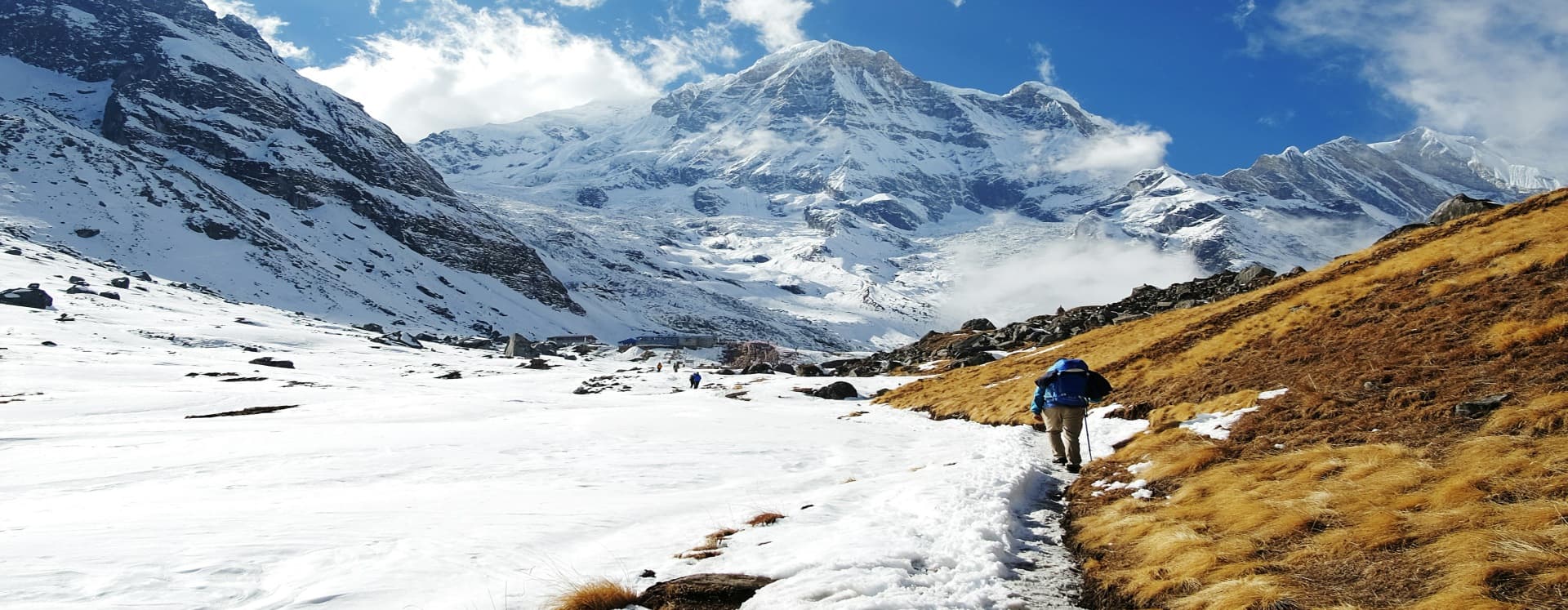
Above 3,500 metres in January, plan for the trail to be snow-covered or icy on any shaded section. The approach from Himalaya Hotel to Machhapuchhre Base Camp and on to base camp itself runs through exposed terrain where wind chill is a real factor. Crampons or microspikes are strongly recommended for this section. Descents on snowy trail can be more technically demanding than the ascent in these conditions. Pack warm layers designed for temperature ranges significantly below what spring and autumn seasons require.
Is February a Good Month for Annapurna Base Camp?
February is still firmly winter but it carries one meaningful difference from January: the days are getting longer and, in settled weather windows, afternoon temperatures at lower elevations can feel genuinely warm. By mid-February the first signs of spring prepare to emerge, though at the altitudes of the sanctuary this is largely an imperceptible shift. The trail character above 3,000 metres remains wintry, with snow and ice possible on the upper approach.
Crowd levels in February are very low. You'll share the trail with a small number of trekkers, and the teahouses that are open tend to have the staff's full attention. Accommodation at higher elevations is the same caveat as January: check what's operational before your departure date and build flexibility into your itinerary in case the upper approach is blocked.
Mountain visibility in February can be outstanding. The atmospheric clarity that defines winter trekking on the ABC route is still fully present, and sunrise views of Machhapuchhre and the Annapurna massif from the sanctuary on a clear February morning are extraordinary. The practical trade-off is the same as January: cold that's serious at altitude, icy trail sections, and services that are thinner than the main seasons.
How does February differ from January?
The practical differences are moderate rather than dramatic. February is slightly warmer, particularly in the first and second week when cold typically eases from January's absolute low. Daylight hours are noticeably longer by late February, which matters when you're navigating a snowy upper approach. And the earliest rhododendron buds may appear on the lowest sections of the trail by the very end of the month, giving a preview of what March will bring at progressively higher elevations.
Is March a Good Month for Annapurna Base Camp?
March is where the ABC trekking calendar begins to come alive. The trail starts transitioning from winter to spring through the month, with the shift happening progressively upward: the lower approach sections warm and dry out early in the month while the high sanctuary still carries winter character into March's first two weeks. By the last week of March, conditions across most of the trail have moved into proper spring territory.
The most distinctive change in March is the beginning of the rhododendron bloom. At lower elevations (from Nayapul through the sections around Ghorepani and Ghandruk), the first red and pink blooms appear as early as the second week of March. By the end of the month, the forest sections below 2,500 metres are producing colour. The mid-elevation bloom at 2,500 to 3,000 metres, which is the most spectacular visual on the classic route, typically arrives in early to mid-April.
Mountain views in March are generally good in the mornings. Afternoon cloud begins to build through the month, but it's typically less developed than in April or May. March is a worthwhile month for trekkers who want the tail end of winter quiet with the beginning of spring warmth, and for photographers who want the early bloom at lower elevations before the trail fills with the April peak.
When do spring flowers begin appearing along the ABC route?
Flowering on the ABC route follows elevation. The lowest trail sections around Nayapul and Tikhedhunga typically see the first rhododendron blooms in early March. The mid-elevation forest sections around Ghorepani (2,860m) and Ghandruk typically peak in late March to early April. Above 3,000 metres, the bloom arrives later still: around Chhomrong (2,170m) the forest is often in full colour in early April while sections above 3,500 metres may still feel wintery. Flowering timing varies year to year depending on local temperature and recent conditions.
Is April the Best Month for Annapurna Base Camp?
For many trekkers, yes. April sits at the intersection of multiple seasonal positives: the rhododendron forest is in peak or near-peak bloom across the middle elevations of the route, temperatures at all elevations are comfortable to cold (rather than dangerously cold), trails are generally dry and in good condition, and residual snow at the sanctuary has typically cleared except in sheltered spots above 4,000 metres. Mountain visibility is reliable in the early part of the day.
The qualification is afternoon cloud. As April progresses, pre-monsoon moisture begins to build and cloud develops from midday or early afternoon on many days. This doesn't prevent trekking or guarantee poor views; it simply means that the sanctuary views are most reliably clear in the morning and potentially clouded in the afternoon. Most experienced trekkers and guides plan the ABC summit day (the overnight at base camp or Machhapuchhre Base Camp and the morning at the sanctuary) to catch the early light rather than expecting clear conditions all day.
April crowd levels are the second-highest of the year after October. The main teahouses along the route, particularly around Deurali, Himalaya Hotel, and Machhapuchhre Base Camp, fill quickly during April's busy weeks. Book accommodation in advance for any departure in the first three weeks of the month.
Is April Better Than October for Annapurna Base Camp?
There isn't a universal answer. April and October each offer strong conditions and each has genuine trade-offs against the other. The question is what you're walking toward.
|
Factor |
April |
October |
Better Suited To |
|
Weather stability |
Good; afternoon cloud builds from mid-month |
Excellent; post-monsoon stability |
Views guaranteed more predictably in October |
|
Mountain visibility |
Good mornings; hazy afternoons possible |
Consistently clear; sharpest light of year |
Photographers and view-focused trekkers: October |
|
Rhododendron flowers |
Peak bloom mid-elevation; spectacular colour |
None; autumn colours in forest |
Flower photographers and spring-colour lovers: April |
|
Crowd levels |
Busy but lighter than October |
Busiest month of the year |
Lighter-pressure trekking: April |
|
Snow on trail |
Residual snow possible above 3,500 m in early April |
None typically; fresh snow possible from late Oct |
Depends on conditions that year |
|
Photography (overall) |
Flowers + peaks + green forest |
Crystal peaks + autumn light + golden landscape |
No universal winner; depends on photographic priority |
Is May a Good Month for Annapurna Base Camp?
May is a viable but more variable month than April. Early May extends the spring season with good conditions: the rhododendron bloom continues at higher elevations and the trail is well-maintained after the busy April season. From mid-May onward, pre-monsoon conditions become more present: humidity increases at lower elevations, afternoon cloud builds more reliably, and short showers are possible in the valley sections below 2,000 metres.
At higher elevations in May, conditions remain noticeably different from the lower valley. The Annapurna Sanctuary at 4,130 metres is largely above the cloud layer that builds through the afternoon in the valleys below, and many trekkers report clear summit views even on days when the lower trail was overcast. This is one of the recurring features of the ABC route that generic seasonal guides often miss: the sanctuary can be clear when the lower trail is not.
May is a less crowded month than April. By the second half of the month, the trekker traffic that peaks in April has eased, which means teahouses are more available and the trail is quieter. For trekkers with limited flexibility in vacation dates, May is a workable option: expect warm conditions lower down, possible showers in the afternoons, and increasingly reliable mornings at altitude.
How does late spring change as you approach higher elevations?
At Nayapul and the lower approach, May feels increasingly humid and warm: locals are already watching the monsoon forecasts. Above Chhomrong, conditions cool and the rhythm changes; the afternoon cloud that sits in the lower valleys has less presence at 2,000 metres and above. By the time you reach Machhapuchhre Base Camp and the sanctuary, temperature is the dominant factor rather than cloud: cool, clear mornings that give way to some afternoon buildup, but with the wide-open sightlines of the high sanctuary making it harder for cloud to fully close in.
Can You Trek Annapurna Base Camp in June?
June marks the official onset of monsoon influence in the Annapurna region. Conditions change noticeably from the late May baseline, with rainfall increasing and cloud cover becoming persistent. The lower sections of the trail through the subtropical and oak-bamboo forest zones become wet and, in places, slippery. The approach from Nayapul through the sections below Chhomrong can carry leeches on shaded wet sections from June onward.
Mountain visibility in June is reduced. The peaks that define the appeal of the Annapurna Sanctuary are obscured by cloud for much of the day on most days in June, with occasional clearings in the morning or evening. A week-long ABC trek in June that produces even two or three clear sanctuary views is a reasonable outcome to expect rather than guaranteed. Some trekkers consider this an acceptable trade-off for the absolute quiet of the trail and the lush green the monsoon brings to the forest sections.
Access can be affected in June. The roads connecting Pokhara to the lower approach trailheads can be disrupted by rain-related road damage, particularly on less-maintained sections. Verify current road and trail conditions before departure.
What changes first when monsoon conditions arrive?
The lower forest sections feel it first. Trails through the oak and bamboo zones below 2,000 metres become wet and slippery before the higher sections show much change. Leeches appear in these sections when the undergrowth is wet. Bridges across smaller streams become more variable in condition through the monsoon months. The sanctuary itself, being above most of the cloud generation zone, can still be relatively clear on some mornings even when conditions below are wet. This elevation differential is one reason some experienced trekkers find June manageable despite the official monsoon timing.
Is July a Good Month for Annapurna Base Camp?
July is peak monsoon. Rainfall at lower elevations is heavy and sustained, trail surfaces in the forested lower sections are wet and slippery, and mountain views in the Annapurna Sanctuary are limited on most days. Clear mountain views at ABC in July require a combination of good timing and luck that is harder to rely on than in any other month except August. The trail is active with leeches below 2,500 metres on wet days.
That said, July is not impossible. The trail is open, teahouses operate (though with reduced traffic), and the landscape from the lower valley to the sanctuary is at its most intensely green and alive. Some trekkers specifically choose July for the solitude: the ABC route in July carries a fraction of the October or April traffic, and there's a particular quality to walking through the monsoon forest when the undergrowth is at its most exuberant.
Landslide risk increases on road sections during July. Access from Pokhara to the lower trailheads should be verified immediately before departure, and itinerary flexibility is essential.
Can you still see the Annapurna mountains in July?
Yes, sometimes, and usually in the early morning. The cloud layer that builds through the day in July typically starts to clear from around 3:00 to 5:00 AM on some days, producing a brief window of clear view at the sanctuary before the cloud rebuilds. This is not reliable enough to plan around as a guaranteed experience, but it does happen, and trekkers who have walked the route in July sometimes describe these unexpected pre-dawn views as among the most dramatic they've seen on any ABC visit, partly because of the drama of the surrounding conditions.
Is August a Good Month for Annapurna Base Camp?
August sits at the height of the monsoon and carries similar conditions to July with one meaningful addition: by the last week of August, the first signs of the monsoon easing can begin to appear on some days. Early mornings become slightly clearer on better days, and the rainfall can feel slightly less relentless than at the July peak. Neither of these signals is consistent enough to recommend August over September, but they give August a marginally more optimistic character by its final week.
Trail conditions in August are at their most demanding for trekkers who aren't comfortable with wet footing: muddy sections, wet stone steps, slippery log bridges, and persistent leech-prone lower sections. The forest is genuinely beautiful in August: the density and colour of the monsoon vegetation makes the approach through the rhododendron and oak forest sections strikingly lush.
Who might choose an August ABC trek?
Experienced trekkers who value absolute trail quiet and have no hard deadline on mountain visibility are the best fit for August. Some long-term Nepal visitors specifically schedule their annual ABC return in August because they find the monsoon forest more interesting photographically than the dry-season landscape. The trail carries very few other trekkers, teahouse interaction is more personal and unhurried, and the experience is categorically different from a peak-season visit. None of this applies to first-time trekkers or travelers for whom clear mountain views are the primary reason for the trip.
Annapurna Base Camp in September: Early vs Late Month
September is one of the most misunderstood months on the ABC route. Most seasonal guides treat it simply as the last monsoon month or the first autumn month. The reality is that September is a genuine transition and the two halves of the month can feel like completely different trekking seasons.
Early September (the first two weeks) is typically still monsoon-influenced: rainfall is present, cloud cover is the norm, and conditions closely resemble August. The second half of September is when things change. The monsoon typically eases from mid-month onward, cloud clears progressively, and by the last week or ten days of September, the Annapurna Sanctuary can produce clear views that rival early October. Trail surfaces in the lower sections are still recovering from the monsoon and can be wet and slippery, but the upper trail dries out faster.
Late September is one of the genuine underrated periods on the ABC calendar for the trekker who can accept some variability. Crowds are still low because most October-bound trekkers haven't arrived yet, accommodation is available without advance booking, and on clear days the post-monsoon views are beginning to sharpen up to the clarity that defines the autumn season. The vegetation is at its most lush and green after months of rain, which gives the landscape a freshness that October's dry season replaces with a different but less vivid quality.
Is early September different from late September?
Substantially. Early September shares more in common with August than with October. Late September shares more in common with October than with August. The week-by-week shift through September is significant enough that it's worth being specific about your departure date when researching conditions: 'September' as a category encompasses a much wider range of conditions than 'October' or 'April'.
Is October the Best Month for Annapurna Base Camp?
October is the most popular month on the ABC route for a reason. The post-monsoon air that settles over Nepal after the rains end produces visibility of exceptional quality: the Annapurna massif, Machhapuchhre, Hiunchuli, and Annapurna South in the sanctuary frame views that are more vivid and sharply defined than in any other month. Daytime temperatures at all elevations are comfortable to cool. Trail surfaces are dry and well-maintained after the summer season. The full range of teahouse accommodation is operational and at its best-stocked.
October is also the busiest month. The trail during the first two weeks of October carries its highest traffic of the year, teahouses in Himalaya Hotel, Deurali, and Machhapuchhre Base Camp fill during peak weeks, and the sanctuary itself can have more trekkers present at any given time than in any other month. Whether this feels like energy or crowding depends on the individual.
Booking accommodation well in advance for October is not a suggestion; it's a practical necessity for anyone planning specific overnight stops above Chhomrong. Guides who operate in October regularly note that parties arriving without teahouse bookings in Himalaya Hotel or MBC during the first half of the month can find options limited.
Is October Better Than November for Annapurna Base Camp?
|
Factor |
October |
November |
|
Weather |
Post-monsoon stable, dry, reliable |
Cooling; still dry and stable |
|
Visibility |
Excellent; among the clearest of the year |
Very good; often even cleaner air than October |
|
Temperature |
Comfortable at lower elevations; cold above 3,500m |
Noticeably colder at all elevations; ABC nights well below freezing |
|
Crowds |
Highest of the year; teahouses fill quickly |
Significantly lower than October |
|
Snow potential |
Very low; possible late October above 4,000m |
Possible at ABC and MBC from mid-November |
|
Overall feel |
Peak conditions, peak people; energetic, busy |
Quieter, colder, still clear; more contemplative pace |
Is November a Good Month for Annapurna Base Camp?
November extends the autumn season with one key shift: it's significantly colder than October, particularly above 3,000 metres. The sanctuary at night in November regularly drops well below freezing, and the approach to Machhapuchhre Base Camp and ABC can feel genuinely cold even in the daytime as the month progresses. But for trekkers who are prepared for the cold, November offers something that October cannot: the same excellent visibility with considerably fewer people on the trail.
The first week or two of November still feel like peak autumn in terms of trekking conditions. By the middle of the month, the temperatures at Machhapuchhre Base Camp (3,700m) and Annapurna Base Camp (4,130m) are noticeably colder than October, and the risk of snowfall at these elevations increases toward the end of the month. Fresh snow on the sanctuary in November is possible and, for trekkers who encounter it, transformative for photography.
Crowd levels drop progressively through November. A trekker on the ABC route in the third week of November will typically share the upper trail with far fewer parties than the same trekker would have encountered in the first week of October. Teahouses are well-stocked, and staff have more time for each group. November has a quiet, considered quality that peak-October trekking doesn't.
Is November too cold for Annapurna Base Camp?
For trekkers with proper cold-weather gear, no. A sleeping bag rated to at least -15C, a heavyweight down jacket, thermal base layers, and warm gloves are adequate for a November ABC trip for most people. The cold is real and it's worth taking seriously, particularly at altitude above 3,500 metres, but it's manageable with the right equipment. Trekkers who underestimate the temperature drop from October to November are the ones who struggle: the difference between a well-prepared November trekker and an under-prepared one is significant.
Is December a Good Month for Annapurna Base Camp?
December is the gateway to winter on the ABC route. Conditions transition progressively through the month: early December often retains some of late November's clear, cold character, while the second half of the month moves into more firmly winter territory. Snowfall at the sanctuary and the approach above 3,500 metres becomes more likely as the month progresses, and temperatures at base camp can drop to -15C or below overnight by late December.
Crowd levels are very low. December is one of the quietest months on the ABC route, with the trail carrying a small number of trekkers who have specifically chosen this period. Teahouses in the lower sections are fully operational; services above Himalaya Hotel become thinner. Daylight hours are the shortest of the year in December, which affects how much walking time is available before you lose the light.
Mountain visibility in December can be excellent on settled days. The clear winter atmosphere that defines January and February is beginning to establish itself, and some trekkers describe December sunrise views of the sanctuary as among the most vivid they've experienced. The practical requirements match the season: treat December above 3,000 metres as a winter trek with appropriate gear.
Who should choose December for ABC?
December suits trekkers who want a genuine cold-weather experience without the full severity of January or February, and who are comfortable with the reduced teahouse services at altitude. It's also a practical option for travelers whose vacation dates fall in the December holiday period: it's a quieter, more personal experience than most people expect from a Christmas or New Year trek, with the sanctuary's winter character adding something that the peak seasons don't.
Best Time for Annapurna Base Camp Views, Flowers, Snow and Fewer Crowds
When Is the Best Time for Clear Mountain Views?
The clearest mountain views on the Annapurna Base Camp route are typically found in October and November. The post-monsoon atmosphere is the sharpest of the year: moisture has been washed from the air through the monsoon months, and the clarity that arrives in October produces a quality of light and definition on the peaks that the pre-monsoon atmosphere of spring can't quite match. Morning is always the most reliable window for clear views, in every season. Cloud builds from the valleys through the afternoon on most days, and the sanctuary views are consistently best between dawn and 10:00 AM.
Spring (March to May) offers good mountain views, particularly in March and early April. The pre-monsoon cloud that builds from mid-April reduces afternoon visibility, but the morning window is reliable. Winter (December to February) can produce exceptional clarity on settled days when no cloud is moving through from the south. The lowest probability of clear mountain views falls in the monsoon months of June through August, though early morning clearings do occur even then.
When Is the Best Time to See Rhododendrons and Spring Landscapes?
The rhododendron bloom on the ABC route is elevation-dependent and typically peaks across the mid-elevation forest sections in late March to mid-April. At the lowest trail sections (around Nayapul and Tikhedhunga), the first red blooms appear as early as early March. The most spectacular visual concentration, in the Ghorepani to Tadapani section and around Chhomrong, typically reaches full colour in late March to early April depending on conditions that year.
The bloom moves upward through the season: sections at 2,000 metres that are past their peak in late March may still be flowering at 2,500 metres in mid-April. Above 3,000 metres, the rhododendron species present are different (lower-growing, smaller-flowered) and the bloom is less dramatic in scale, though still present. April is the strongest single month for the flower experience, with March a close second for the lower sections and a preview of what April will bring.
When Is the Best Time to See Snow at Annapurna Base Camp?
The distinction between snow on the trail and snow on the surrounding peaks is important. Snow on the peaks is present year-round: the high-altitude faces of Annapurna I, Machhapuchhre, and the sanctuary walls carry permanent glacial ice and snow at all times. That image of snowcapped peaks is not seasonal.
Snow on the trail, meaning snow underfoot as you walk, is a winter and early spring phenomenon. Above 3,500 metres, snow on the trail is possible from November and becomes increasingly likely through December, January, and February. By March, snow on the lower sections of the route has typically cleared, but the approach above Machhapuchhre Base Camp (3,700m) may still carry snow in early March. By late March to April, the trail to Annapurna Base Camp (4,130m) is usually snow-free or has only residual patches. Fresh snowfall can occur at altitude in any season from November through April and occasionally later; year-to-year variation is real.
Which Months Are Least Crowded?
The quietest periods on the ABC route, in general order, are: deep winter (December to February), the monsoon months (June to August), and the shoulder transition months (November and late September). October and the first three weeks of April are the busiest periods. The exact crowd character depends on which part of the route you're on: the approach through Chhomrong and Bamboo is always quieter than the upper sanctuary section, and the return trail in both directions is calmer than the main approach direction.
Quieter trails don't automatically mean a better experience: the teahouse social atmosphere that many trekkers find rewarding is more present in October than in February. The choice between a busy trail and a quiet one is genuinely about personal preference rather than an objective quality standard.
Best Month for Annapurna Base Camp Photography
No single month captures everything. Photography priorities on the ABC route pull in different seasonal directions, and the best month depends on which subjects matter most.
|
Photography Priority |
Best Period |
Why |
Limitation |
|
Mountain peaks |
October to early Nov |
Clearest atmospheric visibility of the year |
Cold; October crowds at popular viewpoints |
|
Rhododendron flowers |
Late March to April |
Peak bloom in the middle-elevation forest canopy |
Afternoon cloud may obscure peaks behind the flowers |
|
Snow landscapes |
December to February |
Snow on trail and peaks simultaneously |
Hard cold, short daylight; some angles difficult to access |
|
Lush green forests |
July to August |
Monsoon vegetation is intensely rich and vibrant |
Peaks behind cloud; misty most of the day |
|
Dramatic cloud/moody light |
May to June / Aug to Sep |
Transition weather creates interesting cloud formations |
Unpredictable; mountain views not reliable |
Annapurna Base Camp in Winter and Monsoon: Is Off-Season Trekking Possible?
Annapurna Base Camp is accessible outside the traditional peak seasons. Both winter and monsoon trekking happen regularly. But 'possible' and 'optimal' are not the same thing, and understanding the specific conditions of each off-season period matters for making an informed decision.
Is Annapurna Base Camp Possible in December, January, and February?
Yes, and a meaningful number of experienced trekkers choose these months deliberately. The winter ABC route offers genuine rewards: exceptional clarity on settled days, absolute trail quiet, dramatic snow landscapes at altitude, and a personal experience that peak-season trekking cannot provide. The requirements are straightforward: cold-weather gear appropriate for temperatures well below freezing above 3,500 metres, crampons or microspikes for icy trail sections above 3,000 metres, confirmed accommodation above Dovan before departure (some teahouses reduce services or close), and itinerary flexibility if snowfall closes the upper approach temporarily.
The approach from Chhomrong to Himalaya Hotel is generally walkable in winter. The section from Himalaya Hotel to Machhapuchhre Base Camp and on to Annapurna Base Camp is where winter conditions require the most careful preparation. Snow depth and ice on this section vary considerably by year and by how recently snowfall has occurred.
Can You Trek Annapurna Base Camp in June, July, and August?
Technically yes, practically demanding. The monsoon months bring heavy rainfall at lower elevations, persistent cloud that limits mountain views, slippery trail surfaces throughout the lower sections, leeches on shaded wet forest sections, and the possibility of road disruption affecting access from Pokhara to the trailhead. The upper sanctuary can still produce morning clearings and surprising views even during the monsoon, but the probability is significantly lower than in any other season.
The distinction that matters is this: some trekkers come to the ABC route for the trail experience, the forest, the villages, and the high-altitude feeling of the sanctuary, and accept reduced mountain views as part of a monsoon trade-off. Others come specifically for the mountain panorama, and for them the monsoon months are the wrong choice regardless of other factors. Knowing which category you fall into resolves the decision.
Which Type of Trekker Suits an Off-Season ABC Trek?
|
Traveler Profile |
Off-season Suitability |
Why |
|
Experienced, flexible trekker |
Yes: winter or monsoon both possible |
Has altitude experience, appropriate gear, and can adapt itinerary to conditions |
|
First-time trekker |
Not recommended in deep winter or peak monsoon |
Fewer reference points for judging when conditions require stopping or descending |
|
Photographer |
Winter yes; monsoon depends on priority |
Winter snow + clear skies are rewarding; monsoon peaks are mostly hidden |
|
Family with children |
Stick to spring or autumn |
Predictable conditions, full teahouse services, easier itinerary management |
|
Assess carefully; build contingency days |
Off-season conditions are less predictable; a delay to start or pause mid-route is more likely |
What to Check Before an Off-season ABC Trek
1. Current weather forecast for the relevant date and elevation range
2. Recent trail reports from guides or trekkers who have walked the upper sections within the last two weeks
3. Road and access conditions from Pokhara to the lower trailhead (particularly for June through August)
4. Which teahouses above Dovan and Himalaya Hotel are confirmed open and staffed
5. Gear: sleeping bag rated appropriately for expected temperatures; crampons or microspikes for winter; waterproof everything for monsoon
6. Contingency days built into the itinerary to absorb a weather delay or trail hold
7. Travel insurance covering trekking above 4,000 metres and emergency helicopter evacuation
8. Guide confirmed for the specific dates, with experience of the same season on the same route
How Should You Choose Your ABC Trekking Month?
Which Month Is Best for First-time Trekkers?
October and April are the strongest months for first-time ABC trekkers. Both offer predictable conditions, full teahouse services, dry trails, and reliable mountain views in the morning. October has better atmospheric clarity; April has the rhododendron bloom. For someone trekking at altitude for the first time, predictability matters more than any single seasonal feature, and both months deliver it most consistently.
If you can only choose one and your priority is views over flowers: October. If your priority is a quieter trail with spring scenery and the same reliable conditions: April, or the last two weeks of September.
Which Month Is Best for Families or Slower-paced Trekkers?
Spring (April in particular) and autumn (October) offer the most comfortable conditions for families and groups with a slower or more flexible pace. Daytime temperatures are comfortable at all elevations, teahouses are fully staffed and well-stocked, trails are dry, and contingency options are easy to manage. The main practical adjustment for a family group in October is advance teahouse booking above Chhomrong: room availability tightens quickly in peak weeks.
Which Month Is Best for Experienced Trekkers Seeking Quieter Trails?
November after mid-month, February for winter character, and late September for a post-monsoon shoulder that hasn't yet reached peak traffic. Each of these periods offers something that experienced trekkers who have already done ABC in October typically value: a changed trail atmosphere, lower traffic, and a different sensory experience of the same route. November's cold and February's snow are both real factors rather than romantic abstractions, and they suit trekkers who prepare accordingly.
What If My Vacation Dates Are Fixed?
The five questions to run through for any fixed-date ABC trek:
9. Expected weather pattern: what are conditions typically like in the specific week you're trekking? Read this month-by-month guide and focus on the specific half of the month rather than the full month label.
10. Trail conditions: is the trail surface likely to be wet, icy, snowy, or dry? Does that require specific footwear or gear beyond the standard kit?
11. Mountain visibility: what is the realistic probability of clear views in this month? If views are the primary reason you're making this trip, this question is critical.
12. Traveler experience: does your fitness and altitude experience match the conditions the month is likely to produce? Winter months ask more of trekkers than spring or autumn.
13. Flexibility and contingency: have you built contingency days into your schedule if the trail needs an extra day, or if you want to wait a day at altitude for better conditions? Fixed-date trekkers who build in no flexibility tend to feel more pressure at altitude than those who have a buffer.
Annapurna Base Camp Month Decision Matrix
Use this table to identify the period that best fits your specific priorities. No month covers every column; each recommendation reflects the best available match against the stated priority.
|
Priority |
Best Period |
Why |
Main Trade-off |
|
Best overall conditions |
October, then April |
Reliable weather, clear trail, comfortable temperatures |
Busy; teahouses need advance booking |
|
Clearest mountain views |
October to early November |
Post-monsoon air is the sharpest and cleanest of the year |
Cold in November; October crowds |
|
Rhododendron flowers |
Late March to mid-April |
Peak bloom across middle-elevation forest sections |
Afternoon cloud builds in April; some residual morning haze |
|
Snow on the trail |
December to February |
Snow on trail and surrounding peaks; winter landscape |
Serious cold; crampons likely; some facilities reduced |
|
Fewer crowds |
November, December, Feb, early Sep |
Lower traffic than peak October and April |
Trade weather comfort for quieter trails |
|
Photography (peaks) |
October to early November |
Clearest air, sharpest light, no afternoon haze |
Cold; November light is lower, harder for shadows |
|
Photography (flowers) |
Late March to April |
Rhododendron canopy at peak colour with peaks visible |
Mountain views can be blocked by cloud in afternoon |
|
First-time trekkers |
October or April |
Most reliable conditions, best-stocked teahouses |
Plan well ahead for both; peak demand means full lodges |
|
Winter adventure |
January to February |
Quiet, dramatic, clear skies in settled periods |
Cold is serious above 3,500m; icy trail sections |
|
Monsoon trekking |
Late June to August |
Very few other trekkers; intensely lush landscape |
Limited mountain views; slippery trail; leeches lower down |
Annapurna Base Camp Weather by Elevation: Pokhara to the Sanctuary
One of the most consistently misunderstood aspects of trekking ABC is that the route does not have a single weather character. A sunny day in Pokhara is not a reliable indicator of what's happening at Machhapuchhre Base Camp. A rainy morning in the lower valley sections around Ghandruk may not reflect what's occurring in the sanctuary at 4,130 metres. The ABC route passes through several distinct climate zones between its starting point and the high sanctuary, and conditions can be dramatically different between the bottom and top of the route on the same day.
The lower approach sections from Nayapul through Tikhedhunga, Ghorepani, Ghandruk, and Chhomrong (roughly 1,000m to 2,200m) follow subtropical to temperate forest zones. These sections are most affected by the rainfall that arrives with the monsoon, the warmth of spring and autumn, and the relatively mild winter temperatures. Leeches appear here in the wet season. Rhododendrons bloom here in spring. The lower trail is where the vegetative and cultural experience of the route is concentrated.
Above Chhomrong, through Bamboo, Dovan, and Himalaya Hotel (2,300m to 2,920m), the forest character changes and the terrain becomes more exposed. Temperature drops noticeably. The Himalaya Hotel section is often the first place trekkers feel the cold significantly in spring or autumn, particularly overnight.
Above Himalaya Hotel, through Machhapuchhre Base Camp (3,700m) to Annapurna Base Camp (4,130m), the terrain is high alpine: exposed, cold, and subject to weather that can change faster than the lower sections. Cloud generation is different here: the sanctuary can be clear when the lower valley is covered, and it can be socked in when the valley below is clear. This is why trekkers who judge their ABC trip by whether Pokhara was sunny when they were at Ghandruk sometimes arrive at the sanctuary with no views at all, and trekkers who walked through rain in the lower sections occasionally find a perfect dawn at the sanctuary the following morning.
Should Trekkers Judge ABC Conditions Using Pokhara Weather?
Not directly. Pokhara's weather at 820 metres gives a general seasonal indicator but is not a reliable proxy for conditions at 4,130 metres. The monsoon cloud that keeps Pokhara wet for days at a stretch often stays in the valley while the sanctuary, above the cloud layer, remains clear. Conversely, the cold that makes the sanctuary challenging in winter may not be felt in Pokhara at all. The useful rule: use Pokhara weather as a background indicator of whether you're in wet season, dry season, or transition. Don't use it to predict your specific day's conditions at altitude.
Annapurna Base Camp Packing List by Season
Packing adjustments by season matter more than most general packing guides suggest. The core kit (trekking boots, daypack, sunscreen, trekking poles) is consistent across all months. What changes is the thermal system and rain protection.
Spring (March to May)
• Layers: lightweight base layer + fleece midlayer + down jacket (for above 3,000m and early mornings throughout). Light waterproof shell.
• Sleeping bag: rated to -10C minimum for the sanctuary section; -5C adequate for mid-trail.
• Footwear: waterproof boots; microspikes for early March if snow is present above 3,500m.
• Rain protection: light waterproof shell; pack cover. Afternoon showers possible from late April.
• Sun: SPF 50+ essential above 3,000m; glacier or high-UV sunglasses above the treeline.
Monsoon (June to August)
• Rain gear: this is the defining item for monsoon trekking. Full waterproof outer shell, waterproof pack cover, dry bags for electronics and clothing inside the pack.
• Footwear: waterproof boots, but accept that feet will get wet on extended wet trail sections. Gaiters for lower trail sections where leeches are present.
• Leech protection: salt or specialist repellent; tuck trousers into socks on lower sections; check ankles regularly.
• Warmth: less critical than spring but still needed above 3,000m. A warm midlayer and down jacket for the sanctuary section.
• Sleeping bag: rated to -5C adequate for most of the route in monsoon; warmer bag for the sanctuary section if staying overnight.
Autumn (September to November)
• October kit: similar to spring. Layers: base + fleece + down jacket. A light down jacket is adequate for October; heavier for November.
• November adjustment: add heavier down jacket (rated for -15C at the sanctuary), heavyweight gloves, and a balaclava or similar face protection for early mornings above 3,500m.
• Sleeping bag: -10C to -15C rated for the sanctuary section in late October; -20C rated for November trekkers staying at MBC or ABC overnight.
• Rain protection: pack cover and a light shell; not expected to be heavily used in October or early November.
Winter (December to February)
• Thermal system: heavyweight base layers (merino wool or expedition synthetic), fleece midlayer, heavyweight down jacket (rated to -20C or below), expedition pants or thermal trekking trousers.
• Extremities: expedition-weight gloves or mitts, balaclava, neck gaiter, warm beanie. Frostbite risk is real on exposed sections above 3,500m in January and February.
• Sleeping bag: -20C to -25C rated for the sanctuary section. This is not optional in January and February.
• Traction: crampons or microspikes for the approach above Himalaya Hotel. Ice axe is not needed on the standard route but trekking poles with proper baskets are.
• Daylight adjustment: shorter days mean planning a camp-to-camp schedule with earlier starts. A quality headlamp with fresh batteries for pre-dawn sections.
Teahouses, Road Access and Itinerary Planning by Season
How Does Season Affect Teahouse Availability?
October and April are the months when teahouses above Chhomrong experience the highest demand. The most-requested overnight stops, particularly Himalaya Hotel, Deurali, Machhapuchhre Base Camp, and the small collection of lodges at Annapurna Base Camp itself, fill quickly on busy weeks. Trekkers who arrive without advance reservations in peak October or mid-April can occasionally find the most popular stops full, particularly for groups larger than two or three.
In the off-season months (December through February, June through August), teahouse availability is significantly less pressured and advance reservations are generally not required. The practical concern in winter is not availability but operational status: confirm that teahouses above Dovan are actually staffed and serving food before your departure. In the monsoon, the main concern is access rather than availability.
How Can Weather Affect the Pace of an ABC Itinerary?
Any season can produce weather that slows or pauses an itinerary. In spring and autumn (the most reliable seasons), this is relatively uncommon but not unknown: an unseasonable snowfall in October can close the upper trail for a day, and an early pre-monsoon storm in late April can pin a group at Deurali while conditions clear. The itineraries most vulnerable to weather-forced pauses are those with no contingency day. If you're trekking on a tight schedule with no buffer, a single forced rest day at altitude can compress your planned itinerary significantly.
Off-season trekkers should build at least one and ideally two contingency days into the overall schedule. Winter snowfall can close the MBC-to-ABC section for 24 to 48 hours. Monsoon storms can make the lower trail sections uncomfortably slow for a day. A contingency day at Himalaya Hotel or MBC lets a group wait for conditions to improve without having to choose between pushing on unsafely or abandoning the summit approach.
How Can Rainfall, Snow, or Road Conditions Affect Access?
The road from Pokhara to the lower ABC trailheads is vulnerable to rain-related disruption, particularly on unpaved sections, during June through September. In heavy monsoon years, sections of the approach road can be cut off for hours or occasionally days. Verify current road conditions with your guide before setting out from Pokhara on the approach day.
On the trail itself, the sections most affected by weather are the upper approach from Himalaya Hotel to the sanctuary in winter (snow and ice), and the lower forested sections around Bamboo and Dovan in monsoon (muddy, slippery surfaces). Both are manageable with appropriate footwear and the right pace; neither is a reason to cancel the trek for a prepared trekker.
Final Verdict: How to Choose Your Annapurna Base Camp Month
There's no universal perfect month for Annapurna Base Camp. What there is: a month that fits your priorities better than the others. Spring and autumn are the most reliable overall. October delivers the clearest views with the heaviest crowds. April delivers flowers and comparable reliability with slightly fewer trekkers. November and late September give similar conditions to the peak months with more personal space on the trail. Winter and monsoon offer genuine different experiences for trekkers who can accept their specific trade-offs.
The principle worth carrying into the decision: choose the month that matches your priorities rather than the month with the strongest generic reputation. The trekker who comes in April for the rhododendrons and gets clear mountain views is having a different but equally valid ABC experience from the trekker who comes in October for the views and gets them in exceptional clarity. Both are correct choices. Both depend on knowing why you're making them.
Not sure which month fits your travel dates? A Nepal-based trekking team can compare conditions, itinerary options, and practical considerations for your specific dates and help you build the right trip around the window you actually have.
Get a Custom Quote
Frequently Asked Questions
What is the best time to trek Annapurna Base Camp?
October and April offer the most reliable overall conditions: dry trails, comfortable temperatures, and good mountain visibility. October gives clearer views; April adds rhododendron bloom. Both are busy seasons. Late September and November provide similar conditions with fewer trekkers.
Which month has the best weather for Annapurna Base Camp?
October typically offers the most consistently stable weather. The post-monsoon atmosphere produces dry, settled conditions with excellent mountain visibility. April is the spring equivalent, with good weather but afternoon cloud building as the month progresses toward the pre-monsoon period.
Is October a good month for Annapurna Base Camp?
Yes. October is the most popular month on the route for good reason: stable post-monsoon weather, excellent mountain views, dry trails, and fully operational teahouses. It is also the busiest month, so advance accommodation booking above Chhomrong is essential.
Is April a good month for Annapurna Base Camp?
Yes. April combines reliable weather with the rhododendron bloom in the middle-elevation forest sections, making it the most visually varied month on the route. Afternoon cloud builds in April; morning views are the most reliable window.
Can you trek Annapurna Base Camp in winter?
Yes. Winter trekking is possible in December, January, and February with appropriate cold-weather gear. Conditions above 3,000 metres are cold, with snow and ice possible above that. Some teahouses above Dovan may have reduced services. Experienced trekkers with crampons and proper gear manage well.
Can you trek Annapurna Base Camp during monsoon?
It's possible but not recommended as a first ABC experience. Heavy rainfall, slippery trails, limited mountain visibility, and leeches on lower sections are the main trade-offs. Experienced trekkers specifically seeking solitude and green landscapes sometimes choose June to August.
Which month has the clearest mountain views?
October and early November offer the clearest mountain views, driven by post-monsoon atmospheric clarity. Morning hours in every season are more reliable for clear views than afternoons. March and April offer good morning views with some afternoon cloud build.
Which month is best for rhododendron flowers?
Late March to mid-April is peak rhododendron season on the ABC route. The bloom is elevation-dependent: lower sections flower first in March, and the most spectacular mid-elevation forest sections around Ghorepani and Chhomrong peak in late March to early April.
When does it snow at Annapurna Base Camp?
Snow on the trail above 3,500 metres is possible from November and most common in December through February. Fresh snowfall can occur at the sanctuary in any month from October through April. Permanent glacial snow on the surrounding peaks is visible year-round.
Is Annapurna Base Camp crowded in October?
October is the busiest month on the route. The first two weeks are peak traffic, with teahouses above Chhomrong filling quickly. Advance booking is essential for October departures. The trail is active but the conditions that draw the crowds are genuine.
What is the coldest month for Annapurna Base Camp?
January is typically the coldest month. Overnight temperatures at Annapurna Base Camp (4,130m) in January can fall to -15C or below. Daytime temperatures at the sanctuary may stay near or below freezing even in sunshine. Proper winter gear is essential.
What is the rainiest month for Annapurna Base Camp?
July is typically the wettest month. The ABC route sits within the main monsoon belt and receives significant rainfall from June through September, with July and August at the peak. The sanctuary can clear briefly in early morning even during the rainiest weeks.
Is September a good month for Annapurna Base Camp?
Late September is consistently underrated. The monsoon eases through September, and the final week to ten days of the month often produce good conditions comparable to early October. Early September is still monsoon-influenced. The two halves of September are genuinely different.
Is November too cold for Annapurna Base Camp?
Not for a well-equipped trekker. November is cold above 3,500 metres, with nights well below freezing at the sanctuary, but it's manageable with a -15C sleeping bag, heavy down jacket, and warm layers. Crowds are lower than October and views are excellent.
How many days do you need for Annapurna Base Camp?
Most itineraries run 7 to 12 days depending on trekking style and whether Poon Hill is included. The 7-day option uses jeep access; the classic 12-day walks the full route from Nayapul. The 9-day is the most-booked compromise.
Can you trek Annapurna Base Camp in May?
Yes. Early May extends the spring season with good conditions. From mid-May, pre-monsoon moisture increases and afternoon cloud builds more reliably. The sanctuary tends to sit above the lower-valley cloud on many afternoons, still producing good morning views.
Is March too cold for Annapurna Base Camp?
Early March can still carry wintry character above 3,500 metres, with possible snow residue and cold nights. By mid to late March, conditions warm significantly at lower elevations. The sanctuary section in early March requires similar gear to November.
Does it rain at Annapurna Base Camp?
Yes, seasonally. The monsoon (June to September) brings the heaviest and most persistent rainfall to the lower trail sections. Light rain is possible in spring from late April. Winter and autumn are the driest periods. The sanctuary often sits above the rainfall zone even in wetter months.
Can beginners trek Annapurna Base Camp in the off-season?
Not recommended. Winter and monsoon ABC trekking adds conditions that require experience to assess and manage: cold, ice, reduced services in winter; rain, slippery trail, and limited visibility in monsoon. First-time ABC trekkers should choose October or April.
About the author: Himal Shrestha
Government-licensed trekking guide & travel writer · Accessible Adventure
Himal Shrestha is a government-licensed trekking guide and travel writer with 10 years and counting in the mountains. Trained in first aid and hospitality, he brings firsthand trekking experience to his articles on Nepal, itinerary planning, and travel preparation for Accessible Adventure.
Meet Himal ShresthaRelated Articles
Explore more stories and guides from the Trekking Regions collection