No cancellation fees. No hassle. Book Now, stay relaxed.Cancellation Terms
Accessible Adventure
Outbound
Trekking in Nepal
Expeditions
Activities
Travel Guide
Company
Accessible Adventure Logo
About Us

As Accessible Adventure, we are a trusted adventure tour operator, crafting unforgettable journeys across Nepal, Tibet, and Bhutan that leave lasting memories for every traveler.

Explore More
  • Blog
  • Travel Guide
  • Our Commitments
  • Online Payment
Company
  • Our Team
  • Terms and Conditions
  • No-risk Booking Policy
  • Legal Documents
Have Questions?
  • Phalful Chwok, Nayabazar-16, Kathmandu, Bagmati, 44600, Nepal
  • +9779851352707
  • info@accessibleadventure.com
Contact Us
👥 Follow us:
FacebookX (Twitter)LinkedInInstagramYouTubePinterestTikTokWhatsAppViber

All content and photographs on this website are copyright © Accessible Adventure Pvt. Ltd. and may not be reproduced without prior written permission.

Developed byTuring Research And Development Private Limited ↗
Annapurna Base Camp Trek via Poon Hill

Starting from

$750$595/ person
Book Now ↓
Best Seller

Annapurna Base Camp Trek via Poon Hill

Annapurna Base Camp Trek via Poon Hill costs USD 595 per person, reduced from USD 750.

Country

Nepal

Duration

12 Days

Difficulty

Easy to Moderate

Max Altitude

4,130 m / 13,549 ft

Style

Trekking | Cultural Immersion | Moderate Himalayan Adventure

Best Season

March-June & Sept-November

Why Choose Annapurna Base Camp Trek via Poon Hill?

The Annapurna region of central Nepal draws more trekkers than any other mountain area in the country. Two routes inside this region sit in their own category. Poon Hill, the famous viewpoint at 3,210 meters above the town of Ghorepani, offers a sunrise panorama of Dhaulagiri, Annapurna, and Machapuchhare that has appeared in more travel photographs than almost any other image from Nepal. Annapurna Base Camp, sitting at 4,130 meters inside a natural granite amphitheatre ringed by eight peaks above 6,500 meters, is one of the finest high mountain cirques accessible to trekkers anywhere on earth. This 12-day itinerary visits both.

The route starts at Ulleri and climbs through the stone staircase villages of the lower Modi Khola area to Ghorepani, then rises for the Poon Hill sunrise before crossing the ridge into the Modi Khola valley toward Chomrong, Sinuwa, and the upper sanctuary. The final push through Deurali and Machhapuchhare Base Camp delivers the trekker to ABC on Day 7. The return descends through Bamboo and the rhododendron forest to Jhinu Danda, where natural hot springs beside the Modi Khola provide one of the most welcome endings to a Himalayan trek available anywhere.

Combining these two destinations in 12 days is tight but achievable with the right pacing, good weather, and a guide who understands the daily demands of the route. The itinerary drives from Pokhara to Ulleri on Day 3 to maximise walking time in the sanctuary and minimize transit days, and the return to Nayapul on Day 10 closes the loop before the drive back to Pokhara. No domestic flight is required at any stage.

Two of Nepal's Greatest Trekking Destinations in One Complete Journey

What Makes This Combined Route Special

The standard ABC trek follows a direct route from Nayapul through Tikhedhunga, Ulleri, and Ghorepani, or alternatively through Chhomrong from a higher starting point. A separate Poon Hill trek typically goes in and out from Ghorepani. This itinerary structures the two as a single connected circuit, using the Ghorepani approach for the Poon Hill viewpoint and then continuing north into the sanctuary rather than returning south. The result is a route with genuine geographic flow: you are always moving forward into new terrain rather than retracing steps.

The rhododendron forests on this route deserve specific attention. The trail between Ulleri and Ghorepani passes through what is arguably the finest rhododendron forest in Nepal below 3,000 meters. In March and April, when the blooms peak, the path becomes a corridor of red, pink, and white that is almost unrealistically vivid. In autumn, the same forest is a deep green backdrop for clear mountain views and crisp hiking weather. The route through Tadapani and Chuile descends through more forest before opening onto the terraced hillsides above the Modi Khola, where the scale of the Annapurna range begins to assert itself fully.


Highlights of the Annapurna Base Camp Trek via Poon Hill

  • Poon Hill Sunrise (3,210 m): One of the most celebrated mountain viewpoints in Asia, delivering a panoramic dawn view of Dhaulagiri at 8,167 m, Annapurna I at 8,091 m, Annapurna South at 7,219 m, Hiunchuli, Nilgiri, and Machapuchhare in a single frame.

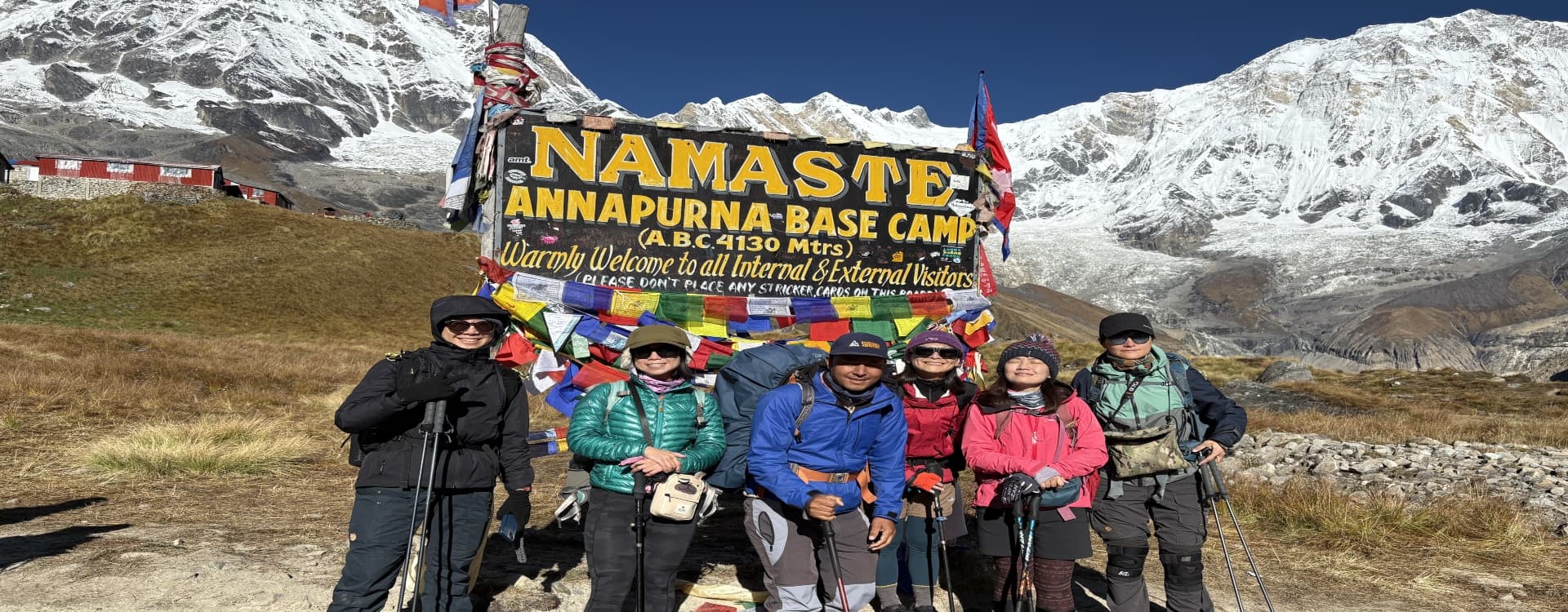
  • Annapurna Base Camp (4,130 m): A granite amphitheatre at 4,130 meters encircled by Annapurna I, Annapurna South, Hiunchuli, Tent Peak, Gangapurna, and Machapuchhare, considered one of the world's finest trekking sanctuaries.

  • Machapuchhare (6,993 m): The sacred fishtail peak whose distinctive double summit appears at almost every stage of the upper sanctuary approach and dominates the view from ABC and Machhapuchhare Base Camp.

  • Rhododendron Forests: The trail from Ulleri through Ghorepani and Tadapani passes through some of Nepal's most extensive and spectacular rhododendron forest, at its most vivid during the March to April bloom.

  • Jhinu Danda Hot Springs: Natural thermal springs beside the Modi Khola river at 1,760 meters, a celebrated final day reward after the physical demands of the upper sanctuary section.

  • Ghorepani Village (2,860 m): The classic Poon Hill gateway village with well-developed teahouse infrastructure and one of the friendliest stopping points on any Annapurna trekking route.

  • Tadapani and Chuile: The forest ridgeline traverse from Ghorepani through Tadapani connects the Poon Hill section to the Annapurna sanctuary corridor through an exceptionally scenic middle section.

  • Chomrong Area: The largest settlement on the upper ABC route, with views across the Modi Khola gorge to Annapurna South and Hiunchuli directly above.

  • No Domestic Flight Required: The entire route is accessible by road from Kathmandu to Pokhara and then to the trailhead, with the return completing the loop at Nayapul for the drive back to Pokhara.

  • Complete Annapurna Experience: Forest villages, terraced hillsides, high alpine meadows, glacial moraines, and the enclosed sanctuary combine in a single 12-day journey that covers the full altitudinal range of the Annapurna region.


Detailed Journey Breakdown

Kathmandu and the Drive to Pokhara

Day 1 covers arrival in Kathmandu with the standard transfer and briefing. Day 2 is the scenic drive from Kathmandu to Pokhara, covering approximately 200 kilometers along the Prithvi Highway through the Trishuli River valley. Day 3 drives from Pokhara to the Ulleri area and begins the trek immediately with the first walk up through Nangethanti to Ghorepani.

The Poon Hill Section

Day 4 begins with the pre-dawn walk to Poon Hill for sunrise, then descends and traverses the forest ridge to Tadapani and Chuile. This is the most visually spectacular single day of the trek for many trekkers, combining the famous Poon Hill panorama with a full forest traverse through the upper rhododendron zone.

The Sanctuary Approach

Days 5 and 6 descend from Chuile through Lower Sinuwa and climb through the Modi Khola gorge to Deurali. The trail passes through Bamboo, Dovan, and Himalayan Hotel, climbing progressively through the narrowing gorge where the walls rise to several hundred meters above the path. Day 7 is the culminating day: the push from Deurali to Machhapuchhare Base Camp and then to Annapurna Base Camp at 4,130 meters.

Return Through the Forest and Hot Springs

Days 8 and 9 descend from the sanctuary through Bamboo to Jhinu Danda, with the hot springs at Jhinu providing a natural conclusion to the high-altitude section. Day 10 covers the final trail walk to Nayapul and the drive back to Pokhara. Day 11 is the drive from Pokhara to Kathmandu and Day 12 is the international departure.

Trip Summary

DayDestination & ActivitiesDistanceTimeMountain Seen
1

Arrival in Kathmandu (1,350 m), hotel transfer, briefing

---
2

Drive Kathmandu to Pokhara (827 m)

---
3

Drive Pokhara to Ulleri, Trek to Ghorepani (2,860 m) via Nangethanti

---
4

Sunrise Hike Poon Hill (3,210 m), Trek to Tadapani / Chuile (2,610 m)

---
5

Trek Chuile to Lower Sinuwa (~2,340 m)

---
6

Trek Lower Sinuwa to Deurali (3,230 m)

---
7

Trek Deurali to Machhapuchhare Base Camp (3,700 m) to Annapurna Base Camp (4,130 m)

---
8

Trek Annapurna Base Camp to Bamboo (2,310 m)

---
9

Trek Bamboo to Jhinu Danda (1,760 m) and Hot Springs

---
10

Trek Jhinu to Nayapul (1,070 m), Drive to Pokhara (827 m)

---
11

Drive Pokhara to Kathmandu (1,350 m)

---
12

International Departure

---

Detailed Annapurna Base Camp Trek via Poon Hill Itinerary

Cost Details

Price Includes

1. Kathmandu and Pokhara Accommodation

  • 1 night hotel in Kathmandu on arrival (Day 1), twin-sharing with breakfast

  • 1 night hotel in Pokhara on arrival (Day 2), twin-sharing with breakfast

  • Private airport pickup on arrival and airport drop-off on departure day

  • All private vehicle transfers within Kathmandu and between Pokhara and the trekking trailheads


2. All Required Permits

  • Annapurna Conservation Area Project (ACAP) permit

  • TIMS card (Trekkers Information Management System)

  • All government documentation and checkpoint registration fees


3. Trek Accommodation (Full Route)

  • Best available teahouse accommodation at all overnight stops from Ghorepani through Jhinu Danda

  • Twin-sharing rooms throughout the trekking days

  • Single supplement available on request at most stops


4. Meals (Full Board on Trek)

  • Three meals per day (breakfast, lunch, dinner) from Day 3 through Day 10

  • Freshly prepared teahouse meals at all stops

  • Safe drinking water provided at all teahouse stops


5. Professional Trekking Team

  • Government-licensed English-speaking guide throughout the trek

  • Porter service (one porter per two trekkers, max 25 kg per load)

  • All staff wages, meals, accommodation, and insurance

  • Ethical employment and fair wage compliance for all team members


6. Safety Equipment

  • Comprehensive first aid kit carried by the guide at all times

  • Pulse oximeter for SpO2 monitoring from Sinuwa onward

  • Emergency coordination support for evacuation if required (covered by traveler's insurance)


7. Taxes and Service Charges

  • All applicable government taxes and VAT

  • Agency service charges with no hidden fees post-booking

Price Excludes

1. International Flights and Visa

  • International airfare to and from Nepal

  • Nepal entry visa fee (obtainable on arrival at Tribhuvan International Airport)


2. Personal Spending

  • Tea, coffee, soft drinks, alcohol, and snacks beyond included meals

  • Hot shower fees at teahouses (NPR 200 to 400)

  • Device charging fees (NPR 100 to 300 per session)

  • Wi-Fi access fees and personal laundry costs

  • Jhinu hot spring entry fee (nominal charge)


3. Personal Equipment

  • Personal hiking boots, trekking poles, and rain gear

  • Personal sleeping bag for the upper sanctuary (recommended from Sinuwa upward)

  • Personal clothing and cold-weather accessories


4. Travel Insurance (Mandatory)

  • Comprehensive travel insurance covering helicopter evacuation from trekking areas is mandatory

  • Coverage must include trekking to at least 4,200 meters altitude

  • Medical treatment and trip interruption coverage


5. Tips and Gratuity

  • Tips for guides and porters are customary and appreciated

  • Standard: USD 5 to 8 per day for the guide, USD 3 to 5 per day for porters


6. Optional and Unforeseen Costs

  • Extra hotel nights due to weather delays or personal preference

  • Any personal medical treatment during or after the trek

  • Poon Hill viewpoint entry fee (nominal, collected at the hilltop)

Additional Information

Oxygen Saturation (SpO2) Reference Chart

Day

Location

Altitude (m)

Estimated SpO2 (%)

Notes

1-2

Kathmandu / Pokhara

1,350 / 827

96-99%

Baseline; no altitude effect

3

Ghorepani

2,860

91-94%

Mild altitude; body beginning to adjust

4

Poon Hill / Chuile

3,210 / 2,610

89-93% / 91-95%

Poon Hill above normal range; Chuile partial recovery

5

Lower Sinuwa

~2,340

92-96%

Lower altitude, comfortable breathing

6

Deurali

3,230

89-93%

Significant altitude; SpO2 monitoring begins

7

ABC

4,130

82-88%

High altitude; guide monitors closely

8

Bamboo

2,310

92-96%

Strong recovery on major descent

9

Jhinu Danda

1,760

94-97%

Near full recovery at low altitude

10-12

Pokhara / Kathmandu

827 / 1,350

96-99%

Complete normalization


A Typical Day on the Annapurna Base Camp Trek via Poon Hill

The daily rhythm of this trek follows the standard teahouse trekking pattern with two specific exceptions: the Poon Hill pre-dawn departure on Day 4 and the longer sanctuary days from Sinuwa to ABC and back.

On a standard trekking day, the teahouse kitchen begins serving breakfast at 6:30 to 7:30 AM. Porridge, eggs, toast, pancakes, and tea or coffee are the standard options, and most teahouses on the main Annapurna routes have kitchens practiced at producing consistent results from these menus. The guide reviews the day's route at breakfast, including altitude gain, approximate walking hours, and any weather considerations. Walking begins at 7:30 to 8:30 AM. The guide sets a pace calibrated to the altitude, the team's condition, and the day's demands.

Lunch is taken at a mid-trail teahouse after two to three hours of walking. Dal bhat, the Nepali staple of rice with lentil soup and vegetable curry, provides the best combination of carbohydrates and protein for a sustained afternoon walk. The guide typically knows the best kitchen stops on each section of the route. Afternoon walking runs for another two to three hours before arrival at the overnight teahouse, typically between 2:30 and 4:30 PM.

From Sinuwa onward, the SpO2 monitoring routine begins each evening. The guide takes pulse oximeter readings from every team member after dinner and notes any individual showing values below the expected range for each altitude. Bedtime at 8:30 to 9:00 PM is the consistent recommendation from the guide on all days above 3,000 meters.

The Poon Hill morning on Day 4 is the one departure from this pattern. Wake time is 4:00 to 5:00 AM depending on season and sunrise time. The headlamp walk to the viewpoint takes 45 minutes to an hour. Breakfast waits until the team returns to Ghorepani after the sunrise.

Accommodation on the Annapurna Base Camp Trek via Poon Hill

Accommodation across the 12 days spans Kathmandu and Pokhara city hotels and the well-developed teahouse network of the Annapurna Conservation Area.

Kathmandu (Day 1) and Pokhara (Day 2 and Day 10) provide comfortable city hotels with private bathrooms, hot water, Wi-Fi, and breakfast. Pokhara's Lakeside district has one of the most pleasant hotel environments of any Himalayan gateway city, with the Annapurna range visible across Phewa Lake on clear mornings.

Ghorepani (Day 3 overnight) is among the most developed teahouse villages in the Annapurna region, with dozens of lodges competing vigorously for trekker business. Private rooms with comfortable beds are generally available. Hot showers with solar or gas heating are standard at an additional fee. Some lodges have attached bathrooms at the better rooms. Wi-Fi is available at most Ghorepani teahouses.

Chuile or Tadapani (Day 4) is quieter than Ghorepani but has adequate teahouse infrastructure. The lodges here are smaller and the setting more forest-enclosed. Lower Sinuwa (Day 5) is basic by comparison with the main Ghorepani circuit stops, with simpler rooms and cold water. Deurali (Day 6) is the most basic teahouse stop on the route, with limited hot water and cold rooms, but it is functional and the guide selects the best available option.

Annapurna Base Camp (Day 7) has a small cluster of teahouses operated seasonally. The facilities are basic given the altitude and remote location, but three-course meals, hot drinks, and adequate sleeping facilities are available. A personal sleeping bag rated to at least -10 degrees Celsius is required from Sinuwa onward, and essential from Deurali and ABC.

Bamboo (Day 8) and Jhinu Danda (Day 9) have more comfortable facilities than the high-altitude stops, with the lower elevation allowing better kitchen variety and warmer overnight temperatures.

Best Time to Visit for the Annapurna Base Camp Trek via Poon Hill

Two seasons dominate the trekking calendar for the Annapurna region: spring from March through May and autumn from October through November. Both deliver excellent conditions on this route, with different aesthetic qualities.

Spring is the most visually spectacular season for the lower approach section. The rhododendron bloom peaks from late March through mid-April, covering the forest corridor between Ulleri, Ghorepani, and Tadapani in vivid red, pink, and white. The lower valley sections are warmer and the days are long. Higher up, the Modi Khola gorge carries more moisture and cloud is more likely in the afternoons as spring progresses. The ABC section in April can have fresh snowfall, which makes the sanctuary scenery even more dramatic but also requires attention to trail conditions above Deurali.

October is consistently the most popular month for the Annapurna region. Post-monsoon air clarity is at its annual best, the rhododendron forest is a deep green backdrop rather than a bloom, and the mountain views from both Poon Hill and ABC are typically sharper and more defined than in spring. Temperatures at the upper sanctuary are colder in October than in April, and the nights at Deurali and ABC in late October can be genuinely frigid. By mid-November the days are getting short and snow on the upper approach is more common.

November is viable through the first half of the month for well-equipped teams. From mid-November the upper sanctuary section carries increasing snow risk and the teahouse services at ABC and Deurali begin to reduce as the season closes.

Winter from December through February is cold with snow on the upper sections, shorter days, and limited teahouse services in the high sanctuary zone. The lower approach to Ghorepani and Poon Hill remains trekable and is beautiful in winter, but the route above Sinuwa requires full winter gear and careful timing.

The monsoon from June through September brings heavy rain to the Annapurna region. The lower forest sections are wet, slippery, and affected by leeches. Cloud regularly obscures the mountain views that are the primary reason for this route. July and August are generally not suitable for this trek in its full 12-day form.

Meals on the Annapurna Base Camp Trek

The Annapurna Conservation Area teahouse network is the most developed and best-provisioned in Nepal, and the food reflects decades of experience catering to international trekkers. The menus at Ghorepani and the more established stops offer a range that surprises most first-time visitors: dal bhat, pasta, pizza (yes, pizza), noodle soups, pancakes, muesli, fresh bread, momos (Tibetan dumplings), and a variety of breakfast options.

Dal bhat is worth choosing repeatedly on this trek. The unlimited refill policy at most teahouses makes it the most calorie-accessible meal available, and the complex carbohydrates support sustained energy across the longer walking days better than most alternatives on the menu. The guide consistently recommends dal bhat on the ABC approach days, particularly from Sinuwa upward where appetite begins to decrease with altitude.

Above Deurali and at ABC, the menu narrows to the most reliable and easily prepared items: soup, rice, noodles, and porridge. At 4,130 meters the kitchen operates with limited supplies carried up from the valley on porter loads, and the range reflects that reality. Hot drinks are the most important item at ABC: the combination of cold, altitude, and physical effort means consistent warm fluid intake directly affects how well the body performs on the descent the next day.

Water management is important from Sinuwa upward. Safe drinking water from boiled teahouse supplies is provided throughout. A reusable bottle and purification tablets as backup are recommended for trail sections between teahouses. Plastic bottle waste is a significant environmental problem in the Annapurna Conservation Area and should be avoided.

Annapurna Base Camp Trek Difficulty: Moderate (What That Means on the Trail)

The Annapurna Base Camp Trek via Poon Hill is classified as moderate. This is a meaningful but not extreme classification. The route is well within the range of any trekker with reasonable fitness and a willingness to walk six to seven hours daily for several consecutive days.

What Moderate Means in Practice

The trail is well-defined, maintained, and clearly marked throughout. There is no technical terrain, no glacier crossing, no rope work, and no equipment beyond standard trekking gear. The altitude maximum at 4,130 meters is high enough to produce mild altitude effects in some trekkers but is significantly lower than the 5,000-plus-meter thresholds where acute mountain sickness becomes a serious concern for most people.

The most physically demanding single day is Day 7, the climb from Deurali to ABC. This day gains 900 meters at altitudes between 3,230 and 4,130 meters and takes four to five hours at a steady pace. The altitude at this stage means the body is working harder than the gradient alone would suggest at sea level, and the guide sets a deliberate pace accordingly.

Day 3, the approach from the Ulleri trailhead to Ghorepani, is the second most physically demanding day, with approximately 800 meters of ascent over five to six hours. This is the day that catches out trekkers who are less fit than they anticipated, arriving at Ghorepani with heavy legs on the first serious walking day.

The Poon Hill Factor

The pre-dawn Poon Hill walk on Day 4 adds a psychological challenge to what is otherwise a straightforward trail day. The 4 AM departure in cold and darkness requires a specific kind of motivation that altitude, fatigue, and early morning cold can undermine. Most trekkers who have done Poon Hill describe the effort as thoroughly worth it. Coming prepared for the pre-dawn start, with headlamp accessible, warm jacket ready, and water bottle packed the night before, eliminates most of the difficulty.

Prior Experience Recommendations

Prior multi-day trekking experience is helpful rather than mandatory. Trekkers who have walked for four or more hours on hilly terrain on consecutive days will find the transition to this route much smoother than those arriving from a purely urban fitness background. The guide adjusts pace to the team's condition throughout, so a less experienced trekker in good general fitness will be supported through the route.

Annapurna Base Camp Altitude: 4,130 m and How Acclimatization Works on This Route

The maximum altitude of 4,130 meters at ABC places this trek in the moderate-altitude category by Himalayan trekking standards. The acclimatization is generally adequate within the itinerary's structure for most healthy trekkers, though individual responses vary and the guide monitors symptoms carefully from Sinuwa upward.

The altitude profile of this route is notably favorable for acclimatization. The approach from Ulleri through Ghorepani at 2,860 meters and the Poon Hill day at 3,210 meters give the body meaningful altitude exposure before the descent to Chuile and the subsequent climb into the sanctuary. The nights at Ghorepani and Chuile, both below 3,000 meters, allow recovery before the more sustained high-altitude section begins at Sinuwa and Deurali.

The most significant acclimatization event on this route is the overnight at Deurali at 3,230 meters on Day 6. This night prepares the body for the 900-meter climb to ABC the following day. The guide takes SpO2 readings at Deurali and uses the readings to assess readiness for the Day 7 push. Any trekker with values significantly below the expected range for 3,230 meters, or any worsening AMS symptoms, will rest at Deurali rather than pushing to ABC until symptoms resolve.

The descent from ABC back to Bamboo on Day 8 provides one of the fastest altitude recoveries of any trekking route, dropping 1,820 meters in a single day. Most trekkers feel dramatically better at Bamboo that evening than they did at ABC the night before, and the energy rebound from dropping altitude is immediate and genuine.

AMS symptoms including headache, nausea, reduced appetite, and disturbed sleep are common above 3,500 meters and should be reported to the guide immediately rather than managed alone. The guide's protocol is conservative: no ascent with worsening symptoms, immediate descent if symptoms do not improve with rest and hydration at the current altitude.

Annapurna Base Camp Trek Permits: ACAP + TIMS (What They Cost and What's Required)

  1. Annapurna Conservation Area Project (ACAP) Permit: Required for all foreign nationals entering the conservation area, which covers the entire trekking route from the lower valleys through the sanctuary. Current cost is NPR 3,000 per person (approximately USD 22 to 25) plus applicable taxes. Checked at the entry checkpoint at Birethanti near Nayapul.

  2. TIMS Card (Trekkers Information Management System): National trekking registration required for the Annapurna region. Current cost is NPR 2,000 for organized group trekkers. Obtained in Kathmandu before the trek begins.


Additional regulations within the Annapurna Conservation Area include: remaining on designated trails, no campfire in the sanctuary above 2,000 meters, no plastic bottles in the upper sanctuary (reusable bottles with purification are required), no removal of natural or cultural objects, and respecting local religious practices at temples, stupas, and mani walls along the trail. The Poon Hill viewpoint has a small entry fee collected at the hilltop itself.


Getting to Annapurna Base Camp: No Domestic Flight Required

The Kathmandu to Pokhara Drive

Private vehicle covers the 200-kilometer journey on the Prithvi Highway in six to seven hours. The drive passes through some of the most scenic river valley terrain in the Nepal midhill zone. Stops at Mugling and other roadside tea stops break the journey. A tourist bus alternative exists for budget travelers but the private vehicle option is included in the package for comfort and schedule control.

Pokhara to Ulleri and Nayapul to Pokhara

A private vehicle from Pokhara reaches the Ulleri trailhead area in 30 to 45 minutes. The return from Nayapul to Pokhara on Day 10 takes one to two hours by private jeep. Both transfers are included in the package.

Trekking as Primary Transport

All movement from the Ulleri trailhead through to Nayapul is on foot, with porters carrying main luggage. Trekkers walk with a 20 to 25-liter daypack. The route is entirely on foot-trail with no vehicle sections between the trailheads.

Emergency Transport

Helicopter evacuation is available from the Annapurna sanctuary and the approach valleys. Landing zones exist at Chhomrong, the sanctuary area near MBC, and at various points along the approach route. Response times from Pokhara are typically 30 to 60 minutes in good weather. All evacuation costs must be covered by mandatory travel insurance.

Annapurna Base Camp Trek Extra Costs: Budget USD 150–250

A realistic personal spending estimate for the full 12 days, covering teahouse extras, city meals in Kathmandu and Pokhara, tips, and the Jhinu hot spring entry fee, is USD 150 to 250. Tips are the largest component: USD 5 to 8 per day for the guide and USD 3 to 5 per day for porters across the seven trekking field days typically totals USD 60 to 100 per person.

Hot shower fees at teahouses from Ghorepani through Sinuwa add NPR 200 to 400 per use. Device charging runs NPR 100 to 300 per session. Wi-Fi fees are generally NPR 200 to 400 per day at the better-equipped stops. Personal snacks from Pokhara markets before the trek begin add NPR 2,000 to 4,000 depending on personal appetite and preference.

Annapurna Base Camp Trek Packing List: What to Bring (Sleeping Bag Rated to -10°C)

Clothing System

  • Base layer: Two to three sets of moisture-wicking thermal tops and bottoms.

  • Mid layer: Fleece or insulated jacket for evening stops and the Poon Hill pre-dawn start.

  • Outer shell: Waterproof, windproof jacket with hood. Essential for the Modi Khola gorge and the upper sanctuary.

  • Trekking trousers: Two pairs, lightweight and quick-drying.

  • Down jacket: Strongly recommended from Deurali upward and for the Poon Hill pre-dawn start.

  • Warm hat and gloves: Required for Poon Hill morning and all nights above 3,000 meters.

  • Gaiters: Useful for the upper sanctuary sections in spring or late autumn when snow is present.

Footwear

  • Waterproof hiking boots with ankle support, broken in before departure.

  • Camp sandals for teahouse evenings.

  • Trekking socks, four to five pairs minimum.

Packs and Sleeping

  • Daypack of 20 to 30 liters with rain cover for daily walking.

  • Main duffel of 60 to 80 liters for the porter load.

  • Personal sleeping bag rated to -10 degrees Celsius: required from Sinuwa upward, strongly recommended from Ghorepani onward.

Safety and Practical Items

  • Headlamp with spare batteries: mandatory for the Poon Hill pre-dawn start.

  • Trekking poles: valuable for the stone staircase sections and the ABC descent.

  • Sunscreen SPF 50 and sunglasses: UV intensity is high in the open sanctuary sections.

  • Water purification tablets as backup to boiled teahouse water.

  • Personal first aid kit: ibuprofen, blister supplies, anti-diarrhea medication.

  • Power bank (10,000 to 20,000 mAh): charging is unreliable above Sinuwa.

Annapurna Base Camp Trek Training: 4-6 Weeks of Preparation

Four to six weeks of consistent training is the appropriate preparation window for a trekker in average fitness aiming to comfortably complete this route. The target is the ability to walk four to five hours on consecutive days with a 10-kilogram daypack without significant muscle soreness or energy depletion the following morning.

Cardiovascular training covering running, cycling, or stair climbing three to four days per week builds the aerobic base for the sustained daily effort of the approach days. Weekend loaded hiking sessions of three to four hours duration, building toward five to six hours in the final preparation weeks, directly simulate the physical demands of the longer trail days. Leg strength work targeting the quadriceps and calves specifically helps with the stone staircase sections on the Day 3 climb and the long descents from ABC.

The Poon Hill pre-dawn start requires a specific kind of motivation that physical training cannot fully prepare. Mental readiness for the 4 AM alarm in a cold teahouse, moving efficiently in the dark and the cold, is largely a matter of preparation and expectation. Packing the headlamp, jacket, and water bottle the night before removes morning decision-making. Going to sleep early enough on Day 3 (by 9 PM) gives the body the maximum possible rest before the early start.

Is the Annapurna Base Camp Trek Safe? Altitude Monitoring and Evacuation Explained

The Annapurna Conservation Area has a well-established emergency response infrastructure relative to more remote Nepal trekking regions. The ACAP management office, the Annapurna Base Camp control room, and the Pokhara-based helicopter operators together provide a response system that covers the main route sections effectively.

The guide monitors SpO2 readings from Sinuwa onward and assesses altitude illness symptoms daily from the upper sanctuary approach. AMS in its mild form is common at Deurali and ABC and is managed with rest, hydration, and conservative decision-making. The guide's authority to prevent ascent or initiate descent for any team member showing worsening symptoms is absolute. The Modi Khola gorge between Sinuwa and Deurali is the section with the most constrained emergency exit options. During heavy snowfall or ice conditions on this section, the guide assesses avalanche risk before proceeding.

Travel insurance covering helicopter evacuation from the Annapurna region is mandatory. A standard helicopter evacuation from the sanctuary area to Pokhara costs USD 1,500 to 3,000 and is covered by most comprehensive adventure travel policies. The guide carries the emergency insurance contact number for every team member from Day 3 onward.

Travel Insurance for the Annapurna Base Camp Trek

Comprehensive travel insurance is required before the team departs Kathmandu on Day 3. The policy must cover trekking to at least 4,200 meters altitude, helicopter evacuation from the trekking area, medical treatment, and trip cancellation. Many standard travel policies exclude trekking above 4,000 meters; read the altitude exclusions carefully before purchasing.

The guide collects the emergency assistance phone number and policy number from every team member at the Day 1 briefing. In any evacuation situation, the guide contacts the insurance company's emergency line directly to initiate the helicopter authorization process, which is required by most insurers before a rescue helicopter can be dispatched.

Recommended providers with established Annapurna region coverage include World Nomads, Global Rescue, IMG Global, and Battleface. Premium costs for 12 days of coverage at the required altitude with evacuation benefits typically run USD 60 to 120 depending on nationality, age, and the specific coverage levels selected.

Best Time for the Annapurna Base Camp Trek: October and April

January and February

Cold winter with snow on the upper sanctuary above Deurali. The Poon Hill and Ghorepani sections are trekable but cold with shorter days. Upper ABC may be closed by deep snow. Not the recommended window for this full itinerary.

March and April

Spring opening. March brings warming temperatures and the beginning of the rhododendron bloom. April is the best spring month: full rhododendron bloom in the lower forest sections, manageable snow on the upper sanctuary, and improving morning weather. Pre-monsoon cloud occasionally builds in afternoon. Recommended.

May

Late spring. Warmer at lower elevations, still good at the sanctuary. Pre-monsoon cloud builds more frequently and afternoon visibility can be reduced. Viable through mid-month.

June through August

Monsoon. Heavy rain, cloud, leeches on forest sections, and limited mountain views. Not suitable for the full route as planned.

September

Monsoon withdrawal. Improving through the month, trekable from mid-September with increasing reliability. Fresh green vegetation and recovering visibility.

October

The premier trekking month in Nepal. Post-monsoon clarity, stable weather, full teahouse operations, and the finest mountain views of the year. The most popular month for both Poon Hill and ABC. Recommended.

November

Good through mid-month. Temperatures drop noticeably after the first week and some upper sanctuary teahouses begin closing from late November. Still viable for a well-equipped team through approximately the 15th.

December

Cold, with early winter snow on the upper sections. The Poon Hill circuit is manageable but full ABC is increasingly difficult. Not the recommended window.


Annapurna Base Camp Trek via Poon Hill vs. the Standard ABC Route

The standard Annapurna Base Camp trek goes directly from Nayapul or Chhomrong without the Poon Hill detour. Many trekkers complete this standard route and then return to Nepal for a separate Poon Hill and Ghorepani trip. This itinerary eliminates the need for a separate Poon Hill trek by incorporating it into a single 12-day circuit that visits both destinations efficiently.

The Ghorepani approach to ABC via Tadapani and Chuile also provides a different cultural and landscape experience from the direct Modi Khola approach. The ridge traverse from Ghorepani through Tadapani moves through villages and forest that the direct ABC corridor bypasses entirely. The stone staircase villages of the lower Ghorepani approach, with their slate-roofed houses and terraced potato and barley fields, are a distinct cultural environment from the larger Chomrong settlement further north.

The Jhinu Danda hot springs conclusion is another element that the standard ABC out-and-back often misses. Routing the return through Jhinu rather than directly back to Nayapul adds a single afternoon's walk and delivers one of the most satisfying physical rewards available on any Nepal trekking route.

How to Book the Annapurna Base Camp Trek

Best Time to Book: Spring (March to May) and autumn (September to November). October departures are the most popular and benefit from booking 45 to 60 days in advance. Private departures are available throughout both prime seasons on request.

Cancellation Policy: Full refund for cancellations more than 30 days before departure. 50 percent refund for cancellations within 30 days. No refund within 7 days or for no-show. Weather-related route modifications are managed within the itinerary structure. Travel insurance covering trip cancellation is strongly recommended for all bookings.


Annapurna Base Camp Trek via Poon Hill Departures

Select Departure Date

Trip duration: 12 Days

Aug - Sep 2026

August 2026

Su
Mo
Tu
We
Th
Fr
Sa
1
2
3
4
5
6
7
8
9
10
11
12
13
14
15
16
17
18
19
20
21
22
23
24
25
26
27
28
29
30
31

September 2026

Su
Mo
Tu
We
Th
Fr
Sa
1
2
3
4
5
6
7
8
9
10
11
12
13
14
15
16
17
18
19
20
21
22
23
24
25
26
27
28
29
30
Your Trip
USD 750SAVE $155
USD 595/ person

Best Price Guaranteed

2-3 People
USD 0/ Person
4-5 People
USD 0/ Person
6-11 People
USD 0/ Person
12-15 People
USD 0/ Person
16+ People
USD 0/ Person
CUSTOMIZE TRIP

Speak to an Expert

Laxmi Malla
Hari Kumar Shrestha
Himal Shrestha
Shiva Kumar Shrestha
UR Ghale

Himal Shrestha

Director 🇳🇵

Chat on WhatsApp

Meet Our Expert Guides

Shiva Kumar Shrestha

Shiva Kumar Shrestha

Managing Director & Senior Guide

20 years of experience

I am an experienced and knowledgeable Senior Guide who has accompanied countless travelers throughout their time spent hiking in Nepal. Beginning my working life in 2004 as a porter, I am now a government-licensed trekking guide in Nepal with many years of experience. I was born and raised in the mountainous region of Dhading, and as a result, I have an in-depth understanding of the region's history, traditions, culture, and festivals. I have extensive experience trekking in the Everest, Annapurna, Langtang, Manaslu, and Dolpo regions.
Deepak Gurung

Deepak Gurung

Trekking Guide

12 years of experience

I have more than ten years of experience directing hikers across the high terrain of the Nepal Himalaya. I was born and grew up in the Gorkha highlands, which has given me profound awareness of the mountains and the way of life of the people who live in them. I have led numerous expeditions to Everest Base Camp and other locations in the Everest and Annapurna ranges. I received training from the Nepal Academy of Tourism and Hotel Management (NATHM) as a Trekking Guide. I am especially skilled at directing groups of senior citizens and families with children.
Ramsaran Shrestha

Ramsaran Shrestha

Senior Trekking Guide

19 years of experience

Anyone who spends some time with me will eventually recognize me for the respectful and knowledgeable gentleman that I am. I started working as a hiking guide at the end of the nineties. Since 2004, I have been one of Accessible Adventure's employees, and I currently have a position as one of the company's senior trekking guides. I am one of the most experienced, competent, and professional trekking guides, and I speak English fluently. I have traveled with trekking groups on an uncountable number of Nepal's trails.
Meena Karki

Meena Karki

Trekking Guide

13 years of experience

I am from the Kaski district in the Annapurna region of Nepal. Trekking has been my passion since childhood as I grew up seeing trekkers and hikers stepping up the trails for trekking adventures. Following my dreams, I took female trekking guide as my profession and now I have more than a decade of experience in this field. I have been to Everest, Annapurna, Langtang, Mustang and most of the trekking regions numerous times. With in-depth knowledge of routes, culture, and history, I ensure your trekking adventure is extra special.
Prakash Gurung

Prakash Gurung

Trekking Guide

8 years of experience

I am a young and enthusiastic guide with enough knowledge in guiding the Himalayas. Having sound experience in the trekking sector, I bring rich experience and readiness to assist trekkers with professionalism and dedication. I respect not only my own culture but also those of other communities. My unwavering commitment has been an enormous boon to the organization's ability to function smoothly. I recently received my license from the Ministry of Tourism Hotel Management tourist training center and have a certificate for providing first aid at high altitudes.
Ram Hari Dhamala

Ram Hari Dhamala

Trekking Guide

11 years of experience

I am a field member of Accessible Adventure with more than a decade of experience working in the field of travel and tourism. I am certified as a trekking guide and was brought up among the wondrous sights and sounds of Mother Nature in the picturesque town of Dhading. The rolling landscape complete with mountains, valleys, and rivers has always piqued my interest. Because of my deep love for the outdoors, I decided to pursue a career in tourism. My disposition is cordial and upbeat, and I am responsible and experienced.

Now Offering 100% Private Treks

Explore Nepal's breathtaking trails at your own pace with our exclusive private treks. No strangers, no rushed schedules—just you, your adventure, and complete flexibility. Enjoy personalized itineraries, expert guides, and a safety-first approach designed for unforgettable experiences.

Tailor-Made Itineraries

Plan your trek exactly how you want it. Choose destinations, duration, and activities that suit you.

Dedicated Guide & Porter

Enjoy expert guidance and personal assistance every step of the way.

Safety & Health Focus

We ensure proper acclimatization, medical support, and emergency readiness.

Flexible Scheduling

Pick your own travel dates and move at a pace that suits your adventure style.

Privacy & Comfort

Ideal for couples, families, and friends who want a fully private experience.

Discover Your Private Trek