No cancellation fees. No hassle. Book Now, stay relaxed.Cancellation Terms
Mera Peak Climbing

Starting from

$2,400$2,295/ person
Book Now ↓
Featured

Mera Peak Climbing

Country

Nepal

Duration

16 Days

Difficulty

Strenuous to Challenging

Max Altitude

6476m

Style

Peak Climbing | High-Altitude Trekking | Himalayan Expedition

Status

March-June & Sept-November

Why Choose the Mera Peak Climbing

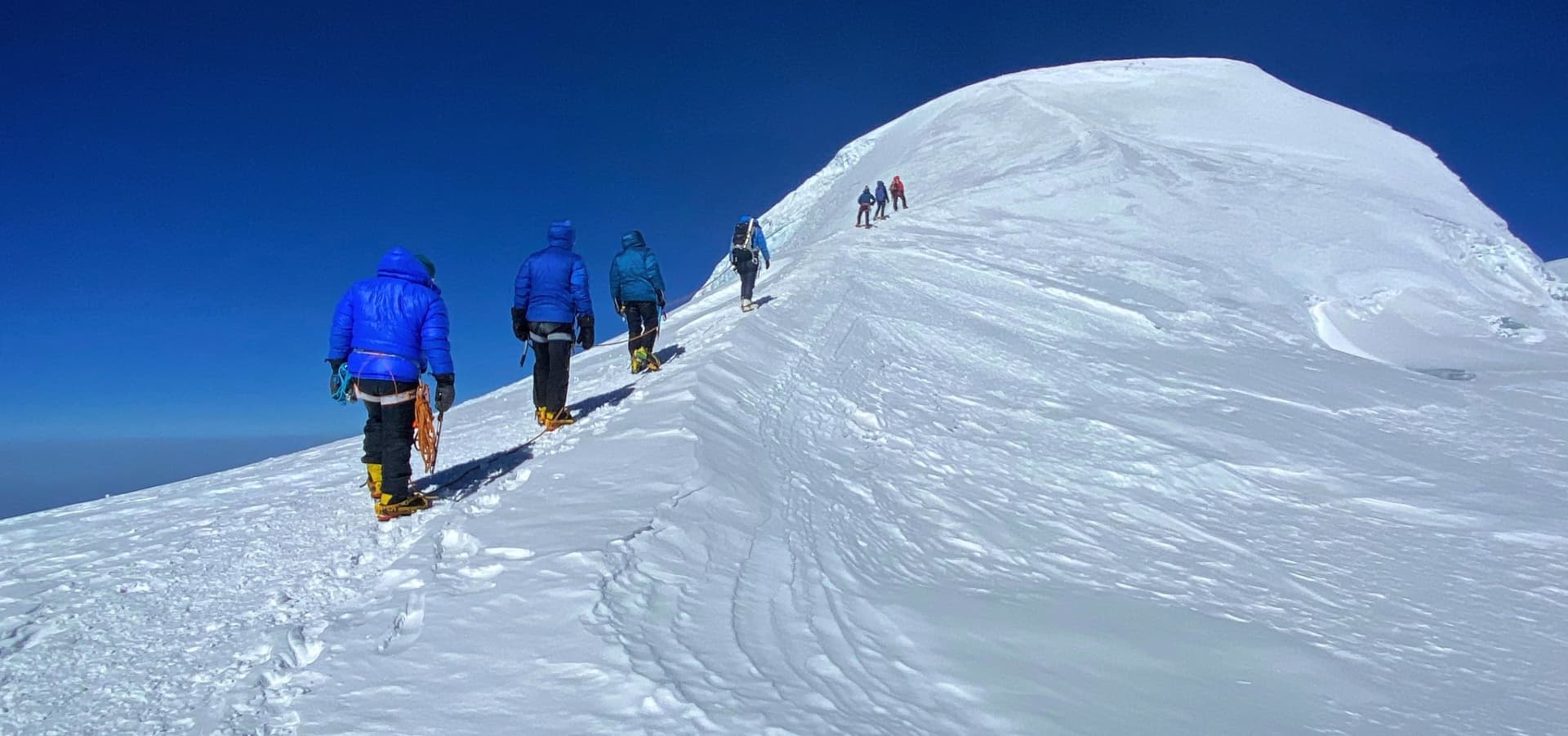
Mera Peak Climbing is one of the best first high-altitude mountaineering experiences in Nepal. Marketed at 6,476 meters and commonly associated with the Mera North summit, the climb offers a non-technical glacier ascent but a serious altitude challenge. The reward is one of the finest summit panoramas in the Himalaya, with views of Everest, Lhotse, Makalu, Cho Oyu, and Kanchenjunga on a clear day.

Our 16-day Mera Peak climbing itinerary is designed for fit trekkers who want a guided climb with proper acclimatization, pre-climb training at Khare, and a realistic summit plan. The route follows the Hinku Valley through forests, alpine ridges, and glacier terrain before reaching High Camp and the summit push.

Mera Peak is often described as a strong beginner-friendly 6,000-meter objective because it is less technical than Island Peak, but that does not mean it is easy. The main difficulties are long trekking days, freezing temperatures, glacier travel, and the thin air above 6,000 meters. If you want a serious Himalayan objective without stepping into a highly technical expedition, Mera Peak is one of the strongest choices in Nepal.

Trip Summary

DayDestination & ActivitiesDistanceTimeMountain Seen
1

Arrival in Kathmandu (1,350m)

10 km 30 minsGanesh Himal, Langtang range (on clear day)
2

Fly to Lukla (2,800m) → Trek to Chutanga (3,475m)

6 km3-4 hrsKusum Kanguru
3

Chutanga → Zatrwa La Pass (4,600m) → Thuli Kharka (4,300m)

7 km6-7 hrsMera Peak, Cho Oyu, Kongde Ri
4

Thuli Kharka → Kothe (4,182m)

9 km6-7 hrsMera Peak, Kusum Kanguru
5

Kothe → Thangnag (4,356m)

6 km5-6 hrsMera Peak, Kusum Kanguru
6

Thangnag → Khare (5,000m)

6 km5-6 hrsMera Peak, Chamlang
7

Acclimatization at Khare (Ice climbing practice)

3 km3 hrsMera Peak, Baruntse
8

Khare → Mera High Camp (5,800m)

5 km6-7 hrsEverest, Lhotse, Makalu, Cho Oyu
9

High Camp → Mera Summit (6,476m) → Khare

10 km8-9 hrsEverest, Lhotse, Makalu, Kangchenjunga, Cho Oyu
10

Spare Day for Climbing / Weather Contingency

N/AN/AHimalayan Panoroma
11

Khare → Kothe

12 km6-7 hrsMera Peak, Kusum Kanguru
12

Kothe → Thuli Kharka

9 km6-7 hrsMera Peak, Kongde Ri
13

Thuli Kharka → Zatrwa La Pass → Lukla

10 km6-7 hrsCho Oyu, Kongde Ri
14

Fly Lukla → Kathmandu / Manthali

N/A35 minsHimalayan aerial panorama
15

Leisure Day in Kathmandu

--Sorrounding kathmandu Hills
16

Final Departure

10 km30 mins-

Detailed Mera Peak Climbing Itinerary

Cost Details

Price Includes

Airport & Transportation

  • Airport pick-up and drop-off service in Kathmandu by private tourist vehicle.
  • Domestic Kathmandu / Manthali – Lukla – Kathmandu / Manthali round-trip flight tickets.
  • All necessary ground transportation during the trip as per itinerary.

Accommodation

  • 3 nights hotel accommodation in Kathmandu at a tourist standard hotel with breakfast.
  • Teahouse/lodge accommodation during the trekking days in the Everest region.
  • Tent accommodation at Mera High Camp during the climbing period.

Meals

  • Three meals a day (Breakfast, Lunch, Dinner) during trekking and climbing days.
  • Tea or coffee with meals during the climb.
  • Freshly prepared meals by climbing staff at high camp.

Permits & Government Fees

  • Nepal Mountaineering Association climbing permit for Mera Peak.
  • Sagarmatha National Park entry permit.
  • Khumbu Pasang Lhamu Rural Municipality entry permit.
  • TIMS card (Trekkers’ Information Management System), if required.
  • All government taxes and official paperwork.

Guide & Staff

  • Experienced, government-licensed trekking guide.
  • Professional climbing guide for Mera Peak summit attempt.
  • Necessary number of porters (1 porter for 2 trekkers).
  • Wages, meals, accommodation, insurance, and equipment for guides and porters.

Climbing Equipment

  • Group climbing equipment such as ropes, ice screws, snow bars, and safety gear.
  • High camp climbing logistics and equipment.
  • Climbing briefing and basic ice climbing training at Khare.

Trekking Equipment

  • Sleeping bag and down jacket (provided if needed, refundable after the trip).
  • First aid medical kit carried by the guide.

Other Services

  • Farewell dinner in Kathmandu with a traditional Nepali cultural show.
  • Trekking completion certificate.
  • All official service charges and government taxes.

Price Excludes

International Travel

  • International airfare to and from Kathmandu.
  • Nepal entry visa fees.

Personal Expenses

  • Personal trekking equipment (boots, crampons, harness, helmet, etc.).
  • Travel insurance (must cover high-altitude trekking and peak climbing up to 6,500 m).
  • Personal expenses such as laundry, internet, phone calls, hot showers, and battery charging during the trek.
  • Bar bills, soft drinks, mineral water, and alcoholic beverages.

Additional Costs

  • Extra hotel nights in Kathmandu due to early arrival, late departure, or flight delays.
  • Extra meals in Kathmandu (lunch and dinner).
  • Costs due to flight cancellations or delays in Lukla Airport.

Tips & Gratitude

  • Tips for trekking guide, climbing guide, porters, and support staff (customary but not mandatory).

Emergency & Rescue

  • Emergency helicopter evacuation (covered by personal travel insurance).
  • Medical treatment and personal medication costs.

Other

  • Any services not specifically mentioned in the “Cost Includes” section.
Altitude in:
Scroll to view full route

Scenic Highlights Along the Mera Peak Climbing

  • Climb Mera Peak on a 16-day guided expedition in Nepal with acclimatization, glacier training, and summit support.
  • Reach one of Nepal’s best-known trekking-peak summits, widely marketed at 6,476 meters.
  • See Everest, Lhotse, Makalu, Cho Oyu, and Kanchenjunga from the summit on a clear day.
  • Trek through the quieter Hinku Valley instead of the busier classic Everest Base Camp corridor.
  • Train at Khare before the summit push with guidance on crampon use, rope handling, and glacier movement.
  • Choose a climb that is less technical than Island Peak but still a serious altitude objective.

Additional Information

Mera Peak Climbing Cost

The cost of the Mera Peak trek can vary depending on various factors such as the season, the duration of the trek, the size of the group, the level of comfort and services desired, and the inclusions and exclusions.

It is important to note that the cost of a trek typically includes the following:

  • Permits and fees for trekking in the area
  • Accommodation during the trek (usually in basic tea houses or camping)
  • Meals during the trek
  • Local transportation (to and from the starting point of the trek)
  • Services of a guide and porters

Additional costs that may not be included in the cost of the trek are:

  • International flights to and from Nepal
  • Travel Insurance
  • Personal expenses such as souvenirs, drinks, and snacks
  • Emergency evacuation or rescue services (if required)

On average, a Mera Peak trek can cost up to USD 2,500 or more. It is advisable to get in touch with to get a more accurate estimate of the cost of the Mera Peak trek.


Best Time for Mera Peak  Climbing/ Expedition

The key to a successful climb is choosing the right time to go. Luckily, we've got you covered with all the insider tips on when to go.

For starters, the spring and autumn seasons are the prime time for climbing Mera Peak.

From March to May and from September to November, you can expect stable and clear weather with a lower chance of rain and snow, creating the perfect conditions for climbing and trekking.

During the spring season, the temperatures are mild and comfortable, making it a popular time for outdoor adventures in Nepal.

March can be somewhat cold as the winter has just ended. April can be considered the best time to climb Mera Peak. The weather is very stable and the temperature is warm. The skies are clear with the best views of the 8,000-meter peaks like Everest and Kanchenjunga. The stunning views of the mountains during this time will take your breath away.

In the autumn season, the weather conditions are equally ideal for your Mera Peak expedition. This time is also considered great for trekking and climbing in the Mera Peak region. During September the rain washes all the pollution away from the dusty trail. So, October remains the best time in the Autumn to catch a glimpse of the clear view of the mountains and trek safely in that region. Keep in mind that this is also a popular time of year for trekkers and climbers, so you can expect some company on the trails.

The summer climbing experience at Mera Peak is not popular for many reasons. As the temperature around this time is high, the snowy trails get slippery. It is very hard and dangerous to traverse at these times. A small slip can lead to fatal consequences, the scorching in the sky doesn't help at all. In summer, you can get easily dehydrated and altitude sickness can be even more prevalent. Thus it is not advised to climb Mera Peak in this season. 

As for the winter season, temperatures drop significantly, making it a challenging time for climbing and trekking. Frequent snowfall and cold winds may also block the trails, making it difficult to reach base camp. Similarly, the monsoon season (June to August) brings frequent rain and high humidity, making it less popular for the Mera Peak expedition.


Mera Peak Climbing Difficulty

Nepal has a grading system for trekking peaks that is used to categorize the difficulty level of climbing peaks. The grading system for trekking peaks in Nepal is based on the technical difficulty, altitude, and overall climbing conditions of the peak.

According to the Alpine grading system, Mera Peak is classified as Alpine Grade PD, which implies that it involves a certain degree of technical climbing and glaciers. However, Mera Peak Trek is considered one of the simplest climbing peaks in Nepal. The climb to the summit of Mera Peak involves some technical mountaineering skills, including the use of ropes, crampons, and ice axes. The climb to the summit is typically done in two or three days, with stops at high camps before the final ascent. The ascent to the summit is steep and strenuous with significant altitude gain. Our guides will help you prepare in every way possible to summit the peak safely.

The trek to Mera Peak typically takes about 15 days to complete, with an elevation gain of approximately 4,500 meters (14,764 feet) from Lukla to Mera Peak Base Camp. The trek includes various terrains, including forests, rivers, and valleys, with a gradual ascent to Mera Peak Base Camp.


Accommodation During Mera Peak Climbing/ Expedition

There are a variety of accommodation options available for climbers and trekkers. Along the trail, you'll find teahouses and lodges that offer basic amenities such as clean rooms, shared bathrooms, and simple meals. These accommodations are usually run by local families and provide a great opportunity to experience the local culture and hospitality.

As you near the base camp, the accommodation options become more basic, with simple tented camps providing shelter and meals for climbers. The base camp itself is typically set up with larger tents that offer more space and comfort for climbers to relax and prepare for their ascent.

We will stay six nights in lodges until we reach the high camp of Mera Peak. It includes Chutanga, Thulikharkha, Khote, Thanglang, and Khare(2 nights).  After that, we will camp for a day in High Camp in tents. We will cover everything required for the camping procedure. After the ascension of the Mera Peak summit, we trace our steps back to the same places. 

We will stay for four nights in lodges until we take the flight from Lukla to Kathmandu. It includes Khare, Kothe, Thuli Kharka, and Lukla.

We have our lodging facility, named Kathmandu Suite Hotel in the Thamel area of Kathmandu. We will be residing in the city during our tours.

It is possible to access amenities such as hot showers and Wi-Fi, but additional fees will apply.

Essential Gear and Equipment during Mera Peak Expedition

Climbing Mera Peak requires appropriate gear and equipment to ensure the safety and comfort of the climber. Some essential gear and equipment for climbing Mera Peak include:

  • Mountaineering boots: Sturdy and comfortable mountaineering boots are essential for climbing Mera Peak. These boots should have a rigid sole and be able to accommodate crampons.
  • Crampons: Crampons are metal spikes that attach to the bottom of mountaineering boots, providing extra traction on snow and ice.
  • Ice Axe: An ice axe is a critical tool for climbing Mera Peak, especially for traversing steep slopes and crossing glaciers.
  • Harness: A harness is necessary for attaching oneself to ropes for protection on exposed sections of the climb.
  • Ropes: Climbing ropes are essential for protection, and fixed ropes may be used in some sections of the climb.
  • Carabiners and slings: Carabiners and slings are used to connect ropes and other equipment for protection.
  • Down jacket: A warm down jacket is necessary for staying warm in cold weather conditions.
  • Thermal clothing: Warm thermal clothing, including base layers, mid-layers, and pants, is necessary for keeping the body warm in cold temperatures.
  • Gloves and mittens: Warm gloves and mittens are necessary for protecting the hands from the cold and wind.
  • Sunglasses and sunscreen: High altitude and sun exposure can cause severe sunburn and eye damage, so sunglasses and high-SPF sunscreen are crucial.
  • Backpack: A good quality backpack with a capacity of at least 50 liters is required for carrying gear and supplies.
  • It is essential to ensure that all equipment and gear are in good condition and appropriate for the climb. It is also recommended to rent or purchase equipment from a reputable outfitter in Nepal or bring your own gear from home.


Mera Peak Climbing- Oxygen Level Chart

Day Location Oxygen Level (% of Sea Level) Expected SpO₂ Range Notes
1 Kathmandu ~84% 95–98% Arrival and trip preparation
2 Lukla ~72% 92–95% Gateway to Everest region
2 Chutanga ~66% 90–93% First night of trekking
3 Zatrwa La Pass ~58% 82–88% First high pass crossing
3 Thuli Kharka ~61% 85–90% Alpine grazing settlement
4 Kothe ~63% 86–90% Village along Hinku River
5 Thangnag ~60% 85–89% Moraine landscape
6–7 Khare ~54% 80–85% Base settlement for Mera Peak
8 Mera High Camp ~49% 75–82% Glacier camp before summit
9 Mera Peak Summit ~43% 70–78% Highest trekking peak in Nepal


Mera Peak Height

 Mera Peak is one of the most popular trekking peaks in Nepal, and it stands at an elevation of 6,476 meters (21,247 feet) above sea level.

Mera Peak is a three-part peak, consisting of Mera North, Mera Central, and Mera South. The highest point is Mera Central, which stands at an elevation of 6,461 meters (21,198 feet) above sea level. Mera North stands at 6,476 meters (21,247 feet) above sea level, and Mera South stands at 6,065 meters (19,898 feet) above sea level.

Safety on the Trek

What makes Mera Peak particularly unique is the opportunity to experience both the thrill of climbing a high-altitude peak and the adventure of trekking through remote and beautiful wilderness areas. It's a chance to test your limits and push yourself to new heights, both literally and figuratively. Unlike some of the more crowded trekking routes in the Himalayas, the Mera Peak trek is still relatively undiscovered, offering a sense of adventure and exploration. With fewer tourists and more rugged terrain,  Mera Peak climbing offers a truly authentic and awe-inspiring experience.

Our Local Expert

Our well-trained and experienced guides will accompany you throughout your trek to ensure an enjoyable and memorable journey. They are all licensed professionals with years of experience trekking and climbing peaks, so you can be confident in their expertise and knowledge.

We understand that you may have heavy luggage, so our porters will carry most of it for you. We assign two people to one porter, and the combined weight of their luggage should not exceed 20 kg. If necessary, we can also arrange for one porter per person to ensure that all your belongings are transported safely and comfortably.

We highly value all of our staff members, who are compensated fairly and provided with insurance, clothing, food, and lodging throughout the trek. If any of our guides or porters become ill or injured, we ensure they receive appropriate medical care.

For Solo Trekking, we can provide an experienced guide with years of experience. We can add several guides if you are willing for it as well.


Acclimatization

Mera Peak lies at a high altitude of above 5000m. At this height, we may be susceptible to altitude sickness and its symptoms. It is essential to acclimatize properly throughout the trek.

We have designated 2 days at Khare for the sole purpose of acclimatization. We will also cover basic climbing techniques and gear information at Khare as well. We also recommend that you stay hydrated by drinking plenty of water. Additionally, our team will provide guidance on precautionary measures to take to avoid altitude sickness. However, if you do experience severe symptoms, the most effective remedy is to descend immediately. Each team member's overall condition will be assessed by the group leader. Some individuals may be more susceptible to altitude sickness than others, and decisions about the group's ascent will be made accordingly.

Meals

During the Mera Peak trek, we will provide meals. We must have a quality and balanced diet during our trek. We offer breakfast, lunch and dinner at different places throughout the trek.

A typical breakfast menu will include:

Nepali options: Tibetan Bread, Local  Porridge, and Nepali Tea

Western Options: Oatmeal, Corn Flakes, Toast with Jam, Butter, Eggs and Coffee

Lunch will include the following options:

Nepali options: (Daat, Bhat, and Tarkari), Tibetian Bread with curry, Momo(Dumplings), Chowmein, Thenduk, Thukpa

Western options: Sandwich, Spaghetti, Pasta, and local fruits.

For Dinner:

Nepali options: (Daat, Bhat, and Tarkari), Tibetian Bread with curry, Momo(Dumplings), Chowmein, Thenduk, Thukpa,  Potato Items, Vegetables, Salads

Western options: Sandwich, Spaghetti, Pasta, Curry, Stew and Dessert

It is worth noting that as you move higher up, the availability of foods will shorten. We may be limited to traditional Nepali dishes like dal-bhaat and vegetable curry. But don't worry, the dish is highly nutritious and will fuel you up with all macronutrients. You can bring some energy bars and canned items with you as well.

The package does not cover personal expenses such as alcoholic beverages, and tea or coffee purchased at tea houses, lodges, or cafes. 

Everything you need to know

Frequently Asked Questions About The Mera Peak Climbing

General

Getting started on Mera Peak begins with an honest assessment of where you currently stand, physically, experientially, and logistically. The mountain is the highest of Nepal's 27 NMA-designated trekking peaks at 6,476 metres, and while it does not require advanced technical mountaineering skills, it demands a serious commitment of fitness and altitude preparation. The starting point for most climbers is to contact a registered Nepali expedition company (one holds an NMA membership), because all permit applications must be processed through a licensed agency. Individual climbers cannot apply directly to the Nepal Mountaineering Association for a climbing permit. Once you have chosen an operator, the company handles the NMA permit, Sagarmatha National Park entry fee, TIMS card, and any additional conservation area permits for the Makalu Barun region depending on the approach route taken.

In practical terms, we recommend beginning your training programme at least three to four months before departure. Mera Peak's standard route involves glacier walking on moderately angled terrain, some crevasse navigation, and a summit day that can run eight to twelve hours round trip from high camp. For that kind of sustained output above 5,000 metres, cardiovascular endurance matters far more than raw strength. Long hikes with a loaded pack on consecutive days are the most specific training you can do. On the documentation side, you will need a valid passport, a Nepal visa (available on arrival at Kathmandu airport), and a comprehensive travel insurance policy that explicitly covers mountaineering rescue and evacuation up to at least 6,500 metres. Trekking insurance without a mountaineering clause will be rejected. Bring printed copies of your policy to Kathmandu for review.

Climbing Mera Peak is best described as a high-altitude endurance effort on non-technical terrain. The standard route ascends the Mera Glacier on the peak's north side, following a broad, moderately angled snowfield from Base Camp at roughly 5,350 metres up to High Camp at about 5,800 metres, and then on to the summit at 6,476 metres. There are no rock faces, no vertical ice sections, and no technical pitches requiring lead climbing. Climbers use crampons, an ice axe, and a basic harness for glacier travel and to clip into any fixed rope sections near the summit dome. The most commonly climbed point is Mera Central at 6,461 metres, though Mera North at 6,476 metres is the true high point.

The summit day itself begins in the pre-dawn hours from High Camp, typically between 2:00 and 4:00 AM. The reasoning is the same as on any glacier route: early starts coincide with colder, firmer snow that is more stable underfoot and less avalanche-prone. The climb to the summit takes anywhere from three to eight hours, depending on conditions and the team's pace, and the descent back to Khare village on the same day is standard on most itineraries. What the experience lacks in technical drama, it makes up for in physiological challenge: the altitude suppresses appetite, disrupts sleep, and makes each uphill step noticeably heavier than it would be at sea level. From the summit, on a clear morning, five of the world's eight-thousanders are visible simultaneously: Everest, Lhotse, Makalu, Cho Oyu, and Kanchenjunga. That panorama is the mountain's most frequently cited reward, and by most accounts, it lives up to its reputation.

Mera Peak occupies a distinctive position in Nepal's climbing landscape precisely because of the combination of altitude and accessibility it offers. At 6,476 metres, it sits high enough to deliver a genuine high-altitude experience, with the oxygen deprivation, cold, and endurance demands that come with it, yet its standard route falls within reach of non-expert climbers who have trekked to altitude before and are willing to put in the physical preparation. It sits in the remote Hinku Valley, a tributary of the Dudh Kosi system east of the main Everest approach, which means the approach itself passes through quiet Rai and Sherpa settlements that see far fewer visitors than the busy Namche Bazaar corridor. The combination of a lesser-travelled approach, spectacular summit views, and a genuine high-altitude objective has made it one of Nepal's most consistently booked trekking peaks for two decades.

On a practical level, Mera Peak is also one of the better-supported trekking peaks in Nepal. The infrastructure in the Hinku Valley has developed steadily; there is a reliable teahouse network from Lukla through to Khare, and the logistical supply chain for Base Camp and High Camp is well-established among experienced Sherpa operators. The peak was first climbed on Mera Central in May 1953 by Colonel Jimmy Roberts and Sen Tenzing, just days before the first Everest summit, and the broader Hinku region was explored extensively by the British expeditions of the early 1950s. That historical connection to the golden age of Himalayan mountaineering gives the area a quiet sense of significance that adds something intangible to the climbing experience. It is not the most dramatic climb in Nepal, but it is one of the most complete introductions to high-altitude mountaineering that the country offers.

The difficulty of Mera Peak is frequently underestimated because its technical grade is low. In the Alpine grading system, the standard route carries a PD (Peu Difficile) rating, which indicates a modest challenge, but that designation refers to the technical complexity of the climbing moves, not to the overall effort of the expedition. The real demands are physiological: sustained output over several weeks at elevations where the available oxygen is less than half of what you breathe at sea level. A typical itinerary runs 17 to 21 days from Kathmandu to Kathmandu. During that period, the body is constantly adapting to altitude, and the cumulative fatigue of long trekking days on difficult terrain, disrupted high-altitude sleep, and reduced appetite compounds steadily. Many climbers who manage the technical sections without difficulty nonetheless find the summit day gruelling simply because of what the altitude does to the legs and lungs.

Mentally, the challenge is patience and commitment to acclimatisation. The instinct when feeling relatively well at Base Camp is to push to High Camp or even attempt the summit faster than the itinerary suggests. That instinct is almost always wrong. In 2022 the summit success rate on Mera Peak was just above 50 percent, and the most common reasons for failure were inadequate fitness and insufficient acclimatisation, not technical difficulty. The mountain does not require you to be an elite athlete, but it does require you to show up in genuine cardiovascular condition and to give the acclimatisation schedule the respect it deserves. Anyone who has a high-altitude trekking background, understands how to use crampons and an ice axe, and has trained specifically for the aerobic demands of the climb can realistically expect to reach the summit with a responsible operator and favourable weather.

There are several reasons Mera Peak earns a place on serious mountaineering itineraries beyond its altitude record. The summit panorama is the most immediately obvious: standing at 6,476 metres on a clear morning with Everest, Lhotse, Makalu, Cho Oyu, and Kanchenjunga all in view simultaneously is a visual experience without a direct equivalent at a similarly accessible altitude anywhere in Nepal. The five peaks visible from Mera's summit collectively contain three of the world's five highest points, and the breadth of the view, which sweeps from the eastern Himalayas across to the Tibetan plateau, makes the summit feel genuinely expansive rather than merely high. On most trekking peaks, the view is rewarding but relatively contained; on Mera, it is extraordinary.

Beyond the summit, the approach through the Hinku Valley is one of Mera Peak's underrated strengths. The trail passes through diverse terrain, from the subtropical forests below Lukla through rhododendron-covered ridges, across the Zatrwa La pass at 4,610 metres, and into the progressively alpine landscape of the upper valley. The communities encountered along the way, primarily Rai villages in the lower sections and Sherpa settlements higher up, see a fraction of the traffic that the Everest Base Camp route carries. The relative quiet of the approach, combined with the physical and psychological arc from Kathmandu to the highest trekking peak in Nepal, gives the expedition a feeling of genuine commitment and discovery that busier routes sometimes lack. For climbers who want a substantive Himalayan experience without the technical complexity of a 7,000-metre peak, Mera delivers that balance consistently.

Mera Peak occupies a rare position: it is genuinely demanding without being exclusive. Most of the world's meaningful mountain summits require either exceptional technical skill, extreme financial investment, or both. Mera Peak requires neither, but it does require serious preparation and commitment, and that combination makes it one of the most democratically available high-altitude experiences on the planet. Standing above 6,400 metres, operating in conditions where the body is working at the outer edge of its comfortable altitude range, and completing a summit that takes a full day of sustained effort from high camp, produces the kind of physical and psychological marker that most people spend years working toward in lower-altitude mountain environments. The fact that it is achievable by a fit, well-prepared, non-expert climber does not diminish what it demands or what it produces in the person who completes it.

There is also a practical argument for Mera Peak as a career milestone for climbers with higher ambitions. The expedition provides direct experience of glacier travel and crevasse navigation at meaningful altitude, acclimatisation above 5,500 metres, and the discipline of multi-week expedition living, all of which transfer directly to more technically demanding objectives. Many guides recommend Mera Peak as the first step in a progression toward peaks like Ama Dablam or Manaslu precisely because the physiological exposure and expedition experience it provides cannot be replicated in a shorter, lower-altitude climb. For someone who wants to understand what they are capable of at altitude, or who wants to build the foundation for higher objectives, Mera Peak is one of the most efficient and rewarding ways to find out.

Mera Peak Climbing Departures

Select Departure Date

Trip duration: 16 Days

May - Jun 2026

May 2026

Su
Mo
Tu
We
Th
Fr
Sa
1
2
3
4
5
6
7
8
9
10
11
12
13
14
15
16
17
18
19
20
21
22
23
24
25
26
27
28
29
30
31

June 2026

Su
Mo
Tu
We
Th
Fr
Sa
1
2
3
4
5
6
7
8
9
10
11
12
13
14
15
16
17
18
19
20
21
22
23
24
25
26
27
28
29
30
Your Trip
USD 2,400SAVE $105
USD 2,295/ person

Best Price Guaranteed

1+ People
USD 2,350/ Person
2-3 People
USD 2,295/ Person
4-7 People
USD 2,165/ Person
8-13 People
USD 2,135/ Person
14-21 People
USD 2,115/ Person

Speak to an Expert

Laxmi Malla
Hari Kumar Shrestha
Himal Shrestha
Shiva Kumar Shrestha
UR Ghale

Himal Shrestha

Director 🇳🇵

Expedition Success

100%

Expeditions
to Summit

100%

Climber
Summit Rate

15

Climbers
Guided

Meet Our Expert Guides

Ongchhu Sherpa

Ongchhu Sherpa

Peak Climbing Guide

15 years of experience

Meet the Legendary Mr. Ongchu Sherpa, our expert peak climbing guide. He is an experienced climber with a passion for adventure and a wealth of knowledge in the Himalayas. Ongchu Sherpa is a professional climber who has accomplished many notable summits, especially Mera Peak, Island Peak, and Lobuche Peak. His deep familiarity with the mountains and his unwavering commitment to professionalism and safety make him a priceless colleague on our team.
Lakpa Sherpa

Lakpa Sherpa

Climbing Guide

16 years of experience

Lakpa Sherpa is a seasoned mountaineer with a remarkable history of climbing numerous mountain peaks with groups and climbers from all over the world. He has more than ten years of experience and is widely regarded as one of the most trustworthy hiking and climbing guides. Peaks such as Tukuche, Island Peak, Mera Peak, Everest, Kanchenjunga, Makalu, and Lobuche are among those he has successfully ascended.
Kipa Sherpa

Kipa Sherpa

Climbing Guide

17 years of experience

Kipa is an experienced climber working as a climbing guide and has been active in this sector since 2006. He evaluates your capability for climbing and mountaineering and guides you to snowy summits accordingly. With an extensive background in climbing and mountaineering, he has successfully completed the ascent of 7000-meter massifs on multiple occasions.
Rengi Lakpa Sherpa

Rengi Lakpa Sherpa

Climbing Guide

18 years of experience

Rengi Lakpa Sherpa was born in the Makalu region and has completed the ascent of Mount Everest twice, along with summiting a number of other notable mountains. He has climbed a significant number of peaks in Nepal and Tibet and leads expeditions as a professional trek and climbing leader.

Similar Packages

Now Offering 100% Private Treks

Explore Nepal's breathtaking trails at your own pace with our exclusive private treks. No strangers, no rushed schedules—just you, your adventure, and complete flexibility. Enjoy personalized itineraries, expert guides, and a safety-first approach designed for unforgettable experiences.

Tailor-Made Itineraries

Plan your trek exactly how you want it. Choose destinations, duration, and activities that suit you.

Dedicated Guide & Porter

Enjoy expert guidance and personal assistance every step of the way.

Safety & Health Focus

We ensure proper acclimatization, medical support, and emergency readiness.

Flexible Scheduling

Pick your own travel dates and move at a pace that suits your adventure style.

Privacy & Comfort

Ideal for couples, families, and friends who want a fully private experience.