
Your adventure guide is here
Your adventure guide is here
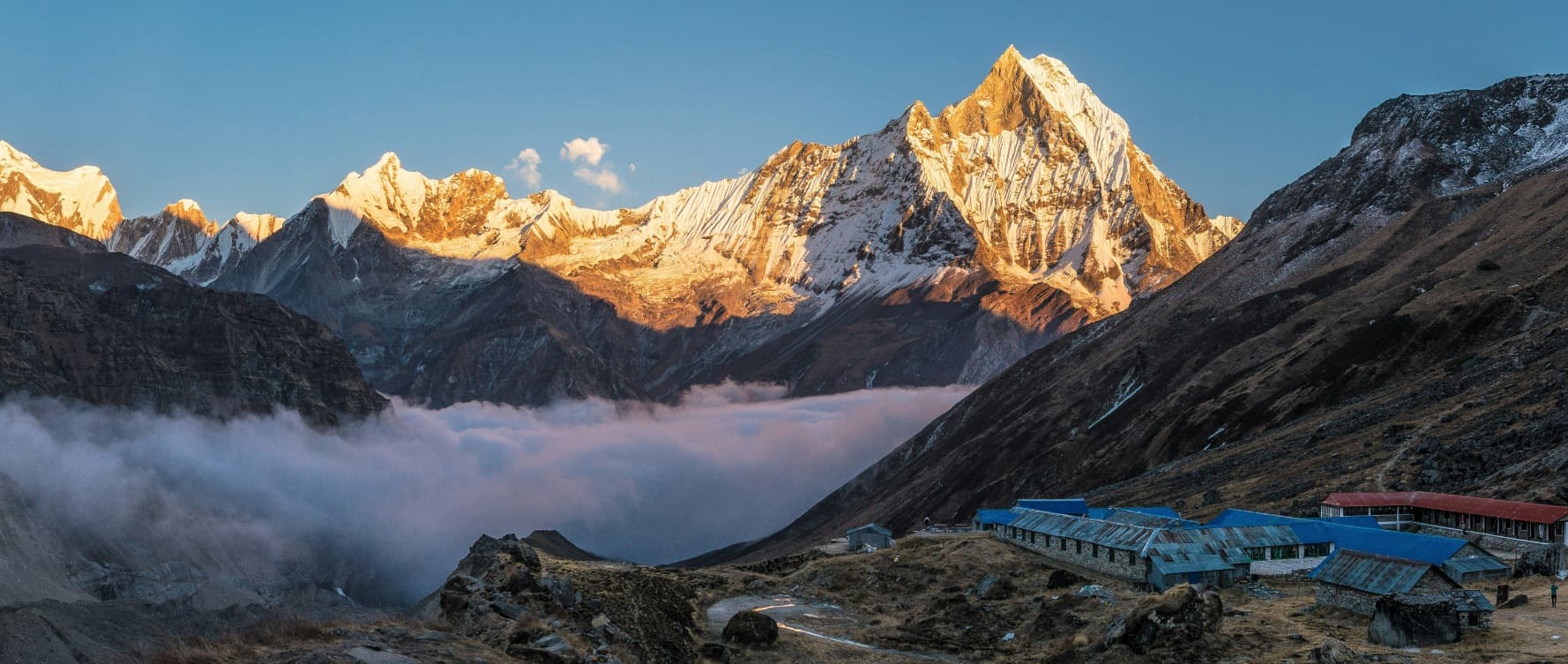
Somewhere beneath a wall of 7,000-metre peaks in central Nepal sits one of the most rewarding short treks on earth, and also one of the more reasonably priced ones. The Annapurna Base Camp Trek has built its reputation on that exact combination: a genuine high-altitude experience, delivered without the three-week commitment or five-figure budget that routes like Everest Base Camp tend to demand. If a 2027 itinerary is taking shape in your head right now, the Annapurna Base Camp Trek cost is almost certainly the first number standing between you and an actual booking, and it deserves a straight answer rather than a vague "it depends."
Here is the short version. Expect to pay somewhere between USD 500 and USD 1,500 per person, depending heavily on how you choose to travel. For that money, you walk into a natural amphitheater ringed by peaks that punch past 7,000 metres, standing at 4,130 metres, or 13,549 feet, above sea level, having covered somewhere between 70 and 115 kilometres round trip over 7 to 12 days. Along the way you pass through Gurung villages clinging to terraced hillsides, thick rhododendron forest that turns crimson through March and April, and the steep, narrow Modi Khola gorge that funnels straight toward Annapurna's south face.
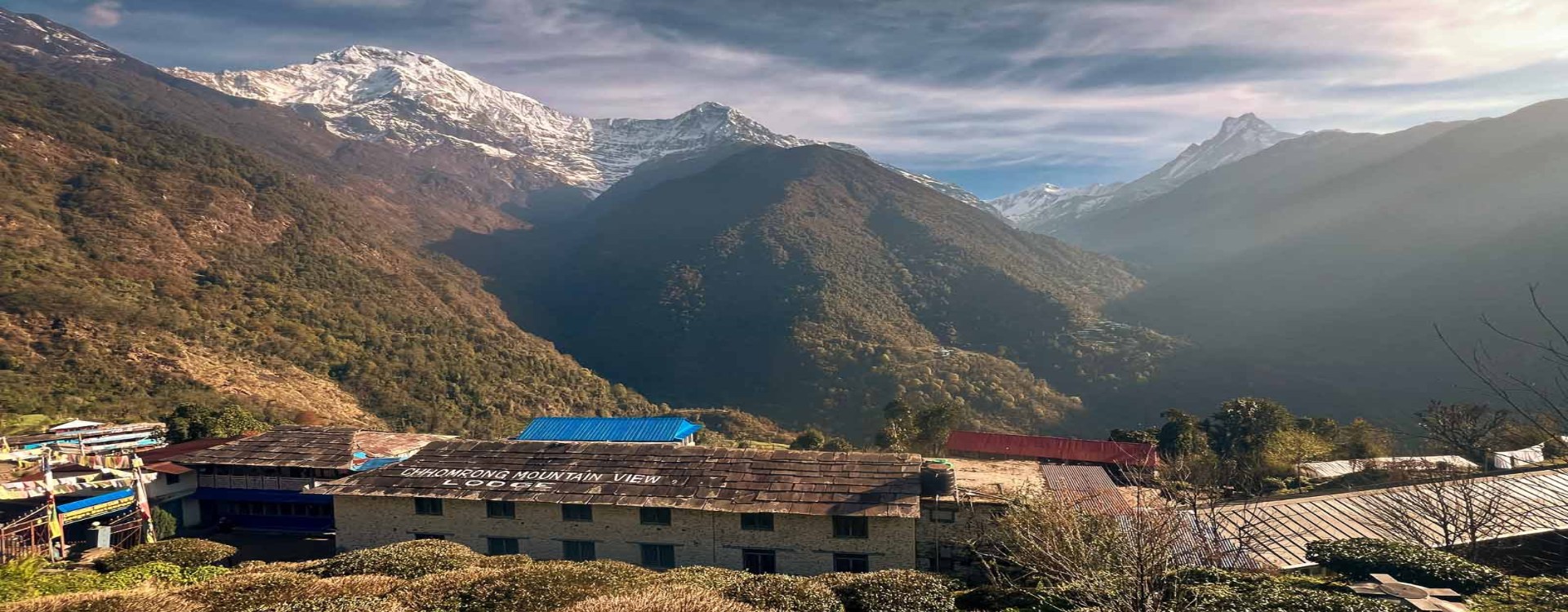
Most itineraries follow a well-worn path through Jhinu Danda, Chhomrong, Sinuwa, Bamboo, Deurali, and Machhapuchhre Base Camp before the final push to ABC itself. Chhomrong in particular sits as something of a hinge point on the route. Nearly every variation of the trek, whether it starts from Nayapul, Ghandruk, or a jeep-accessible trailhead at Samrung, funnels through this one large Gurung settlement before a single trail continues onward to the Sanctuary. Its winding stone-step lanes, small bakeries, and even the occasional espresso machine have made it a favorite overnight stop, and it is here that many trekkers first sense the shift from farmland and forest into proper mountain terrain.
This guide breaks down every part of what drives that final number: permits, guides, food, lodging, transport, and the smaller costs that tend to catch first-time trekkers off guard. By the end, the goal is that you know not just what the trek costs, but why it costs that, and where you have genuine room to spend less, or more, depending on what actually matters to you.
The Annapurna Base Camp Trek cost in 2027 typically lands somewhere between USD 500 and USD 1,500 per person. That is a wide range on paper, but it narrows quickly once you understand which variables move the needle: trek style, group size, season, and the level of service you are after. A solo trekker chasing the cheapest possible trip and a couple booking private rooms with three hot meals a day are, in effect, buying two different products that happen to follow the same trail through the same mountains.
It helps to think of the total cost less as a single figure and more as a stack of four separate expenses layered on top of one another: mandatory government fees, guide and porter wages, daily trail costs for food and lodging, and whatever comfort or convenience extras you decide to add on top. Strip away the extras and you land near the lower end of the range. Add a private vehicle, upgraded lodges, and a helicopter flight out of the Sanctuary, and you climb toward the top of it, and sometimes well past it.
It is worth pausing here on why this range exists at all, since a first-time trekker often assumes a single "correct" price must be out there somewhere. It is not, and the reason has less to do with hidden fees than with the sheer diversity of trekkers who attempt this route each year. A 22-year-old backpacker traveling on a gap year and a couple in their fifties celebrating an anniversary are both walking to the same base camp, but one is comfortable sharing a room with strangers and skipping the hot shower, while the other wants a private room every night and would rather not think about Wi-Fi fees at all. Neither approach is wrong. The cost simply follows the choice.
All-inclusive guided packages, the kind almost every trekker books today, average USD 700 to USD 1,000 for a standard 7 to 13 day itinerary. That price typically bundles permits, a licensed guide, a porter, teahouse lodging, and meals into one upfront payment, which is precisely why most people prefer it. You know the number before you leave home, and there is very little left to negotiate once you are actually on the trail with a pack on your back and altitude in your legs.
The appeal of this structure goes beyond simple convenience. When permits, guide wages, and lodging are all bundled together, an agency also takes on the logistical headache of coordinating them, which matters enormously on a route where teahouse space during peak weeks can fill up by early afternoon. A trekker booking independently risks arriving at Deurali in October only to find every room already claimed by an earlier group. A package trek, arranged in advance through an established agency, sidesteps that entire problem.
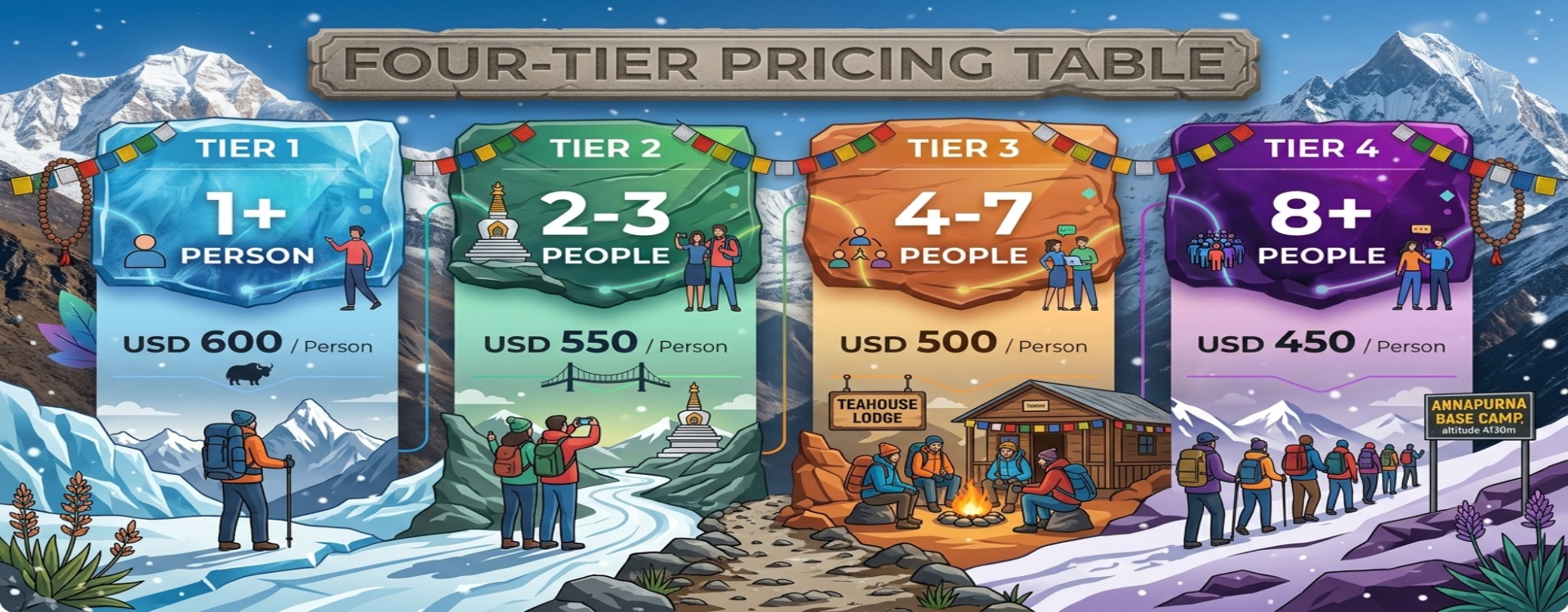
Package pricing on the ABC route tends to cluster into four recognizable tiers:
None of these figures include international airfare into Nepal, so keep that expense entirely separate when building a full trip budget. It is easy to see a $700 package quote and forget that flights, visas, and a few nights in Kathmandu or Pokhara before and after the trek still need their own line items.
No. Since April 2023, Nepal has required all foreign trekkers entering the Annapurna Conservation Area to travel with a government-licensed guide, and that rule has only become more consistently enforced with each passing season. Fully independent solo trekking, once a rite of passage for budget travelers threading their way through the Annapurna Sanctuary with nothing but a guidebook and a decent pair of boots, is no longer a legal option here.
The change followed a string of incidents involving lost, injured, or stranded solo trekkers across Nepal's national parks and conservation areas. Nepal Tourism Board data cited in coverage of the rule change noted that of roughly 300,000 trekkers who visited the country before the shift, tens of thousands were traveling independently, and it was precisely this group that accounted for a disproportionate share of search-and-rescue callouts. The new mandate applies well beyond Annapurna. Everest, Langtang, Manaslu, and the country's restricted regions, including Upper Mustang and Dolpo, all fall under the same requirement, though the restricted areas had already required agency-arranged permits well before 2023.
For the Annapurna Conservation Area specifically, checkpoints at Birethanti, Chhomrong, and several other points along the route now verify that trekkers are carrying valid permits alongside proof of a registered guide. Enforcement in the early seasons after the rule took effect was admittedly inconsistent, with many checkpoints unstaffed for stretches of time, but by the 2026 and 2027 seasons that gap had closed considerably. Attempting to rely on an enforcement loophole that may no longer exist is a poor foundation for a multi-day trip into remote mountain terrain.
A few practical consequences follow directly from this rule:
If you are weighing whether to save money by skipping this step, it is worth being direct about the trade-off. Attempting the trek without a licensed guide can mean turned-back permits at Birethanti, fines, or being escorted off the trail entirely partway through your trip, which wastes far more money and time than the guide fee ever would have cost. The guide fee is not an optional upsell dressed up as a requirement. It is baked into what a legal ABC trek costs in 2027, and treating it as negotiable is the fastest way to turn a planned trek into a stressful, unplanned return to Pokhara.
There is also a case to be made that the rule change, inconvenient as it may feel to trekkers used to older norms, has genuinely improved the experience for many people rather than diminished it. A first-time high-altitude trekker walking with a licensed guide gets real-time judgment on pace, weather, and altitude symptoms that a guidebook simply cannot provide. Guides on this route walk it dozens of times a year and develop an instinct for subtle changes in cloud cover or trail conditions that even experienced hikers from other parts of the world would miss.
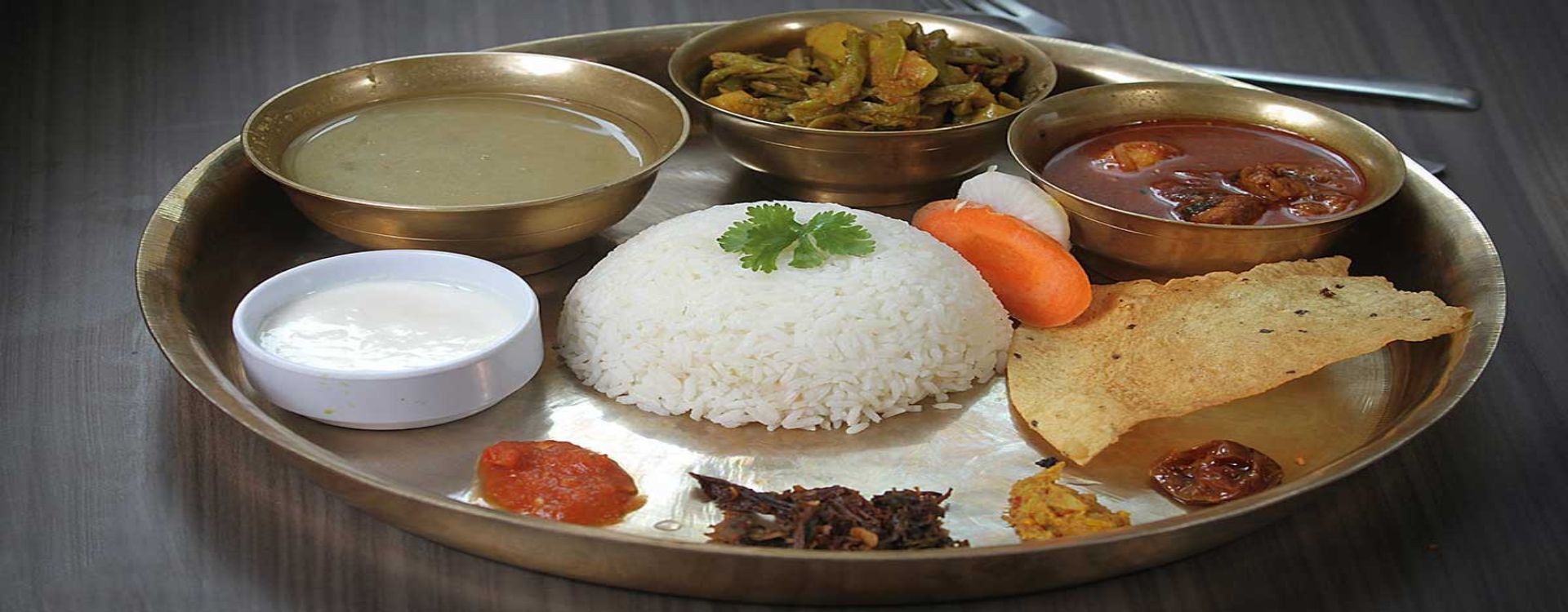
Once permits and guide fees are sorted, day-to-day spending on the trail settles into a fairly predictable rhythm. Expect roughly USD 35 to USD 60 per day for teahouse lodging, meals, tea, and basics like charging your phone or getting online, and that figure sits on top of guide and porter fees, which are usually paid as a lump sum at the end of the trek rather than tracked as a daily line item.
Budget an extra $5 to $10 per day the higher you climb. Everything on this trail, from cooking gas to canned goods to bottled water, arrives on the back of a porter or a mule train, and prices climb accordingly with every thousand metres of elevation gained. What costs $6 for a plate of noodles in Ghandruk might cost $9 or $10 by the time you reach Deurali, simply because someone had to carry that same bag of noodles for two or three additional days uphill to get it there.
It is also worth carrying a reasonable buffer beyond your calculated daily average. Weather delays, an extra rest day for acclimatization, or a spontaneous decision to buy a celebratory beer at Machhapuchhre Base Camp after finally reaching the Sanctuary can all push a given day's spending above the norm, and arriving with a cushion of $50 to $100 beyond your core budget removes a source of unnecessary stress on the trail.
With the baseline numbers in hand, it is worth slowing down and looking closely at exactly which decisions push your total cost up or down. Four factors do most of the work here: how many days you spend on the trail, which season you travel in, how large your group is, and which package tier you choose. Understanding each one lets you build a budget around your own priorities instead of guessing at a number and hoping it holds.
Shorter, jeep-assisted itineraries tend to cost less in total, simply because you are paying for fewer nights of lodging, fewer days of guide and porter wages, and less food across the whole trip. A five-day version of the trek, for instance, can drive by jeep as far as Samrung or Jhinu Danda before the walking even begins, trimming a day or two of lower-altitude trekking off the front end entirely. But these compressed itineraries pack a lot of elevation gain into fewer walking days, which raises the physical demand and, for some trekkers, the altitude risk that comes with ascending too quickly.
The classic 10 to 13 day route, which typically includes a detour to Poon Hill for sunrise views over the Annapurna and Dhaulagiri ranges, costs more overall but spreads acclimatization across a gentler pace, with more built-in buffer for weather delays or an unplanned rest day if someone in the group is feeling the altitude more than expected.
Neither end of that range is objectively better than the other. A fit, time-constrained trekker might genuinely prefer the 7-day option and accept the faster pace as a reasonable trade for a shorter trip. Someone prioritizing comfortable acclimatization, or simply wanting more time to enjoy the villages and Gurung culture along the way, tends to get more value from the longer classic itinerary even at a somewhat higher price tag.
It is also worth noting that trekking distance varies meaningfully depending on which route variation you choose, not just the number of days. A short five-day version starting from a jeep-accessible point might total 52 to 60 kilometres round trip, while the Poon Hill combination pushes total distance closer to 85 to 100 kilometres over nine trekking days. Neither number tells you everything about difficulty on its own, since a shorter distance compressed into fewer days can feel more demanding than a longer distance spread comfortably across more time.
The best time to trek, in terms of weather and trail conditions, is autumn, running from September through November. Skies tend to stay clear, trails are dry and well-maintained after monsoon repairs, and mountain views are about as reliable as the Himalayas ever get during any season. That reliability comes at full-service pricing, since this window is also when demand peaks and teahouse space becomes genuinely competitive. Winter and monsoon months, on the other hand, offer 10 to 20 percent lower rates from local operators simply because fewer trekkers are booking, and lodges have every incentive to fill empty rooms.
If your budget is tight and your schedule is flexible, shoulder weeks just before or after the main autumn season, think early September or late November, often deliver a useful discount without the worst of winter cold or monsoon mud. These transitional weeks tend to fly under the radar for many trekkers who default to the well-publicized October peak, which means slightly better availability and marginally lower prices for those willing to travel just outside the busiest stretch.
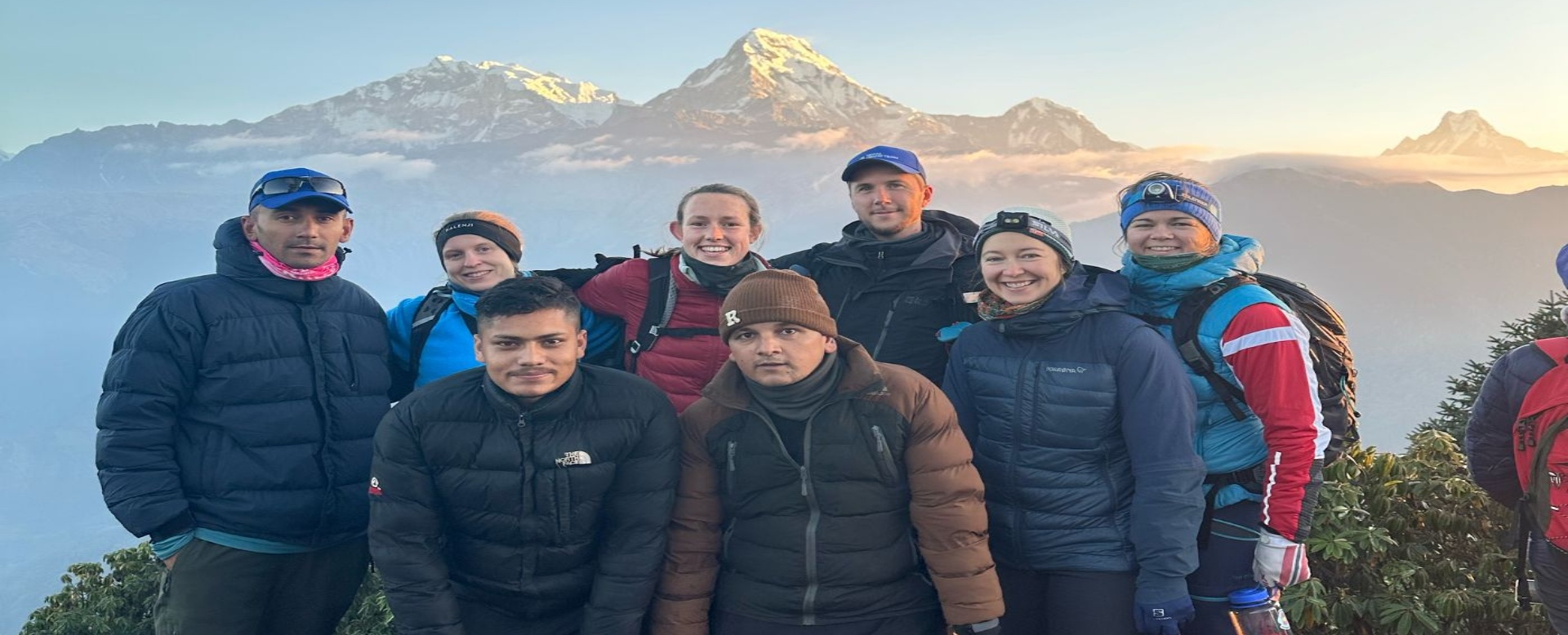
Group treks split several fixed costs, guide wages, transport, and permit paperwork, among more people, which tends to cut the per-person price by 15 to 30 percent compared to trekking solo. This is one of the more painless ways to reduce your total spend, since it changes nothing about the trek itself beyond who you are sharing the trail with day to day.
If you are traveling alone but flexible on timing, ask your operator whether they can place you into an existing small group. Many agencies, ourselves included, regularly combine solo bookings into shared departures specifically so trekkers do not have to absorb the full private-guide cost by default. This practice has become increasingly common precisely because the 2023 guide mandate pushed more solo travelers to look for ways to share costs without sacrificing the flexibility of a small, compatible group.
Permits and guide fees form the non-negotiable core of any legal ABC trek, and they are worth understanding in real detail since they apply identically no matter which operator you book with, and no amount of shopping around changes the underlying government fee structure.
The ACAP, short for Annapurna Conservation Area Permit, costs NPR 3,000, roughly USD 22 to 25, for foreign nationals in 2027. This fee stays fixed regardless of how long your trek runs or which season you travel in, and it applies to every foreign trekker entering the conservation area, whether you are doing a fast 7-day version or the full 12 to 13 day classic route with Poon Hill included. SAARC nationals pay a reduced rate, generally around NPR 1,000, and children under ten are typically exempt from the fee entirely, though their details still need to be registered at the permit counter.
The ACAP fee funds trail maintenance, conservation projects across the Annapurna Sanctuary, and community programs in the villages the trek passes through, so this is not simply a toll booth charge collected for its own sake. It is one of the more direct ways trekking tourism gives something back to the region it depends on so heavily, supporting everything from forest protection to the maintenance of the stone staircases that make up so much of the trail between Chhomrong and Sinuwa.
The permit itself is typically arranged in Kathmandu or Pokhara before the trek begins, and it stays valid for the entire route once issued, meaning you carry the same document from the trailhead all the way to Base Camp and back. Anyone attempting to obtain the permit directly at the entry checkpoint in Birethanti rather than in advance often finds themselves paying a doubled fee, another reason most trekkers prefer to have their agency arrange this ahead of time.
Do You Still Need a TIMS Card in 2027?
Yes, in practice. A group TIMS card, the Trekkers' Information Management System registration, typically running NPR 1,000 to 2,000, is still issued alongside the ACAP for emergency safety tracking. On-trail enforcement of the TIMS card specifically has become somewhat inconsistent since the 2023 guide mandate took effect, since your licensed guide and agency registration now serve much of the same safety-tracking purpose that the card was originally designed to provide.
Even so, agencies continue to issue it as standard practice, and it costs little enough on top of the ACAP fee that skipping it would save almost nothing while adding unnecessary risk if a particular checkpoint does still ask for it. The card was originally introduced by the Nepal Tourism Board specifically to help authorities track trekker movements for search-and-rescue purposes, and while its role has shifted somewhat with the newer guide mandate, it remains part of the standard paperwork bundle most operators handle without a second thought.
A licensed guide runs $25 to $35 per day, while a porter typically costs $18 to $25 per day. Some trekkers opt for a combined porter-guide, someone certified to lead the route who also carries a portion of the load, which usually runs $25 to $30 per day and can be a sensible middle option for solo trekkers or small groups trying to keep costs down without giving up either service entirely.
|
Service |
Daily Rate (USD) |
|
Licensed guide |
$25–$35 |
|
Porter |
$18–$25 |
|
Combined porter-guide |
$25–$30 |
These rates typically cover the guide or porter's own wages, but not necessarily their full board and insurance, which is why reputable agencies build those costs into the package price rather than leaving trekkers to work out meal arrangements for their guide and porter on the trail themselves. A porter can typically carry between 20 and 25 kilograms, and many trekkers traveling as a pair choose to share a single porter between them, splitting the daily rate and reducing what each person pays individually.
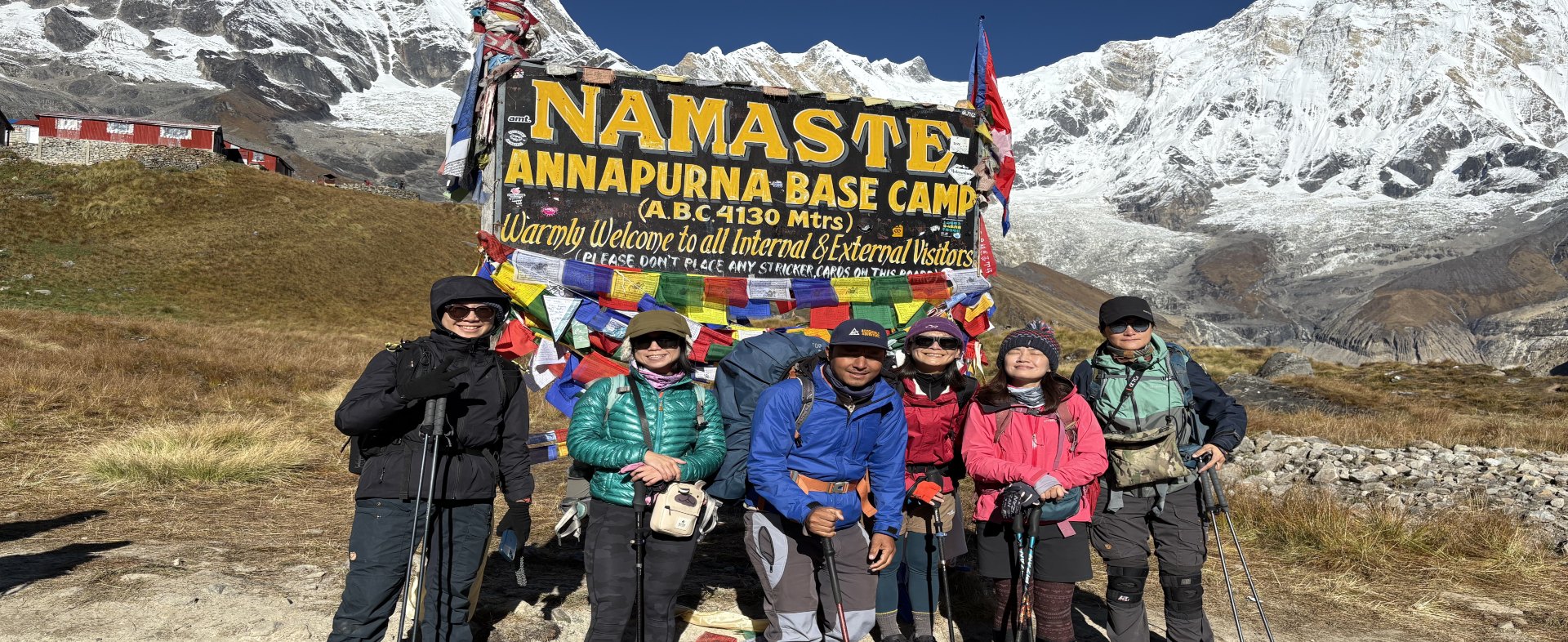
Budget roughly 10 to 15 percent of your total trek cost, or about $7 to $10 per day combined, as an end-of-trek tip for your guide and porter. This is not strictly mandatory in a legal sense, but it has become a well-established norm on Nepal's major trekking routes, and it reflects the fact that guide and porter wages, while fair by local standards, still depend meaningfully on tips to make the work sustainable over a long trekking career. Most trekkers present this as a single lump sum on the final day of the trek, often with a short note of thanks, rather than doling out small amounts daily throughout the trip.
Once you understand the fixed costs, the real decision comes down to comfort. The Annapurna Base Camp Trek accommodates a genuinely wide range of travel styles, and knowing what separates a budget package from a premium one helps you spend money where it actually improves your trip, rather than paying for upgrades you will not notice or use.
Budget packages typically cover permits, a licensed guide, basic teahouse lodging, and two meals a day, usually breakfast and dinner, with lunch and any extras like hot showers or Wi-Fi paid for directly on the trail as you go. This is the leanest legal version of the trek available in 2027, and it works well for trekkers who are comfortable with simple rooms, shared bathrooms down the hall, and a bit of improvisation around meal timing depending on when the lodge kitchen is available.
Rooms at this tier are typically twin-share, with a thin mattress, a couple of blankets, and walls thin enough that you will hear your neighbors' conversations. None of this diminishes the experience for trekkers who came primarily for the mountains rather than the accommodation, and many find the simplicity part of the charm rather than a hardship to be endured.
Premium packages layer on private rooms wherever teahouses can accommodate them, all three daily meals included rather than just two, and priority lodge bookings, which matters more than it sounds during peak autumn weeks when popular teahouses in villages like Chhomrong or Sinuwa fill up fast and a group without a reservation can find itself with limited options by early afternoon.
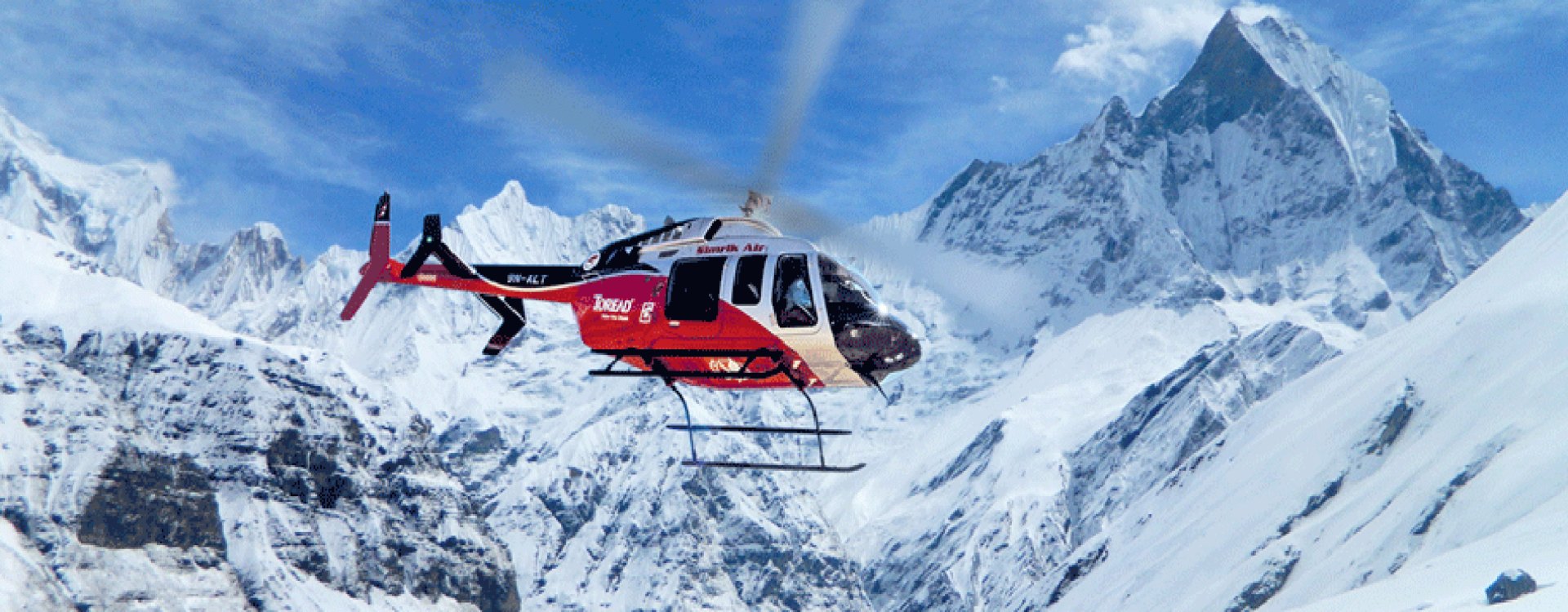
Increasingly popular at the top of this tier is a helicopter return flight from Base Camp back to Pokhara, replacing several days of walking with a roughly 25-minute scenic flight over the same terrain you spent days climbing on foot. This add-on typically runs $500 to $700 when priced as a supplement to an otherwise standard walking itinerary, often shared among a group to bring the per-person cost down further. Full luxury packages that build the helicopter return into the base itinerary from the outset, rather than adding it as an optional extra, can run considerably higher once accommodation upgrades, private transport, and flight logistics are all factored in together, sometimes reaching well above $1,500 depending on group size and exact routing.
The appeal of the helicopter option goes beyond simple comfort. For trekkers with limited vacation time, it can compress what would otherwise be a multi-day return walk into a single morning, freeing up extra days for exploring Pokhara's lakeside district or adding a short cultural stop in Kathmandu before heading home. It also offers a genuinely different perspective on the same landscape, since the aerial view over the Modi Khola valley and the peaks surrounding the Sanctuary shows the terrain in a way that is simply impossible to appreciate while walking through it at ground level.
Cutting costs on the ABC trek does not have to mean cutting corners on safety. Several of the most effective savings come from decisions that have nothing to do with skimping on permits, guides, or insurance, all of which should remain non-negotiable regardless of how tight your budget is.
Beyond these categories, a few smaller expenses tend to slip through the cracks of most budget estimates entirely. Bottled water along the trail, purchased rather than treated with a filter or purification tablets, can add up meaningfully over a week or more, particularly at higher altitude where a single bottle might cost two or three times what it did lower down. A modest daypack of snacks, chocolate, energy bars, or dried fruit bought before the trek begins also tends to be both cheaper and more reliable than relying entirely on what teahouses stock along the way.
Group size, season, and how much comfort you want along the way, more than anything else, decide what you will pay for this trek. Whether you are working with a lean $500 budget or planning a premium trip with a helicopter return, the Annapurna Base Camp Trek remains one of the best value-for-money Himalayan adventures available in 2027, and understanding exactly where your money goes makes it far easier to plan with genuine confidence rather than guesswork.
The trek's enduring popularity, even as prices have shifted somewhat with the 2023 guide mandate and broader inflation across Nepal's tourism sector, comes down to a simple fact. Few places on earth let you stand inside a natural amphitheater of 7,000 and 8,000 metre peaks after only a week or so of walking, without a technical climbing permit, specialized mountaineering gear, or months of dedicated training beforehand. That combination of accessibility and genuine grandeur is difficult to overstate, and it is exactly why so many trekkers who complete Annapurna Base Camp describe it as one of the most rewarding trips of their lives, regardless of which budget tier they booked into.
Ready to turn these numbers into a real itinerary? Get a free, no-obligation Annapurna Base Camp Trek quote, and let licensed local guides build a package that fits your budget and your bucket list.
The Annapurna Base Camp Trek cost in 2027 ranges from about USD 500 to USD 1,500 per person, depending on group size, season, and package tier.
Yes. ABC typically costs 40 to 50 percent less than Everest Base Camp, since it is shorter, needs no domestic flights into a mountain airstrip, and skips the pricier Sagarmatha National Park permit fees that apply in the Everest region.
Yes. You need the ACAP, the Annapurna Conservation Area Permit, costing NPR 3,000, about USD 22 to 25 for foreigners, plus a TIMS card for safety tracking.
No. Since April 2023, Nepal requires all foreign trekkers in the Annapurna Conservation Area to hire a licensed guide, so solo independent trekking is not permitted.
A licensed guide typically costs USD 25 to 35 per day, usually covering their wages, meals, lodging, and mandatory insurance through your agency.
Budget roughly 10 to 15 percent of your total trek cost for tips, or about USD 7 to 10 per day combined, given at the end of the trek.
The best time is autumn, September through November, or spring, March through May, for clear skies and stable trails, though winter and monsoon offer lower prices in exchange for tougher conditions.
Most itineraries take 7 to 12 days round trip from Pokhara, depending on route, acclimatization pace, and whether Poon Hill is included.
Annapurna Base Camp sits at 4,130 metres, 13,549 feet, above sea level, inside a natural amphitheater surrounded by peaks over 7,000 metres.
Meals typically cost USD 6 to 10 each, so budget around USD 20 to 30 per day for food alone, with prices rising slightly at higher elevations.
Yes. Insurance covering high-altitude trekking up to 5,000 metres and helicopter evacuation is strongly recommended, since it is not included in most packages.
A porter typically costs USD 18 to 25 per day and can carry up to 20 to 25 kilograms, often shared between two trekkers to reduce costs.
Yes, a bare-bones package starting around USD 500 is possible in the off-season with a small group, though it skips extras like hot showers and Wi-Fi.
No. Most packages cover permits, guides, lodging, and meals in Nepal, but exclude international airfare, Nepal visa fees, and Kathmandu to Pokhara transport.
The round-trip trekking distance is approximately 70 to 115 kilometres, 43 to 71 miles, depending on your trailhead and whether Poon Hill is included.
Bringing unforgettable Himalayan adventures to everyone. Our expert guides and carefully curated experiences ensure that everyone can explore the beauty of Nepal, Tibet, and Bhutan.
Learn More