How to Combine Trekking, Culture, and Wildlife in One Nepal Trip
Field-reviewed by Hari Kumar Shrestha
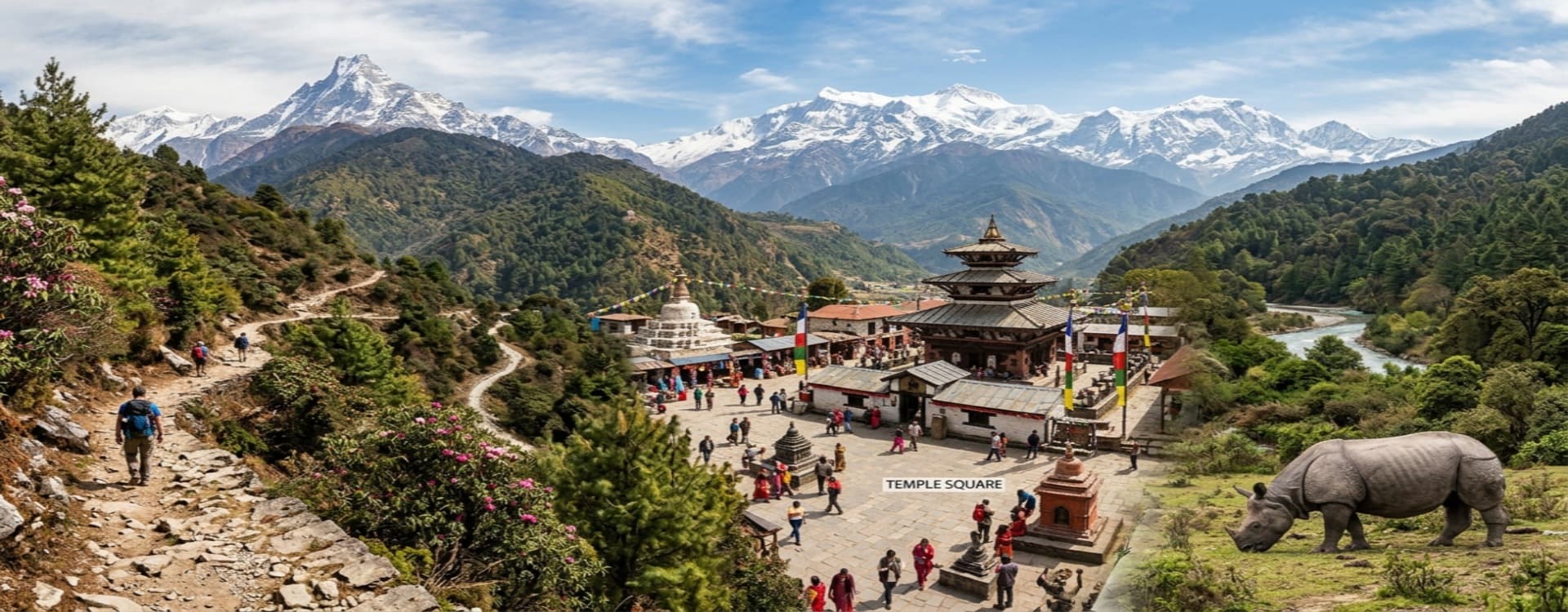
Nepal packs an unusual amount into a small map. In a single holiday you can walk beneath snow peaks, spend a morning among temples that have been in daily use for centuries, and drift down a jungle river looking for rhinos. Most travelers who contact Accessible Adventure, a Kathmandu-based trekking operator, wants a taste of all three. The question we hear most often is how to fit them together without turning the holiday into a race.
The answer comes down to choices. Which experience matters most? How many days do you really have? How far apart are the places, and how much recovery time does your body need between a big trek and a long drive? This article walks through those decisions. It uses Kathmandu, Pokhara and Chitwan as examples to think with, because they sit on the most popular routes and show clearly how geography shapes a plan. It describes how the pieces fit together without handing you a ready-made itinerary, since your own plan should grow out of your priorities.
Start by choosing the main focus of the holiday
Every successful combination trip has a headline. It might be a trek, a deep dive into Kathmandu Valley's living heritage, or a few days of wildlife watching in the lowlands. The headline gets the most days, the best timing and the most energy. The other experiences fit around it.
A simple test helps. Imagine describing the trip to a friend a month after you get home. Which experience would take up most of the conversation? If it is the mountains, plan the trek first and let the rest fill the gaps. If it is the temples and the old cities, give Kathmandu Valley real time and choose a gentler trek. If it is wildlife, fix your dates around the best months for the lowlands and add shorter mountain and cultural pieces.
Naming the headline early saves a lot of back and forth. When a traveler tells us "mountains first, culture second, wildlife as a bonus," we can start building straight away. When the answer is "all three equally," we will probably talk through some trade-offs, because equal weight on three things usually means each one gets too little time.
Why these three pair well, and where they pull apart
The three experiences complement each other in a practical way. A trek is physical and quiet. A city visit is busy and sensory. A jungle safari is early mornings, slow movement and patience. Alternating them keeps the trip varied, and a day in the lowlands after a trek is a welcome change for tired legs.
They also differ in ways that affect planning. Kathmandu sits at roughly 1,400 metres. Pokhara is lower, at around 800 metres, and Chitwan is close to sea level in the Terai plains. A trek climbs far higher than any of them, and the weather, clothing and daily rhythm change completely from one place to the next. Heat is the main issue at Chitwan in the warmer months, while cold is the main issue high on a trek in the same season.
The three experiences also run on different seasons. Trekking is best in clear spring and autumn windows. Chitwan's wildlife viewing is generally strongest in the dry months from October to March, with hotter conditions from March to May. The monsoon, from about June to September, limits access in both the mountains and the jungle. Most good combination trips happen where those seasons overlap, which we look at below.
Kathmandu, Pokhara and Chitwan as building blocks
We use these three places here as illustrations. Nepal offers many other places for culture, scenery and wildlife, and the thinking below applies to any of them.
Kathmandu is the gateway for almost every visitor and the natural base for culture. According to UNESCO, the Kathmandu Valley is a World Heritage property made up of seven monument zones: the old royal squares of Kathmandu, Patan and Bhaktapur, the Buddhist stupas of Swayambhunath and Boudhanath, the Hindu complex of Pashupatinath, and the temple at Changu Narayan. These are living places where worship carries on around the visitors. Some come with rules worth knowing in advance. At Pashupatinath, for example, the main temple is open only to Hindus, though other visitors can observe the complex and its rituals from across the Bagmati River. A few days here give you a strong sense of the country before or after the mountains.
Pokhara is a lakeside town at the foot of the Annapurna range. It works well as a recovery stop, a trek starting point or a place to add a few easy activities such as boating on the lake, a sunrise viewpoint or a paragliding flight on a clear day. It rewards slow time. Many Annapurna-region treks start from the area, which makes Pokhara a natural link between the trail and the rest of the trip.
Chitwan National Park is a UNESCO World Heritage Site in the Terai lowlands, famous for one-horned rhinoceros and home to Bengal tigers, elephants, crocodiles and a rich bird population. Visitors explore it with licensed guides by jeep, on foot with a lead guide and a back-up tracker, and by canoe on the river. Rhinos are often seen. Tigers are elusive, and no operator can guarantee a sighting, so treat one as a bonus rather than an expectation. Many lodges also arrange visits to Tharu villages, which adds a cultural thread to the wildlife days. Elephant-back safaris, once common here, have been reduced in recent years as animal-welfare concerns have grown, and many lodges now offer jeep, walking and canoe safaris instead.
Plan around geography and transfer time
The numbers on a map hide the real cost of Nepal's roads. Distances are short, and journeys are slow. Winding highways, river gorges, roadworks and traffic mean a transfer can take most of a day.
Here is a rough guide to the main links between the three places:
|
Route |
Distance by Road |
Typical Road Time |
By Air |
|
Kathmandu to Pokhara |
About 200 km |
7–9 hours by tourist bus; usually less by private vehicle |
About 25–30 minutes |
|
Kathmandu to Chitwan |
About 150–180 km |
Roughly 5–7 hours |
About 25 minutes to Bharatpur |
|
Pokhara to Chitwan |
Road distance varies by route |
Often 4–5 hours |
Check current flight options with your travel planner |
These times are approximate and based on typical conditions; check current road and flight status with your operator before travel. Roadworks, festival traffic and, from June to September, landslides can add hours or close a road for a spell. Mountain and hill flights depend on weather, and they can be delayed or cancelled. Travel insurance that covers trekking altitude, emergency evacuation and trip delays is strongly recommended. For that reason, we treat any transfer as a half day at minimum and avoid scheduling anything important on the same day.
Chitwan sits between Kathmandu and Pokhara. That makes a loop the most efficient shape for a trip: Kathmandu to Chitwan to Pokhara, or the reverse. Travelers who do this avoid driving the same stretch of highway twice. A flight can save a day where time is short, though it adds cost and weather risk.
Treks add their own geography. Annapurna-region routes usually link well with Pokhara. Everest-region treks start with a flight to Lukla, and in the busiest seasons many of those flights operate from Ramechhap airport rather than Kathmandu, and schedules can change by season, so confirm the current arrangement before booking, which means an early drive from Kathmandu beforehand. That changes how a trek fits with everything else, and we plan it with extra buffer time.
Choose a trek that sits well with the rest
Not every trek combines easily. A long, high-altitude route needs a lot of days, gradual ascent and rest time. It is a headline on its own and leaves little room for other priorities in a two-week trip.
Shorter and lower treks suit combination holidays better. Routes in the Annapurna foothills, for example, climb to a few thousand metres, and viewpoints such as Poon Hill sit about 3,200 metres. Slightly longer routes reach higher, such as Annapurna Base Camp at about 4,100 metres. They use fewer days than the big circuits and finish near Pokhara, where the easy stage of the holiday can begin.
When you tell us how many days you have, we choose a trek that leaves enough room for the other two experiences. If you are set on a big route, we will talk through what that does to the rest of the plan. The altitude advice stays the same either way. The US Centers for Disease Control and Prevention advises that above about 3,000 metres, sleeping elevation should increase by no more than about 500 metres per night, with a rest day roughly every three to four days, so a trek cannot be shortened by squeezing the climb. If your holiday is brief, a different route will usually serve you better than a compressed version of a longer one.
Match the season to all three
Because the three experiences keep different calendars, season is one of the most useful things to settle early.
• Autumn (late September to November): Clear mountain views, comfortable trekking and good conditions in the lowlands as the grass settles after the monsoon. This is the busiest period, so lodges and flights fill early. The big festivals of Dashain and Tihar also fall in this window and affect transport and office hours, so check the dates for your year.
• Winter (December to February): Cold at altitude, with lower trekking more comfortable than high routes. Chitwan is pleasant for walking and wildlife, and the city sights are quiet.
• Spring (March to May): Good trekking, with rhododendrons in bloom on many routes and warmer days. Chitwan grows very hot, with afternoon temperatures that can reach into the high thirties Celsius, though thinner vegetation helps some visitors spot animals.
• Monsoon (June to September): Rain, leeches and cloud, plus a higher risk of landslides on the main highways. Access to the jungle is limited. For current conditions, see our region-by-region safety guide after the 2026 floods.Some northern regions stay drier, but combination trips are harder to plan.
A traveler who wants all three in comfort will often land on late October to November, or on February and March, depending on how much they value heat, crowds and mountain views.
Build in recovery after the trek
Trekking tires the body in ways that are easy to underestimate. After days of climbing and descending, most people want a hot shower, a soft bed and a day without a schedule. A trip that follows a big trek with an early start and a long drive can leave you feeling flat for the part you were looking forward to.
A few habits help:
• Put the trek in the first half of the trip when you can, so that culture and wildlife serve as a gentle second act. The reverse order also works, though starting with a long road journey after the trek can feel harsh.
• Plan at least one easy day after the trek. Pokhara's lakeside, a slow morning in Kathmandu or a lodge by the river in Chitwan all work well.
• Leave the most physical activity of the trip out of the days directly after the trek.
• Keep the early starts for a rested body. A pre-dawn jeep safari feels very different on day two after a trek than on day five.
Leave buffers and stay flexible
Nepal is a place where plans bend. Flights wait for clear skies. Roads slow down for roadworks, festivals or landslides. A buffer protects both your holiday and your connection home.
The most important buffer sits at the end. If your trip includes a mountain flight, a long drive or both close to your international departure, leave at least one spare day between the last activity and the flight home. It costs little and prevents a lot of stress.
Smaller buffers help in the middle. Try not to schedule long transfers on the same day as something you care about. Leave one open half-day in Kathmandu or Pokhara so that a delay on one leg does not cancel a highlight. If one stage runs late, the open time absorbs it.
Flexibility also covers the experiences themselves. A clear day for the mountains might arrive earlier or later than expected, and a cloudy morning at a viewpoint can be rescheduled if you have room. Rigid plans break. Plans with slack bend.
Match the experiences to the days you have
A useful way to plan is to count nights in each place. These are rough guides, and your own pace and priorities will move them around.
• Around one week: Choose two of the three experiences, or one with a light taste of another. A short, low trek plus time in Kathmandu and Pokhara is realistic. Adding Chitwan stretches things.
• About ten days to two weeks: A short trek, a few nights for culture and two or three nights in Chitwan can fit together, as long as transfers are kept under control.
• Three weeks or more: A bigger trek becomes possible alongside the other two, with proper time for recovery.
For Chitwan, travelers who want a real taste of the park commonly allow at least two nights, which is enough for a jeep safari, a canoe ride, a jungle walk and a village visit without feeling rushed.
Two hypothetical combinations
These two sample structures show how the building blocks fit together and are planning models rather than fixed itineraries. They describe the shape of a trip only. Dates, routes and activities would be set after we talk through your preferences.
Combination A: a trek-led holiday of about two weeks (hypothetical). The headline is a moderate trek in the Annapurna foothills. The trip opens with two or three nights in Kathmandu for the old squares and a stupa or two, and for adjusting to the time zone. A transfer to Pokhara leads into the trek, which takes up the middle section of the holiday. After the trek come a couple of easy nights in Pokhara, and a road or flight link brings the group to Chitwan for two nights of wildlife and a village visit before returning to Kathmandu with a buffer day before departure. The trek gets the most time, the culture and wildlife frame it, and the recovery nights sit right where tired legs need them.
Combination B: a culture-led holiday of about ten days (hypothetical). The headline is Kathmandu Valley, so it gets the largest share of nights, perhaps four, split between the city, Patan and Bhaktapur so that each gets proper attention. A short, gentle hill walk of a few days adds a taste of the mountains without long climbs. Two nights in Chitwan bring in the wildlife, followed by a spare day in Kathmandu before departure. This shape suits travelers who care most about history and daily life, with the mountains and the jungle as welcome additions.
Both examples keep transfers few, put a rest day after the hardest part and leave a gap before departure. Those three features matter more than the specific places.
What to leave out when time is limited
Every trip eventually meets a limit. When a holiday is short, the best plans make confident choices about what to drop. These are the first things we usually look at:
• A second trek or a second region. One good trek is better than two rushed ones.
• Long transfers for short visits. A full day on the road for one night somewhere rarely pays off.
• Everything in Kathmandu Valley. The seven monument zones can fill a week. Choose two or three that appeal and give them time.
• Chitwan on a very tight schedule. If you can only give it a night, consider whether the transfer is worth it. A shorter plan with fewer places is often more enjoyable.
• Back-to-back early starts. A day of rest between big mornings protects your energy for the things you most want to see.
Skipping something today leaves it available for a later visit. Plenty of travelers return to Nepal for the part they left out, and a calm first trip often makes a second one more likely.
Questions to discuss with a planner before combining experiences
These questions help turn a wish list into a workable plan. Ask them of any operator, and confirm that your guides are licensed and that the operator is registered with Nepal’s Tourism Department.
• Given my days and dates, which of the three experiences fits best, and which should I shorten?
• How much transfer time does this route involve, and where are the flight options?
• Where does my plan include recovery after the trek?
• What buffer do you recommend before my international flight?
• How does the season affect each part of the plan, including the heat and any monsoon risk?
• What is realistic to expect from wildlife viewing, and what happens if the weather changes the schedule?
• Which parts of the plan carry the most weather or road risk, and what is the backup?
• What would you cut first if I wanted a slower pace?
Start your own combination
Every combination trip starts with a few honest answers about your priorities, your dates and your energy. When you are ready, Accessible Adventure Pvt. Ltd., a Kathmandu-based trekking operator, can help you create a tailor-made Nepal holiday around them. Tell us how many days you have, which experience matters most and what you would happily leave out, and let us show you how to combine your preferred Nepal experiences into a trip that feels full without feeling rushed.
About the author: Himal Shrestha
Government-licensed trekking guide & travel writer · Accessible Adventure
Himal Shrestha is a government-licensed trekking guide and travel writer with 10 years and counting in the mountains. Trained in first aid and hospitality, he brings firsthand trekking experience to his articles on Nepal, itinerary planning, and travel preparation for Accessible Adventure.
Meet Himal ShresthaRelated Articles
Explore more stories and guides from the Traveler Information & Planning collection