Private Trek vs Group Trek in Nepal: Which Suits Your Travel Style?
Field-reviewed by Hari Kumar Shrestha
Almost everyone who plans a Himalayan trek runs into the same early decision. Do you walk with the people you already travel with, or do you join a scheduled group of travelers you have never met? Both formats work well in Nepal, and both have loyal fans. The better choice depends on your dates, your pace, your budget and how you like to spend the evenings after a long day on the trail.
We run private treks, and we say so up front so you can read everything below with that in mind. This comparison draws on the planning and guiding experience of our team, who organize private treks across Nepal’s trekking regions.The comparison still deserves a fair hearing, because a good decision starts with an honest picture of both formats. This article explains what each arrangement means in practice, how they differ on dates, pace, guiding, company, lodging and cost, and which questions to put to any operator before you pay a deposit.
What private and open group trekking mean
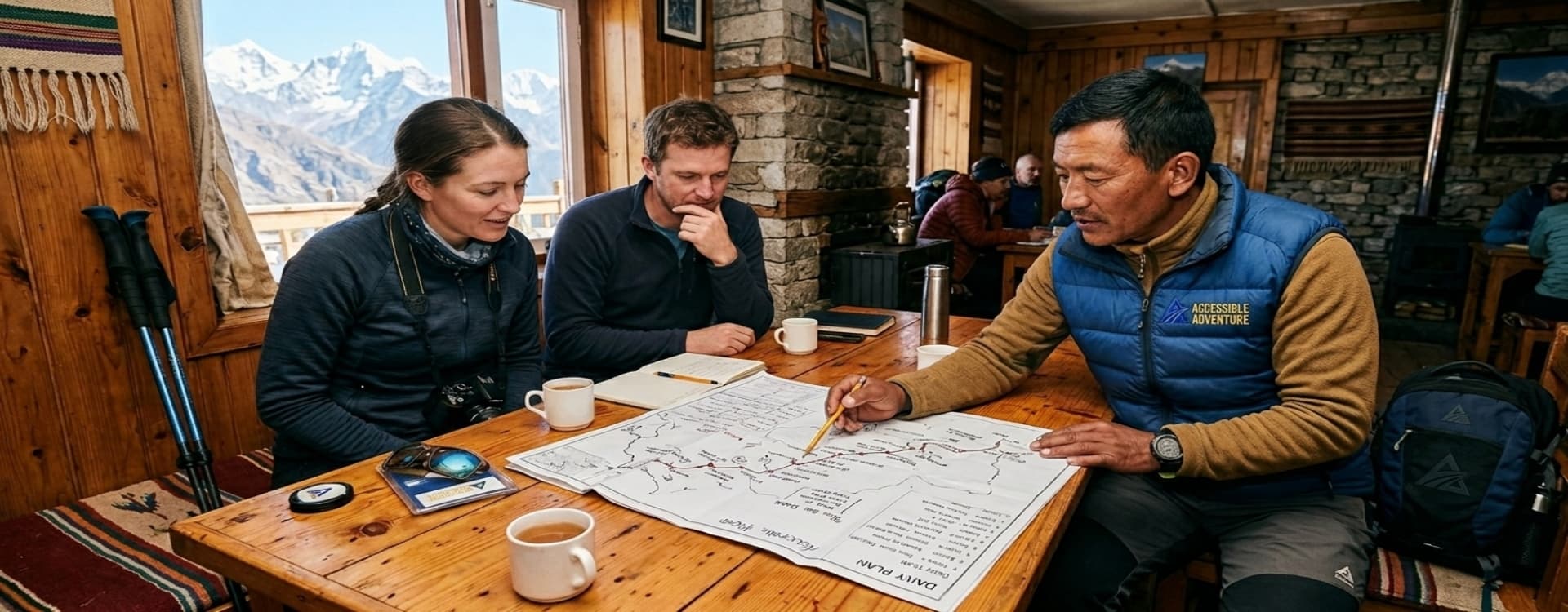
A private trek is arranged for you and the companions you choose. Your party might be a couple, a family, or a few friends. The start date is set around your calendar, and the guide and support crew work with your party and nobody else.
An open group trek, often called a group-joining trek or fixed departure, works the other way around. The operator publishes a route and a start date. Travelers book individually, and the people who sign up for that date become the group. Group sizes vary by operator, commonly ranging from a handful of travelers to around ten or twelve, and the minimum number needed for a departure to run also differs, so it is worth asking before you book. The price is quoted per person, and everyone follows the same itinerary.
One rule shapes both formats. Foreign trekkers in Nepal’s trekking regions are required to hire a licensed local guide arranged through a registered agency, so walking the trails entirely alone is no longer an option on most routes. Rules can change, so please confirm current requirements with the relevant authority or a registered agency before you travel. The real choice is how that guide, and the crew around the guide, are shared. In a private arrangement, they belong to your party. In an open departure, they belong to the whole group.
A private trek and a customized itinerary are different ideas
These two terms get mixed up a lot, so it helps to separate them early.
A private trek describes who is in your party. A customized itinerary describes what the route and schedule look like. A private trek can follow an established itinerary day by day, with only your party on it. A group departure follows the operator's schedule and has little room for change, because everyone on it needs the same plan.
Private trekking opens the door to customization, since there is only one party to please. Adding a rest day, choosing a different start date or shortening a stage is much more realistic when your party is the only one affected. Each of those changes still has to work with permits, lodge availability, flights and safety, and we cover what can and cannot change on a trek in a separate article. For this comparison, keep the distinction in mind: choosing private is a decision about company, and choosing a customized route is a decision about content. Many travelers choose both, and some choose only one.
Departure dates and scheduling
On an open group trek, you fit your holiday around the operator's calendar. Departures usually cluster in the spring and autumn seasons, with a handful of dates each month. If one of them matches your leave, booking is simple. Someone else has already chosen the route, and the schedule is published. If none of the dates suit you, the trek is simply out of reach for that season.
A private trek reverses that. You choose a start date within the trekking season, and we work out permits, lodges and transport around it. If your leave runs from the 3rd to the 20th, we build the trip into those days. That freedom matters most for people with fixed commitments such as school holidays, a wedding or a limited block of annual leave.
Two scheduling details deserve a question before you book either format:
• Minimum numbers on open departures. Some departures run only once a minimum number of travelers has joined. Ask whether the date is guaranteed, and what happens if it is cancelled. A cancelled departure can leave you rebooking flights.
• Arrival buffers. Open departures often ask you to reach Kathmandu a day or two before the start, because the group leaves together. If your international flight is delayed, a group may already be on its way. A private party can usually shift its start by a day, subject to permit and lodge availability.
Seasonal events also matter in both formats. Festivals such as Dashain and Tihar change transport demand and when government offices are open, so it helps to check the calendar for your year before you commit.
Walking pace and rest stops
Pace is where the two formats feel most different on the trail.
In a group of strangers, the pace sits somewhere between the quickest and the slowest walker. Good operators manage this well. A lead guide sets the rhythm, and an assistant guide often walks at the back so nobody is left alone, which lets faster walkers move ahead and slower walkers take their time. The daily stages, lunch stops and overnight villages stay fixed, though, because the whole group shares one plan. You also cannot choose the fitness or experience of the people around you.
In a private party, the pace belongs to your companions. If one of you loves to stop for photographs and another enjoys a steady rhythm, the guide can shape the day around both. If someone has a slow morning, the day adjusts. If you decide you want a half-day in a village you love, there is room to ask. This does not remove the need for honesty. The slowest member of any party shapes the day, so it is worth talking openly among yourselves about expectations before you arrive.
Rest days and altitude deserve a special mention. Mountain trekking relies on gradual ascent, and widely cited medical guidance, including that of the US Centers for Disease Control and Prevention, is to limit how much higher you sleep each night above about 3,000 metres and to build in rest days. On a fixed departure the acclimatization days are already part of the plan, and adding another is rarely possible, because the whole group would need to agree and the operator's bookings are set. A private party has more room to add a night at a good altitude or slow down the ascent if someone feels off.
That flexibility does not make private trekking automatically safer. Both formats use licensed guides and follow the same basic safety practices, and a well-run group departure is a sound way to trek. Private pacing simply gives you more ways to respond when your body asks for something different.
Guide attention and staffing
Guide attention is easy to describe and harder to compare, because it depends on the operator.
Here is what the rules say. Foreign trekkers need a licensed guide arranged through a registered agency. In restricted areas, guide-to-trekker ratios are set by government rules, which are updated from time to time, so please confirm the current figure when you book. Outside those areas, the ratio depends on the operator. Open departures commonly add an assistant guide as groups grow, and some operators quote one assistant for every five trekkers or an assistant once a group reaches eight. Those figures differ from company to company, so ask for the specific ratio.
In practice, a larger group divides the lead guide's attention. A good guide handles this skillfully, but a person at the back of a group of eleven will have a different experience from a person in a party of three. In a smaller party, a guide can usually observe each trekker’s pace and wellbeing more closely, which helps when adjusting the day’s plan. That means more room for questions about the culture, the villages and the mountains around you, and faster responses when someone needs a change of plan, a longer rest or a slower pace.
The support crew works similarly in both formats. The standard arrangement in Nepal is one porter for every two trekkers. The International Porter Protection Group sets a maximum of 30 kilograms for a porter's load in Nepal, and many responsible operators set their own limits lower, particularly at higher altitude. We follow this guidance and encourage travelers to ask any operator about their own porter standards.Your share of the duffel is therefore modest in either format, often around 10 to 15 kilograms per person. Staff welfare is worth a question regardless of how you travel: insurance for guides and porters, proper clothing and shelter at altitude, and fair pay. How a company treats its crew is a useful indicator of its wider standards, so we encourage you to ask for the details in writing.
Social experience
This is the category where preferences differ most, and neither answer is wrong.
On an open group trek, the company is part of what you buy. You meet travelers from other countries, share meals, swap stories on rest days and often leave with new friends. For someone traveling alone, or for a couple who enjoy meeting new people, that can be the best part of the holiday. The flip side is that chemistry is a matter of luck. Groups can include people with different expectations of pace, conversation, evenings and early starts, and you cannot choose them.
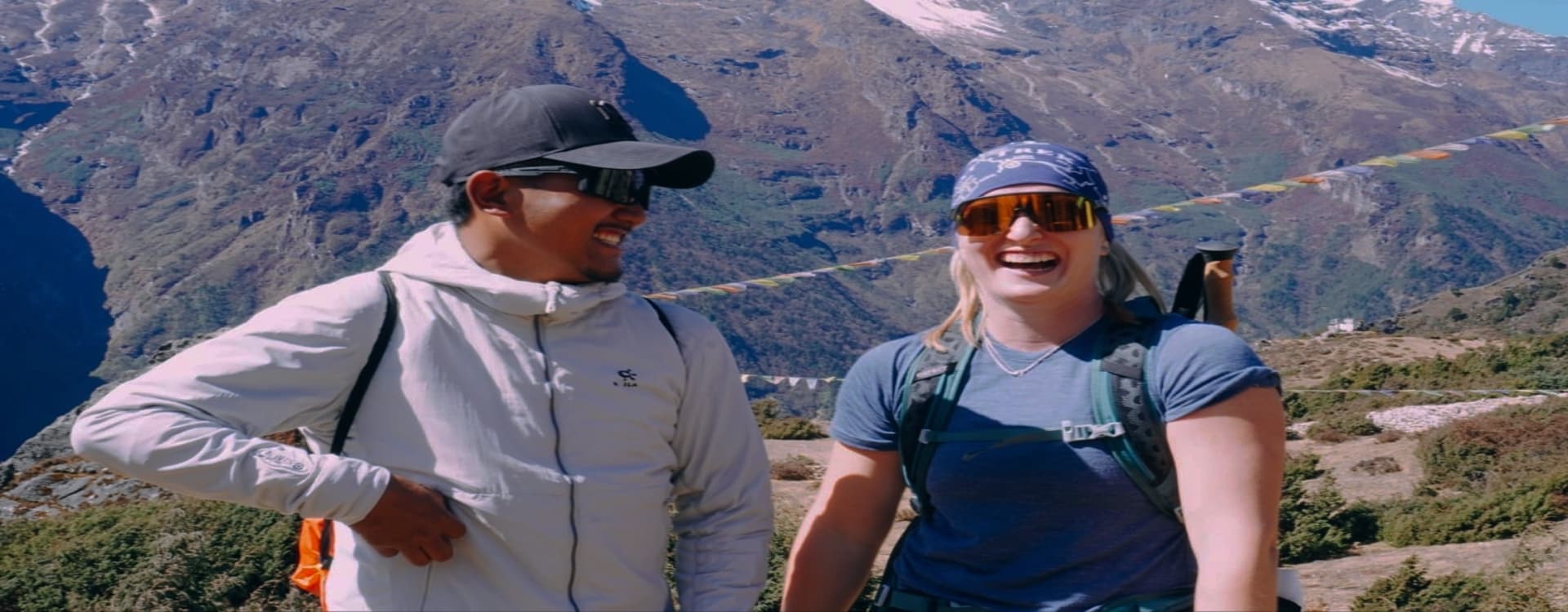
On a private trek, you are with the people you chose. Conversation flows easily, you can keep your own schedule and you can have quiet evenings. Families and close friends often value this because they can share the experience in their own way. Private does not mean isolated, either. Teahouse dining rooms are shared spaces, and you will meet other trekkers and local families at tea stops, in villages and over dinner. You simply decide how much of that you want.
A good question to ask yourself is how you feel at the end of a big day in the mountains. If you picture a table full of new faces, a group may suit you. If you picture a warm dining room, your own company and an early night, a private trek may be the better fit. Neither format is right for everyone, and the best choice depends on your own priorities.
Accommodation and shared facilities
One point causes more surprise than any other, so we will state it plainly. A private trek means a private party, and the trail and the lodges stay shared. You walk the same paths as other trekkers, cross the same bridges and sleep in the same teahouses. Dining rooms are communal, and bathrooms are often shared, particularly at higher altitudes. Teahouse rooms are generally simple, and room availability varies by village and season. Heating in the evening usually comes from a stove in the dining room, which everyone gathers around.
What changes between the formats is how rooms are allocated.
• Open group trek: Rooms are usually twin-share. If you travel alone, you are commonly paired with a traveler of the same gender. A single-room supplement may be available, though availability tends to shrink with altitude, and in some villages a single room is simply not offered.
• Private trek: You choose how to share within your own party. A couple can take a double or twin, friends can pair up as they wish and a family can ask for a family room where the lodge has one. The usual limits of the village still apply.
In Kathmandu and Pokhara, hotels vary widely in style and price. A group departure typically uses the hotel standard written into the package. A private trek leaves more room to choose a level that matches your taste, from a simple guesthouse to a heritage hotel.
Cost factors
Cost is the place where simple answers can mislead, so we will avoid saying that one format is always cheaper.
The basic principle is cost sharing. A trek has costs that stay the same however many people take part, such as the guide's daily rate, a vehicle for transfers and some administrative work. Other costs, such as permits and domestic flight seats, are charged per person regardless of group size. In an open group departure, the shared costs are divided among eight, ten or twelve travelers, which often brings the per-person price down. In a private party of two, those same costs are divided between two people, which often means a higher price per person. A private party of four or six spreads them further and narrows the gap.
Several other factors can move the comparison in either direction:
• Season. Peak spring and autumn dates cost more than shoulder months in both formats.
• Inclusions. Hotels, meals, domestic flights, insurance for staff, porter ratios and permits are packaged differently from one operator to another. A low price can reflect fewer inclusions or less generous staffing, so compare like with like.
• Single supplements. A traveler who joins an open departure and wants their own room may pay extra.
• Extra nights. A delayed flight can mean extra hotel nights, and the cost of those depends on whether your plan has a built-in buffer.
• Tips and extras. Tipping for guides and porters, charging fees, hot showers and bottled drinks are usually extra in both formats.
• Cancellation and change terms. These differ widely. Read them before paying a deposit, because a group departure often has set refund rules and a private trek may allow more adjustment.
A fair way to compare is to ask each operator for a written list of what the price includes and excludes, then line up the lists side by side.
Private trek and open group trek compared
A side-by-side view of the main differences:
|
Feature |
Private Trek |
Open Group Trek |
|
Who You Walk With |
Your own party only |
Travelers booked on the same departure |
|
Start Dates |
Flexible dates within the trekking season |
Fixed departure dates |
|
Itinerary |
Can be tailored to your party |
Follows a set itinerary |
|
Walking Pace |
Adapted to your party’s preferences |
Managed by the guides to suit the group |
|
Extra Rest Days |
More flexibility to add or adjust rest days |
Limited flexibility once the itinerary is set |
|
Guide Attention |
Focused on your party |
Shared across the group |
|
Rooms on the Trail |
Arrangements tailored to your party, subject to availability |
Usually twin-sharing with another trekker |
|
Lodges & Trails |
Shared with other trekkers |
Shared with other trekkers |
|
Cost per Person |
Depends on party size and inclusions; often higher for smaller parties |
Often lower per person, depending on group size and inclusions |
|
Social Experience |
Travel with familiar companions and meet others along the trail |
Built-in companionship with fellow travelers |
|
Booking Process |
Share your preferences, and the itinerary is planned around your needs |
Choose a published departure date and join the group |
Which arrangement suits which traveler
No single format wins for everyone. These pairings describe tendencies, and your own priorities matter most.
A private trek tends to suit travelers who:
• Have fixed dates or limited leave and need the trek to start on a particular day.
• Are traveling as a couple, a family or a group of friends and want the experience to stay within that circle.
• Like a flexible pace, extra rest days or time to explore villages and take photographs.
• Have different fitness levels within their party and want the day shaped around everyone.
• Prefer to choose their own room arrangements.
An open group trek tends to suit travelers who:
• Can match one of the published dates and like the simplicity of booking a ready-made departure.
• Are traveling alone and want company on the trail.
• Enjoy meeting people from other countries and are comfortable sharing rooms.
• Are happy with a fixed itinerary and a shared pace.
• Want to keep the per-person price as low as possible and have confirmed that the inclusions match their needs.
Some travelers sit between the two. A group of friends who like the idea of company can book a private trek with a larger party, which gives them a social trip with familiar faces and shared costs. A solo traveler who wants company will find that an open departure is the format built for that purpose.
Questions to ask an operator before booking
Whichever format you choose, a handful of questions reveal a lot about how a trek will run. We encourage you to ask them of every operator you consider, including us, and to request the answers in writing.
• How many people will be in my group, and is there a maximum?
• If it is an open departure, what is the minimum number needed for the date to run, and what happens if it is cancelled?
• How many guides and assistant guides will there be for my party?
• What is the porter ratio and the maximum load each porter carries?
• How are guides and porters insured, equipped and paid?
• Who decides the pace, and what happens if someone is slower or faster than the rest?
• How are rooms shared, and is a single room possible at each stop?
• What happens if a traveler needs to turn back or rest for a day?
• What does the price include and exclude, in writing?
• What are the terms for changes and cancellations?
Clear, specific answers are a good sign. Vague ones are worth following up.
Our approach to private trekking
Our treks are private, and they start with two travelers.Solo travelers may find our guide to solo trekking in Nepal helpful for current rules and options. That means our guides and crew work with your party, and you decide the start date within the season. We do not run open group departures, and we say so plainly because we want you to choose the format that suits you rather than the one we happen to sell. A private trek also does not give you a private trail or a private lodge. You will share the route and the teahouses with other trekkers, as everyone does in Nepal.
If a private trek sounds right for your party, you can read more about our private trekking approach and how we plan these trips.
Start the conversation
Choosing between a private trek and an open group trek comes down to a few honest questions. When can you travel? How do you like to walk? Who do you want beside you on the trail? How do you want your evenings to feel? If your answers point to a private trek, we would be glad to hear from you. Tell us your dates, the size of your party and the kind of experience you hope for, and share your plans with our team. Our team will be glad to help you work out what is realistic and what suits you best, whether that is with us or with another operator.
About the author: Himal Shrestha
Government-licensed trekking guide & travel writer · Accessible Adventure
Himal Shrestha is a government-licensed trekking guide and travel writer with 10 years and counting in the mountains. Trained in first aid and hospitality, he brings firsthand trekking experience to his articles on Nepal, itinerary planning, and travel preparation for Accessible Adventure.
Meet Himal ShresthaRelated Articles
Explore more stories and guides from the Traveler Information & Planning collection