Planning a Custom Nepal Trip for Travelers with Different Interests
Field-reviewed by Hari Kumar Shrestha
Few travel parties want exactly the same holiday. One partner dreams of mountain passes, and the other would happily spend a week among temples and tea houses. A parent wants the whole family to stand in front of a big peak, while a teenager mostly wants a good story to tell. Three friends agree on "Nepal" and almost nothing else. Planning a trip that works for everyone is a common challenge, and our Kathmandu-based planning team helps with regularly.
The good news is that differences make a trip richer when they are handled early and honestly. This article walks through how companions can agree on a plan, what to say about pace, fitness and comfort, which compromises tend to work in practice, and where Nepal's mountain geography sets real limits on splitting a party. It ends with a worksheet your group can fill in together and a made-up example that shows how a compromise comes about.
Why differences cause trouble, and why they are solvable
Disagreements usually surface late. Someone says yes to a trip without really picturing it, and by day three on the trail the gap shows up. One person is tired and quiet, another is restless, and nobody planned for either feeling.
Nearly all of this is avoidable with a conversation before you book. A trek puts people close together for days, with limited ways to change the plan once you are in the hills. It also runs on a fixed rhythm of walking, eating and sleeping, so small mismatches grow quickly. Talking through expectations at home, where there is time and a comfortable chair, costs almost nothing.
As a registered trekking agency based in Kathmandu, our job as a planner is to turn those conversations into a plan with room for everyone. That starts with understanding what each person wants.
Step one: identify each person's priorities
Ask every traveler to think alone first. Group discussions tend to favor the loudest voice, and a quieter person may not mention what matters most to them. Give each person a few minutes with three prompts:
• One experience I would hate to miss.
• One thing I would happily skip.
• One thing I am unsure about and want to talk through.
Then compare. Most parties discover that the overlap is larger than they expected. The person who wants mountains and the person who wants culture often both love the same village at the end of a trail, with its stone houses, prayer flags and a long dinner by the stove. The differences that remain are easier to solve once you can see them clearly.
Write the answers down. A shared list stops the same debate from restarting every time someone gets tired or hungry, and it gives us something concrete to work with when you contact us.
Step two: be honest about experience and pace
Pace is the biggest source of friction on the trail, so it deserves a frank discussion. Start with experience. Has each person done multi-day walks? Has anyone slept above 3,000 metres? How long can each person comfortably walk in a day, and over how many days in a row?
Two habits make the answers more useful. First, describe what has actually happened, such as "I did a four-day hut walk last summer and felt fine on day three." A record of how you did tells us more than a guess about how you might cope. Second, talk about how you recover. Some people feel strong on day one and fade by day four. Others start slowly and gain energy. A planner reads those patterns differently from a single fitness number.
Then decide how the group will handle the gap. Most itineraries are built around the person who needs the most time, because the stronger walkers can cope with a gentler pace more easily than the reverse. Good planning builds rest and variety into the days so the faster walkers have something to look forward to, such as an optional afternoon walk from the lodge or an early start for a viewpoint.
On many routes, a guide can also manage the day so both walkers get what they want. A stronger walker can set off a little ahead at their own speed while the guide stays with the slower walker, and everyone meets again at the lodge. That works where the trail is clear and the arrangement is agreed beforehand, and it is something to raise with us early so the guiding and porter plans match.
Fitness and age: what the evidence says
Parties often assume that the oldest person or the least athletic person will be the limiting factor. That assumption deserves some care, because the medical evidence on altitude shows a more interesting picture.
Travel medicine guidance, including the 2026 edition of the CDC Yellow Book, written by altitude-medicine specialists Peter Hackett and David Shlim, says that physical fitness does not protect against altitude illness. A very fit person can feel unwell at height, and a modestly fit person can feel fine. The same guidance names the rate of ascent as the most important risk factor, with a previous history of altitude illness close behind. Travel-medicine references, including the CDC Yellow Book, note that previous performance at altitude is probably the best single predictor of how someone will do next time.
Age behaves differently from what many people expect. Studies of age and altitude illness are mixed. Some find older travelers less affected, and others find no link, so a traveler's years alone say little. Children appear to be about as vulnerable as adults, with one more complication: younger children may have trouble telling an adult how they feel, which makes symptoms harder to spot.
What does this mean for a mixed party?
• Choose routes and pacing by experience and history, with age and fitness as only part of the picture. A fit 25-year-old and a 60-year-old with a long record of mountain walking might both do well on the same schedule, and either could struggle.
• Build gradual ascent and rest days into the plan for everyone. This helps all travelers, and it removes some of the pressure on whoever feels slowest.
• Say what you know about your own history with altitude. If someone has felt unwell high up before, tell us, because it shapes the route.
• See a doctor, ideally one experienced in travel or altitude medicine, before you go, and ask whether preventive medication is appropriate for you. Health questions belong with a professional who knows your history, and any serious medical matter is worth discussing privately with us before a plan is set.
Health support in remote areas aries, is often limited to basic first aid and small village health posts, and cannot be promised, so we plan realistic days, build in margin and talk openly about what each route involves.
Find the shared activities everyone enjoys
Once priorities and pace are on the table, look for the overlap. Think about activities that give different people different rewards from the same experience. A village walk can satisfy a photographer, a history lover and someone who just enjoys being outdoors. A lakeside afternoon in Pokhara suits both the person recovering from a long walk and the person who wants a gentle paddle. A sunrise viewpoint reached by a short climb can please those who love early mornings, with others joining by a gentler route if one exists.
Shared moments matter. When a party spends most of the trip doing separate things, the holiday can feel like several trips glued together. Aim for a handful of experiences everybody looks forward to and let those anchor the plan. The remaining days can flex around individual tastes.
Agree on accommodation, budget and rest time
Comfort and money are the quiet source of many disagreements. One traveler is happy with a simple teahouse room and a shared bathroom. Another has a strong preference for a private room, a hot shower and a comfortable hotel at either end of the trek. Neither is wrong, and both are easier to manage if they are on the table early.
Some questions to settle together before talking to us:
• How much should each person spend, and is the budget per person or shared?
• Is a private room important for anyone, and where?
• Does anyone want a comfortable hotel in the cities to balance simple lodges on the trail?
• How much rest does each person want in the plan? Some travelers love a slow day, and others get restless.
Where the answers differ, mixing is a practical solution. Simple lodges on the trail and a nicer hotel at the end suit many parties. Teahouses vary a great deal by route and altitude, and higher up the choices narrow, so it helps to hear what each place realistically offers before you decide what to compromise on.
Optional activities and separate arrangements
Sometimes the best solution is for the party to do different things for part of the trip. One person might spend a day in Kathmandu while the others walk. Two travelers might take a rest day at a lodge while others make a side trip to a viewpoint and return. Separate arrangements work well in cities and at the start and end of a trek, where transport and guides are easy to organize.
Raise these ideas with us early. Doing things separately usually means extra arrangements: another guide, another vehicle, another set of tickets or an additional room, and those carry extra cost. Some activities depend on season and availability. We can only arrange them well when we know about them ahead of time.
A day of separate time can also improve the whole trip. Many parties find that a few hours apart give everyone a chance to rest, to have an experience of their own and to compare notes at dinner.
Limits on splitting a party on remote routes
On a remote trek, the geography leaves much less room to split up, and it is better to understand why before you plan around it.
Under Nepal’s trekking regulations, administered by the Department of Tourism, foreign trekkers need a licensed guide arranged through a registered agency in most trekking areas. If your party splits into two groups, each group needs its own guide, and that means extra staffing and cost. In restricted areas, a single guide may lead no more than seven trekkers under the rules updated in March 2026 (please confirm the current wording with the Department of Tourism or your agency before travel), which can matter for larger parties.
Distance matters as well. On many routes, you are one to several days' walk from the nearest road. If one person wants to turn back midway, they will need a guide to accompany them, and the route down may take as long as the route up. Helicopter evacuation is sometimes possible and is usually coordinated between the guide and the traveler’s insurer, though it depends on weather, on location and on your insurance, and it is never something to count on. Phone coverage is patchy in many valleys, so splitting up mid-trek is harder to coordinate than it sounds.
For these reasons, we usually advise parties to make their split decisions at the start of a trek, in places with road access. Halfway along a remote valley is a hard place to change plans. We also recommend that every traveler check that their travel insurance covers trekking to the highest altitude on the planned route, including emergency evacuation by helicopter, and confirm the policy’s maximum altitude in writing.
If you suspect that one person might not complete a long, remote route, the better answer is usually a different route or a shorter one that suits the whole party. A trek that everyone can finish together beats an ambitious plan that forces a split.
Settle disagreements before they turn into standoffs
Even with a worksheet, some choices stay stuck. Two people want different things, and neither is willing to give way. A few ground rules help.
Agree on how decisions will be made before you argue about a specific one. Some parties give each traveler one must-have that the others commit to protecting. Others rotate, so one person's priority shapes this stage of the trip and another person's shapes the next. Both approaches work because everyone can see that their turn is coming.
Listen hardest to the quietest person. In many parties, the traveler who says least is the one who is most nervous about the pace, the altitude or the cost, and a worry kept to themselves can surface at a bad moment on the trail. A direct question such as "What would make this trip hard for you?" often opens a conversation the group needs.
Finally, give the planner the real disagreement. If you tell us "we cannot decide between a longer trek and more time in the cities," we can sketch both and show what each one costs in days, effort and money. Seeing the trade-offs written out often settles an argument that discussion alone could not.
A simple travel-party preference worksheet
Print this table or copy it into a document, and have each traveler fill in their own column before you compare. Keep the answers short.
|
Questions |
Travelers 1 |
Travelers 2 |
Travelers 3 |
|
The one experience I would hate to miss |
|||
|
Something I am unsure about |
|||
|
Walking I enjoy (hours per day, steady or slow) |
|||
|
Highest I have slept before |
|||
|
Comfort that matters most (room, bathroom, food) |
|||
|
How much rest I like in a holiday |
|||
|
What I would give up to keep the group together |
|||
|
One thing I want to do on my own, if anything |
Read the answers aloud together. Mark the items that appear in more than one column, then mark the ones where the group disagrees. The overlap becomes the backbone of the plan, and the disagreements become the short list of things to talk through with a planner.
A hypothetical example of reaching a compromise
The example below is invented to show how a conversation can go. It does not describe a real group.
Four relatives are planning a trip: two adults in their forties, a teenager and a grandparent in their sixties who has done a lot of walking in the hills at home. Each fills in the worksheet separately.
The adults both want mountain views and a real trek. The teenager is happy to walk but gets bored by long stretches without something new to see. The grandparent loves slow walking and village life, has no interest in high passes and would like a comfortable room each night. Nobody has trekked in Nepal before, and none has slept above 3,000 metres.
Reading the sheets side by side, they notice that all four marked "a village and its people" as something they enjoy. All four also marked a comfortable room as important at least once. The adults' wish for big views and the grandparent's wish for a gentler pace are the main tension.
Here is the compromise they talk through with the planner. They choose a moderate route that stays below the highest altitudes, which suits the grandparent and spares anyone from a hard push. They build in an extra rest day at a scenic village, where the adults can take a half-day walk to a viewpoint while the grandparent explores the village at their own speed. They ask for private rooms wherever lodges can provide them. A licensed trekking guide will move at the pace of the slowest walker, and the teenager will have time to walk ahead with the guide's agreement on clear sections and regroup at the lodge. Before the trek, they add a couple of easy days in the cities so everyone starts rested.
Each person got at least one thing they had named as important, and everyone knew in advance what the plan would look like.
Keep the plan flexible once you arrive
A good plan for a mixed party has some slack in it. Someone may feel stronger or weaker than expected, the weather may change a day, or a village may turn out to be more interesting than anyone guessed. A spare half-day, a rest day with options and a licensed guide who is willing to adjust the pace and check in on how each traveler is feeling let the group respond as they go.
It also helps to agree on small rules for the trail. Decide in advance how the group will check in with one another, what a person should say if they feel unwell and who will make the call if the group has to choose between pressing on and resting. With those few points settled, the trek can unfold at an easier pace for everyone.
Talk it through with your planner
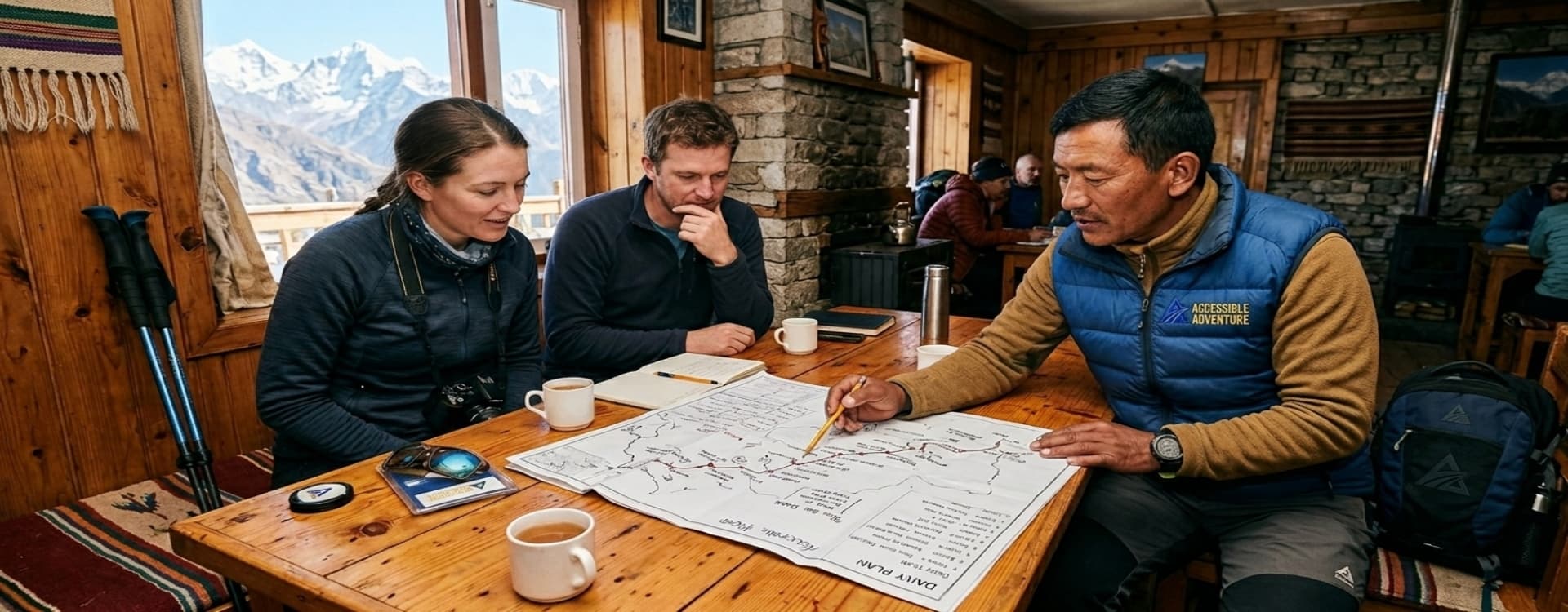
When your party is ready to approach a planner, bring the worksheet and a clear idea of where you agree and where you still disagree. A good planner works with the real picture, disagreements included, and tells you plainly which parts of the plan look easy to combine and which will need a trade-off.
Useful topics to raise:
• Which route suits the whole party, given our experience and our concerns about altitude?
• How would a split work, and what would it add in cost and staffing?
• What happens if someone needs to rest or turn back?
• Which parts of the plan could include separate activities without disrupting the rest?
• How do we keep the plan flexible if our needs change after we arrive?
Plan a trip around your whole party
A trip built around a travel party needs a little more thought than a solo adventure, and it usually repays that effort many times over. If you are ready to start, you can plan a trip around your travel party with our team. Send us your worksheet, your dates and your questions, and discuss your group's travel preferences with us by email at info@accessibleadventure.com or through our contact page. We will help you find a plan that works for everyone in the group.
About the author: Himal Shrestha
Government-licensed trekking guide & travel writer · Accessible Adventure
Himal Shrestha is a government-licensed trekking guide and travel writer with 10 years and counting in the mountains. Trained in first aid and hospitality, he brings firsthand trekking experience to his articles on Nepal, itinerary planning, and travel preparation for Accessible Adventure.
Meet Himal ShresthaRelated Articles
Explore more stories and guides from the Traveler Information & Planning collection