
Why Choose Mera Peak Climbing?
Last updated
Mera Peak Climbing is a 16-day guided expedition to 6,476 meters, making it the highest of Nepal's 27 NMA-designated trekking peaks and the most achievable serious high-altitude summit in the Himalaya. The route follows the Hinku Valley through Chutanga, Zatrwa La, Thuli Kharka, Kothe, Thangnag, Khare, Mera High Camp, and the summit. It is designed for fit trekkers and first-time Himalayan climbers who want a real 6,000-meter objective without needing advanced technical mountaineering skills. The current offer price for this package is USD 2,295 per person, with the standard rate at USD 2,350.
The Hinku Valley approach is one of the main things that sets this route apart from other Everest region climbs. From Lukla, the trail heads southeast instead of north toward Namche Bazaar, which means the crowds that define most Khumbu routes disappear almost immediately. By Day 3, when the team crosses Zatrwa La Pass at 4,610 meters and drops into the upper Hinku, the only people on the trail are this group and the yak herders who have worked the valley for generations. That combination of genuine remoteness and a serious altitude summit is genuinely rare at this price point anywhere in the world.
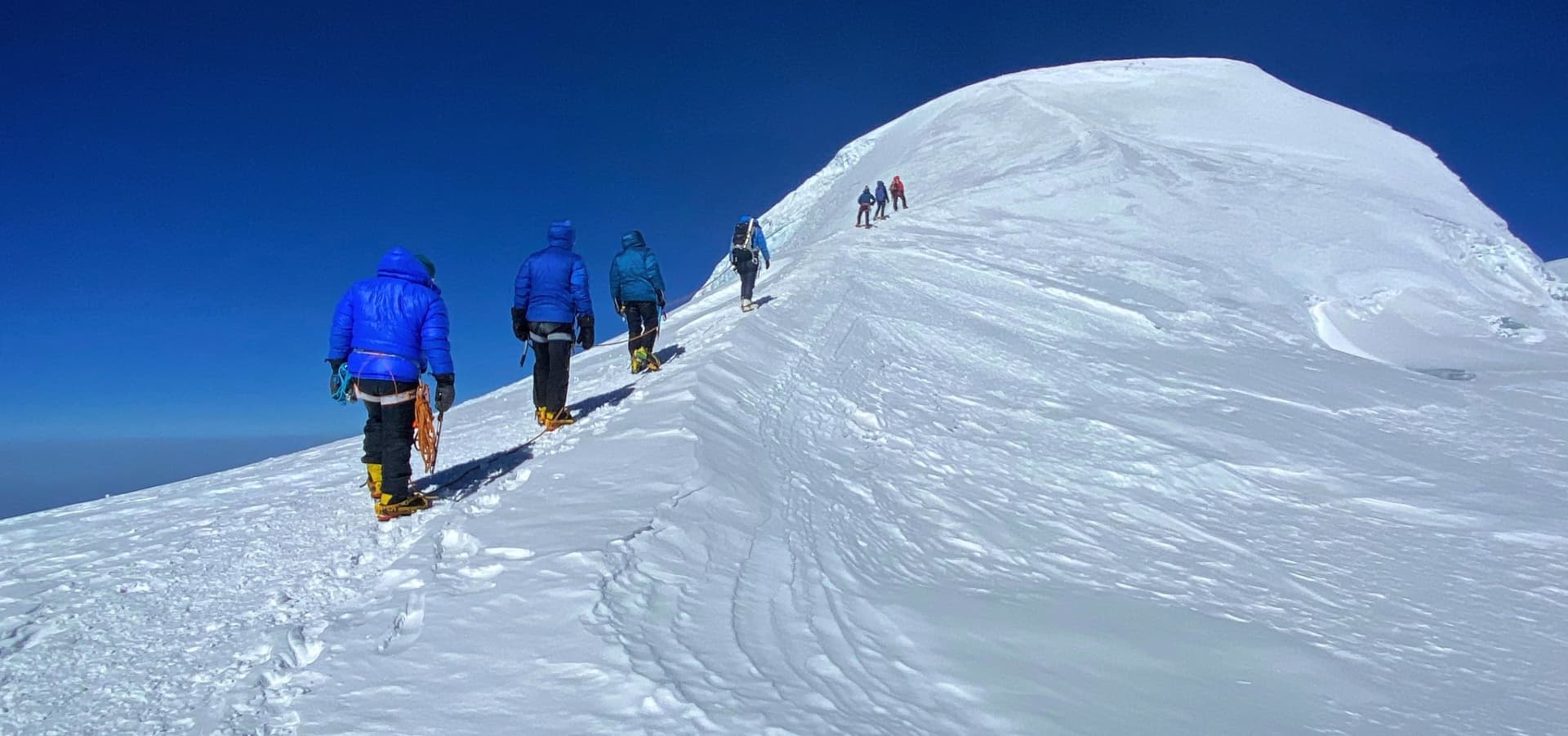
Mera Peak is often described as less technical than Island Peak, and that is accurate. The normal route is a moderately angled glacier ascent on the northern face, peaking at 30 to 45 degrees on the steepest fixed rope section near the summit ridge. What makes it hard is not the technical complexity but the altitude, the cold, and the length of summit day. Starting from High Camp at 5,800 meters before dawn and climbing 676 vertical meters to the top before descending all the way back to Khare takes most teams 10 to 12 hours. On a clear morning, the view from the top includes five of the world's fourteen 8,000-meter peaks: Everest, Lhotse, Makalu, Cho Oyu, and Kanchenjunga. That panorama is the reward the climb has been building toward since Day 1.
This 16-day itinerary is built around a specific set of decisions. Two nights at Khare at 5,000 meters, with a full dedicated training day, give the body adequate time to adjust before the High Camp move. A weather contingency day on Day 10 provides a genuine second summit window if conditions on Day 9 are unsuitable, which removes the pressure that compresses shorter itineraries create. And the Day 7 glacier training session covers crampon technique, ice axe use, and fixed rope movement on real glacier terrain above 5,000 meters, 24 hours before the summit push. These choices consistently produce better summit outcomes and safer experiences than programs that skip them.
Quick Facts
|
Trip Detail |
Information |
|
Duration |
16 Days |
|
Max Altitude |
6476m |
|
Highest Overnight |
5,800 m (Mera High Camp) |
|
Difficulty |
Strenuous to Challenging | Alpine Grade PD |
|
Start / End |
Kathmandu, Nepal |
|
Best Season |
March to May and late September to November |
|
Accommodation |
3 nights hotel in Kathmandu, teahouses on trek, tented camp at High Camp |
|
Meals |
Breakfast, lunch, and dinner included on all trekking and climbing days |
|
Guides |
Government-licensed trekking guide plus certified climbing guide |
|
Technical Grade |
Alpine PD (non-technical glacier ascent with fixed rope sections) |
|
Permits Included |
NMA climbing permit, Sagarmatha National Park, Khumbu Pasang Lhamu, TIMS |


