No cancellation fees. No hassle. Book Now, Cancellation Terms
Peak Climbing InformationPeak Climbing+20
2 min readBest Time to Climb Island Peak: Spring vs Autumn
September 22, 2026
2 min
2 views
A month-by-month breakdown of weather, ice conditions, and crowds, and how to pick the season that actually suits your climb
Timing an Island Peak climb comes down to a narrower window than most first-time climbers expect. Nepal's Himalaya operates on a fairly strict weather calendar, shaped by the monsoon, and Island Peak sits squarely inside a mountain range where that calendar is not a minor inconvenience. It is the difference between standing on the summit with clear views in every direction and turning back at the headwall because fresh snow buries the fixed ropes.
Two windows dominate the climbing calendar here, spring and autumn, and most climbers eventually narrow their planning down to a choice between the two. Both deliver strong summit conditions in a typical year, but they are not identical, and the differences matter more than a quick glance at a seasonal chart suggests. Ice texture on the headwall, crowding on the trail, temperature swings between day and night, and even the specific week within each season all shift the experience in ways worth understanding before you commit to dates.
This guide breaks down exactly what spring and autumn each bring to an Island Peak attempt, why winter and monsoon climbs carry real additional risk, and how to choose between the two main seasons based on what you personally want out of the trip.
It is worth saying upfront that the difference between a well timed climb and a poorly timed one rarely comes down to luck alone. Nepal's Himalayan weather follows recognizable seasonal patterns shaped by the South Asian monsoon system, and understanding roughly how and why those patterns shift through the year makes it much easier to read conditions reports, trust your operator's seasonal recommendations, and set realistic expectations for your specific dates.
The Short Answer
Spring, running roughly from March through May, and autumn, running roughly from September through November, are the two established climbing windows for Island Peak. Both offer generally stable weather, established fixed ropes on the headwall, and reliable Lukla flight schedules. Spring tends to bring slightly warmer daytime temperatures and harder, more consolidated ice on the headwall, which rewards precise crampon technique. Autumn tends to bring the clearest mountain views of the year and often somewhat softer, more forgiving snow conditions on the same section, post-monsoon.
Neither season is definitively better across every measure, and the right choice usually comes down to whether you prioritize warmer temperatures and rhododendron blooms on the lower trail, or crisp visibility and slightly quieter trails higher up. Both windows are avoided in favor of the shoulder seasons, winter and monsoon, for good reason, which the sections below cover in detail.
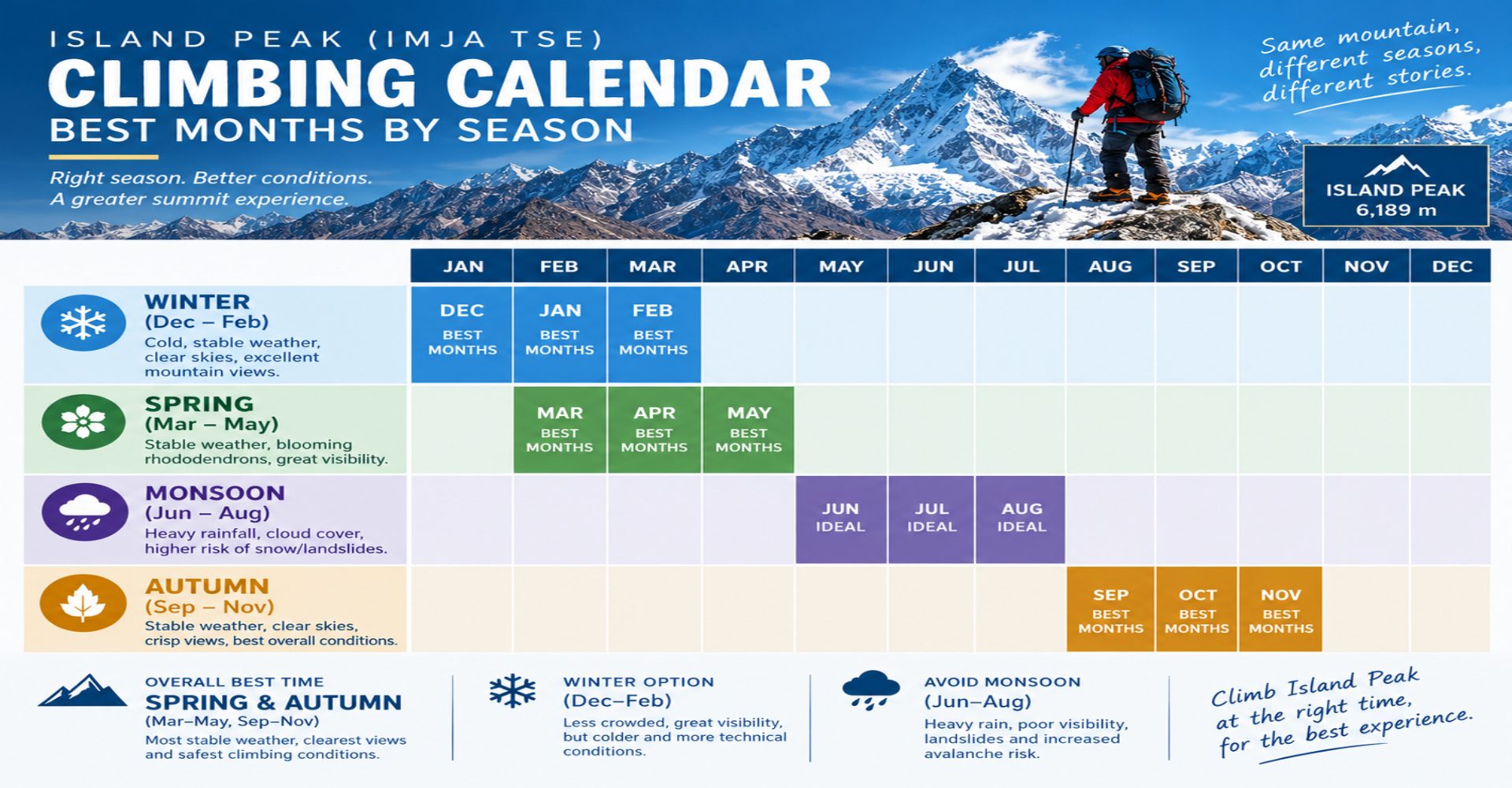
Island Peak Climbing Calendar at a Glance
|
Month |
Conditions |
Recommendation |
|
March |
Cold but improving, occasional late-winter snow |
Early spring option, fewer crowds |
|
April |
Stable weather, consolidated ice, warming days |
Peak spring month, widely recommended |
|
May |
Warmest spring temperatures, afternoon cloud buildup increases |
Strong option, aim for early starts |
|
June |
Pre-monsoon transition, increasing rain and humidity |
Not recommended |
|
July |
Full monsoon, heavy rain, high avalanche and rockfall risk |
Avoid |
|
August |
Monsoon continues, poor visibility, unstable snow |
Avoid |
|
September |
Monsoon tapering off, trails still drying out |
Late option, improving through the month |
|
October |
Clearest skies of the year, stable weather, cool nights |
Peak autumn month, widely recommended |
|
November |
Cold but stable, shorter daylight hours |
Strong option into early November |
|
December |
Very cold, strong winds, reduced operator support |
Not recommended for most climbers |
|
January |
Coldest month, high winds, minimal operator activity |
Avoid outside experienced winter attempts |
|
February |
Still cold, transitional toward spring by late month |
Generally avoid, marginal conditions |
Climbing Island Peak in Spring
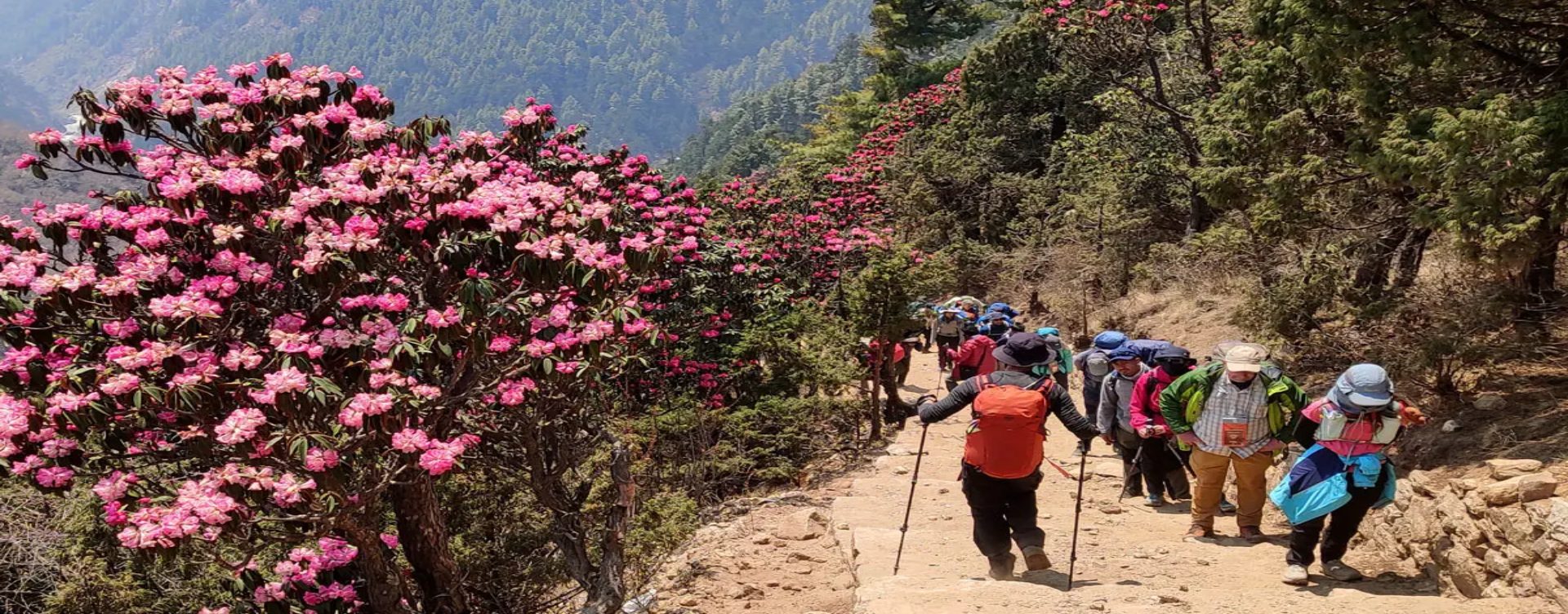
Spring is the most popular season on Island Peak, and for good reason. As winter loosens its grip through March, temperatures climb steadily, snowpack on the lower approach stabilizes, and the trail through the Khumbu comes alive with blooming rhododendron forest between Lukla and Namche Bazaar. By April, most operators consider conditions close to ideal.
Spring Weather and Temperatures
Daytime temperatures at base camp and on the lower trail typically range from about 5 to 15 degrees Celsius, dropping to minus 10 degrees Celsius or lower at higher camps and on summit night. Daylight hours lengthen through the season, often reaching 12 to 14 hours by April and May, which gives climbing teams more flexibility on a long summit day. Mornings tend to be calm and clear, with afternoon cloud buildup becoming more common as the season progresses into May, which is one reason most operators push for an early alpine start on summit day regardless of season.
Spring Ice and Snow Conditions
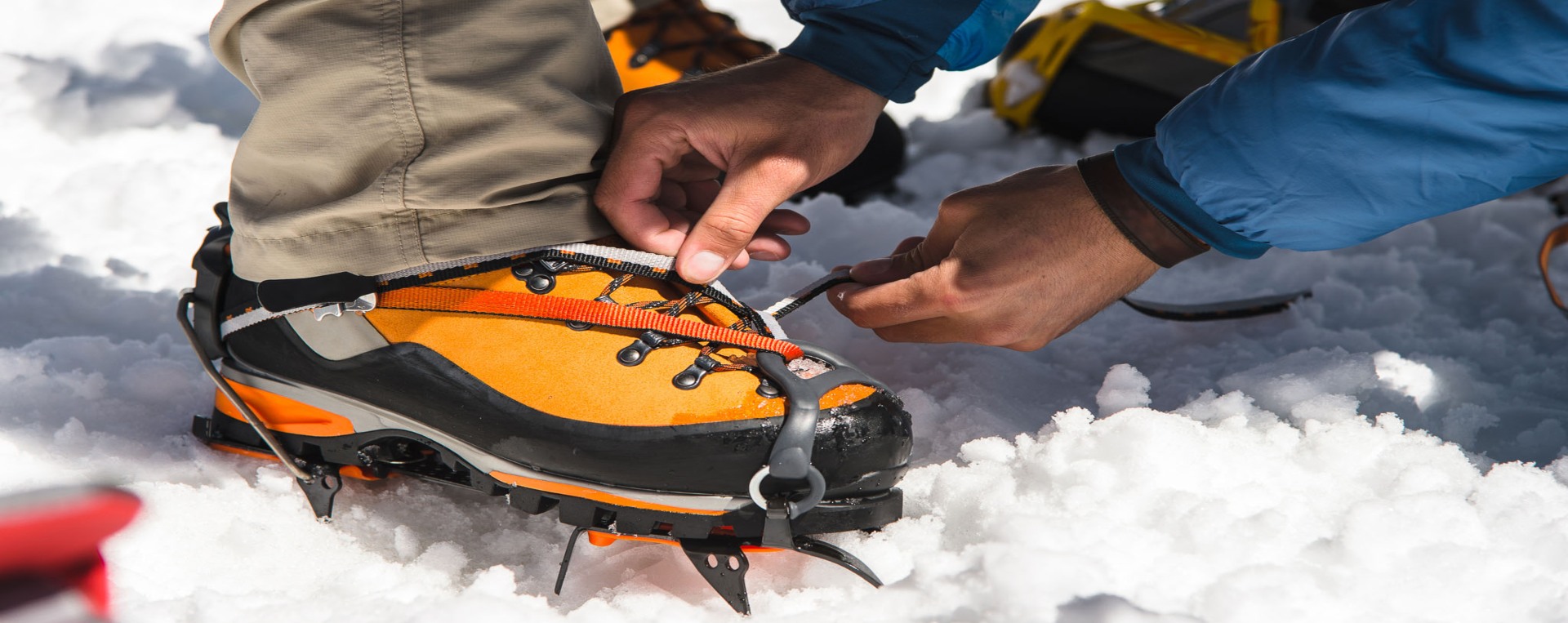
This is where spring genuinely distinguishes itself from autumn. Pre-monsoon climbs in spring tend to meet harder, more consolidated ice on the headwall, sometimes described by guides as glassy or firm underfoot. This rewards precise, deliberate crampon placement and generally produces a more predictable climbing surface, though it also means the wall can feel unforgiving if your footwork technique is not dialed in. Climbers with some prior crampon experience often find spring conditions particularly rewarding, since firm ice holds an edge well and the fixed ropes tend to run through well anchored, established terrain by this point in the season.
Spring Crowds and Logistics
Spring is peak trekking season across the entire Everest region, not just for Island Peak climbers. Everest Base Camp trekkers, other trekking peak expeditions, and Everest expedition teams all share the same trail through Namche Bazaar and Tengboche during April and May, which means busier teahouses, more climbers on the headwall's fixed lines on any given day, and the need to book accommodation and permits further in advance. Lukla flights run reliably during this window but can still face weather delays, and it is worth budgeting a buffer day on both ends of the trip regardless of season.
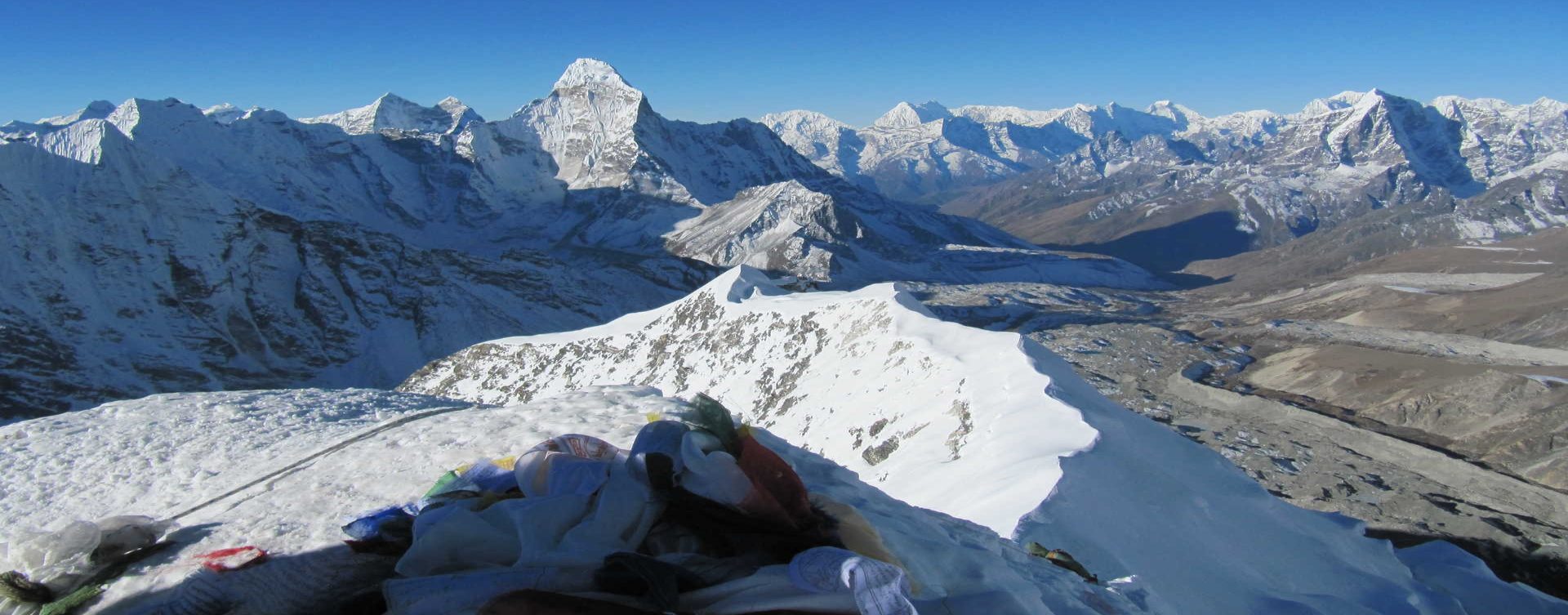
Climbing Island Peak in Autumn
Autumn rivals spring as the best time to climb Island Peak, and many experienced guides consider it the stronger of the two windows specifically for summit day visibility. September brings the tail end of the monsoon, with clearing skies becoming more consistent as the month progresses. By October, the region typically settles into some of the most stable weather of the entire year.
Autumn Weather and Temperatures
Daytime temperatures at lower altitudes generally run from around 10 to 20 degrees Celsius, cooling considerably at higher camps and during the pre-dawn summit push, similar to spring's cold snap on summit night itself. The post-monsoon air is notably drier and clearer than at almost any other point in the year, which translates directly into the kind of sweeping, unobstructed Himalayan views that make Island Peak's summit photographs so striking. Nights grow colder as the season progresses into November, and daylight hours shorten steadily, which is worth factoring into summit day planning since a later season attempt leaves a narrower window of daylight for a long climbing day.
Autumn Ice and Snow Conditions
Post-monsoon autumn climbs often find more consolidated snow on the headwall rather than the harder blue ice more typical of spring, a byproduct of the moisture the monsoon leaves behind settling and firming up as temperatures drop through September and October. This snow tends to be somewhat more forgiving underfoot than spring's harder ice, though it can also be slower going in places, since snow depth and consistency shift more noticeably through the season than the more uniformly hard ice conditions spring tends to offer. Neither condition is objectively easier across the board, and conditions can shift within a single season depending on recent weather, which is one of the reasons a guide's real-time judgment on summit day matters more than any fixed seasonal generalization.
Autumn Crowds and Logistics
Autumn draws fewer total trekkers to the region than spring, though it remains a genuinely busy season by any normal standard, particularly through October. Climbers seeking a quieter trail and a less crowded headwall on summit day often find autumn, especially the second half of October and into November, noticeably calmer than peak spring weeks. Lukla flights tend to run with similar reliability to spring, benefiting from the same settled post-monsoon weather pattern that makes the climbing conditions favorable in the first place.
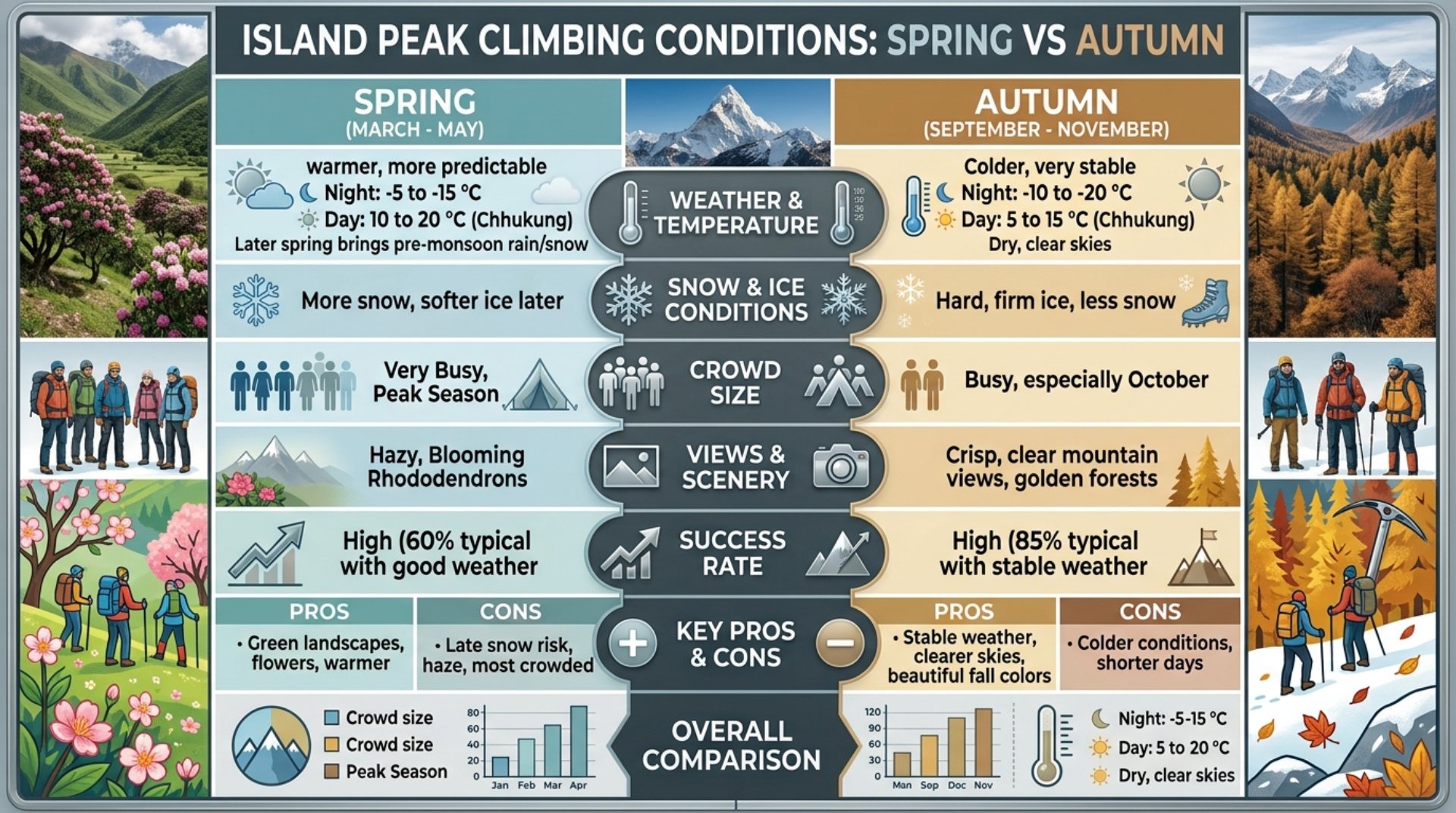
Spring vs Autumn at a Glance
|
Category |
Spring (March to May) |
Autumn (September to November) |
|
Daytime temperature |
5 to 15 degrees Celsius at lower elevations |
10 to 20 degrees Celsius at lower elevations |
|
Headwall ice conditions |
Harder, more consolidated blue ice |
Softer, more consolidated snow |
|
Visibility |
Good, with afternoon cloud buildup by May |
Often the clearest skies of the year |
|
Crowds |
Busiest season of the year |
Busy but generally lighter than spring |
|
Scenery bonus |
Rhododendron blooms on the lower trail |
Crisp, dry post-monsoon air and mountain views |
|
Daylight hours |
Longer, up to 12 to 14 hours by May |
Shorter, decreasing through November |
|
NMA permit fee |
Higher, 350 US dollars for foreign climbers |
Lower, 175 US dollars for foreign climbers |
Why the Permit Fee Changes by Season
One detail that surprises many first-time climbers is that the Nepal Mountaineering Association charges a different climbing permit fee depending on the season. Under the current fee schedule, foreign climbers pay 350 US dollars per person for a spring ascent, and 175 US dollars for an autumn, winter, or summer climb. This structure effectively makes autumn, along with the off-seasons, the cheaper permit option by a meaningful margin, which is worth factoring into your season decision if budget is a significant consideration alongside weather and crowd preferences.
Why Nepal's Seasons Behave This Way
The seasonal pattern that shapes Island Peak's climbing calendar traces back to the South Asian monsoon, a large-scale weather system that dominates the region's annual cycle far beyond just Nepal. Moisture-laden winds sweep north from the Bay of Bengal starting around June, colliding with the Himalayan range and dumping heavy rainfall across the lower valleys and correspondingly heavy snowfall at altitude through roughly the end of August. This is the mechanism behind monsoon's poor climbing conditions, and it is also why the season breaks so distinctly once the monsoon retreats each September.
Spring operates on the other side of this cycle, in the dry, cooling months before the monsoon builds. Winter's cold snap gradually loosens through February and March, and by April the region typically settles into the stable high-pressure pattern that defines the best of the spring climbing window, right up until the monsoon begins building again through late May and into June. Autumn is essentially the mirror image, a settling-out period immediately after the monsoon clears, when the atmosphere is at its driest and clearest before winter's cold reasserts itself from December onward. Understanding this underlying rhythm is part of why spring and autumn consistently outperform the shoulder seasons, rather than the timing being an arbitrary convention operators simply repeat each year.
What Summit Day Feels Like in Each Season
Numbers on a seasonal chart only tell part of the story. Walking through what an actual summit push feels like in each window makes the practical difference easier to picture.
A Spring Summit Push
Most spring teams leave base camp between midnight and 3am, moving through crisp, cold air over rock and moraine before reaching the crampon point. The glacier crossing and headwall tend to present firmer, harder ice underfoot, which many climbers describe as reassuring once they trust their crampon placement, since the surface holds an edge predictably. Mornings are typically calm, and by the time the team reaches the summit ridge, the longer spring daylight hours mean there is usually a comfortable margin before any afternoon cloud buildup rolls in. Descent back to base camp happens in full daylight for most of the way, and the surrounding rhododendron forest lower on the trail adds a welcome burst of color to the final trekking days after the climb.
An Autumn Summit Push
Autumn summit attempts follow a similar structure but with a few notable differences. The cold on summit night can feel just as sharp as spring, sometimes sharper as the season moves toward late October and November, but the payoff tends to be exceptional visibility, with crisp, dry post-monsoon air producing some of the clearest panoramic views available anywhere on the mountain. The snow on the headwall, generally softer and more consolidated than spring's harder ice, can feel more forgiving underfoot, though climbers sometimes note it requires slightly more deliberate step-kicking in places. Shorter daylight hours later in the season mean teams often plan a slightly earlier departure from base camp to preserve the same safety margin spring's longer days provide naturally.
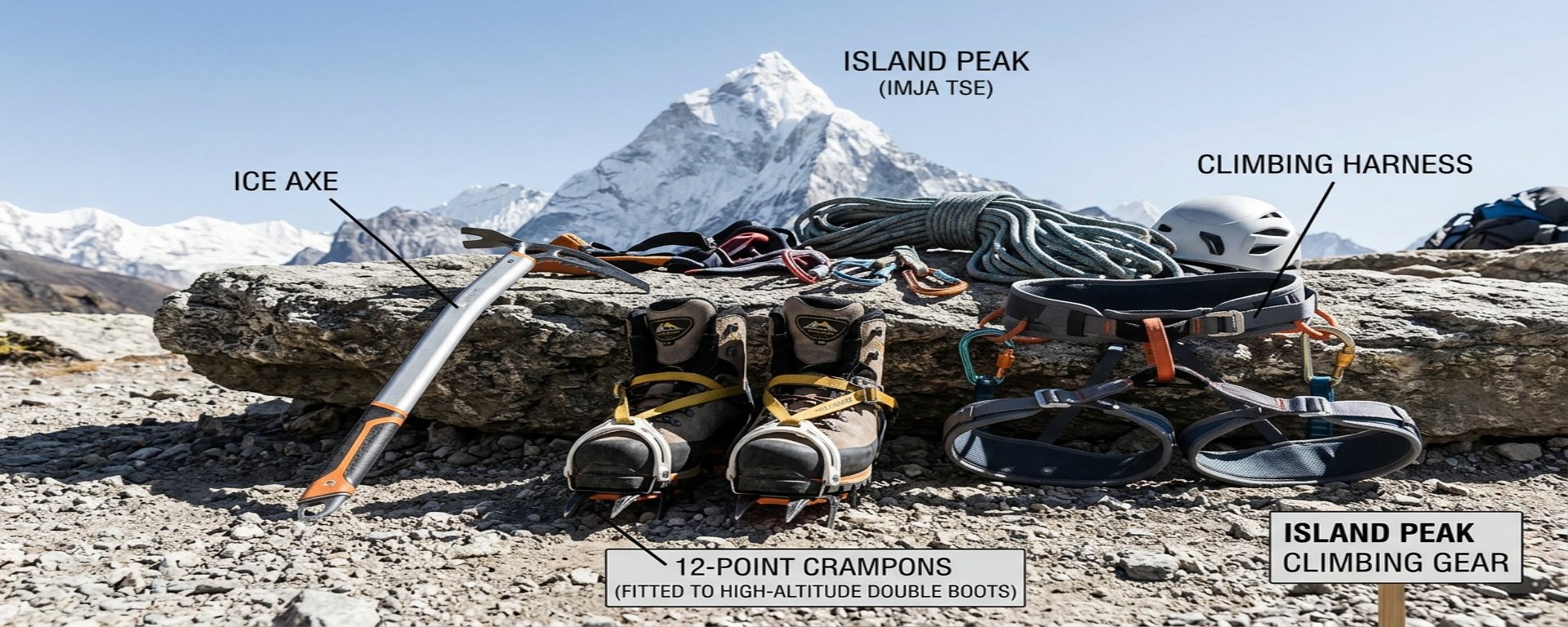
How Your Gear List Changes by Season
The core Island Peak gear list , mountaineering boots, crampons, harness, ice axe, and cold weather layering, stays essentially the same across both climbing windows, since summit night is genuinely cold regardless of which season you choose. A handful of details do shift enough to be worth planning around.
Spring Packing Considerations
Because spring days on the lower trail run warmer, a slightly lighter daytime layering system works well for the trekking approach, with the heavier insulated pieces reserved for camp and summit night specifically. Sun protection deserves real attention in spring, since longer daylight hours and stronger UV exposure at altitude combine with snow glare on the glacier to create genuine risk of sunburn and snow blindness if sunglasses and sunscreen are treated as an afterthought. Given the harder ice conditions typical of spring, well-maintained, sharp crampon points make a noticeable difference in security on the headwall, so it is worth having crampons professionally sharpened or checked before departure if you are bringing your own.
Autumn Packing Considerations
Autumn's colder overnight temperatures, particularly by late October and into November, push many climbers toward a slightly heavier insulated layer for camp life at Chhukung and base camp, even if summit night gear itself does not change dramatically. Shorter daylight hours later in the season mean a reliable headlamp with fresh batteries matters even more than usual, since more of both the approach to the glacier and the descent may happen in darkness compared to a long spring daylight window. The softer snow conditions common on autumn's headwall can pack into crampon points more than spring's harder ice does, so a small tool or firm tap to clear snowballing from crampons periodically during the ascent is worth knowing how to do before summit day.
Timing Your Training Around Your Chosen Season
Physical preparation for Island Peak does not change fundamentally based on season, but the calendar around your training does. Climbers targeting an April summit typically need to have serious training underway by December or January, given how much of the winter falls within the standard three to four month preparation window. Climbers targeting an October summit have a natural advantage here, since summer months offer better outdoor training conditions in much of the world, including easier access to hiking trails, longer daylight for training sessions, and often better opportunities to test gear on local terrain before departure.
Whichever season you target, the training principles stay the same. Cardiovascular endurance built through multi-hour hikes, ideally with a loaded pack, upper body and core strength for the jumar ascent, and if possible even a single practice session with crampons and an ice axe before departure, all matter regardless of which window your dates fall within.
Why Winter and Monsoon Are Generally Avoided
Island Peak can technically be attempted outside the two main windows, and a small number of experienced climbers do attempt winter ascents each year. For the large majority of climbers, though, both winter and monsoon carry risks that outweigh whatever appeal a quieter mountain might offer.
Winter: December Through February
Winter brings genuinely extreme cold to the Khumbu, with high camp and summit conditions regularly dropping well below what most climbers have trained or equipped for. High winds compound the cold significantly, and the combination of deep, occasionally unstable snow with reduced daylight hours narrows the safety margin on an already long summit day. Many operators reduce or suspend guided departures during the coldest stretch of winter, and climbers who do attempt it typically need more advanced cold weather experience and gear than a standard spring or autumn ascent requires.
Monsoon: June Through August
Monsoon season brings heavy rainfall to the lower approach trail and correspondingly heavy snowfall at altitude, both of which create serious problems for an Island Peak attempt. Visibility drops sharply, often obscuring the summit panorama that draws many climbers to Island Peak in the first place. Fresh, unconsolidated monsoon snow is considerably more dangerous underfoot than the settled conditions of spring or autumn, and hidden crevasses become harder to detect as snow bridges weaken under fluctuating temperatures. Lukla flight delays also become far more common during monsoon, since low cloud and rain frequently ground the short mountain flights that begin and end every Island Peak itinerary. Only very experienced climbers with a specific reason to attempt a monsoon ascent should consider this window, and even then, success rates during this period are considerably lower than in spring or autumn.
How to Choose Between Spring and Autumn
With both main windows offering genuinely strong conditions in a typical year, the decision usually comes down to personal priorities rather than one season being objectively superior.
Choose Spring If
• You want warmer daytime temperatures on the approach trek and slightly milder overnight conditions at lower camps
• You are drawn to the rhododendron blooms and greener scenery on the lower trail between Lukla and Namche Bazaar
• You have some prior crampon experience and are comfortable with firmer, harder ice on the headwall
• Your travel dates are more flexible around a busier trail and teahouse system
Choose Autumn If
• Your priority is the clearest possible mountain views and photography conditions
• You prefer a somewhat quieter trail and headwall, particularly in the back half of October and into November
• You would like to save on the NMA permit fee, since the autumn rate runs roughly half the spring rate
• You are comfortable with a shorter daylight window as the season progresses toward late November
A useful rule of thumb among guides who have worked both seasons repeatedly is that April tends to be the single most reliable month of the year for a first-time Island Peak climber, offering warm enough conditions, established fixed lines, and manageable crowds before the late spring rush. October holds a similar reputation on the autumn side, generally regarded as delivering the most stable, clear weather of the entire calendar.
For climbers who genuinely cannot decide between the two, it can help to think about which disappointment would bother you more. Missing the clearest possible summit photograph because of afternoon cloud on a warm spring day, or dealing with a colder, shorter daylight window in exchange for the crispest views of the year. Neither outcome is likely to derail a well-guided climb, but framing the decision this way tends to surface a genuine preference faster than comparing temperature charts alone.
It is also worth remembering that neither season guarantees a specific outcome on any single day. A well-timed spring departure can still meet an unusually warm week with softer, less predictable ice, just as an autumn trip can occasionally catch an early cold snap that firms the headwall up more than typical for the season. Choosing the right window meaningfully improves your odds, but it works alongside good guiding and flexible planning rather than replacing the need for either.
None of this should discourage careful planning around the season. It simply means the goal of picking spring or autumn is to stack the odds in your favor, not to lock in a guaranteed script for how the climb will unfold. Most climbers who go in with that expectation end up far less rattled by an unexpected weather delay or a guide's call to wait an extra day, and far more able to enjoy the trip regardless of which specific week their summit attempt lands on.
What Doesn't Change Regardless of Season
Whichever window you choose, a handful of fundamentals stay constant. A licensed climbing guide is mandatory on Island Peak year-round, and the NMA permit, national park entry fee, and municipality fee all apply regardless of the month you climb. Acclimatization matters just as much in October as it does in April, and a rushed itinerary with inadequate rest days at Namche Bazaar and Dingboche undermines your summit chances in any season.
Weather can also shift within a single season, sometimes significantly, regardless of which window you have chosen. A guide's real-time read of conditions on the day, particularly regarding the headwall's ice and any incoming weather system, ultimately matters more to your outcome than the specific month printed on your itinerary. Booking within the two established windows dramatically improves your odds of stable conditions, but it does not eliminate the need for a flexible, well guided approach on the mountain itself. Climbers who arrive expecting a fixed, guaranteed weather pattern simply because they picked the right season sometimes struggle to adapt when a guide recommends a short delay or a schedule adjustment, so it helps to go in understanding that the season sets the odds rather than the outcome.
How Season Choice Interacts With a Combined EBC Itinerary
Climbers planning to combine Island Peak with Everest Base Camp face the same seasonal considerations, with one added wrinkle. The extended itinerary spends more total days on the trail, which means more exposure to whatever weather pattern is dominant during your chosen window. In practice, this rarely changes the season recommendation itself, since both spring and autumn remain the strongest choices for the combined trip just as they are for Island Peak alone, but it does raise the value of building in a genuine buffer day or two, particularly around the Lukla flight on both ends of a longer trip.
Autumn's clearer skies carry a bit more weight for climbers adding the Everest Base Camp and Kala Patthar detour specifically, since the payoff of that extension is largely the view itself. A hazy or cloud-filled Kala Patthar sunrise is a real disappointment on a trip where seeing Everest clearly was a central reason for the extra days. Spring remains a perfectly strong choice for the combined itinerary too, particularly for climbers prioritizing warmer trekking temperatures across a longer trip.
How Far in Advance to Book for Each Season
Booking timelines differ somewhat between the two seasons, largely reflecting how much total traffic each window sees across the Everest region as a whole. Spring, and April in particular, benefits from booking as early as six months out where possible, since flights, teahouse space, and guide availability all come under real pressure during the busiest weeks of the season. Permits themselves are rarely the bottleneck, since the NMA does not impose the kind of hard quota system some other Himalayan regions use, but the logistics around a popular date can still tighten considerably without early planning.
Autumn offers somewhat more flexibility, though popular October dates, particularly around the most reliable stretch of the month, still benefit from three to four months of advance planning. Climbers targeting the quieter tail end of the season into November generally have an easier time securing preferred dates closer to departure, though the tradeoff is the shorter daylight window discussed earlier in this guide.
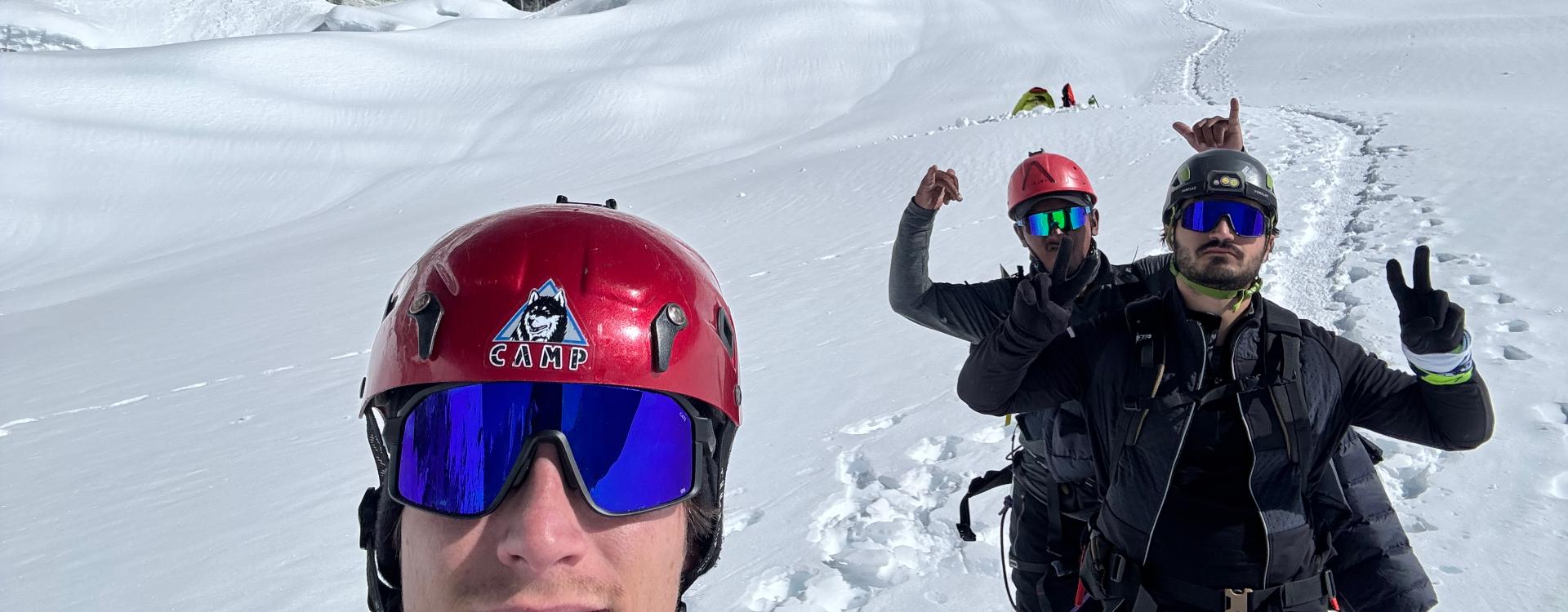
Planning Your Island Peak Climb With Confidence
Both spring and autumn deliver a genuine shot at a safe, well supported Island Peak summit, and the choice between them comes down to what you personally value more, whether that is warmer trekking weather and rhododendron color, or the clearest possible mountain views and a marginally lighter permit fee. What matters far more than the specific season is booking within one of these two established windows rather than being tempted by the quieter trails of winter or monsoon, where the real risks to safety and summit success increase substantially.
When you are ready to lock in your dates, we can walk you through current conditions reports, availability, and which specific weeks within your chosen season tend to offer the best balance of stability and crowd levels for your climb.
There is no wrong choice between a well planned spring departure and a well planned autumn one. Both have sent thousands of climbers to Island Peak's summit under good conditions, and both will continue to do so. What actually determines your outcome, far more than the month on your ticket, is the quality of your preparation, the experience of your guide team, and your willingness to trust their read of the mountain on the specific day you attempt it.
Frequently Asked Questions
Spring, from March through May, and autumn, from September through November, are the two established climbing windows for Island Peak. Both offer stable weather, established fixed ropes on the headwall, and reliable Lukla flight schedules, making either season a strong choice.
Neither season is definitively better. Spring tends to bring warmer temperatures and harder, more consolidated ice on the headwall. Autumn tends to bring the clearest skies of the year and somewhat softer, more forgiving snow conditions. The right choice depends on your personal priorities around temperature, visibility, and crowds.
April is widely regarded as one of the most reliable months for a spring attempt, offering warm enough conditions and established fixed lines before the late spring rush. October holds a similar reputation in autumn, generally delivering the most stable, clear weather of the year.
It is technically possible, but not recommended for most climbers. Winter brings extreme cold, high winds, and reduced daylight hours, and many operators reduce or suspend guided departures during the coldest stretch of the season. Climbers who do attempt it typically need more advanced cold weather experience than a standard spring or autumn ascent requires.
Yes, for the large majority of climbers. Monsoon season, from June through August, brings heavy rain, reduced visibility, unstable fresh snow, and frequent Lukla flight delays. Success rates during this period are considerably lower than in spring or autumn.
The Nepal Mountaineering Association charges 350 US dollars per person for a spring ascent and 175 US dollars for an autumn, winter, or summer climb. This makes autumn the more affordable option in terms of the government permit fee specifically.
Spring generally brings harder, more consolidated blue ice, which rewards precise crampon technique but can feel less forgiving. Autumn generally brings softer, more consolidated snow, which is often more forgiving underfoot but can be slower going. Conditions can vary within either season depending on recent weather.
Autumn generally draws somewhat fewer total trekkers to the region than spring, particularly in the second half of October and into November, though it remains a busy season overall. Spring, especially April and May, is the single busiest period on the trail.
Summit night itself is the coldest part of the climb in any season, with temperatures commonly dropping to around minus 10 degrees Celsius or lower at high camp and above, regardless of whether you climb in spring or autumn.
Yes, to some degree. Spring and autumn both offer strong success rates with an experienced operator, commonly cited in a broadly similar range for both seasons. Winter and especially monsoon see meaningfully lower success rates due to weather, visibility, and snow stability challenges.
Spring bookings, particularly for April and May departures, benefit from earlier planning given how busy the season gets across the entire Everest region. Autumn has a bit more flexibility, though popular October dates still fill up well in advance.
It can be, if scenery on the lower trail matters to your decision. Rhododendron blooms typically appear along the trail between Lukla and Namche Bazaar during spring, adding notable color to the lower sections of the trek, though this has no bearing on conditions at altitude or on the headwall itself.
Yes. Spring offers longer daylight hours, sometimes reaching 12 to 14 hours by April and May, giving more flexibility on a long summit day. Autumn's daylight hours shorten as the season progresses, particularly by November, which is worth factoring into planning for a later season attempt.
Yes. Even within the two established windows, weather can shift within hours, which is why an early alpine start on summit day and a guide's real time judgment about conditions matter more than the calendar date alone.
Early September still carries the tail end of monsoon conditions in most years, with trails and visibility improving as the month progresses. Late September into October tends to offer noticeably more stable and reliable conditions than the earlier part of the month.
About Accessible Adventure
Bringing unforgettable Himalayan adventures to everyone. Our expert guides and carefully curated experiences ensure that everyone can explore the beauty of Nepal, Tibet, and Bhutan.
Learn More