No cancellation fees. No hassle. Book Now, Cancellation Terms
Peak ClimbingTrekking Regions+32
32 min readIsland Peak Summit Day: Base Camp to Summit and Back
August 11, 2026
32 min
170 views
Summit day on Island Peak is unlike any other day of the expedition. The approach trek from Lukla has been challenging in its own right, covering ten or more days of altitude gain through the Khumbu, but it is fundamentally a walking experience. Summit day is something else. It begins in darkness several hours before first light, involves a steep rocky scramble in below-freezing temperatures, crosses a glaciated and crevassed snowfield roped to a climbing guide, ascends a 45-degree headwall on fixed ropes using a mechanical ascender, and traverses a narrow exposed summit ridge before reaching the highest point of the mountain at 6,189 meters. Then it reverses the whole sequence for the descent.
Understanding the day in advance, section by section and hour by hour, changes how climbers experience it. Those who arrive at the crampon point knowing exactly what is coming tend to move through the technical sections with more confidence and better decision-making than those for whom each new terrain type is a surprise. This guide walks through Island Peak's summit day in the level of detail that matters: not a summary, but an account of what the route actually involves, why it is demanding, what the fixed ropes look like, and what the summit itself delivers.
The information here is drawn from direct guide experience on the mountain across spring and autumn seasons. The route has consistent characteristics that allow for reliable description, though specific conditions, snow accumulation on the headwall, crevasse locations on the glacier, and weather on the summit ridge vary by season and year. Everything that follows reflects the standard picture; your guide team will brief you on conditions specific to the day.
Island Peak Summit Day at a Glance
| Metric | Details |
|---|---|
| Summit elevation | 6,189m |
| Starting point | Island Peak Base Camp ~5,100m |
| Departure | 1-3 AM |
| Summit time | Usually 7-9 AM |
| Total duration | 10-14 hours |
| Elevation gain | ~1,089m from base camp |
| Technical crux | 100-150m fixed-rope headwall |
| Headwall angle | ~45-50° |
| Summit ridge | ~300m |
| Difficulty | PD / technical trekking peak |
| Best seasons | Spring & autumn |
| Main skills | Crampons, ice axe, fixed-rope/ascender technique |
The Night Before Summit Day: Base Camp and High Camp
Island Peak summit day typically launches from one of two starting points: base camp at roughly 5,100 meters, or high camp at approximately 5,500 meters. Which one your team uses depends on the operator's approach and the weather forecast.
Climbing from base camp is the more common arrangement for standard guided expeditions. Base camp has better facilities, a proper kitchen tent, more comfortable sleeping conditions, and the psychological comfort of being at a slightly lower altitude when trying to sleep. The trade-off is a longer summit day, typically adding one to two hours to the round trip compared to departing from high camp.
High camp shortens the approach to the glacier and crampon point but involves sleeping at a more demanding altitude in more exposed conditions. Tents at high camp are pitched in a narrow, wind-exposed location, and the cold is noticeably more severe than at base camp. For climbers who struggle with the altitude at base camp and are sleeping poorly, high camp can paradoxically make things worse rather than better. The guide team will make a recommendation based on conditions, group acclimatization, and weather.
The evening before the summit push follows a deliberate rhythm. Dinner at base camp is served early, typically by 5 or 6 PM, to allow maximum time for rest before the pre-dawn wake-up. The menu is deliberately simple and calorie-dense: rice dishes, pasta, soup, and plenty of hot drinks. Eating a full meal matters even when altitude-suppressed appetite makes this difficult, because summit day will demand 10 to 14 hours of sustained physical effort and the body needs fuel reserves before departure.
Gear preparation happens after dinner and before sleep. Harnesses are adjusted over the clothing layers that will be worn tomorrow. Crampons are checked against the boots they will be fitted to. The ascender is confirmed to operate smoothly. Headlamp batteries are tested and spares placed in a jacket pocket where body warmth will keep them from losing charge overnight. Water bottles are filled, insulated, and placed in the tent. Snacks for summit day go into the top lid of the daypack. By the time this preparation is complete, and the sleeping bag is zipped up, it is often past 7 PM.
Sleep at altitude before a big effort is frequently poor. Periodic breathing, the common high-altitude pattern of alternating rapid and slowed breathing during sleep, disrupts rest and can produce a sensation of breathlessness that wakes climbers repeatedly through the night. This is physiologically normal above 5,000 meters and not a sign that something is wrong. Accept poor sleep as a feature of the altitude rather than a problem to solve. The body's adrenaline and the relatively short physical window of the climb ahead will more than compensate for an imperfect night of rest.
The Pre-Dawn Start: 1 to 3 AM
The wake-up call comes somewhere between 1 and 3 AM depending on team size, conditions, and the guide's read of the day. Waking in the dark at base camp at altitude is one of the more disorienting experiences of the expedition. The tent is cold, the sleeping bag is warm, and the distance between those two realities requires deliberate willpower to bridge.
The kitchen team has been awake before the climbers. Hot tea, coffee, or a warm drink appears at the tent, along with a light pre-climb meal: porridge, toast, boiled eggs, or whatever the climber can manage. Eating before a long effort at this altitude is more an obligation than a pleasure; the goal is carbohydrates in the body before the first section begins.
Dressing in the tent takes longer than expected. The full layering system goes on in sequence: thermal base layers, fleece mid-layer, down jacket, shell trousers, and shell jacket. Glove layers are assembled. The hat goes on. Harnesses are pulled on over all layers and adjusted until the fit is firm without cutting into circulation. Mountaineering boots, which have been kept inside the tent to prevent them from freezing solid overnight, go on last. The headlamp goes on the helmet or directly on the head, checked, and confirmed working before leaving the tent.
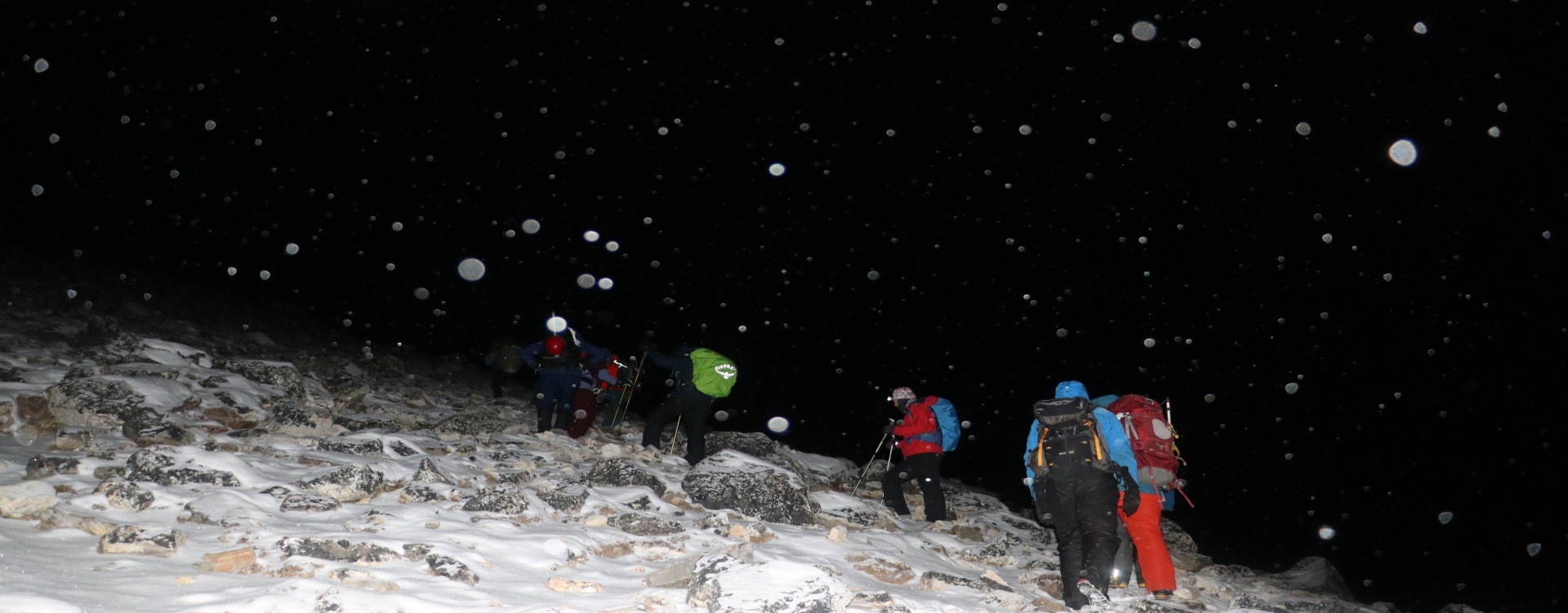
Outside the tent, the cold is immediate and serious. Pre-dawn temperatures at base camp in October or April regularly sit between minus 10 and minus 20 degrees Celsius, factoring in wind. The darkness is complete except for the headlamps of the climbing team and, if other groups are on the mountain that day, the dotted lights of other teams already on the slope above.
The guide team assembles the group, confirms everyone's harness fit and headlamp function, and delivers the day's briefing. The guide explains the route sections, the approximate timing for the crampon point and glacier, and the key safety instructions for the headwall. The summit day briefing at base camp is short because the longer technical briefing happened the day before at the training session. This one covers the specific decisions and weather notes for today.
Departure follows shortly after. In the darkness and cold, the team sets off toward the mountain.
Phase One: The Rocky Scramble to the Crampon Point
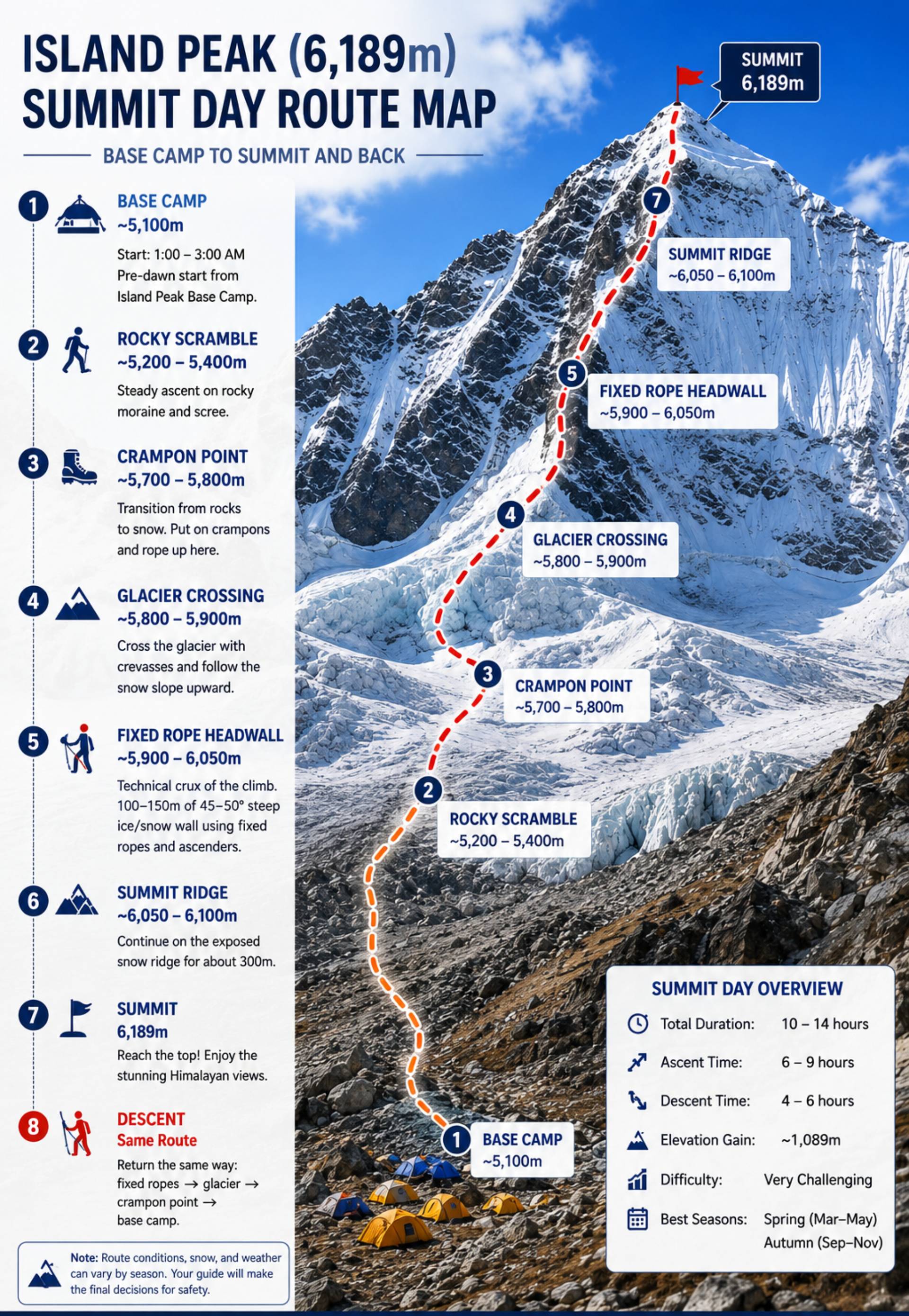
The first section of Island Peak's summit day is not glaciated and not technically complex, but it is steep, relentlessly so, and it is covered in the dark. The trail from base camp climbs through loose scree, broken rock, and occasional short scrambling steps on a ridgeline that gains approximately 700 meters of altitude before the glacier begins.
This section takes two to three hours depending on pace, conditions underfoot, and the team's altitude fitness. At a sustained high-altitude trekking pace, which is deliberately slow to manage oxygen consumption, the rocky approach feels longer than the distance suggests. Each switchback reveals another section of slope above, and the headlamp beam illuminates only the next few meters of ground.
The cold on this section is at its most intense. Moving slowly on rough terrain while dressed for the glacier conditions above means the body does not generate enough heat to warm the extremities as effectively as it does during vigorous trekking. Feet should already feel the benefit of mountaineering boot insulation; hands need both liner and outer gloves from the start. Those who underdress for this section on the logic that the headwall will be warmer arrive at the crampon point with numb fingers and a mounting cold management problem.
The psychological character of this phase is defined by two things: darkness and uncertainty about how far away the crampon point is. For first-time climbers, the rocky approach can feel longer and more demanding than expected. The section ends when the ridge opens onto the glacier, a distinctive change in terrain from loose rock to firm snow that announces itself clearly even in the dark. Some years, a fixed rope section on steeper rock just below the glacier provides assistance on the final steep section before the flat approach to the crampon point.
One practical note that experienced guides on Island Peak consistently emphasize: do not try to go fast on this section. The temptation, particularly for physically fit climbers, is to move quickly through what feels like relatively simple terrain to stay warm and get to the glacier sooner. Burning through glycogen stores and elevating heart rate before the technical sections begin is a common cause of premature fatigue later in the day. Maintain the guide's pace exactly, however slow it feels.
Phase Two: The Crampon Point at Around 5,800 Meters
The crampon point is one of the most distinctive moments of Island Peak summit day. After hours of darkness and rocky scrambling, the team arrives at a defined transition zone where rock gives way to glacier. This is where the character of the day changes completely.
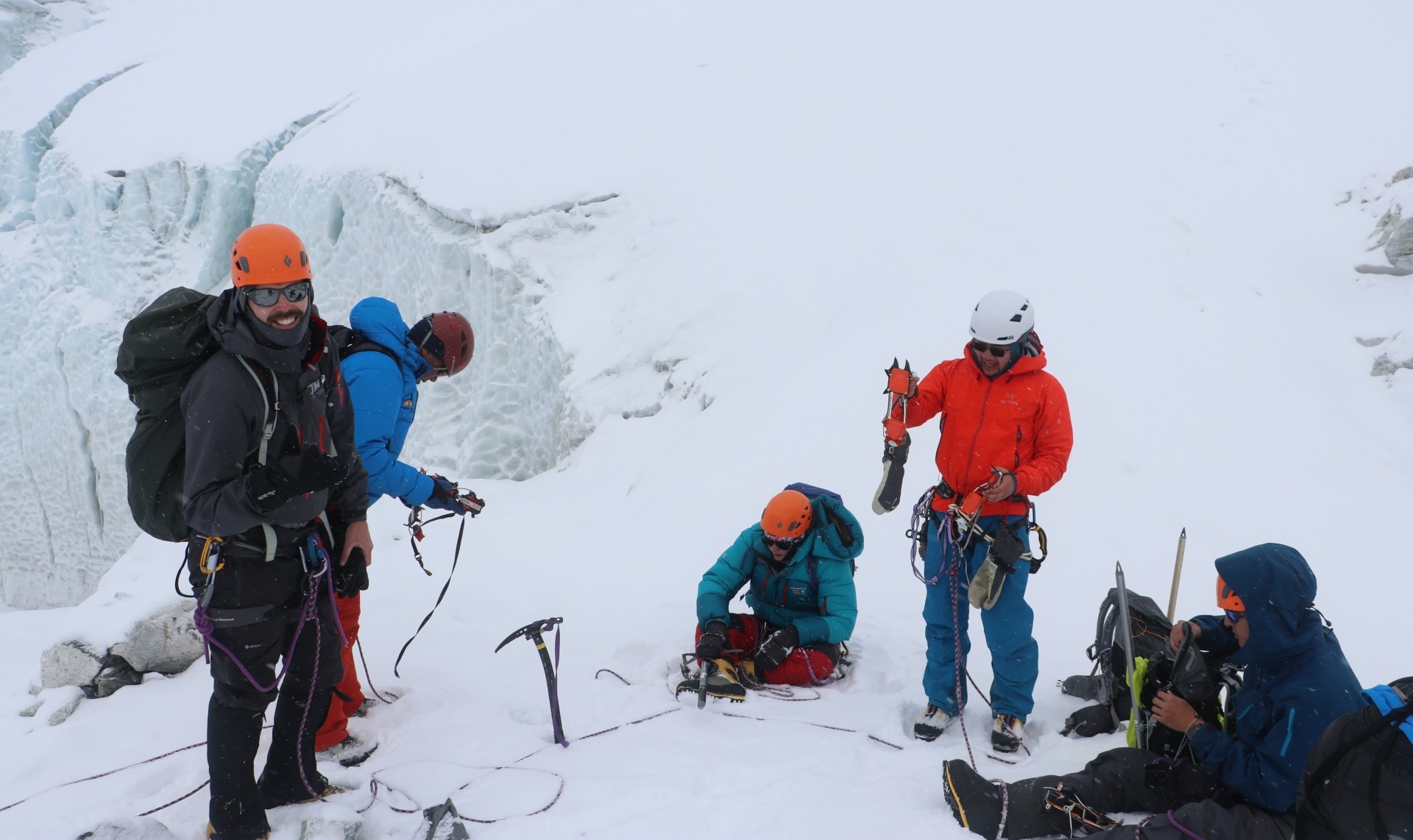
The first task at the crampon point is a brief stop to rest, drink water, eat a snack, and gear up for the glacier and headwall sections above. In the cold and darkness, this process needs to be efficient. Crampons are fitted to the boots and binding checked for secure lock. The harness is confirmed seated correctly and all gear loops are loaded. The ascender is clipped to the harness and a locking carabiner attached. Ice axe goes into the uphill hand. The guide ropes up the team, checks each person's connection, and delivers any last instructions before the glacier begins.
The crampon point stop also serves a psychological function. It marks the end of the approach and the beginning of the genuine mountaineering section. Many climbers describe feeling a shift in focus here: the cold and darkness are the same, but the quality of attention becomes sharper and more specific. The guide is now making live route decisions rather than following a trail, and the rope connecting the team creates a shared physical commitment that changes the dynamic of the group.
At the crampon point, if other teams are present on the mountain that day, a queue may develop. Island Peak's route narrows significantly above this point, particularly on the headwall where only one fixed rope typically handles all upward traffic. The guide team negotiates the order of ascent with other groups and manages waiting time so that the team does not lose too much body heat while stationary in the cold at 5,800 meters.
Phase Three: Crossing the Glacier
Above the crampon point, the terrain opens onto Island Peak's upper glacier. This section is one of the most distinctive and visually striking parts of the entire climb. The glacier is wide and undulating, lit by the first traces of predawn sky in the east, with the dark shapes of Lhotse and Nuptse rising against the stars ahead.
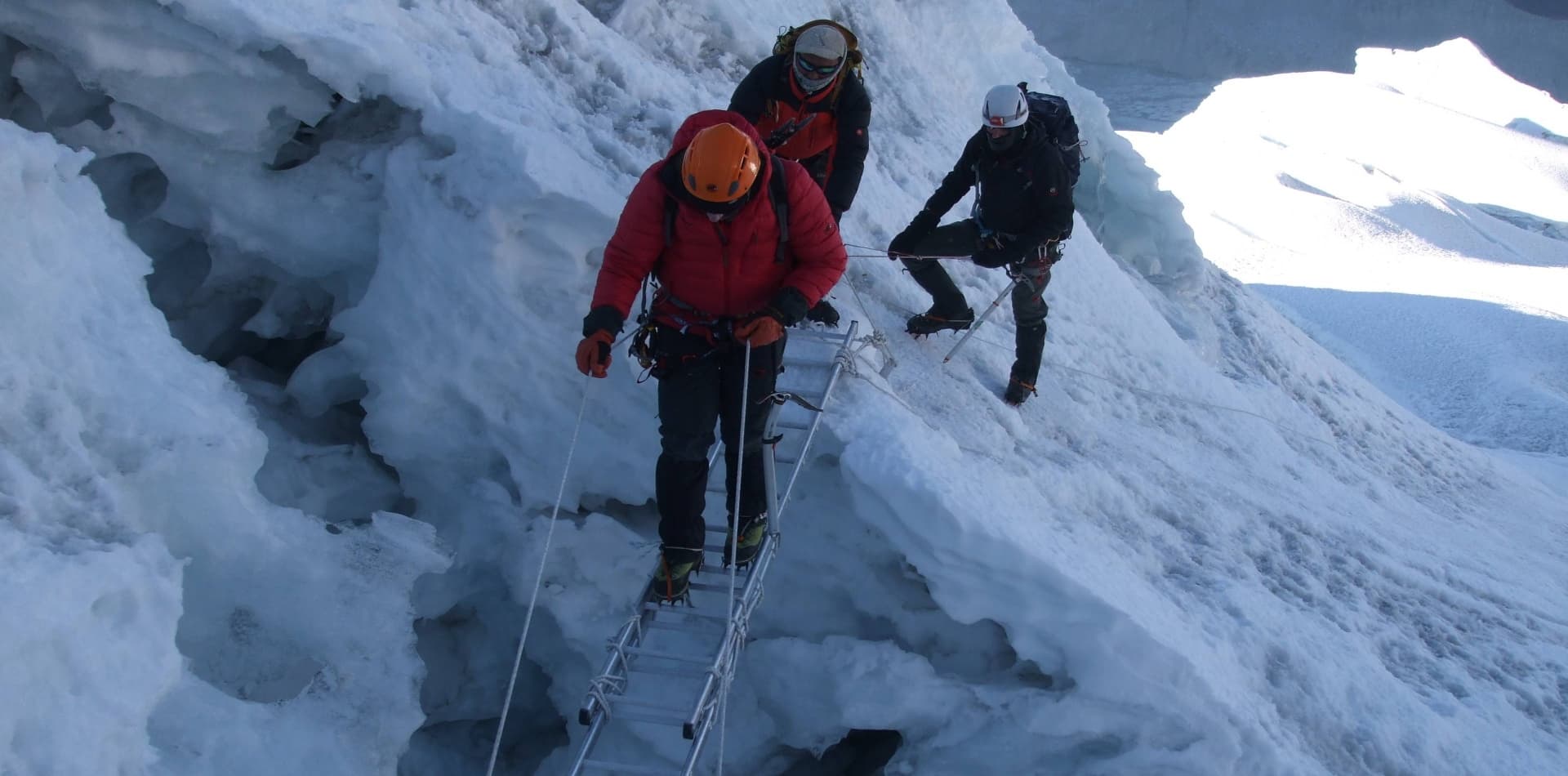
The glacier traverse is moderately technical. The surface is a mix of firm snow, areas of exposed ice, and occasional crevasse sections where bridges of compacted snow cross the gaps. The guide navigates the route, which varies each season slightly as the glacier moves and bridges shift. In some years the traverse includes crossing one or two crevasses using ladders; in others the route passes around or over consolidated snow bridges. The guide makes all route decisions based on current conditions.
Roped travel across the glacier means moving at a shared pace. The rope team typically includes the climbing Sherpa guide at the front and all climbing clients connected behind. Maintaining the correct rope tension is important: slack rope creates a tripping hazard; taut rope pulls the person behind off balance. A moderate tension, with a rope length between climbers that allows a natural walking pace, is what the guide demonstrates. Follow the guide's footsteps precisely, particularly around crevasse areas, where the tested snow is reliably weight-bearing, and the untested ground beside the footprints is not.
Pace on the glacier is even slower than the rocky approach. At this altitude, sustained aerobic effort must be managed carefully. Many climbers begin to feel the altitude more acutely on the glacier than on the lower sections, as the combination of exertion, cold, thin air, and cumulative fatigue from the hours already walked begins to register. The guide monitors the group during rest stops, checking breathing rates and asking about how people feel. This is not small talk; it is altitude assessment.
Dawn typically arrives somewhere on the glacier for teams that departed at 2 or 3 AM. The transition from headlamp navigation to natural light is one of the memorable moments of the climb. As the sky behind Lhotse lightens from black to deep blue and then to the first orange of the sun, the scale of the surroundings becomes visible for the first time. The glacier stretches behind and above. The headwall rises ahead, considerably steeper and more defined in the dawn light than it appeared in the dark. And the peaks around the Chukhung Valley begin to materialize from silhouettes into full, lit mountain faces.
Phase Four: The Fixed Rope Headwall - The Technical Crux
The headwall is the defining feature of Island Peak and the section that determines the character of the entire summit day. Everything before it has been approach work. The headwall is the climb.
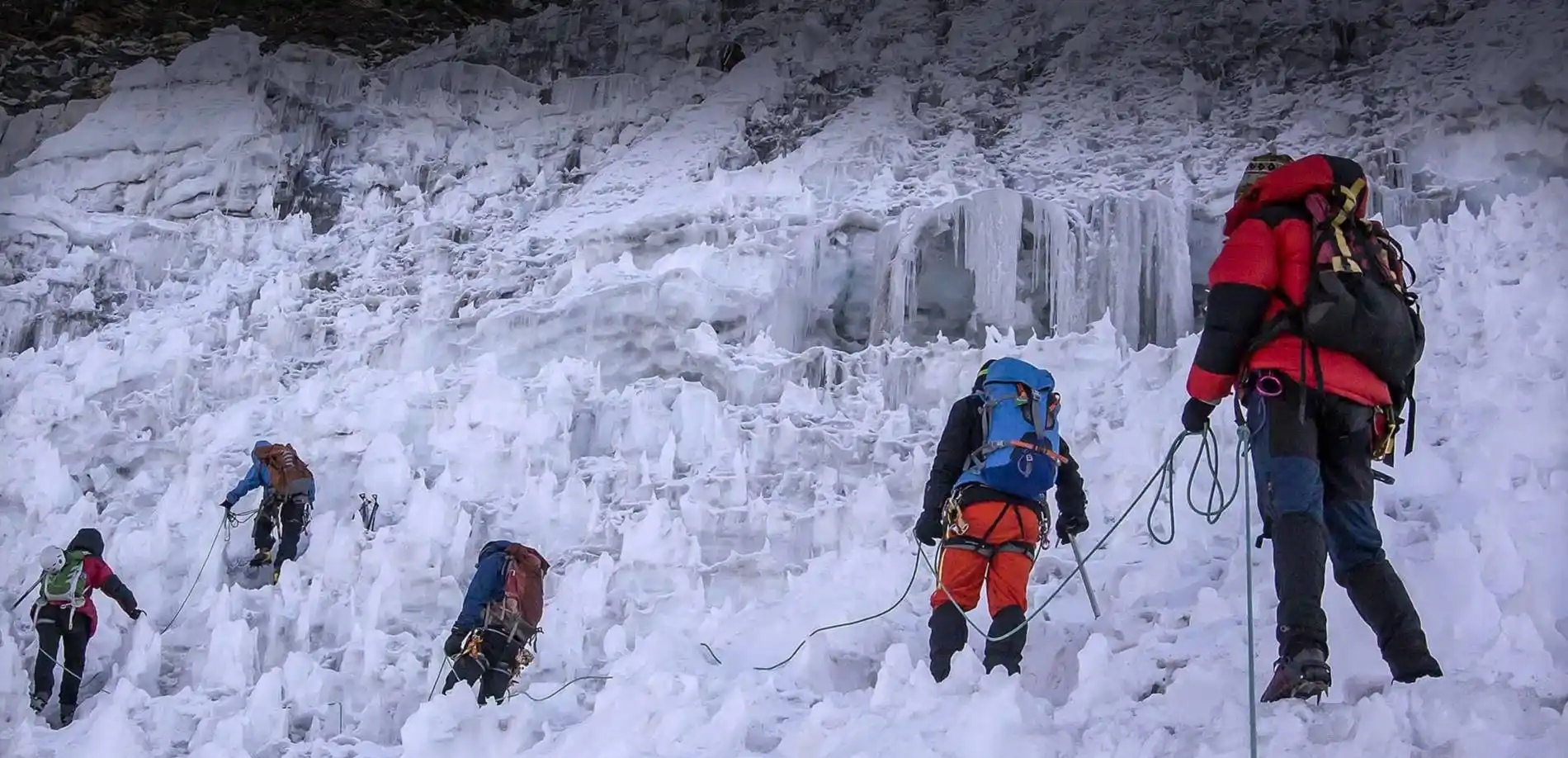
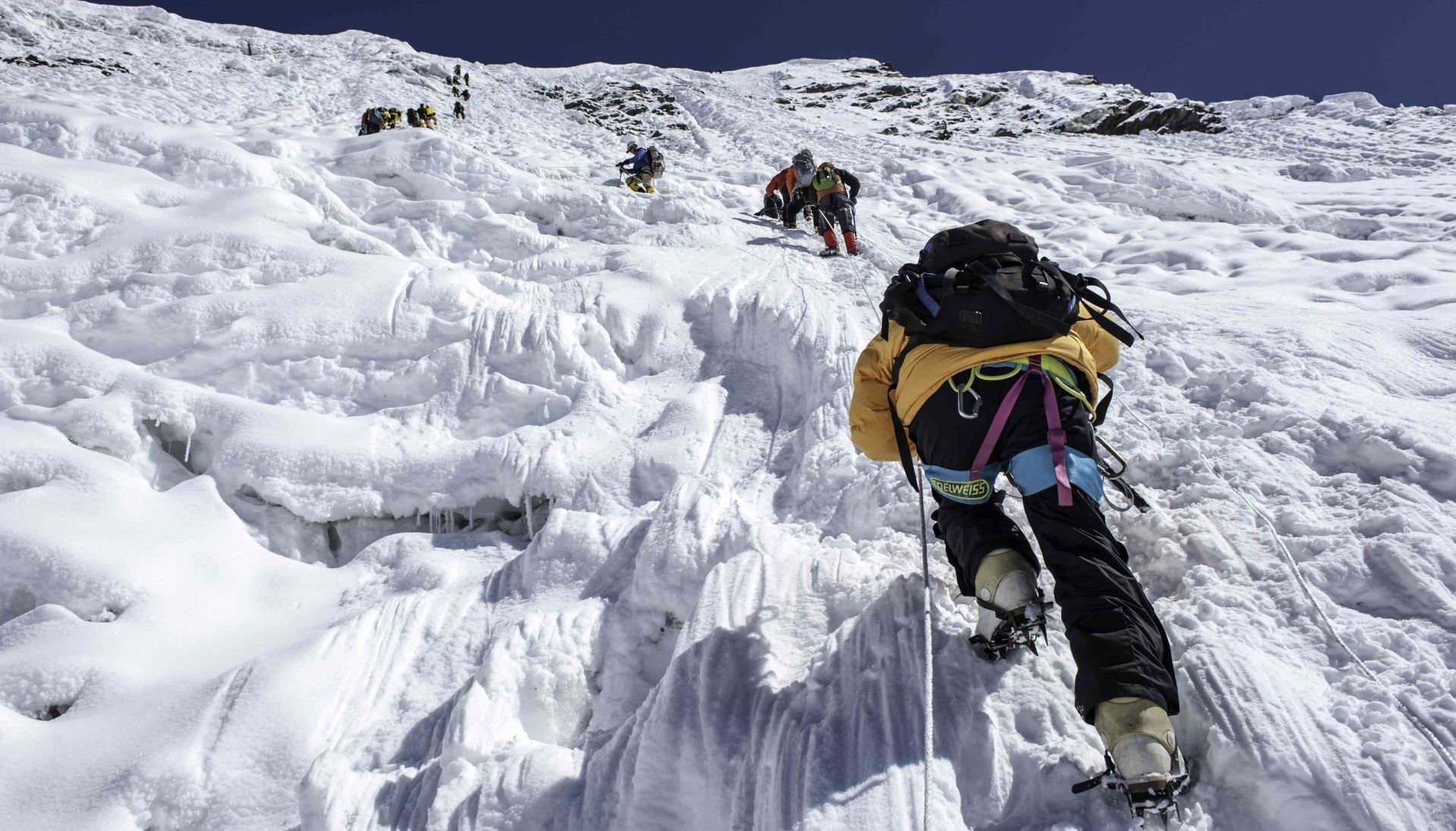
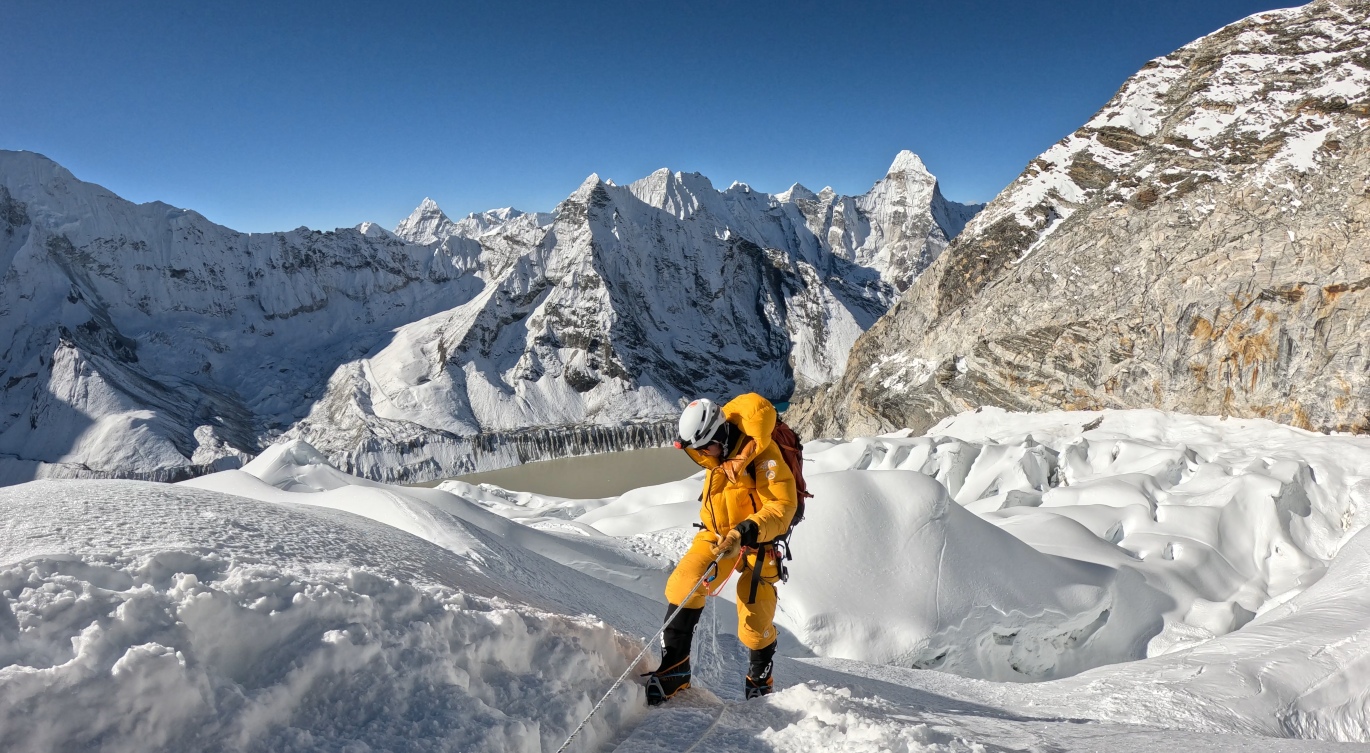
The headwall is a steep face of snow and ice rising approximately 100 to 150 meters at a gradient of roughly 45 to 50 degrees to the summit ridge. Fixed ropes, installed by the climbing Sherpa team before the first attempt of each season, run the full length of this face. At the base of the headwall, the route from the glacier narrows to the width of the fixed rope, and the team transitions from roped glacier travel to single-file fixed rope ascent.
Attaching to the Fixed Rope
At the base of the headwall, the guide demonstrates the ascender attachment if this was not already practiced at the crampon point. The ascender (jumar) is clipped onto the fixed rope with the gate facing the climber. The device slides freely upward and locks when downward load is applied. A locking carabiner connects the ascender to the harness belay loop. A second safety connection from the harness to the fixed rope using a short sling or a second carabiner provides redundancy.
The technique on the headwall is methodical and repetitive: push the ascender up the rope as high as the arm reaches, step up with the feet using crampons for purchase on the ice, shift weight onto the ascender, push it up again. The ice axe provides additional balance, gripped in the free hand with the pick facing back for a self-arrest position if required. Each movement on the headwall should be deliberate. Rushing is both physically ineffective and potentially dangerous: a crampon placement that is not fully secure on a 45-degree ice face with full body weight above it requires immediate recorrection before the next step.
The Physical Reality of the Headwall
The headwall is where the altitude most acutely imposes itself on the physical effort. At 5,900 to 6,100 meters, the air contains approximately 47 percent of the oxygen available at sea level. Every step on the headwall's steep ice requires a disproportionate level of cardiovascular effort compared to the same step on flat terrain at low altitude. The sensation is not pain; it is a sustained heaviness and a requirement to pause more often, breathe more deliberately, and slow the pace to a sustainable rhythm.
The guide sets the pace on the headwall. For less experienced climbers, the guide's pace can feel agonizingly slow. For climbers who have pushed harder than the guide's pace on the lower sections, it may feel accurate or even fast. Both cases underscore the same principle: follow the guide's pace exactly. The headwall is two to three hours of sustained effort for most climbers, and burning reserves too early on the lower headwall leaves nothing for the upper section and the summit ridge.
Rest stops on the headwall are taken while clipped into the fixed rope, standing on the front points of the crampons on the ice. The guide selects anchor points or naturally flatter sections for rest stops, and the team clips in with a sling or spare carabiner before pausing. Short rest stops of two to three minutes allow breathing to recover without losing too much warmth in the cold exposed position.
The Mental Dimension of the Headwall
The headwall is also where the mental dimension of climbing becomes most apparent. The sustained effort, the exposure below, the physical fatigue, and the remaining distance to the top combine into a test of determination that is distinct from anything on the trekking approach. The urge to estimate how much further there is becomes counterproductive above a certain point. Most experienced guides on this route recommend a strategy of focusing on the next 10 meters of rope rather than the remaining distance to the ridge. The cumulative effect of ten-meter sections covers the headwall more reliably than any attempt to track progress against an imagined whole.
Communication with the guide on the headwall should be brief and clear: yes, no, I need to stop, I feel sick, I am okay. The guide is assessing every member of the team continuously through the headwall. Someone who is not communicating their actual state, who is managing visible distress silently to avoid appearing weak or slowing the group, creates a safety problem. The guide cannot make a good decision about whether to continue or descend without accurate information.
When the headwall ends, it ends suddenly. The ice gradient flattens, the fixed rope becomes almost horizontal, and the exposure of the ridge opens on both sides. This transition is one of the clearest physical moments of the entire summit day, the shift from vertical effort to the final traverse toward the top.
Phase Five: The Summit Ridge
The summit ridge of Island Peak is one of the features that makes this climb genuinely remarkable. After the tunnel-vision focus of the headwall, emerging onto the ridge at around 6,100 meters delivers the first proper view of the surrounding Himalaya in its full scale. The ridge extends for approximately 300 meters to the summit, narrow and exposed on both sides, with the fixed rope continuing along its length.
Walking the ridge requires deliberate crampon placement and controlled movement. The route is not technically difficult relative to the headwall, but the exposure on both sides creates a psychological demand that is distinct from the sustained effort below. Looking left, the Chukhung Valley drops thousands of meters to the valley floor. Looking right, the glacier hangs above a similar void. Ahead, the ridge narrows slightly before widening onto the summit plateau.
The fixed rope runs along the ridge and provides both a psychological and physical safety line. Climbers stay clipped in throughout the ridge traverse. The guide manages the pace, which is typically deliberate and steady rather than either rushed or very slow. Wind on the summit ridge is more exposure than on any other section of the route, and the time spent on the exposed traverse is worth keeping efficient.
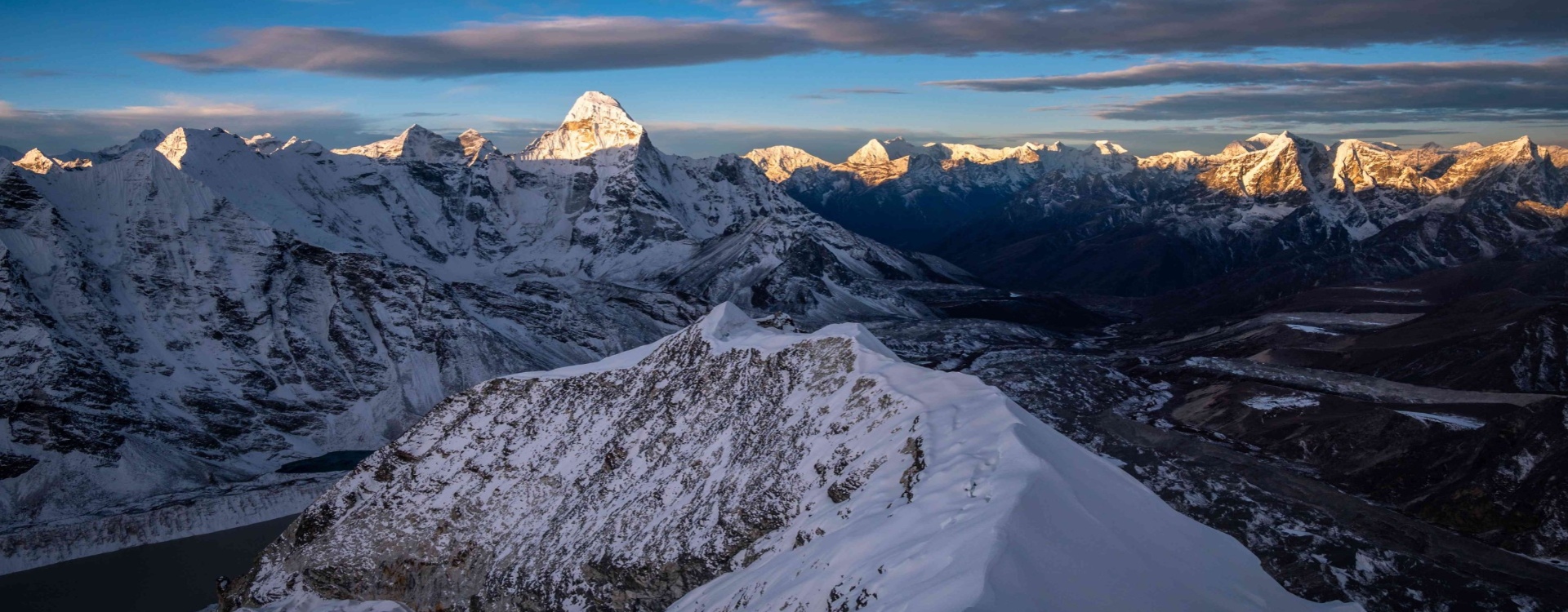
The light on the ridge in the morning hours, particularly in spring and autumn, is extraordinary. At 6,000 meters, the air is thin enough that colors are unusually vivid: the blue of the sky is a deeper, darker tone than at lower altitudes, and the snow faces of Lhotse and Ama Dablam in the morning light carry an almost luminous quality. This is the view that many Island Peak climbers recall most vividly afterward, not the summit itself but the ridge leading to it, high and narrow and magnificent in the early light.
The Summit at 6,189 Meters
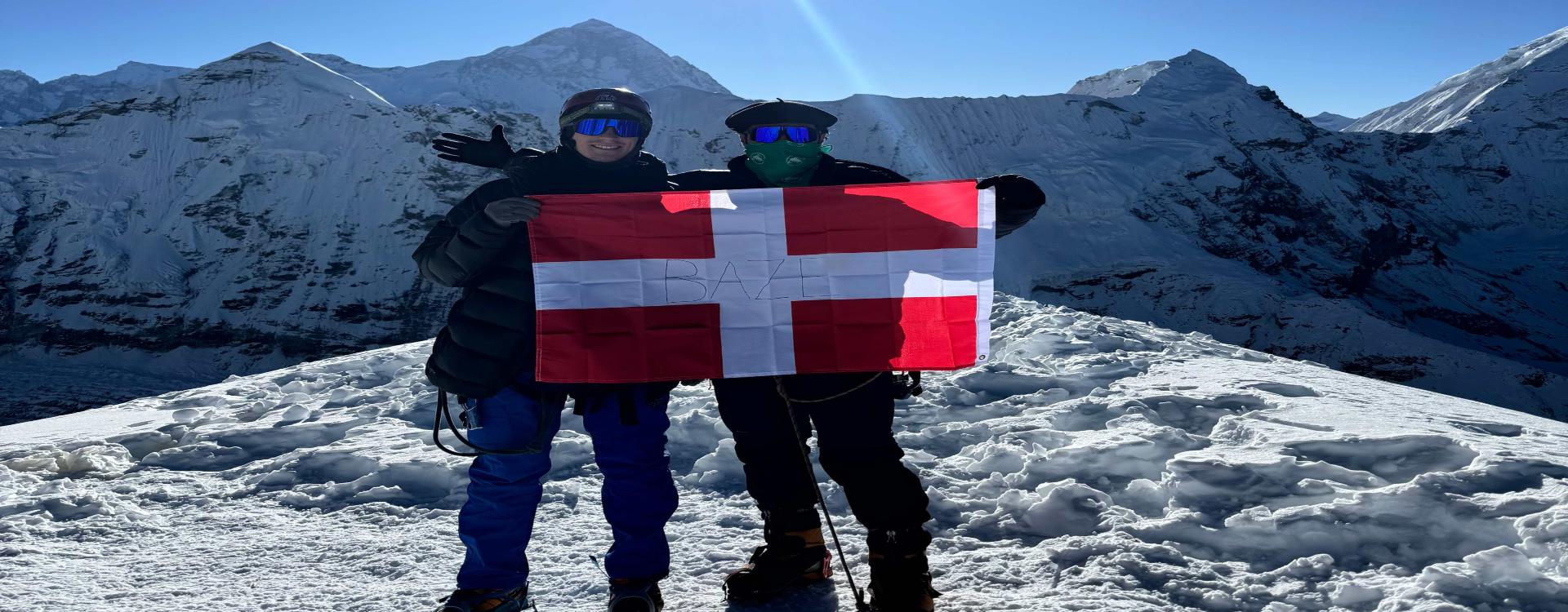
The Island Peak summit is one of the smallest summits in Nepal's popular climbing repertoire. The top plateau is approximately the size of a large dining table: enough room for four to five people to stand comfortably, but no more. On busy days in peak season when multiple teams are on the mountain, the summit can feel briefly crowded before the first arrivals begin their descent to make room for the next group.
The view from the Island Peak summit is the reward that organizes everything preceding it. Lhotse rises directly above to the north, its 8,516-meter south face so close that it fills an enormous portion of the sky. Ama Dablam stands to the west, the mountain many consider the most beautiful peak in the Khumbu, its distinctive summit cross-shaped against the blue. Makalu, thev fifth highest mountain in the world, is visible to the east. Baruntse's glaciated face fills the southeastern horizon. Nuptse's ridge runs northwest. The full Chukhung Valley lies directly below, the Imja Lake visible as a dark patch against the moraine, and the path of the entire approach trek visible from Dingboche onward.
Everest itself is not visible directly from the Island Peak summit due to Lhotse standing directly in the line of sight to the north. This is worth knowing in advance to avoid the slight disappointment of reaching the top expecting an Everest view. What the summit does deliver in place of Everest is an immersive panorama of the surrounding 6,000 and 7,000-meter terrain that is, in many respects, more immediate and more comprehensible in scale than the distant view of Everest from Kala Patthar.
Time at the summit is kept deliberately short. Reasons are both physiological and logistical. At 6,189 meters, with oxygen at roughly 47 percent of sea-level concentration, the body is working hard simply to maintain baseline function. Extended time at this altitude without supplementary oxygen accomplishes nothing useful and consumes energy and warmth that are needed for the descent. Photographs, a brief shared acknowledgment of the achievement, and then the turn begins. The guide starts the descent within 10 to 20 minutes of summiting for most groups.
The emotional quality of the summit moment varies widely between climbers. Some describe an immediate and overwhelming sense of joy. Others describe a sense of calm, almost an absence of strong feeling, which is a documented altitude effect on emotion. Many report that the full emotional weight of the achievement lands later, on the descent, or back at base camp, or in the days afterward in Kathmandu, rather than on the summit itself. All of these responses are normal.
The Descent: Down the Headwall and Back to Base Camp
The descent from Island Peak's summit requires at least as much attention as the ascent, and in some respects more. The headwall on the way down is where the majority of incidents on this mountain occur. Physical fatigue from the ascent, reduced vigilance after the emotional peak of the summit, and the psychological pressure of wanting to return to base camp quickly all combine to create a riskier environment on the descent than many climbers anticipate.
Descending the Summit Ridge
The ridge descent retraces the ascent route with the fixed rope now on the downhill side. Movement is slow and deliberate, crampon placements checked before weight is fully transferred, and the safety connection to the fixed rope maintained at all times. The guide leads from a position where the full team can be observed, managing the pace of descent to prevent rushing.
The Headwall Descent on Fixed Ropes
The headwall descent uses a descender or belay device clipped to the fixed rope. The guide manages the setup at the top of the headwall, explaining and demonstrating the descent system before the first person begins. The technique is controlled abseiling: face the slope, feet planted in the ice with crampon front points, the descender controlling the rate of downward movement on the fixed rope, and the ice axe in the uphill hand for additional balance and self-arrest capacity.
The descent is technically more demanding than the ascent for many climbers. Going up the headwall, the body is facing the slope with the next hold visible directly above. Going down, the exposure below is visible and the position of the feet is harder to monitor. The correct response is a slower, more deliberate pace with shorter controlled moves rather than the instinct to move quickly to reduce the time spent in the exposed position.
The guide descends either in front of or behind the clients, adjusting position based on team needs. When all clients are safely past the technical headwall section and back onto the lower-angle glacier terrain, the tone of the descent shifts. The immediate technical demands reduce, oxygen levels improve with every hundred meters of altitude lost, and the physical and emotional recovery from the summit effort begins.
The Glacier Return and Descent to Base Camp
The glacier return follows the ascent route in reverse, with the guide navigating back across the same snow bridges and crevasse sections covered earlier. The ice surface may have changed slightly since the morning crossing if temperatures have risen with the sun; the guide assesses each crossing point and may choose different lines than those used on the ascent if conditions warrant.
Crampons come off at the crampon point on the descent, and the team transitions back to the rocky scramble for the final descent to base camp. This section, which felt steep and unending in the dark on the way up, feels considerably shorter in daylight on the return. The pace can be more relaxed, the visibility is complete, and the knowledge that the summit is done and base camp is below creates a lightness that most climbers describe as one of the best physical sensations of the expedition.
Arrival at base camp typically falls in the early to mid afternoon, between 1 and 3 PM for teams that departed at 2 AM and maintained a steady pace. The kitchen team will have hot drinks and food ready. The first proper meal after a summit day, with altitude already dropping and appetite beginning to recover, is one of the expedition's most satisfying moments.
After the Summit: The Return to Chhukung
After arriving at base camp and resting for a few hours, most teams make the descent to Chhukung on the same day. The walk from base camp to Chhukung takes approximately two hours at a comfortable post-summit pace and drops to around 4,730 meters from the 5,100-meter base camp elevation. This descent makes a meaningful physiological difference: the body recovers from altitude stress faster when lower, and sleep at Chhukung after a summit day is generally markedly better than any of the preceding high-altitude nights.
Chhukung has good teahouse accommodation by Khumbu standards. Hot showers, a varied menu, and the pleasure of a comfortable bed after a summit day make the extra two hours of walking from base camp worth every step. The evening meal at Chhukung after a successful summit is typically a group celebration, the closest thing the expedition has to a formal recognition of what was accomplished during the day.
For operators running combined Island Peak and Everest Base Camp itineraries, the summit day at Island Peak is followed by the return trek back through Dingboche, Tengboche, Namche, and Lukla over the subsequent days. These descent days feel considerably easier than the corresponding ascent stages: oxygen levels improve with every day's walk toward Lukla, appetite recovers, sleep normalises, and the physical and mental energy returns. Many trekkers describe the descent portion of the circuit as the most enjoyable days of the entire trip for exactly these reasons.
Why Some Climbers Turn Back Before the Summit
Island Peak has a summit success rate that varies by operator, season, and acclimatization schedule, but generally runs between 75 and 90 percent for parties with appropriate preparation. Understanding why the other 10 to 25 percent turn back helps set realistic expectations and identifies the preparation choices that make the biggest difference to outcomes.
The most documented cause of failed summits on Island Peak is not weather and not technical difficulty: it is inadequate acclimatization. Climbers who rush the approach, skip acclimatization days, or arrive at base camp having spent insufficient time above 4,000 meters on the approach are physiologically unprepared for the demands above 5,800 meters. The correlation between rushed acclimatization and failed summits on this peak is strong enough that experienced operators build the schedule around it rather than around travel convenience.
Footwear failure is the second most consistently cited factor. Climbers whose boots are not warm enough for the temperatures above the crampon point begin losing sensation in the toes progressively through the headwall section. At a certain point, the guide identifies or the climber reports that foot sensation is compromised, and the responsible decision is immediate descent. Cold feet that reach the threshold of real frostbite risk do not recover by continuing upward.
Physical fitness arriving below the required level is the third common factor. Summit day is a 10 to 14-hour effort at extreme altitude. Climbers who have not trained specifically for sustained cardiovascular output find the cumulative fatigue of the headwall section arriving much earlier in the effort than expected. A fitness base built through months of consistent aerobic exercise before departure, not weeks, makes the difference between reaching the headwall with capacity and reaching it on empty.
Weather is the fourth factor and the only one entirely outside the climber's control. Summit day is postponed or abandoned when conditions on the headwall or ridge are unsafe. Strong winds, fresh snowfall on the headwall that covers the fixed rope or makes the ice unstable, or thunderstorm development in the afternoon force a return to base camp. A reserve day built into the itinerary manages this contingency in most cases.
All of the first three factors, acclimatization, footwear, and fitness, are within the climber's control before departure. The reserve day manages the fourth. A realistic assessment of each of these dimensions before booking and an honest commitment to the preparation required makes the difference between an expedition that ends on the summit and one that turns back on the headwall.
The Mental Side of Island Peak Summit Day
Physical preparation for Island Peak is well covered in most pre-expedition guides. Mental preparation receives less attention, but it matters as much on summit day as cardiovascular fitness.
The section of the climb where mental preparation most directly determines outcomes is the headwall. At two to three hours of sustained vertical effort in cold, thin air, the headwall is long enough that motivation needs to be self-sustaining rather than externally provided. The guide encourages and manages, but the internal decision to keep moving upward, one crampon placement and one jumar push at a time, comes from the climber.
Several mental frameworks help on the headwall. The first is deliberate narrowing of focus: instead of measuring progress against the top of the headwall, focus on the next five meters of fixed rope. The entire headwall covered in five-meter sections is manageable. The entire headwall viewed as a single remaining distance is discouraging. The second is physical anchoring: at rest stops, notice the breath, feel the feet on the ice, drink water deliberately. The body's physical sensations in the present moment are more useful as an anchor than thoughts about how much is left or how tired the legs are.
The third framework is one that guides on this mountain develop from experience: the commitment to honest communication. The climber who says I am struggling and I think we should talk about what to do next is making a safer decision than the one who suppresses that information and continues upward in increasing distress. The guide can respond to honest information. They cannot respond to information they do not have. Part of the mental preparation for Island Peak is deciding in advance to communicate honestly, including communicating difficulties, and trusting the guide team to make good decisions with that information.
Timing, Conditions, and What Makes a Good Summit Day
The standard departure time of 1 to 3 AM is determined by a combination of factors that have been worked out over decades of Island Peak guiding experience.
Weather on the upper mountain is most stable in the early morning. By midday, thermal heating in the Chukhung Valley creates updrafts that can produce rapid cloud build-up and wind increases on the summit ridge and headwall. A team that reaches the summit by 8 or 9 AM and descends the headwall by 10 or 11 AM is generally off the technical section before afternoon weather deteriorates. A team that departs late and reaches the headwall at 8 AM may still be on the summit ridge at noon when conditions are at their most uncertain.
The colder early morning temperatures, while uncomfortable for the approach, also keep the fixed rope sections in better condition. As the sun hits the headwall in mid-morning, melt-freeze cycles on the surface can create slightly more unpredictable ice conditions compared to the firm cold ice of the predawn hours. The early morning cold is the price paid for the better technical conditions.
A good summit day on Island Peak has the following characteristics: clear or mostly clear sky at departure, firm snow on the glacier and lower headwall, wind below 20 to 30 kilometers per hour on the ridge, and the team on the descent side of the headwall before noon. All of these conditions are more likely in the core spring weeks of April and the core autumn window of October. The guide team monitors weather forecasts in the days before the summit attempt and factors the forecast into the departure time and go/no-go decision.
Even with the best preparation and conditions, summit day on Island Peak is genuinely hard. It demands everything prepared in the preceding weeks: the altitude exposure from the approach, the fitness built in the months before departure, the gear chosen and tested before arrival, and the mental readiness to commit to a full day of sustained, technically demanding effort in cold thin air. What it returns for that investment, the summit itself and the panorama from the ridge, is commensurate with the effort in a way that is difficult to convey and impossible to forget.
Preparing for Island Peak Summit Day with an Experienced Team
Summit day on Island Peak is a genuinely remarkable experience that sits at a unique intersection: demanding enough to require months of physical preparation and technical gear, accessible enough that fit, well-prepared trekkers with no prior mountaineering background can reach the top. The route, from the pre-dawn rocky scramble through the glacier and up the fixed rope headwall to the summit ridge, is distinct and memorable in a way that long-distance trekking routes are not.
Our guide team briefs every climbing group on the exact route, current fixed rope conditions, and the day-specific weather outlook before every summit attempt. We conduct gear checks, run the training session at base camp, and make experienced go/no-go decisions based on conditions rather than schedules. If you have specific questions about summit day, the technical sections, or what to realistically expect from your first 6,000-meter summit, reach out before booking. The conversation is easier at sea level than at 5,100 meters the night before the climb.
Frequently Asked Questions
Summit day starts between 1 and 3 AM from base camp, or slightly later from high camp due to the shorter approach. The exact departure time is set by the guide based on current conditions, weather forecast, the size and pace of the team, and whether other groups are on the mountain that day. A 2 AM departure from base camp (5,100m) typically allows the team to reach the crampon point around 4 to 5 AM, the glacier in the pre-dawn light, and the headwall as first light arrives. This timing places the team on the summit ridge in the morning's most stable weather window and off the technical descent before midday.
Total summit day duration from base camp departure to base camp return runs between 10 and 14 hours depending on team fitness, conditions on the headwall, and the number of teams using the fixed rope simultaneously. The ascent alone from base camp to the summit takes approximately 6 to 9 hours. The descent is generally faster, at 4 to 6 hours, depending on queue time on the headwall descent and conditions on the lower approach. Teams in strong condition with favorable weather on a clear fixed rope can complete the round trip in 10 to 11 hours. Slower teams or those dealing with congestion at the headwall may take 13 to 14 hours.
The crampon point is the transition zone at approximately 5,800 meters where the rocky approach trail meets the glacier on Island Peak's upper section. Here, the team stops to fit crampons to boots, adjust and check harnesses, attach ascenders and carabiners, and rope up for the glacier and headwall above. The crampon point is a distinct physical landmark where rock gives way to snow and ice, and it marks the beginning of the technical climbing section. Teams may wait at the crampon point if other groups are ahead on the narrow glacier route or headwall fixed rope.
The headwall is a face of snow and ice rising approximately 100 to 150 meters at a gradient of roughly 45 to 50 degrees. It is the final and steepest section of the route before the summit ridge. The surface is typically a mixture of firm packed snow and exposed ice depending on the season; spring headwalls tend to have more consolidated snow while late autumn conditions can be icier. Fixed ropes run the full length of the headwall, installed and maintained by the climbing Sherpa team before each summit attempt. The headwall's gradient is steep enough that an unprotected slip would be serious, which is why the fixed rope and proper crampon technique are both essential.
Fixed ropes on Island Peak are static lines anchored to the headwall at regular intervals using snow pickets or ice screws. They run the full length of the headwall and continue along the exposed sections of the summit ridge. The ropes are set by the climbing Sherpa guides before each season's climbing begins, typically in late February for spring season and early September for autumn. The condition of fixed ropes is monitored and sections are replaced when wear or damage makes them unreliable. Most operators contributing teams to the route participate in a shared rope setting arrangement through the climbing Sherpa teams. Climbers attach to the fixed ropes using an ascender for upward movement and a descender for the rappel descent.
Everest is not directly visible from Island Peak's summit due to Lhotse standing between the two mountains and blocking the line of sight to the north. This surprises some climbers who arrive expecting an Everest view. What the summit does deliver is a close, immersive view of Lhotse's south face rising almost directly above (Lhotse at 8,516 meters is strikingly close), Ama Dablam to the west, Makalu to the east, Baruntse to the southeast, Nuptse to the northwest, and the full sweep of the Chukhung Valley below. It is a panorama that most climbers describe as genuinely exceptional despite the absence of Everest's peak from the immediate field of view.
The summit plateau of Island Peak is notably compact, approximately the size of a large dining table, large enough for four to five people to stand comfortably. On busy days in peak October or April season when multiple teams may be on the mountain simultaneously, the summit becomes congested quickly. Guide teams manage this by timing their summit approach to either reach the top before other groups or to allow the first group to descend before the next moves onto the summit plateau. Teams that linger too long at the top create a queue on the fixed rope below, so summit time is kept deliberately brief.
The ascender (jumar) is clipped onto the fixed rope and attached to the harness belay loop with a locking carabiner. The technique is a rhythmic sequence: push the ascender up the rope as far as the arm can reach while keeping crampons planted on the ice, shift weight onto the ascender, step the feet up to a new position, push the ascender up again. The ice axe is held in the free hand in a self-arrest ready position, not planted for upward leverage (the rope and ascender handle that). Each move should be deliberate and fully committed before the next begins. Rushing or making partial moves creates crampon instability on the steep ice. The guide will demonstrate the sequence at the base of the headwall and can observe and correct technique during the early section.
The headwall descent carries more risk than the ascent for most climbers because of the combination of post-summit fatigue, the change in orientation (facing away from the slope on the rappel versus facing into it on the ascent), and the reduced vigilance that often follows a summit. The majority of incidents recorded on Island Peak occur on the descent rather than the ascent. The controlled rappel technique on the fixed ropes using a descender is straightforward when executed correctly, but requires the same deliberate attention to crampon placement and controlled speed as the ascent. Moving slowly and staying fully clipped in throughout the descent is more important than reaching base camp quickly.
Starting from high camp (5,500m) rather than base camp (5,100m) shortens the summit day approach by approximately one to two hours and reduces the total distance covered on the round trip. The trade-off is spending a night at higher altitude in more exposed and less comfortable tented conditions, which affects sleep quality and recovery before the summit push. Some climbers who acclimatize well find high camp preferable because it allows a slightly later departure time while still reaching the headwall before the heat of the day. Others find the extra altitude of high camp actually impairs rather than helps their rest. The guide team will recommend an approach based on the group's acclimatization and the specific weather window for the summit attempt.
The guide team may postpone or cancel a summit attempt for several weather-related reasons: sustained wind on the ridge or headwall above 30 to 40 kilometers per hour, fresh snowfall that covers the fixed ropes or creates unstable surface conditions on the headwall, afternoon thunderstorm development forecast for the summit window, or cloud that reduces visibility to the point where glacier navigation becomes unsafe. A light overcast or partially cloudy day generally does not prevent a summit attempt if wind and snow conditions are acceptable. The decision is made by the lead guide on the morning of the planned attempt based on direct observation and forecast data.
Eat a full but easily digestible pre-climb meal at base camp before departure, even if altitude has reduced appetite. Porridge, rice, pasta, eggs, and bread are typical options. During the climb, high-energy snacks carried in accessible pack pockets provide fuel at rest stops: energy gels, chocolate, nuts, protein bars, and dried fruit all work well. Eat at every rest stop, not only when hungry, since altitude suppresses appetite even when the body needs calories. Drink from insulated water bottles (not a hydration bladder, which will freeze) consistently throughout the day at 15 to 20 minute intervals regardless of thirst. A thermos of hot sweet tea or diluted sports drink provides both hydration and caloric value and stays warm for the early approach hours.
October and April are the busiest months on Island Peak. During peak weeks, it is possible to find multiple teams on the fixed rope headwall simultaneously, with only one upward route available and descending teams needing to pass ascending teams at awkward sections. Congestion at the headwall adds waiting time in cold, exposed conditions and can significantly extend the summit day duration. Operators who depart earlier than the majority of teams on a given day can manage ahead of congestion; those who depart later may encounter queues. The guide team is aware of other teams on the mountain and factors departure timing into the plan where possible.
The summit ridge runs approximately 300 meters from the top of the headwall to the summit plateau. It is narrow, with drop-offs on both sides, and fixed ropes continue along its length for protection. The ridge is not technically steep like the headwall; the challenge is the exposure and the narrow footing required for confident crampon placement on a relatively thin ridge path. Most climbers find the ridge exhilarating rather than technically threatening, with the view opening dramatically on both sides as the summit draws closer. Wind is more exposed on the ridge than on any other section of the route, which is one reason the guide keeps movement deliberate and efficiently paced rather than stopping for extended breaks.
Yes, and this is always the correct decision when it is warranted. The guide team supports descent at any point on the route if a climber develops serious altitude symptoms, cold injury signs, or physical incapacity. The fixed rope provides a safe return route from the headwall for climbers who need to descend before reaching the summit. Turning back before the summit due to a genuine health or safety concern is not a failure; it is the correct application of the risk management framework that responsible Himalayan climbing depends on. The guide makes the final call on whether descent is necessary, and that call is based on the safety and wellbeing of the team member, not on the schedule or anyone's summit ambitions.
The two summit days are meaningfully different despite both being classified as Himalayan trekking peaks. Mera Peak's summit day at 6,476 meters follows a broader, less technical glacier route and does not involve a defined headwall section comparable to Island Peak's. Mera is considered more demanding in terms of altitude and total elevation gain on summit day, but less technically complex in terms of the specific climbing skills required at the crux. Island Peak's headwall, at 45 to 50 degrees on fixed ropes, is a more technical section than anything on Mera's standard route, but Mera's sustained high altitude makes it harder for the body overall. The two peaks are often described as complementary objectives: Mera for altitude exposure and endurance, Island Peak for technical skill development.
This scenario is managed before it becomes a crisis in a well-organized expedition. The climbing Sherpa team checks the condition of the fixed ropes before each summit attempt and will repair or replace sections that are unsafe. If significant sections of fixed rope are absent or badly damaged, the guide makes the call on whether the team has the technical capability and equipment to proceed safely or whether to wait until repairs are made. Attempting the headwall without functional fixed ropes requires a level of technical climbing skill that goes beyond what a standard guided expedition targets. The organized approach to Island Peak, working through a registered operator with experienced Sherpa guides, is specifically designed to avoid this situation through active management of the route infrastructure.
Emotional blunting at altitude is a documented physiological phenomenon. The combination of hypoxia, exhaustion, cold, and the narrow focus required to get safely to the top often suppresses the emotional response that climbers expect to feel on the summit. If the summit moment feels quieter or more neutral than anticipated, this is normal and not a sign that the experience was not meaningful. For many Island Peak climbers, the full weight of what was accomplished arrives in the hours and days afterward, at base camp over dinner, on the descent toward Chhukung, or back in Kathmandu in a warm restaurant with a phone full of summit photographs. The summit itself is the event; the emotional processing of it follows on its own schedule.
There is no single fixed point of no return, but the top of the headwall is the most committing section of the route. Below the headwall, descent to base camp via the rocky approach is straightforward even in poor conditions. On the headwall itself, descent is possible but requires controlled technique on the fixed ropes. Above the headwall on the summit ridge, descent is via the same route with the guide managing the team back down. The guide assesses the risk-return balance continuously through the day and can initiate descent from any point on the route. The most committing situation is being on the upper headwall in deteriorating conditions, which is the circumstance the early departure timing is specifically designed to prevent.
Mental preparation for Island Peak summit day has two main dimensions. The first is expectations management: know in advance what each section involves, roughly how long it takes, and what the physical sensations of the altitude and effort will be like. Surprises during summit day cost energy and focus. The second is practicing the specific mental tools useful on the headwall: narrowing focus to the immediate section rather than the remaining distance, breathing deliberately at rest stops rather than just resting, and pre-committing to honest communication with the guide rather than managing distress silently. Reading accounts of the route from other climbers, such as this guide, is part of this preparation. Knowing that the headwall takes two to three hours and feels like sustained effort in thin cold air is more useful than imagining it and having the reality feel different.
About Accessible Adventure
Bringing unforgettable Himalayan adventures to everyone. Our expert guides and carefully curated experiences ensure that everyone can explore the beauty of Nepal, Tibet, and Bhutan.
Learn More