No cancellation fees. No hassle. Book Now, Cancellation Terms
Peak ClimbingTrekking Regions+41
15 min readMera Peak vs Island Peak- Which Summit Should You Conquer?
June 18, 2026
15 min
447 views
Mera Peak vs Island Peak: Which Should You Climb First?
Two names come up again and again when trekkers in Nepal start asking about their first 6,000m summit. Mera Peak and Island Peak sit less than a week's walk apart in the same stretch of the Khumbu, and both get booked by people who have never used an ice axe in their life. That's where the easy comparison ends.
We get the Mera Peak vs Island Peak question from almost every climber who calls us before their first Himalayan trip. Our guides have stood on both summits more times than we've bothered to count, and we've watched plenty of first-timers pick the wrong one for their fitness level or their nerves. This guide lays out the real differences: height, technical demand, cost, permits, season, and which peak fits which kind of climber. Read it end to end and you'll know which mountain belongs on your list this year.
The Short Answer
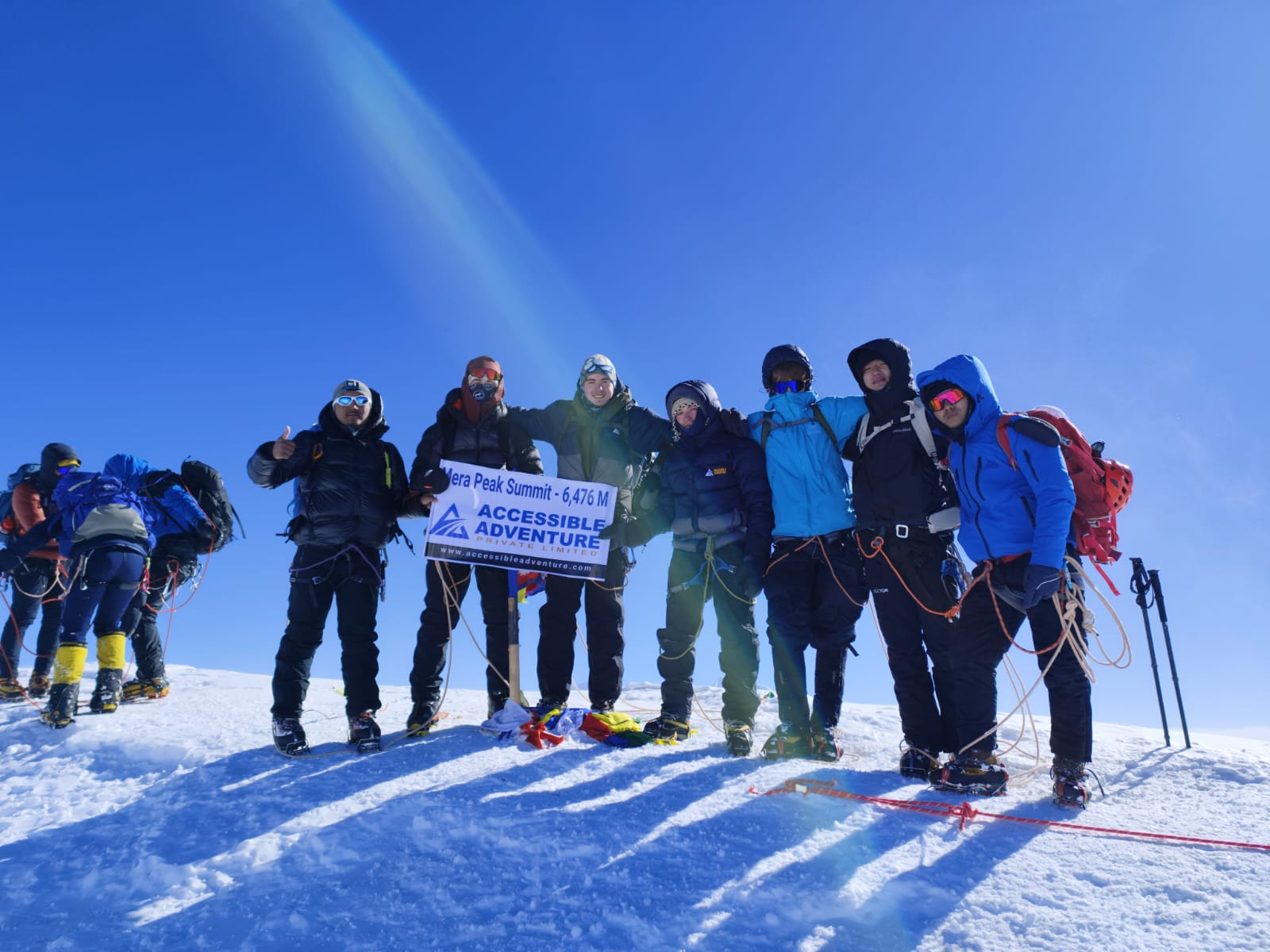
Mera Peak stands taller at 6,476m (21,247ft) and asks for raw stamina more than skill. The walking is long, the air is thin, and the summit day runs eight to twelve hours, and a fixed rope only comes out if conditions turn rough.
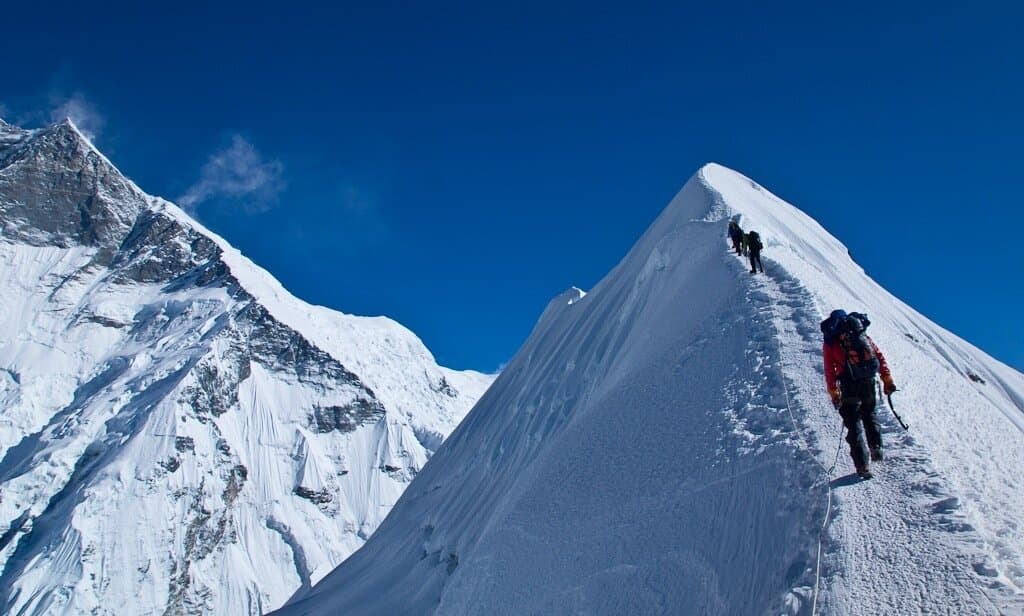
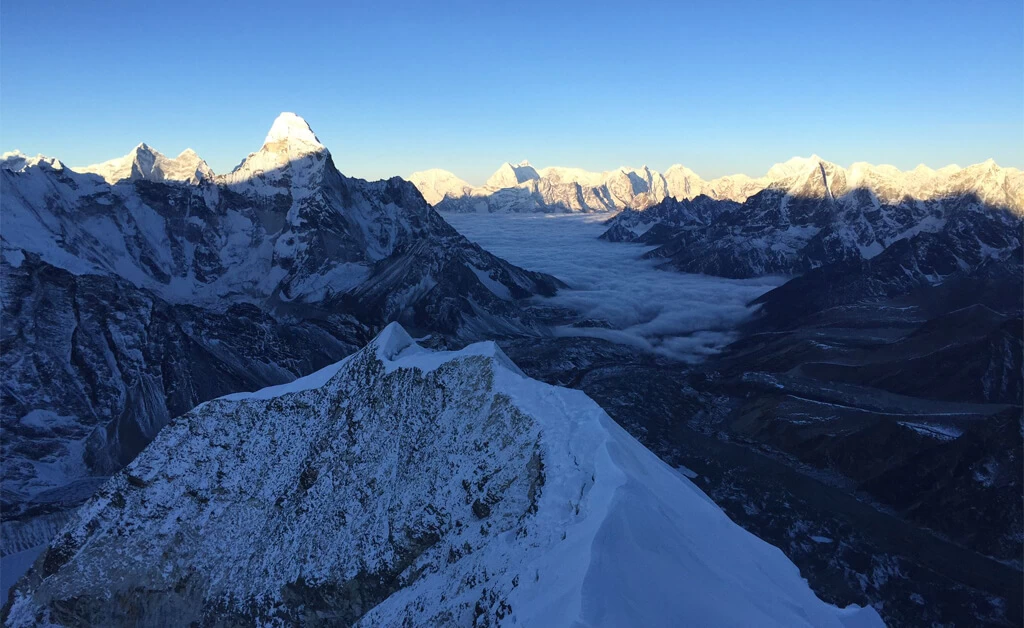
Island Peak, known as Imja Tse, tops out lower at 6,189m (20,305ft) and throws a genuinely technical finish at you: a fixed-rope headwall, a ladder over a crevasse, and a summit ridge with real exposure.
If you want a big altitude number and a more gradual climb, pick Mera Peak. If you want to test mountaineering skills and don't mind a shorter but steeper push, pick Island Peak. Strong trekkers with no climbing background tend to do better on Mera Peak. Climbers who already know how to use crampons and jumar a fixed line often prefer Island Peak.
Mera Peak at a Glance
Mera Peak holds the title of Nepal's highest trekking peak, and it earns that title by a wide margin. The summit sits at 6,476m, which puts it well above most other peaks on the Nepal Mountaineering Association's trekking peak list. The mountain actually has three summits, Mera North, Mera Central, and Mera South, and most guided trips aim for Mera Central, first climbed back in 1953 by Jimmy Roberts and Sen Tenzing.
The approach runs through the Hinku Valley, a quieter side of the Khumbu that sees far fewer trekkers than the Everest Base Camp trail. You'll cross the Zatrwa La pass at around 4,600m early in the trek, drop into the valley, then climb steadily through Kothe, Thaknak, and Khare before reaching high camp at roughly 5,780m. From there, summit night is a long, cold slog over a glacier, not a technical climb. The route sits at an alpine PD grade, meaning a fairly straightforward ascent with no real rock climbing or steep ice. You'll wear crampons and rope up on the glacier, but ladders and fixed-rope headwalls don't come into it.
What you get for the effort is one of the best summit views in Nepal. On a clear morning, Mera Peak's summit shows you five 8,000m giants in one sweep: Everest, Lhotse, Makalu, Cho Oyu, and Kanchenjunga. Few trekking peaks in the world put that many giants in a single frame.
Island Peak at a Glance
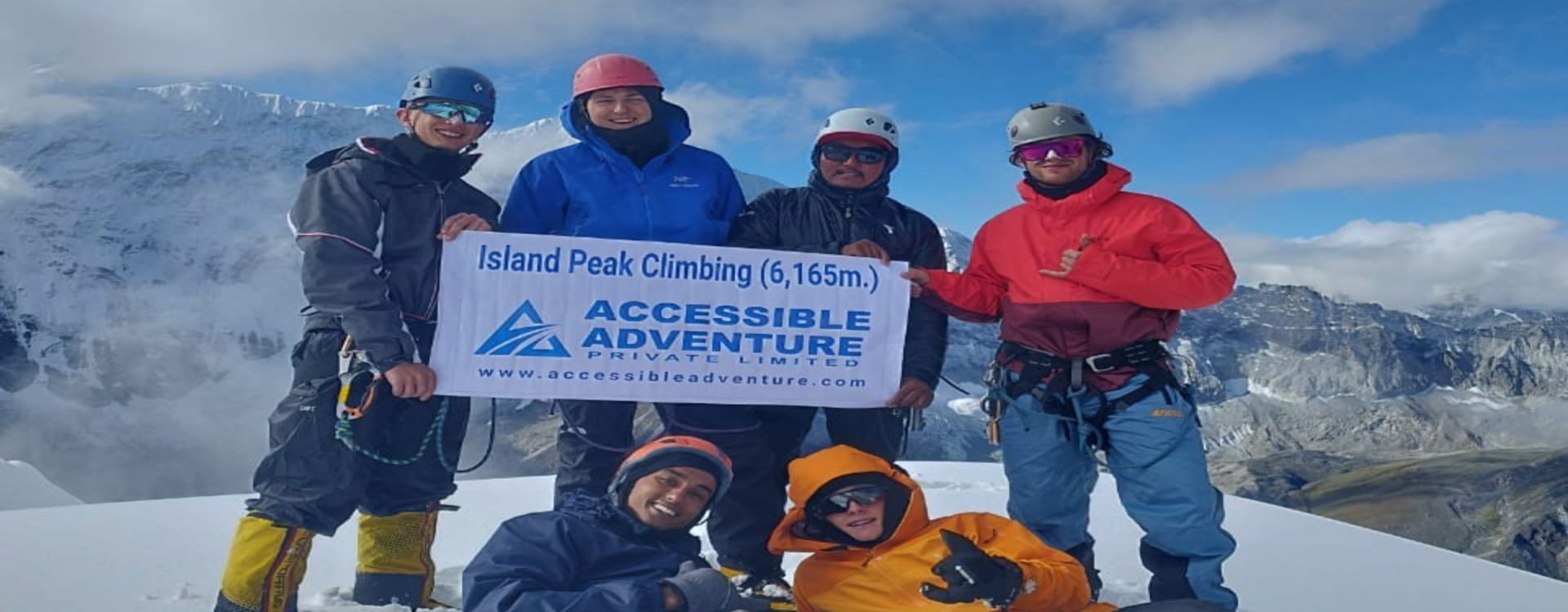
Island Peak earned its English name from Eric Shipton's 1952 expedition team, who looked up from the Chhukhung valley and saw a peak rising out of a sea of ice like an island. Tenzing Norgay and the British Everest team used it as a training climb the year before their own summit push, and the route they pioneered is still the one climbers follow today.
At 6,189m, Island Peak sits 287m lower than Mera Peak, but don't let the smaller number fool you. The approach follows the classic Everest Base Camp trail through Lukla, Namche Bazaar, Tengboche, and Dingboche before branching off at Chhukhung. The walk to base camp is gentler this way and better supplied with teahouses than the Mera route. The climb itself is where Island Peak earns its reputation. From base camp, you'll cross a glacier, navigate a crevasse on a short ladder, and then face the headwall. It's a steep snow and ice wall fixed with rope, and you'll jumar up it, often in the dark, before a final exposed ridge walk to the summit.
That technical finish is exactly why so many climbers use Island Peak as a stepping stone toward bigger mountains like Ama Dablam or the 8,000m peaks, and why it pairs so naturally with an Everest Base Camp trek. Plenty of our climbers do both in one trip: trek to Base Camp and Kala Patthar, then swing south to Chhukhung and finish with the Island Peak summit push.
Difficulty: Technical Skill vs Raw Endurance
This is where the Mera Peak vs Island Peak debate really gets settled, and the answer depends on what kind of hard you're prepared for.
Mera Peak is physically harder. You're walking at extreme altitude for longer stretches, and the trek approach gains and loses elevation constantly. Summit night alone can run eight to twelve hours, in temperatures down to minus 20 or minus 30 degrees Celsius with wind chill. None of that requires technical climbing skill. You won't rappel, you won't navigate a fixed-rope headwall, and most of the route is simply putting one foot in front of the other on snow and glacier ice.
Island Peak flips that balance. The trek to base camp is easier than the Mera approach, with better trails and more teahouse comfort along the way. The summit push is where it bites: fixed ropes for a long stretch of the upper mountain, a crevasse crossing on a short ladder, and a headwall steep enough that you'll be using a jumar to ascend the rope rather than just walking. Climbers with zero rope experience can still do it with good guiding, but the learning curve on summit day is steeper, and there's less room for hesitation once you're on the fixed line.
|
Factor |
Mera Peak |
Island Peak |
|---|---|---|
|
Summit elevation |
6,476m / 21,247ft |
6,189m / 20,305ft |
|
Alpine grade |
PD (non-technical) |
PD+ to AD (technical sections) |
|
Fixed ropes |
Minimal, only in rough spots |
Extensive on the headwall |
|
Ladder crossing |
Not required |
Yes, over a crevasse |
|
Trek to base camp |
Harder, more remote, fewer teahouses |
Easier, classic EBC trail, more teahouses |
|
Typical trip length |
15-21 days |
15-19 days alone, 18-21 with EBC |
|
Best suited for |
Strong trekkers, first 6,000m summit |
Climbers wanting technical practice |
Altitude and Acclimatization
Don't read Island Peak's lower number as "easier on the body." Both peaks put you well into the altitude zone, where oxygen levels run close to half of what you'd breathe at sea level. Both demand a real acclimatization schedule, not a rushed one.
Mera Peak's extra 287m matters more than it sounds. That gap shows up most on summit night, when the air gets noticeably thinner in the final hour below the top. A good Mera Peak itinerary builds in acclimatization nights at Kothe, Thaknak, and Khare, plus a practice day on the lower slopes of Mera La before the summit attempt.
Island Peak benefits from a built-in acclimatization advantage. Most climbers reach it after a week or more on the Everest Base Camp trail, and that trail already pushes them above 5,000m at Kala Patthar before they ever step on Island Peak's glacier. If you're skipping the EBC portion and going straight for Island Peak, you'll want extra rest days at Chhukhung to make up for that missing acclimatization.
Whichever peak you choose, the rule stays the same. Climb high, sleep low, drink more water than feels necessary, and never push through a bad headache hoping it clears on its own.
The Trek to Base Camp: Which Route Is Harder
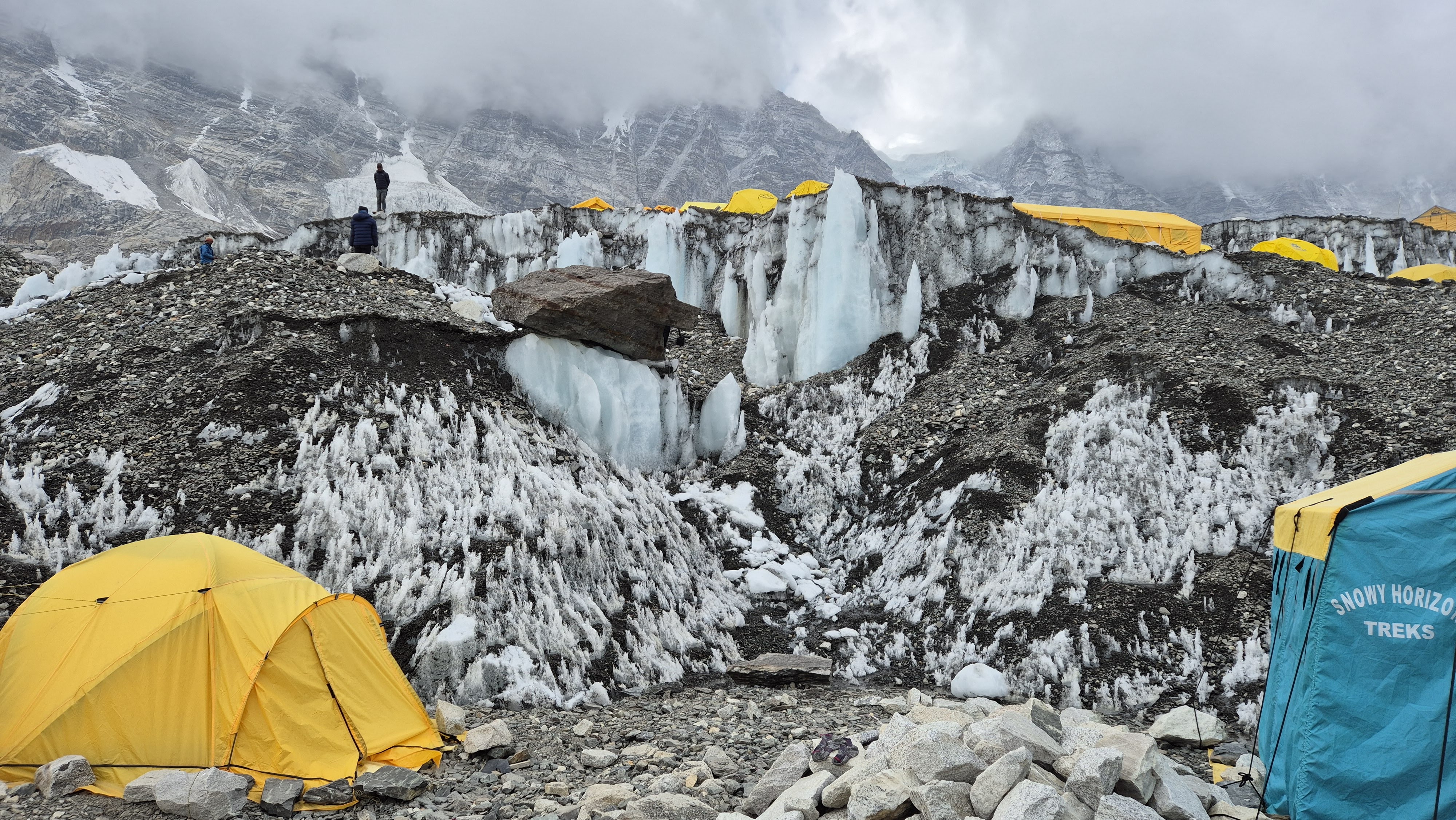
Strip away the summit day and look only at the walk-in, and the comparison flips. The Mera Peak trek through the Hinku Valley is the harder of the two. Trails are rougher, teahouses are sparser, and the Zatrwa La crossing near the start puts you over 4,600m before your body has had much time to adjust. Above Khare, the trip switches from teahouse lodging to camping, which adds a layer of logistics most EBC-trail trekkers never deal with.
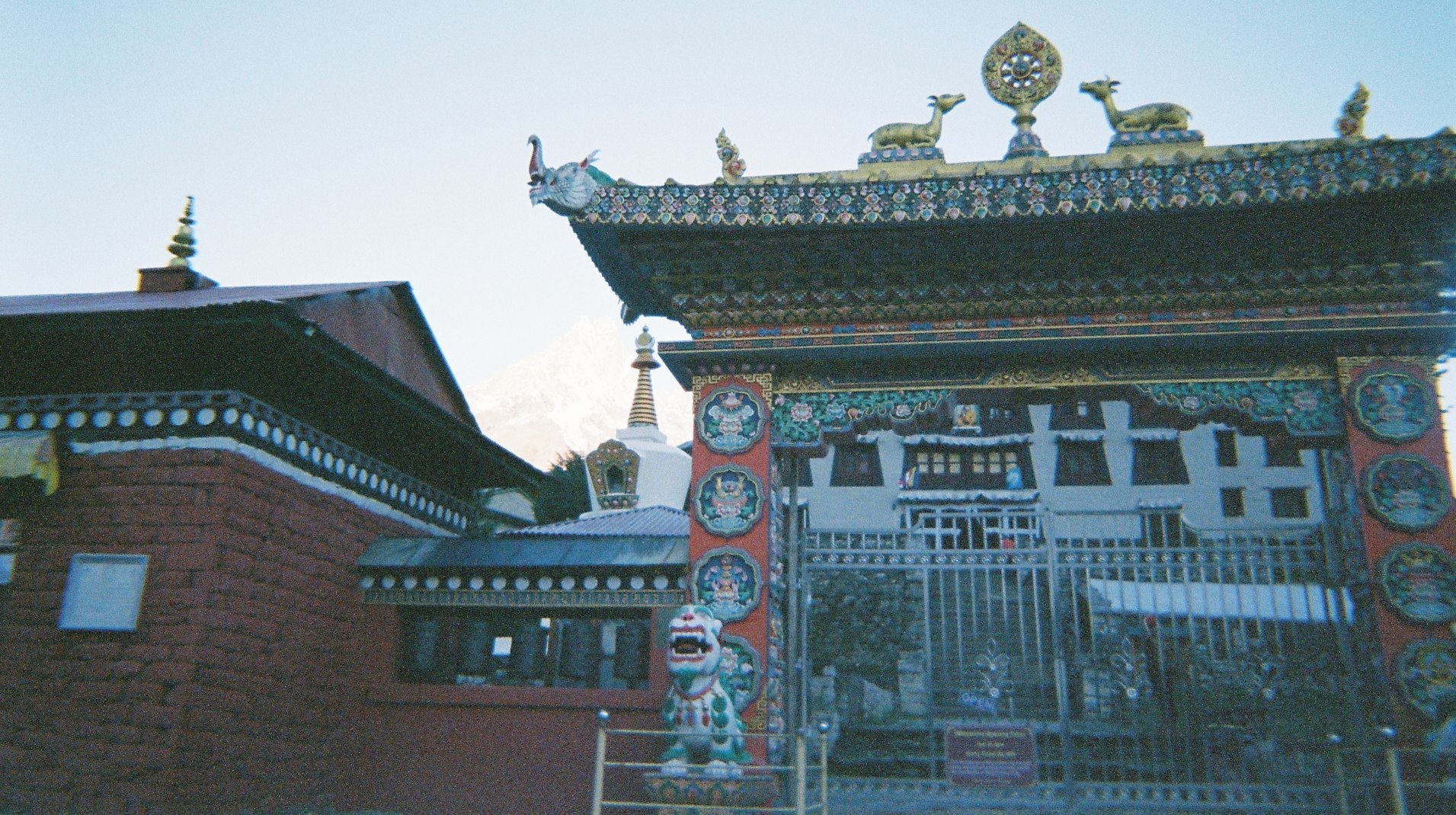
Island Peak's approach runs along the best-known trekking corridor in Nepal. Namche Bazaar's Saturday market, the Tengboche monastery, and comfortable lodges the whole way mean you're trading solitude for comfort. The trade-off is crowding. During peak season, you'll share the trail and the teahouses with the steady stream of EBC trekkers.
If solitude matters to you as much as the summit, Mera Peak's quieter valley is the better pick. If you'd rather walk a well-trodden trail with hot showers most nights and save your hardest effort for the climb itself, Island Peak's approach makes more sense.
Cost Breakdown
Pricing for both peaks moves with season, group size, and how much support you book, so treat the numbers below as a planning range, not a fixed quote.
|
Item |
Mera Peak |
Island Peak |
|---|---|---|
|
Guided package (per person) |
Roughly $2,700-$3,500 for a 15-21 day trip |
Roughly $1,800-$2,500 alone, $2,400-$3,500 combined with EBC |
|
NMA climbing permit |
$350 spring, $175 autumn/winter/summer |
$350 spring, $175 autumn/winter/summer |
|
National park entry |
Makalu Barun National Park, around $22 |
Sagarmatha National Park, around $22 |
|
Rural municipality fee |
Khumbu Pasang Lhamu, around $20 |
Khumbu Pasang Lhamu, around $20 |
|
TIMS card |
NPR 2,000 (roughly $15) |
NPR 2,000 (roughly $15) |
|
Garbage deposit |
$500 refundable, covers the team |
$500 refundable, covers the team |
|
Gear rental in Kathmandu |
$50-$120 for a full technical set |
$50-$120 for a full technical set |
|
Travel insurance |
$100-$250 for high-altitude and rescue cover |
$100-$250 for high-altitude and rescue cover |
The NMA raised its permit fees on September 1, 2025, so older blog posts you find quoting $250 for spring are out of date. Both Mera Peak and Island Peak sit in the NMA's Group B trekking peak category, which keeps their permit costs lower than the big expedition peaks above 6,500m, and identical to each other.
Best Time to Climb
Both peaks share the same two good windows: spring, from March to May, and autumn, from September to November. Spring brings settled weather after winter and busier base camps, with prices and permit fees running higher to match. Autumn often gives crisper air and clearer summit photos, with the first half of October standing out as a sweet spot before the cold sets in hard.
Winter and the summer monsoon both stay open on paper, with cheaper permits to match, but neither suits a first attempt. Winter cold turns a long Mera Peak summit night brutal, and monsoon cloud cover plus avalanche risk make both mountains a poor bet from June through August.
Permits You Need
Solo climbing isn't an option on either mountain. Nepal requires a licensed guide and a registered trekking agency to apply for your permits, full stop.
For Mera Peak, you'll need three documents: the Makalu Barun National Park entry permit, the NMA Group B climbing permit, and the Khumbu Pasang Lhamu Rural Municipality entry fee. For Island Peak, swap the national park permit for the Sagarmatha National Park entry instead, and the other two stay the same. A TIMS card and a $500 refundable garbage deposit round out the paperwork for both. Your operator should handle every one of these on your behalf and hand you copies before you fly to Lukla.
Training and Gear
Mera Peak rewards cardio fitness above almost everything else. Aim to start training three to six months out, with four or five sessions a week mixing hiking, running, and cycling, plus strength work for your legs and core. Practice carrying a loaded pack, building up to around 12kg, and try to get comfortable with back-to-back days of 1,000m of elevation gain and loss before you fly to Lukla.
Island Peak asks for the same fitness base plus a working knowledge of crampons, an ice axe, a harness, and a jumar. If you've never used any of that gear, a day or two at a climbing gym or an indoor ice wall before your trip pays off. You don't want to be learning rope technique for the first time at 6,000m in the dark.
Gear lists overlap heavily between the two peaks. Pack insulated mountaineering boots, crampons, an ice axe, a climbing harness, a down jacket rated to around minus 20 degrees Celsius, a sleeping bag rated the same, and a full layering system. Most technical gear rents cheaply in Kathmandu, so you don't need to own a harness or jumar before you arrive, but boots and gloves should fit you personally rather than come from a rental shelf.
Which Peak Should a First-Time Climber Pick?
If you're strong on your feet, comfortable with long days, and new to ropes and ice tools, Mera Peak is the safer first step. The climb stays non-technical from start to finish, and the biggest test is simply staying upright and motivated through a long, cold summit night.
If you already have some scrambling or rope experience, or you want a taste of real mountaineering before committing to a bigger peak like Ama Dablam, Island Peak gives you that test in a shorter trip. The technical sections are short but real, and clearing them builds confidence you can carry into harder climbs.
Neither peak demands prior Himalayan experience. Both demand honest fitness, patience with acclimatization, and a guide you trust on summit night.
Can You Climb Both?
Plenty of climbers do, and not always in the same trip. Some treat Mera Peak as the warm-up year, building altitude experience and confidence, then come back a season later ready for Island Peak's technical finish. Others combine an Island Peak climb with the full Everest Base Camp trek in one extended itinerary, since the trail overlaps for most of the walk-in.
A back-to-back trip covering both peaks in one visit is possible, too, though it asks a lot of your schedule and your legs. Expect close to a month on the ground if you want both summits with proper acclimatization between them. Talk to your guide early if this is the plan, since the route logistics between the Hinku Valley and the Khumbu need careful sequencing.
Our Take
We don't think there's a wrong choice between these two mountains, only a better fit for where you're starting from. Climbers chasing their first big altitude number with a manageable skill curve tend to walk away from Mera Peak, glad they picked it. Climbers who want to leave Nepal with real rope skills under their belt usually say the same about Island Peak.
What matters more than which peak you pick is who you climb with. Ask any operator about their guide-to-client ratio, their acclimatization schedule, and what happens if the weather shuts down your first summit window. A trip with extra acclimatization days and an experienced NMA-certified guide will get you to the top safely far more often than the cheapest package on the page.
If you're still torn, talk to us. We'll walk through your fitness level, your timeline, and your budget, and help you pick the mountain that fits, not just the one with better marketing.
Frequently Asked Questions
Mera Peak is the easier climb overall. It's higher and physically more demanding, but the route stays non-technical, with no fixed-rope headwall or ladder crossing. Island Peak is lower but more technical, which makes most guides rate it as the harder of the two.
Yes. Mera Peak doesn't require prior mountaineering experience, only good fitness and a willingness to train for several months. Your guide will teach you crampon and rope basics during the trek.
Yes, with the right guide and preparation. Most operators run a short training session at base camp covering crampons, the harness, and the jumar before the summit push. You don't need climbing experience walking in, just a strong fitness base and a calm head on the fixed rope.
Most guided itineraries run 15 to 21 days from Kathmandu and back, including acclimatization days and a buffer for weather.
Island Peak alone usually runs 15 to 16 days. Combined with the full Everest Base Camp trek, expect 18 to 21 days.
Budget roughly $2,700 to $3,500 per person for a comprehensive guided package, on top of your international flights, visa, and personal gear.
A standalone Island Peak package typically runs $1,800 to $2,500 per person. Combined with Everest Base Camp, expect $2,400 to $3,500
Both need an NMA Group B climbing permit, a national park entry permit (Makalu Barun for Mera, Sagarmatha for Island Peak), a Khumbu Pasang Lhamu Rural Municipality fee, a TIMS card, and a refundable garbage deposit. Your trekking agency handles the paperwork.
Spring (March to May) and autumn (September to November) both work well for either peak. Autumn tends to bring clearer skies and smaller crowds, with the first half of October a strong pick.
No. Neither peak requires bottled oxygen for a standard guided climb. Good acclimatization and a flexible itinerary matter far more than oxygen at these altitudes.
Mera Peak's summit gives you five 8,000m peaks in one view: Everest, Lhotse, Makalu, Cho Oyu, and Kanchenjunga. Island Peak's summit puts you closer to the Khumbu giants, with a striking, near-vertical view of Lhotse's south face and Ama Dablam.
Yes, though it takes close to a month with proper acclimatization between the two climbs. Many climbers instead treat them as separate trips, often starting with Mera Peak.
Yes. You'll need a policy that covers high-altitude trekking above 6,000m and helicopter evacuation. Standard travel insurance usually excludes this, so check the policy wording before you book.
Most operators set the minimum age at 16, sometimes with a parent or guardian present, though this varies by company. Check directly with your operator if you're booking for a younger climber.
Prior trekking experience helps but isn't mandatory for either peak. What matters more is your current fitness level and the months of training you put in beforehand.
About Accessible Adventure
Bringing unforgettable Himalayan adventures to everyone. Our expert guides and carefully curated experiences ensure that everyone can explore the beauty of Nepal, Tibet, and Bhutan.
Learn More