Mera Peak and Island Peak: Complete Guide to Nepal’s Best Combined Climbing Expedition
Field-reviewed by Hari Kumar Shrestha
Table of Contents
Two summits, one journey:
from the remote Hinku Valley to the heart of the Khumbu, and why doing both peaks changes the experience of each
At some point in the planning process for a Nepal climbing expedition, most serious aspirants run into the same problem. Mera Peak and Island Peak are both compelling enough on their own terms that the question of which one to choose feels genuinely difficult to answer. Mera Peak at 6,476 metres is the highest trekking peak in Nepal, offers an extraordinary summit panorama of five eight-thousanders, and approaches through the remote Hinku Valley on a trail most trekkers never see. Island Peak at 6,189 metres sits in the heart of the Khumbu, combines naturally with the Everest Base Camp corridor, and presents a more technically demanding climbing challenge with a near-vertical headwall that tests skills Mera Peak does not require. Both are objectively excellent reasons to fly to Nepal.
The question of which to choose misses something important, however, and that is the option to climb both on a single expedition. The combined Mera Peak and Island Peak route, which links the two summits via the Amphu Laptsa Pass at 5,845 metres, is one of the most complete mountain experiences available to non-technical climbers anywhere in the Himalaya. It takes a well-structured expedition of 24 to 27 days, demands a higher level of fitness and commitment than either peak alone, and rewards those demands with a journey that covers two distinct valleys, two summit panoramas, a technically interesting high-pass crossing, and an acclimatisation profile so well-graduated that climbers routinely describe feeling genuinely strong on Island Peak after the days spent above 5,000 metres on Mera.
This guide covers everything relevant to the combined expedition: the case for doing both, how the two peaks compare as individual climbs, the connecting Amphu Laptsa Pass and what crossing it involves, the full route structure, the physical and technical requirements, the cost breakdown, the best season, and the specific type of climber this route suits. If you are trying to decide between the two peaks, or are already leaning toward a combined expedition and want to understand what it actually involves, the information below addresses both questions in detail.
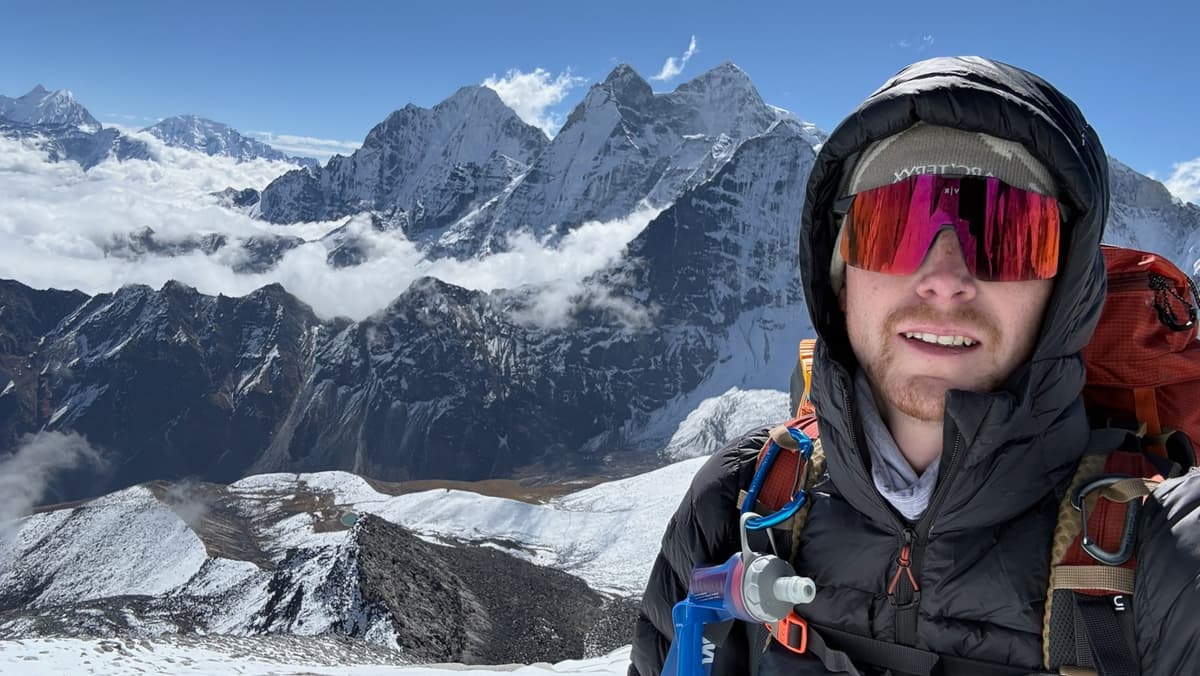
Mera Peak and Island Peak: What Makes Each One Different
The two peaks share a region and a permit classification but very little else. Understanding how they differ is the starting point for deciding whether to choose one or both.
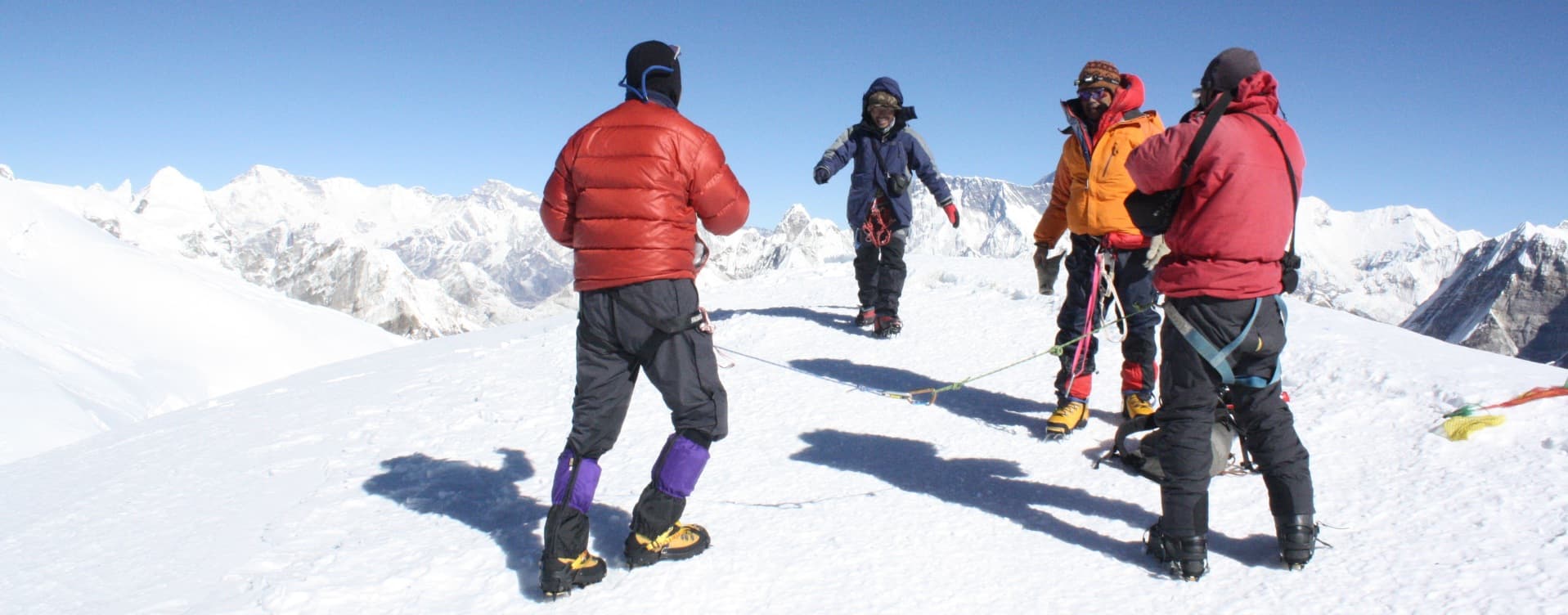
Mera Peak is an altitude climb. At 6,476 metres, it is 287 metres higher than Island Peak, and that difference is physiologically meaningful at this elevation. The standard route involves glacier travel on slopes that rarely exceed 30 degrees, with fixed ropes only on the steeper sections near the summit ridge. The technical demands are genuinely moderate: confident crampon technique, basic ice axe use, and jumar operation on fixed ropes are the skills required, and all three are taught on the mountain during training sessions at Khare base camp for climbers who arrive without prior mountaineering experience. What the route does demand is physical endurance. Summit day runs ten to fourteen hours from High Camp at 5,780 metres to Mera North at 6,476 metres and back, starting in darkness, at an altitude where each breath delivers roughly 47 percent of the oxygen available at sea level. The mountain is accessible, but it is not forgiving of poor preparation.
Island Peak is the technical climb. At 6,189 metres, it is lower, but the final 200 metres involves a near-vertical headwall of compacted snow and ice that represents a genuine technical challenge requiring confident jumar work, correct crampon technique on steep ground, and focused composure on the exposed summit ridge above the headwall. The approach follows the classic Khumbu trekking corridor through Namche Bazaar, Tengboche, Dingboche, and Chukhung, then climbs to base camp at 5,087 metres above the Imja Valley. The headwall is the thing climbers talk about afterward: the most technically demanding section on any standard Nepal trekking peak, requiring a steady ascent on fixed ropes above ground that drops away sharply on both sides. Climbers who have sound crampon technique but no experience of genuinely exposed terrain find that Island Peak recalibrates what they thought they understood about high places.
The summit views are different enough to be worth describing separately. From Mera North, the defining feature is breadth: five of the world’s fourteen eight-thousanders are visible simultaneously, with Everest, Lhotse, Makalu, Cho Oyu, and Kangchenjunga arranged across a horizon that requires a slow rotation of the head to take in fully. This panorama is often cited by guides as the finest summit view available to any non-expedition climber in Nepal, and it is difficult to argue with. From Island Peak, the experience is entirely different: intimate rather than panoramic. The south face of Lhotse fills the view to the north-west with an immediacy that has no equivalent from Mera. Ama Dablam stands to the west. The Imja Glacier spreads below the summit. The scale is closer and more immediate rather than sweeping. Experienced Himalayan climbers who have stood on both summits consistently say the two views are genuinely incomparable and that the comparison is itself the wrong frame.
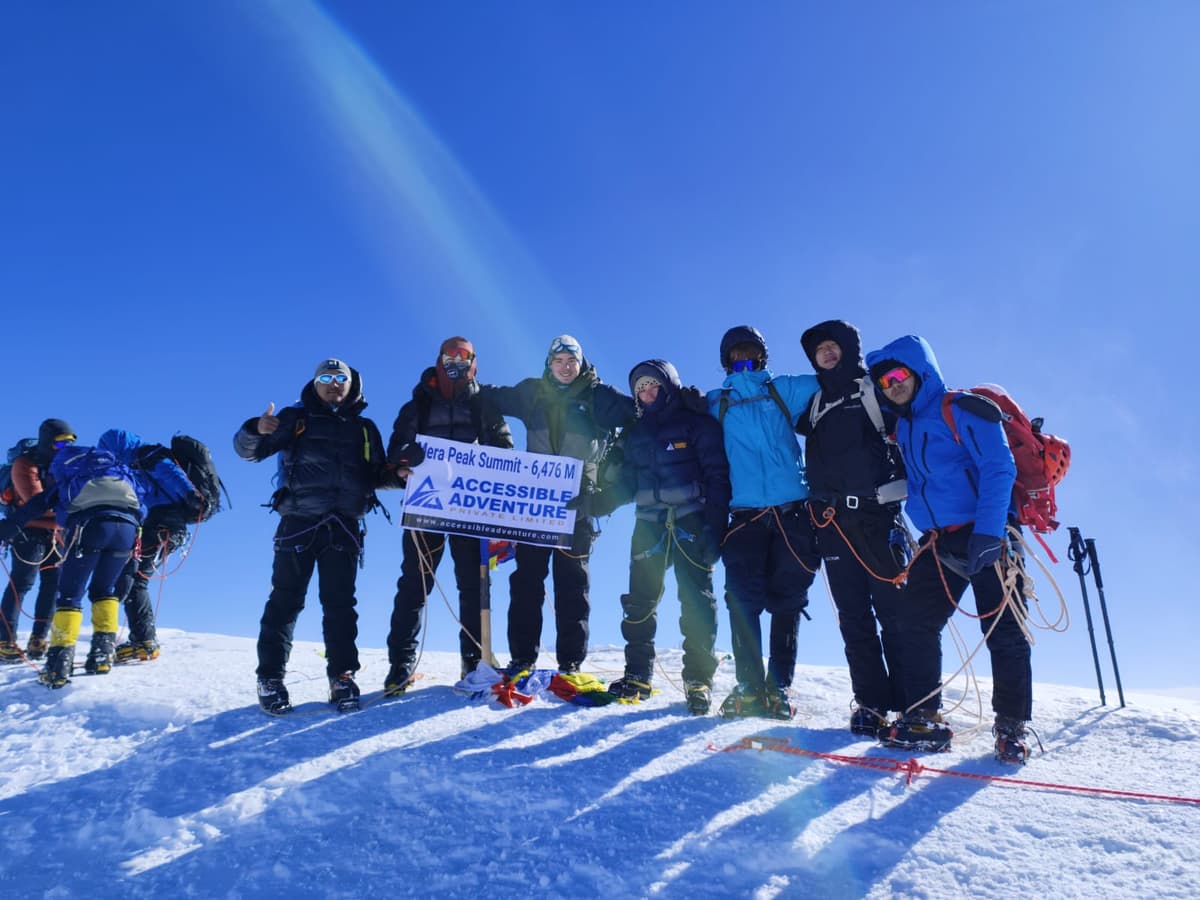
The Case for Combining Both Peaks in a Single Expedition
The most practical argument for the combined expedition is acclimatisation. Mera Peak, approached through the Hinku Valley over eight to ten days from Lukla, provides one of the most gradual and well-structured acclimatisation profiles available on any Nepal trekking peak. The route ascends from Lukla at 2,860 metres through the valley over multiple days, sleeping progressively higher while maintaining a sensible rate of gain, and arriving at Khare base camp at 5,045 metres with a body that has had adequate time to adapt. Climbers who summit Mera and then cross to Island Peak via the Amphu Laptsa Pass arrive at Island Peak base camp with a physiological advantage that cannot be manufactured by any other means: genuine, days-long acclimatisation above 5,000 metres, confirmed by actual summit performance. The reports from guides who lead this combined route consistently note that Island Peak summit day, which ordinarily challenges climbers who approach it fresh from a lower altitude itinerary, feels measurably more manageable for those who have already stood on Mera.
The financial case is also real. Running two separate expeditions to Nepal, each with its own international flights, domestic flights, Kathmandu accommodation, permit fees, guide costs, and logistical overheads, costs substantially more than a single combined expedition in which those fixed costs are shared across the full journey. Most operators offering the combined expedition price it at less than the sum of both individual packages, reflecting the efficiencies of combined logistics, shared staffing costs, and the elimination of the redundant Kathmandu bookends that each separate trip would otherwise require.
There is also a less quantifiable argument that many climbers find the most persuasive one. Mera Peak and Island Peak together cover more of the eastern Himalaya’s character than either does alone. The Hinku Valley approach to Mera, remote and rarely visited by the standards of Nepal trekking, delivers a kind of wilderness that the Khumbu’s main corridors have not offered for decades. The Khumbu approach to Island Peak delivers something else entirely: the density of Sherpa culture, the busy mountain hub of Namche Bazaar, the sight of Everest’s summit from Kala Patthar. These are not similar experiences happening at similar mountains. They are complementary ones, and the Amphu Laptsa Pass crossing between them is neither a logistical inconvenience nor merely a connector. It is, by most accounts of people who have done it, one of the great crossings in the Himalaya.
The Amphu Laptsa Pass: What the Crossing Actually Involves
The Amphu Laptsa Pass at 5,845 metres is the linchpin of the combined expedition. It connects the upper Hinku Valley, where Mera Peak sits, to the Imja Valley in the Khumbu, from which Island Peak is approached. Without the pass, the two peaks cannot be linked on a single continuous journey and the expedition would require a return to Lukla followed by a fresh departure up the Khumbu. The Amphu Laptsa removes that requirement and creates the circular route that makes the combined expedition work.
The crossing is more technically demanding than either peak’s standard route and is the section of the combined expedition that requires the most direct attention in planning. From the Hinku side, the approach to the pass base camp follows lateral moraine past Seto Pokhari, a glacial lake sitting at around 4,900 metres, before ascending through increasingly rocky terrain toward the col. The ascent to the pass itself is on the south-facing side and is considerably more straightforward than the descent: the approach from the Hinku is a steep but manageable climb on rock and scree that gains the col without significant technical difficulty. The view from the pass is widely described as one of the most dramatic in the eastern Himalaya. Lhotse’s south wall fills the skyline directly across the valley with a proximity and scale that visitors to Everest Base Camp rarely see this clearly, and the diminutive profile of Island Peak in the foreground, with the full Khumbu panorama behind it, is the frame that defines the crossing.
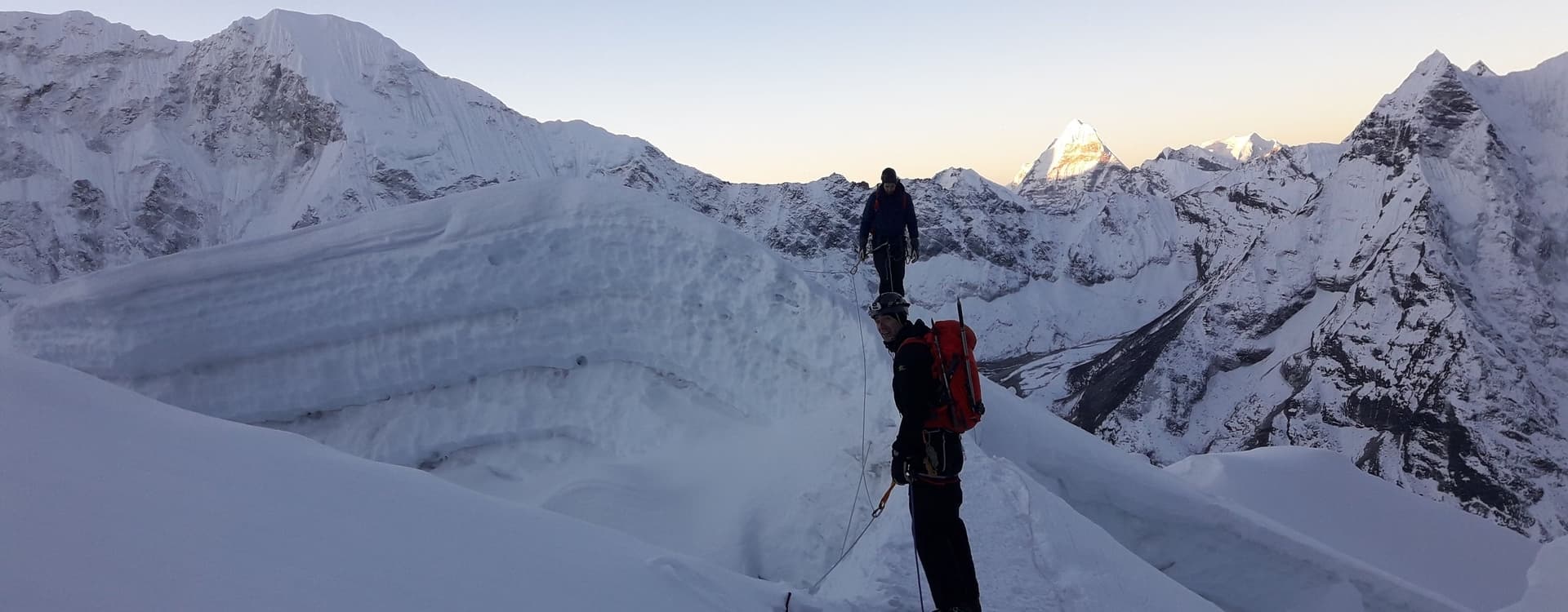
The descent from the Amphu Laptsa on the north-facing Khumbu side is the technically demanding section. The north face of the col carries steep snow slopes that require fixed rope work and careful crampon technique, with an abseil section on the upper section before the terrain opens onto the glacial snowfields below. The climbing Sherpa team sets fixed ropes on this section and manages the descent sequentially; the process of moving the full expedition team, porters, and equipment through the descent is logistically involved and typically takes a full day from the pre-pass camp to Island Peak base camp on the far side. This is precisely the kind of day that benefits from the confidence and technical familiarity that the Mera summit and the training days at Khare have already provided.
The Amphu Laptsa should not be treated as a pass that requires the same level of preparation as the two peaks. It is not harder than the Island Peak headwall and does not reach the altitude of Mera’s summit. What it requires is that the skills developed during the expedition are applied to terrain that offers less margin for error than a glacier slope of 30 degrees. Climbers who have given proper attention to their crampon technique and fixed rope management during the earlier sections of the expedition handle the crossing without incident. It is the section most likely to slow a group down, and the day should be planned with generous time rather than a minimum-time assumption.
Route Structure and Day-by-Day Logic
The combined expedition runs in a single linear direction from Lukla, through the Hinku Valley to Mera Peak, over the Amphu Laptsa Pass, and into the Khumbu for Island Peak. The expedition ends at Lukla after descending through Chukhung, Dingboche, and the standard Khumbu trail corridor. This linear structure, travelling through three distinct valleys without retracing significant sections of trail, is one of the route’s most appealing features.
From Lukla, the first segment follows the Hinku Valley approach over eight to ten days to Khare at 5,045 metres. This section is covered in detail in the standalone Mera Peak guide; the key points here are that the approach should not be shortened and that the acclimatisation days at Tangnag and Khare are genuinely important, not optional rest-day additions. The two training days at Khare, which cover crampon technique, self-arrest, and fixed rope management, are the technical foundation for everything that follows on both peaks and on the Amphu Laptsa.
The Mera climb follows: Mera Base Camp on the glacier, High Camp at 5,780 metres, and summit day to Mera North at 6,476 metres. After descending and returning to the Hinku side for rest and recovery, the expedition then moves toward Seto Pokhari and the Amphu Laptsa Pass base camp over one to two days. The pass crossing to Island Peak base camp at 5,100 metres follows, and after rest and gear reorganisation, Island Peak summit day rounds out the technical climbing. The descent from Island Peak follows the standard route through Chukhung and Dingboche before rejoining the main Khumbu trail toward Namche Bazaar and Lukla for the flight back to Kathmandu.
The total itinerary runs 24 to 27 days, including the Kathmandu nights. Operators who compress this to fewer days typically do so at the expense of acclimatisation and rest on the Hinku side, which degrades the summit success rate on both peaks. The route does not benefit from rushing. The additional days in a properly structured itinerary are not padding; they are the mechanism by which climbers arrive at both summits in a condition to finish what they started.
Physical and Technical Requirements
The combined expedition requires a higher level of fitness than either peak individually. The relevant baseline is the ability to sustain six to eight hours of daily movement at altitude for two consecutive weeks, to recover adequately between demanding days while sleeping above 5,000 metres, and to perform technically on the Amphu Laptsa descent and the Island Peak headwall after an already demanding first half of the expedition. Climbers who trained adequately for Mera Peak as a standalone objective typically find themselves at or near the baseline required for the combined route, though the additional duration and the Amphu Laptsa crossing merit a more thorough preparation period.
Training should begin at a minimum of four months before departure, with a specific emphasis on sustained aerobic output over long durations rather than peak cardiovascular performance. Weighted uphill hiking on variable terrain at weekends, carrying twelve to fifteen kilograms over five to seven-hour routes, builds the specific muscular and cardiovascular endurance that the expedition demands. Leg strength training, particularly quad eccentric conditioning through step-downs and slow single-leg squats, prepares the knees for the long descents from Mera High Camp and from the Amphu Laptsa. Core stability work supports the balance demands of glacier travel and fixed rope sections under load.
Prior high-altitude experience above 5,000 metres is strongly recommended rather than simply noted as beneficial. Climbers who have completed the Everest Base Camp trek, the Annapurna Circuit over Thorong La, or a comparable high-altitude route arrive at the combined expedition with a physiological and practical understanding of how their body responds to altitude that cannot be substituted by any amount of lower-elevation training. First-time climbers with no prior altitude exposure above 4,000 metres should treat Mera Peak as a standalone first objective and plan the combined expedition for a subsequent season.
Technical skill requirements are modest but non-negotiable. Competent crampon walking on slopes up to 40 degrees, confident jumar operation on fixed lines, correct self-arrest technique, and basic harness management including anchor clipping, are all required before the expedition’s most demanding days. These skills are taught and practised during the training sessions at Khare base camp. Climbers who arrive having completed a one-day mountaineering skills course in their home country before departure use those training days more effectively and carry more confidence into the Amphu Laptsa descent and the Island Peak headwall than those learning everything for the first time at 5,000 metres.
Season, Permits, and Costs
Spring (April to May) and autumn (late September to November) are the viable windows for the combined expedition, following the same seasonal logic that governs both individual peaks. October is the month most consistently recommended by experienced guides for the quality of visibility on both summits and the stability of conditions on the Amphu Laptsa Pass. The post-monsoon skies in October produce the clearest mountain views of the year on both Mera and Island Peak, and the snowpack on the pass tends to be firmer and more predictable than in the softer conditions of late May. April and early May offer the spring window with the rhododendron bloom on the lower Hinku approach as an additional attraction.
The permit requirements cover both peaks individually. The Mera Peak Climbing Permit from the Nepal Mountaineering Association costs approximately USD 350 per person in spring and USD 175 in autumn. The Island Peak permit costs approximately USD 250 per person in spring and USD 175 in autumn. The Sagarmatha National Park permit, required for the Khumbu section, costs USD 30. The Makalu Barun National Park permit, covering the Hinku Valley approach, costs approximately NPR 3,000. All permits are arranged by the expedition operator and included in the package price; climbers cannot obtain NMA peak permits independently.
Total package costs for a fully inclusive combined Mera Peak and Island Peak expedition from a reputable operator typically run between USD 3,500 and USD 5,500 per person, reflecting the longer duration, greater logistical complexity, and higher staffing requirements compared to either peak individually. This range covers all domestic flights, Kathmandu hotel nights, all accommodation and meals throughout the expedition, both climbing permits and national park fees, a licensed NMA guide, the 1:1 climbing Sherpa ratio for technical sections, porter support, camp equipment, and all fixed ropes and technical group gear. Personal expenses on top of this include the Nepal visa (USD 50 for 30 days), travel insurance with mountaineering coverage to 7,000 metres and helicopter evacuation, tips for guides and porters, and any gear purchased or rented in Kathmandu.
The insurance requirement deserves specific emphasis on the combined expedition. The route crosses terrain at consistently high altitude for a longer period than either standalone peak and involves a technically demanding pass crossing between the two climbing sections. The policy must explicitly cover trekking or climbing activities at or above 6,500 metres and must include emergency helicopter evacuation from remote mountain terrain. Standard travel insurance does not provide this coverage even when it lists trekking as a covered activity. Adventure-specific policies from providers such as World Nomads, Battleface, and IMG Global cover the altitude and activity requirements for this expedition. The cost of helicopter evacuation from above 5,000 metres without insurance starts at USD 3,000 and can exceed USD 10,000 depending on location and conditions.
Who the Combined Expedition Suits
The combined Mera Peak and Island Peak expedition is not an appropriate first climb for someone with no prior altitude exposure. The altitude duration, the technical demands of the Amphu Laptsa, and the length of the expedition all require a foundation of experience that a genuine first-timer is unlikely to have. The right profile for the combined route is a climber who has completed at least one multi-week high-altitude trek above 5,000 metres, who has either completed a mountaineering skills course or has prior experience with technical gear, and who can genuinely sustain the physical demands described above across a 24 to 27 day expedition.
For the trekker who has already completed the Everest Base Camp route and wants to step into actual climbing, the combined expedition provides a more complete and more challenging introduction to Himalayan mountaineering than either peak alone. For the climber who has already summited one trekking peak and wants to add a second summit with greater technical challenge, the combined route offers a structurally logical progression: Mera provides the altitude exposure and summit confidence, the Amphu Laptsa introduces more demanding technical terrain, and Island Peak tests those skills on a headwall that requires everything the expedition has taught up to that point.
The combined route also suits climbers who want to do both peaks eventually and are calculating whether to do them on separate trips or together. The acclimatisation advantage described earlier is real enough to make a meaningful difference to the Island Peak summit success rate. The cost savings relative to two separate expeditions are significant. The continuity of experience, travelling through two valleys on a single connected journey rather than flying in and out of Kathmandu between two separate trips, is a qualitative advantage that most people who have done the combined route describe as genuinely important.
What to Expect When You Come Down
The return journey from Island Peak to Lukla follows the main Khumbu trekking corridor, which after the Hinku Valley approach and the Amphu Laptsa transition feels like a very different world. Namche Bazaar, with its lodges, bakeries, and reliable hot showers, occupies the same position in the emotional geography of the return that the teahouses of Kothe occupy on the Mera approach: the moment when the sustained demands of the high-altitude section give way to the physical relief of lower elevation and the particular pleasure of food eaten in a warm room after days of altitude-compressed appetite.
Most climbers describe the descent from Island Peak to Chukhung, and then the walk to Dingboche and Namche, as one of the more genuinely pleasurable stretches of the entire expedition. The technical weight is behind them, the altitude is decreasing, and the full breadth of what the preceding three and a half weeks involved becomes available to reflection in a way that the summit days themselves do not allow. The views from the Khumbu trail looking back toward Island Peak, Ama Dablam, and the Everest massif are, for climbers who know what the approach terrain of each one looks and feels like from the inside, more legible and more meaningful than they are for trekkers walking the same path for the first time.
The combined expedition ends in Kathmandu with a debrief, two summit certificates from the Nepal Mountaineering Association, and typically two or three days before the international departure that feel remarkably unhurried. People who have been on expeditions of this kind tend not to have a strong opinion about what restaurant to eat at on the final evening. The Mera summit view and the Island Peak headwall and the pass crossing have already decided what the trip was about, and the details that follow do not compete with them.
Frequently Asked Questions
Should I climb Mera Peak or Island Peak first if I am doing both?
The standard recommendation, and the sequence used on all properly structured combined expeditions, is Mera Peak first. The Hinku Valley approach to Mera provides the best acclimatisation profile of the two routes, and the time spent above 5,000 metres before the summit gives the body the adaptation it needs to perform well on Island Peak. Doing Island Peak first and then Mera would also require approaching from the Khumbu and then somehow connecting to the Hinku, which is logistically more complex and loses the clean linear route structure that makes the combined expedition work.
How much harder is the combined expedition than either peak alone?
The combined expedition is meaningfully harder, primarily because of its duration and the Amphu Laptsa crossing rather than because either summit is harder on the combined itinerary than on a standalone one. Twenty-four to twenty-seven days at altitude, with two summit days and a technical pass crossing, demands more of the body and the mind than eighteen to twenty-one days with one summit. Climbers who are well-prepared for Mera Peak as a standalone objective and have genuine prior altitude experience are typically within range of the combined expedition. Those who found a standalone Mera Peak itinerary extremely challenging should treat the combined route as a subsequent goal.
Can I do the combined expedition without any prior mountaineering experience?
Not recommended. The Amphu Laptsa crossing and the Island Peak headwall both require technical skills that are difficult to learn fully from scratch during a single training session at Khare, particularly when the preceding days have already accumulated altitude fatigue. Prior experience using crampons and an ice axe, even from a single one-day mountaineering course in your home country, is the minimum technical foundation for this route. Climbers who arrive with no prior mountaineering exposure at all are better placed starting with Mera Peak as a standalone objective before attempting the combined route.
How does the acclimatisation work on the combined route?
The Hinku Valley approach to Mera, which ascends gradually from 2,860 metres at Lukla over eight to ten days to Khare at 5,045 metres, provides the acclimatisation foundation for the entire expedition. The rotation days above Khare, training sessions on the glacier, and the Mera summit itself build on this foundation progressively. Crossing the Amphu Laptsa into the Khumbu and then descending to Island Peak base camp involves a small altitude drop that gives the body a brief recovery period before the Island Peak summit push. The result is that Island Peak summit day typically benefits from two weeks of sustained high-altitude exposure rather than starting from a lower baseline, which is one of the most commonly noted advantages of the combined sequence over the standalone Island Peak approach.
What is the summit success rate on the combined expedition?
Properly structured combined expeditions with experienced operators and conservative acclimatisation schedules report Mera Peak summit success rates of 75 to 85 percent and Island Peak success rates that run slightly higher than standalone Island Peak expeditions with comparable climbers, due to the acclimatisation advantage of the Mera approach. Weather remains the primary variable on both summits. Summit days on both peaks build buffer days into the itinerary for exactly this reason. A well-designed 24 to 27 day combined expedition with at least one buffer day per summit provides meaningful protection against weather-related failure without extending the expedition beyond a reasonable length.
About the author: Himal Shrestha
Government-licensed trekking guide & travel writer · Accessible Adventure
Himal Shrestha is a government-licensed trekking guide and travel writer with 10 years and counting in the mountains. Trained in first aid and hospitality, he brings firsthand trekking experience to his articles on Nepal, itinerary planning, and travel preparation for Accessible Adventure.
Meet Himal ShresthaRelated Articles
Explore more stories and guides from the Peak Climbing collection