Best Time to Climb Mera Peak: Spring vs Autumn and Monthly Conditions
 Written by Himal ShresthaGovernment-licensed trekking guide & travel writer10 years and counting in the mountains
Field-reviewed by Hari Kumar Shrestha
Table of Contents
The best time to climb Mera Peak is generally April or October. April is a strong spring choice for increasing daylight, a greener Hinku Valley approach and opportunities between spring weather systems. October is often preferred for clear post-monsoon mountain views. Both months still bring the possibility of snowfall, high wind, poor visibility and an abandoned summit attempt.
The wider Mera Peak climbing season runs approximately from March to May and from late September to November. March, late May, September and November are more dependent on the exact week and current conditions. The key is not simply when Kathmandu feels pleasant: a departure must work on the Hinku Valley trail, over Zatrwa La, at Khare and on the glacier above Mera High Camp. The same weather system can affect each stage differently.
This guide focuses on seasonal decisions for Accessible Adventure's 16-day direct Zatrwa La–Hinku Valley approach. Its published Best Season field names spring (March–May) and autumn (September–November), while the package's Additional Information also discusses a broader advertised March–June departure window. The distinction matters: a bookable date is not a mountain-conditions recommendation. This is not the route plan for a longer lower-Hinku itinerary or a Mera–Island Peak combination.
Spring vs autumn: which Mera Peak climbing season should you choose?
| Factor | Spring: March–May | Autumn: late September–November |
|---|---|---|
| Strongest planning month | Often April | Often October |
| Lower Hinku approach | Forest vegetation and rhododendrons; the trail can still be wet or snowy in places | Greener after the monsoon at first, usually drying as autumn advances |
| Zatrwa La crossing | Residual winter snow may complicate early departures | Recent snow or early winter storms can complicate later departures |
| Daylight | Days generally lengthen toward May | Days shorten toward November |
| Visibility | Clear mornings are possible; afternoon cloud can become more frequent later in spring | Post-monsoon visibility can be particularly good, especially in October |
| Upper mountain | High Camp and summit route remain cold, exposed and weather-sensitive | High Camp remains cold; late autumn increases concern about shorter, colder days |
Spring suits climbers who prefer a longer daylight window and the flowering lower approach, while accepting that March may retain winter snow and late May may become cloudier as the monsoon approaches. April is usually the sensible month to investigate first, not a promise of a settled summit forecast.
Autumn suits climbers who value sharp mountain views and generally drier post-monsoon conditions. October is an attractive first choice; the opening of the season can still be wet, while November is colder with less daylight. A clear October sky in Lukla does not prove the summit ridge will be safe.
Mera Peak weather by month: January to December
The following is a qualitative planning guide, not a climate forecast or a table of measured monthly averages. Snow cover, wind, visibility and the timing of Nepal's monsoon vary between years. Before departure, the climbing leader must consider the actual state of the pass, lodges, glacier and summit route.
| Month | Hinku approach and Zatrwa La | Khare and upper mountain | Planning judgment |
|---|---|---|---|
| January | Winter snow or ice can make the high pass and remote approach difficult | Very cold, exposed conditions with limited usable weather windows | Not a normal choice for this guided itinerary |
| February | Daylight increases, but the pass may retain substantial winter snow | High wind, severe cold and snow remain possible | Still a winter-style objective |
| March | Spring starts on lower trails; Zatrwa La may still hold winter snow | Cold nights and unsettled snow conditions require careful assessment | Possible early-season option, more conditional than April |
| April | Popular spring approach, with forest bloom and generally more usable trekking days | Potential spring climbing windows, but storms and summit winds remain possible | One of the leading months to consider |
| May | Warmer lower route; afternoon cloud and precipitation may increase later in the month | Visibility can deteriorate; new snow or wind can still stop an ascent | Often viable, with greater late-season uncertainty |
| June | Transition toward monsoon: wetter trails and greater travel disruption risk | Cloud, fresh snowfall and poor visibility can complicate glacier decisions | Not equivalent to an April departure |
| July | Monsoon rain, mud, cloud and possible trail disruption | Snowfall, cloud and difficult route assessment possible | Avoid for a standard first Mera attempt |
| August | Continued monsoon influence and reduced visibility | Fresh snow and uncertain upper-mountain conditions possible | Avoid for the standard itinerary |
| September | Early weeks may remain wet; the pass needs a fresh conditions check | The upper mountain may not settle as quickly as the lower valley | Late September can be considered cautiously |
| October | Often a drier, clearer approach after the monsoon | Good visibility opportunities, although cold and wind remain serious | One of the leading months to consider |
| November | Generally colder; fresh snow can complicate either Zatrwa La crossing | Shorter days and increasing exposure to severe cold | Potentially viable, especially earlier in the month |
| December | Winter conditions begin to dominate the pass and upper trail | Severe cold, shorter days and a narrower margin for delays | Not a normal choice for this itinerary |
These descriptions are intentionally not converted into a monthly summit-success percentage or a single temperature for “Mera Peak.” A sheltered lodge at Khare and an exposed ridge above High Camp do not share one meaningful forecast.
Why conditions differ along the Mera Peak route
1. Lukla, Chutanga and the Hinku Valley approach
Accessible Adventure's published 16-day trip flies to Lukla and heads toward Chutanga, then Thuli Kharka, Kothe and Thangnag before reaching Khare. Forest sections can feel comparatively mild in spring, and rhododendrons are a seasonal attraction. In autumn, the valley often becomes clearer after the monsoon. Nevertheless, wet ground, cloud, runoff or fresh snow can slow a day even when the forecast for Kathmandu looks comfortable.
The lower Hinku route is not interchangeable with routes that first descend through Paiya and Panggom. Those alternatives have different elevations and staging days; their weather advice cannot be copied directly into this itinerary.
2. Zatrwa La: a pass to assess twice
The direct route crosses Zatrwa La at approximately 4,610 m on Day 3, from Chutanga toward Thuli Kharka, and returns over it on Day 13 en route to Lukla. The outbound crossing is a demanding early ascent to altitude, before the team has spent many nights high up; the trekking guide must watch the group's pace and symptoms as well as assess the trail. Residual snow or ice in March, a new storm in April or October, and colder conditions later in November can all change the crossing. A climbing team must consider the return crossing as well as the outbound one.
Even when the high mountain is visible, snow cover or wind on a pass can affect whether it is practical to proceed. A flexible summit plan does not remove the need for a viable return route.
3. Khare: acclimatization, training and changing visibility
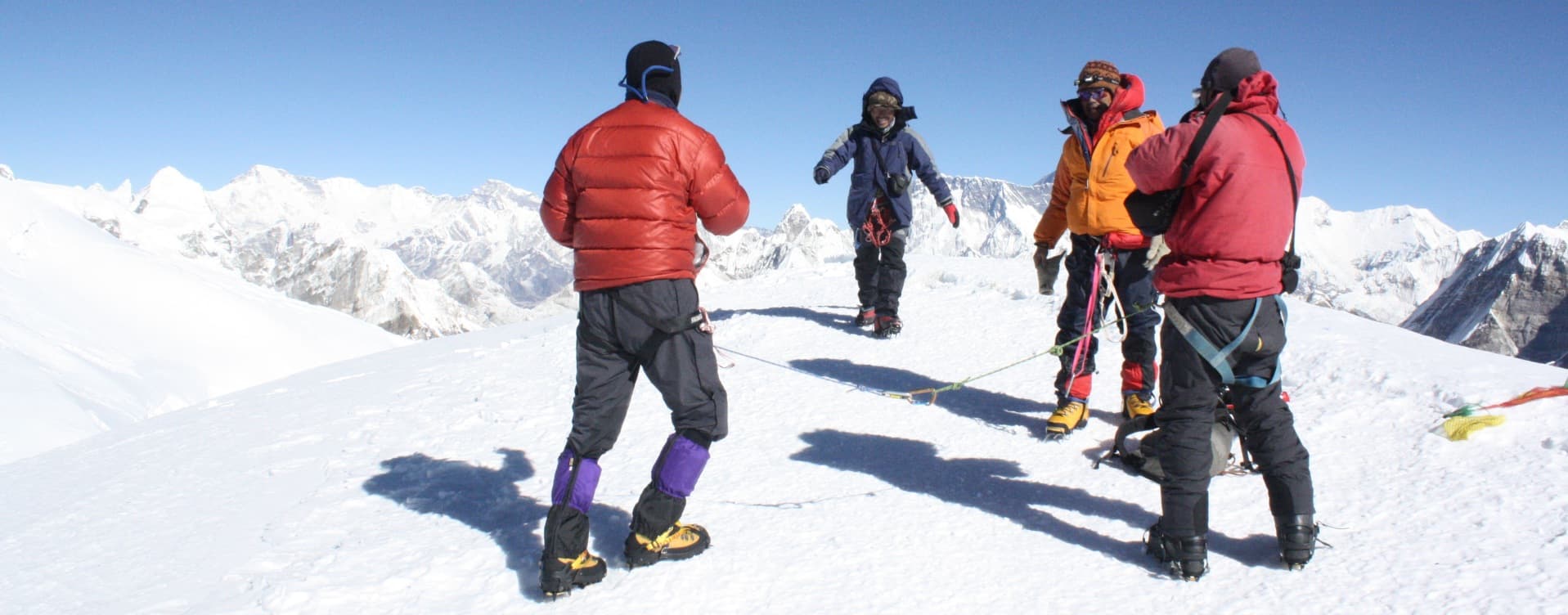
Khare, around 5,000 m on this itinerary, is the final lodge-based staging point. Accessible Adventure schedules two nights at Khare, on Days 6 and 7, with a short acclimatization hike above the settlement and supervised snow-and-ice practice on Day 7. The company describes crampon fitting and foot placement, basic ice-axe and self-arrest positioning, and safe movement on fixed ropes using appropriate clips or an ascender (jumar), followed by a gear check and summit briefing. Weather at Khare affects visibility, where practice can occur, rest, and the guide's assessment of readiness. A bright morning may become cloudy later, particularly toward the end of spring or during seasonal transitions.
Khare is also where a seasonal decision becomes a personal one. Accessible Adventure's published safety approach includes regular checks for headache, nausea, dizziness, fatigue, appetite, sleep and breathing changes; pulse-oximeter checks may be used where appropriate, but no single reading proves that ascent is safe. Fitness, a day of practice and the calendar month cannot guarantee acclimatization. Concerning symptoms must be assessed, and ascent may have to stop or be replaced by descent even if the forecast briefly improves. For the wider physical and technical demands, see the Mera Peak difficulty and preparation guide.
4. Mera High Camp, glacier and the summit route
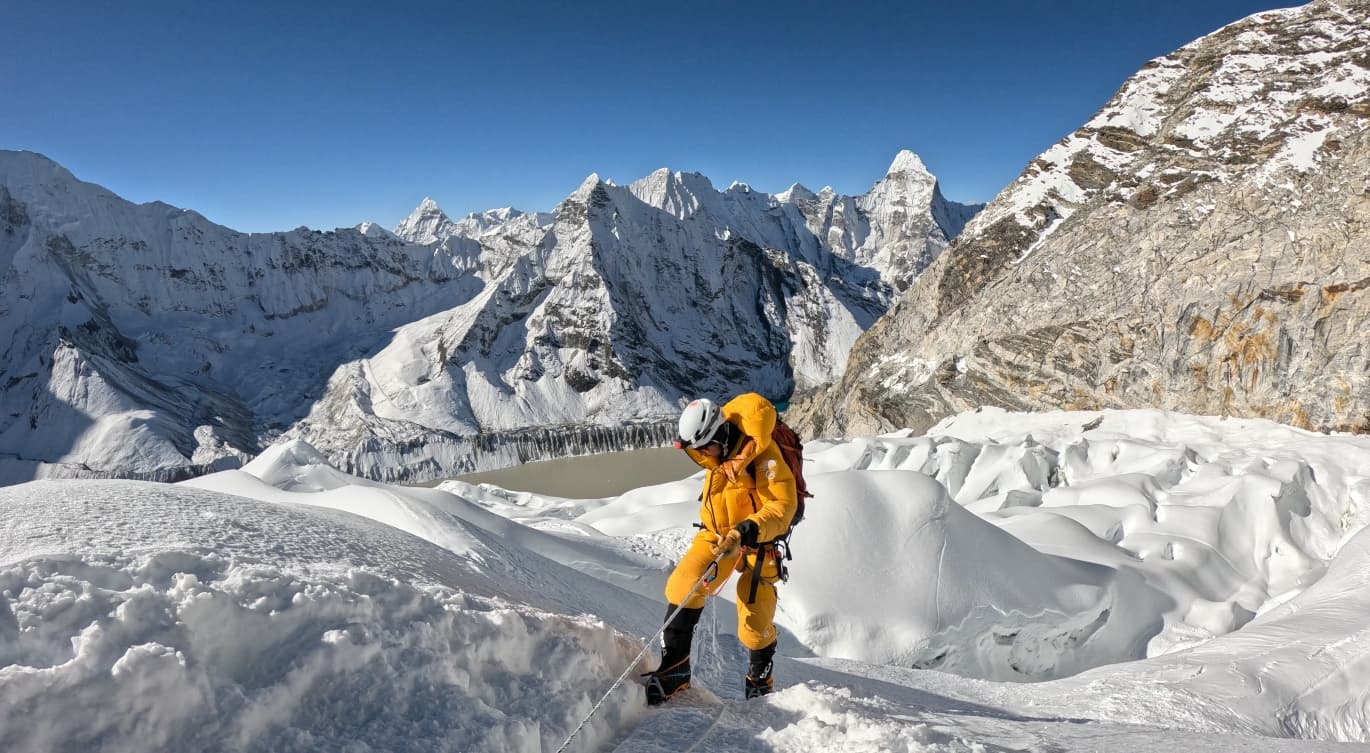
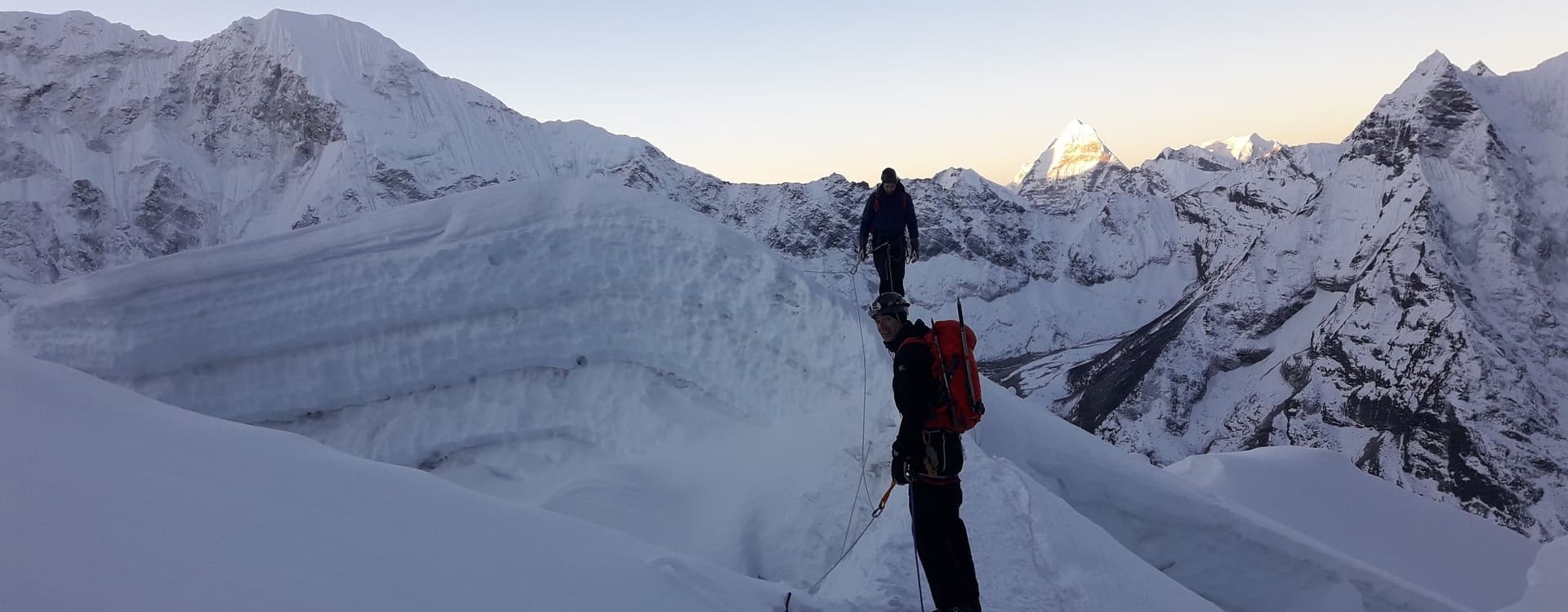
The published 16-day plan moves directly from Khare to Mera High Camp, at approximately 5,800 m, on Day 8, with one planned tented night and a conditional early summit attempt on Day 9. It does not schedule a separate overnight at Mera Base Camp. The company includes High Camp arrangements and climbing-team support, but not lodge-style heating or facilities at this exposed camp. Regardless of whether you choose April or October, High Camp and the glacier can be bitterly cold. Strong wind can make an otherwise clear day unsuitable; cloud or snowfall can obscure the route and complicate movement across crevassed terrain. The climbing guide's assessment of snow, glacier travel, rope requirements, visibility, each climber's condition and descent timing takes priority over the date.
Mera is a multi-summit massif. Mera North, approximately 6,476 m, is the highest point; Mera Central is commonly listed at approximately 6,461 m. These are not interchangeable summit claims. Confirm the actual objective for your departure rather than inferring it from the package's advertised maximum elevation.
Early and late season: the trade-offs that matter
March versus April
March may appeal to climbers who want an earlier spring trip, but the Zatrwa La crossing and upper glacier can retain winter conditions. April usually offers a more attractive balance of daylight and seasonal access. Neither month should be selected without asking what snow remains on the pass and how the team will assess the glacier.
April versus late May
Days generally lengthen into May, but warmer weather low in the valley does not translate into warmer or safer snow conditions on the mountain. Cloud, showers or new snowfall can become more disruptive as the pre-monsoon transition progresses. If choosing May, discuss the expected timing of the summit attempt rather than relying only on the Kathmandu departure month.
Late September versus October
A late-September start may encounter lingering wet trails and uncertain post-monsoon snow or cloud higher up. October is usually the clearer autumn planning choice, but the monsoon does not switch off on a fixed date. Confirm that the approach and pass have become workable; a clear forecast for Lukla alone is insufficient.
October versus November
November can offer excellent visibility, but daylight shortens and the cold becomes more consequential at Khare, High Camp and the return crossing of Zatrwa La. Early November may still be worth considering for a well-prepared group. Late November requires particular care with weather flexibility, insulation and the possibility of new snow.
Departure availability is not the same as suitable summit conditions
A departure calendar answers whether a trip can be booked; it does not certify that the summit route will be safe on the relevant day. Accessible Adventure's published season guidance highlights March–May and September–November, but its Additional Information also discusses an advertised March–June range, and dates outside the core window may appear in availability. A June or winter departure therefore needs a separate and explicit suitability discussion, not the assumption that availability means a normal spring or autumn climb. The company's written booking confirmation, not an informal enquiry or a general weather description, establishes the confirmed reservation.
For this specific 16-day program, the published plan puts the Khare training day on Day 7, the move to High Camp on Day 8, and the planned summit attempt with descent toward Khare on Day 9. Day 10 is marked as a climbing/weather contingency day if an attempt is postponed, or recovery if the summit was completed. It does not guarantee a second attempt: the guide must confirm weather, health, staffing, accommodation, supplies, descent and return logistics. The itinerary does not fully specify how a repeat attempt would work after a descent to Khare.
The published plan also puts the return flight from Lukla on Day 14 and a leisure/buffer day in Kathmandu on Day 15. That Kathmandu day may absorb some flight delay; it is not an extra high-mountain summit day. Allow additional flexibility around international flights if a missed connection would be costly.
How Accessible Adventure's included services affect a seasonal departure
Teahouses, food and an exposed High Camp
The published price inclusions specify a tourist-category Kathmandu hotel with breakfast, teahouse or lodge stays along the Hinku approach, three meals a day during scheduled trekking and climbing, and the planned High Camp overnight. The cost details list three hotel nights in Kathmandu; confirm the exact nights in your written quotation. Lodges around Chutanga, Thuli Kharka, Kothe, Thangnag and Khare are basic, with limited heating and variable shower, charging or Wi-Fi facilities. At roughly 5,800 m, High Camp is a tented arrangement rather than a heated lodge. In March and November, prepare for cold evenings at both the lodges and the camp; in wet transitional months, allow for damp clothing and restricted drying opportunities. Meals are subject to local supply conditions, and snacks or drinks bought separately are not automatically included.
Technical gear: included group equipment versus personal rental
Accessible Adventure lists shared climbing equipment and group ropes, plus a rental down jacket and sleeping bag and a duffel bag, among the trip inclusions. However, the package excludes a separate USD 150-per-person personal technical-equipment rental package, described as including mountaineering boots, crampons, harness, ice axe, jumar and carabiners, subject to availability and fit. A good April or October forecast does not remove the need for suitable insulation, waterproof layers, gloves, eye protection or a headlamp for a cold summit start. The company's trekking and peak-climbing equipment guide notes that some gear can be rented in Kathmandu or at Khare, but suitable sizes and condition cannot be guaranteed. Check boot–crampon compatibility and exactly which items are included in your quote before flying to Lukla; do not wait for the Day 7 practice session to discover an equipment problem.
Guides, porters and mountain decisions
For this 16-day departure, the inclusions name an English-speaking government-licensed trekking guide for the approach, an experienced climbing guide for the upper mountain, and porter service normally based on one porter for two trekkers, subject to the agreed load limits. A separate Accessible Adventure company-selection blog describes a two-climbers-per-guide ratio, but the primary package FAQ does not guarantee a specific summit-day ratio. Confirm the guides assigned to your actual departure rather than treating the wider company claim as a binding inclusion. Accessible Adventure's safety and emergency response plan describes weather-forecast review, local condition checks, guide–Kathmandu office communication, and the ability to delay, change or cancel a summit attempt. Rescue coordination support is not a promise that a helicopter can fly during poor weather, and evacuation charges are excluded from the package.
Permits and insurance are not reasons to choose bad weather
The package includes coordination of the Mera Peak climbing permit, Makalu-Barun National Park entry and other route documentation listed in its cost details. Requirements and fees can change; the Mera Peak permit guide provides background, but the precise current checklist must be confirmed for the chosen departure. The company requires personal travel and rescue insurance, excluded from the trip price, covering high-altitude mountaineering or glacier travel and emergency evacuation to at least the package's stated 6,500 m coverage level. The policy must actually cover roped climbing and the intended objective; do not assume ordinary trekking insurance is enough. Confirm exclusions, payment authorisation and weather-related interruption benefits directly with your insurer. Accessible Adventure's travel insurance guide gives general questions to ask.
For the authoritative schedule, inclusions and currently advertised dates, check the Mera Peak climbing itinerary and departures.
How spring and autumn affect Lukla flights
The selected package includes scheduled round-trip Lukla flights and airport/ground transport as specified in the inclusions. Flights may operate via Kathmandu or Manthali (Ramechhap), according to the airline's operational schedule; when Manthali is used, the related road transfer must be confirmed with the operator. This is particularly important in busy spring and autumn departure periods. Do not assume every flight runs directly from Kathmandu or that a newly proposed route change is automatically included.
Low cloud, rain, wind or poor visibility can delay Lukla flights in any season, including April and October. Monsoon transitions may add uncertainty, but a favorable climbing month is not a flight guarantee. The outbound flight matters for reaching the approach on time, and a delayed return may affect an international connection. Accessible Adventure's Nepal flight delay guide explains the wider issue.
Who pays for disruptions matters: the company's published terms and conditions say they cover guesthouse accommodation and breakfast/lunch in the departure city when a domestic flight is delayed at the start of a trip. The same terms assign extra food, accommodation and optional helicopter costs following return-flight delays to the client and do not cover missed international connections. The package exclusions broadly warn that extra hotels and transport caused by disruptions may cost extra unless otherwise agreed. Because these descriptions are not fully aligned for outward delays, get the departure-specific flight-delay coverage in writing. An international flight buffer and suitable interruption insurance are sensible even in October.
How to choose your departure month
- Choose April when a strong spring planning window, increasing daylight and flowering lower-valley scenery matter most.
- Choose October when clear post-monsoon views and a usually drier approach are your main priorities.
- Consider March or early November carefully if your group is comfortable planning around colder conditions and possible snow on Zatrwa La.
- Assess late May or late September week by week because seasonal transitions may affect the approach and upper mountain differently.
- Do not choose June–August or midwinter just because dates are listed without a candid route- and weather-specific explanation from the operator.
Before confirming flights or paying a deposit, ask the operator which summit is planned, whether both Zatrwa La crossings are expected to be workable, what recent conditions at Khare and High Camp show, how the Day 10 contingency can actually be used, who is guiding the summit section, what gear is included, and whether your Lukla flight will operate via Kathmandu or Manthali. Accessible Adventure's general Nepal-trip terms describe a 20% booking deposit, with booking only confirmed by the company's invoice or confirmation email; seasonal departure changes and personal cancellations are subject to the published cancellation policy and your specific agreement, not a general promise of free cancellation. For the broader national context, compare the climbing seasons across Nepal, but use this Mera-specific assessment for the direct Hinku approach.
Bottom line: for most climbers deciding between standard seasonal departures, start by comparing April and October. Then choose the particular departure whose pass conditions, summit forecast, acclimatization plan, operational arrangements and return flexibility have been discussed with the climbing team. No calendar month guarantees a summit.
Frequently Asked Questions
What is the best time to climb Mera Peak?
The principal climbing windows are spring (March to May) and autumn (late September to November). April and October are often the most practical months to consider, but wind, snowfall, visibility, glacier conditions and climber health still determine whether an ascent is possible.
Is April or October better for Mera Peak?
April generally offers increasing daylight and spring scenery on the Hinku approach. October often offers clearer post-monsoon mountain views and a drier approach. Neither month is guaranteed to have safe summit conditions, so compare the actual departure dates and the forecast close to the climb.
Can I climb Mera Peak in March or November?
A March climb may face lingering winter snow on Zatrwa La and the upper mountain. November can be clear but has shortening daylight and colder conditions, especially later in the month. Both are more conditional choices than the core April and October windows.
Is September a good month for Mera Peak?
Late September can be an option, but early September may still be strongly affected by the monsoon. Wet lower trails do not always improve at the same time as conditions at Khare or on the upper glacier. Ask the guide about recent conditions on both Zatrwa La crossings before committing.
Can I climb Mera Peak in June, winter or the monsoon?
A listed departure outside the principal windows is not evidence of suitable summit conditions. June may be affected by the arriving monsoon; July and August are generally poor choices for a standard attempt. December through February involve winter cold, short days and possible heavy snow or wind. These periods require a specific expert assessment, not normal-season assumptions.
Does a bookable Mera Peak departure mean the summit weather will be safe?
No. Booking availability only means that a departure is offered, not that snow, wind or glacier conditions will be suitable. Accessible Adventure's climbing team reviews the route, weather and climbers' health and may delay, modify or cancel the attempt even in April or October. Get the confirmed flight arrangements, guide support and Day 10 contingency terms in writing; the operator's booking confirmation does not guarantee a summit.
How many weather or reserve days are included in Accessible Adventure's 16-day Mera Peak trip?
Accessible Adventure's published Day 10 is a conditional climbing/weather contingency day, or recovery if the planned Day 9 summit is completed. It is not a guaranteed second attempt: High Camp, staffing, supplies, overnight and descent arrangements must allow it. Day 15 is a Kathmandu leisure/buffer day for the scheduled Day 14 return flight, not another summit day. The company also distinguishes outgoing from returning flight delays in its terms: return-delay extra accommodation, food and optional helicopter costs are the traveller's responsibility.
Does the 16-day Mera Peak trip climb Mera North or Mera Central?
Mera North is the massif's high point at about 6,476 m, while Mera Central is commonly cited at about 6,461 m. Accessible Adventure's published pages have not consistently identified the offered summit objective. Obtain written confirmation from the operator for your departure; a maximum-altitude number alone is not proof of the summit planned or reached.
About the author: Himal Shrestha
Government-licensed trekking guide & travel writer · Accessible Adventure
Himal Shrestha is a government-licensed trekking guide and travel writer with 10 years and counting in the mountains. Trained in first aid and hospitality, he brings firsthand trekking experience to his articles on Nepal, itinerary planning, and travel preparation for Accessible Adventure.
Meet Himal ShresthaRelated Articles
Explore more stories and guides from the Peak Climbing collection