
Why Choose Pashupatinath and Muktinath Darshan Package ?
Last updated
Nepal holds a singular position in the Hindu and Buddhist worlds. Two of its most revered shrines, Pashupatinath Temple in Kathmandu and Muktinath Temple in the Mustang district, sit at opposite ends of the spiritual and geographic spectrum. One stands along the sacred banks of the Bagmati River in the capital, where the deity Pashupati has been worshipped without interruption for at least fifteen centuries. The other rises at 3,710 meters above sea level in the cold, windswept trans-Himalayan valley below the Thorong La pass, where the air is thin and the landscape stripped bare to rock and sky. Between these two shrines, this pilgrimage package draws a single thread, connecting the lush religious life of Kathmandu with the raw, elemental devotion of the high Mustang. Both temples carry the weight of centuries. Both inspire the kind of silence that settles over a person when something much larger than ordinary life is felt nearby.
The journey follows a practical and unhurried route. From Kathmandu, where most international arrivals land, the itinerary moves through a full day of heritage sightseeing that includes Pashupatinath itself, before heading by road or air to Pokhara. Pokhara serves as the staging ground for the high-altitude leg of the trip. A short mountain flight over the Annapurna foothills drops you into Jomsom, the dusty, wind-scoured capital of Mustang district, and from there a jeep drive through the Kali Gandaki valley delivers you to Ranipauwa village and the temple complex at Muktinath. The return route retraces through Pokhara and back to Kathmandu, leaving time for a proper rest and a final departure. In total, the package spans nine days and covers some of the most spiritually and visually compelling terrain Nepal has to offer.
This package suits pilgrims, spiritually inclined travelers, and those who simply want to encounter the Hindu and Buddhist traditions of Nepal in their living, breathing form rather than through museum glass. No serious trekking is required. The highest altitude reached is the Muktinath temple complex itself, and the ascent from the jeep drop-off point at Ranipauwa to the temple gate is a gentle uphill walk of thirty to forty minutes. Families with older adults, solo travelers, couples, and small groups all find this itinerary workable. The best seasons are autumn, from late September through November, and spring, from March through May, when skies over both Kathmandu and the Mustang valley are clear and temperatures remain manageable. Book early during October, which fills teahouses in Jomsom and flights from Pokhara to Jomsom well in advance.
Why Choose This Pilgrimage Package: 7 Reasons
1. Two of the Holiest Hindu Shrines in a Single Journey
Pashupatinath stands as Nepal's national deity shrine and one of the most important Shiva temples in the world, attracting over a million devotees each year. Muktinath is one of the 108 Divya Desams, the sacred Vaishnava pilgrimage sites mentioned in Tamil devotional literature, and holds the rare status of being revered simultaneously by both Hindus and Tibetan Buddhists. Visiting both sites in one journey is not merely a logistical convenience. For devoted pilgrims, it carries immense spiritual merit. For culturally curious travelers, it provides a rare side-by-side encounter with two very different expressions of Himalayan devotion.
2. The Eternal Flame and 108 Water Spouts of Muktinath
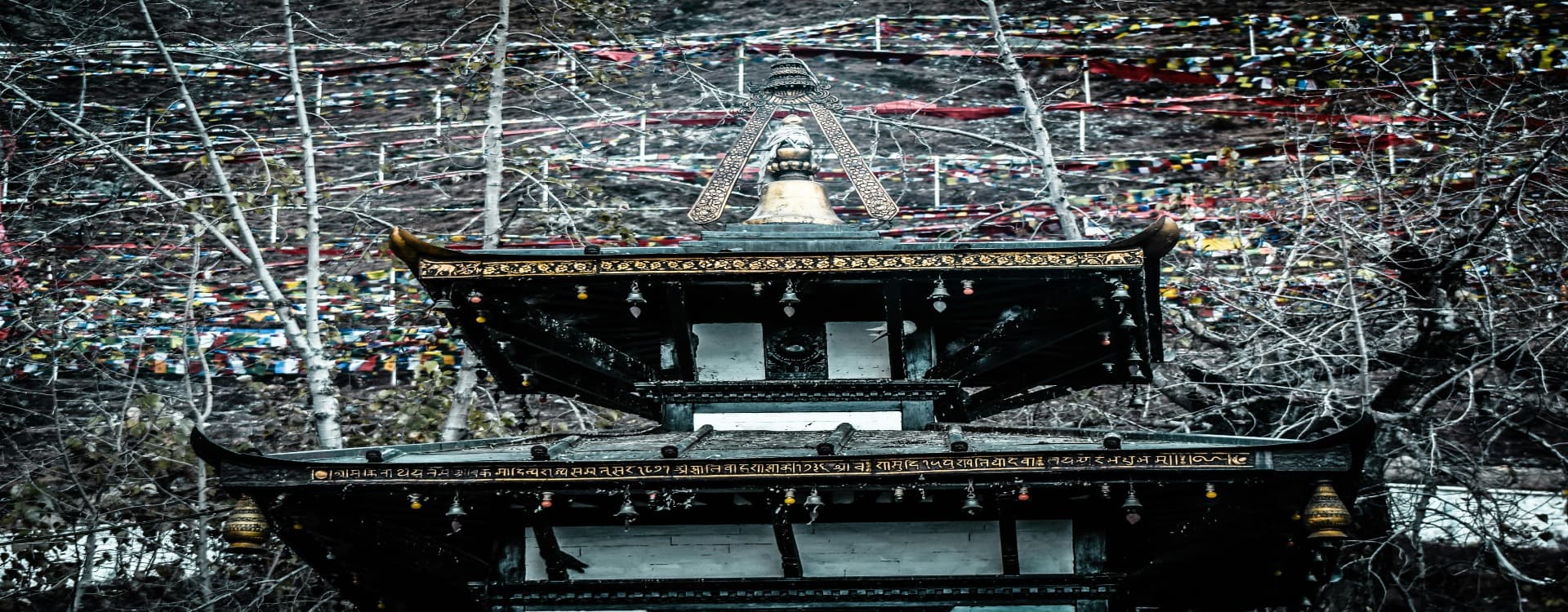
Muktinath's most extraordinary feature is the coexistence of fire and water within the same sacred space. Inside the Jwala Mai temple adjacent to the main Vishnu shrine, a small flame burns from a natural gas seep in the rock, emerging from a crack through which water also flows. Hindus interpret this phenomenon as the five sacred elements, earth, water, fire, air, and space, manifesting together in one place, an occurrence so rare it is considered a direct sign of divine presence. Outside the main Muktinath temple, 108 water spouts in the shape of cow heads pour icy glacial water into stone troughs. Pilgrims pass beneath all 108 spouts as an act of ritual purification, believing this cleanses accumulated sin and advances the soul toward liberation. Watching devoted pilgrims complete this circuit in near-freezing water, their prayers audible over the sound of the flow, is something that stays with you.
3. The Spiritual Atmosphere of the Bagmati Ghats at Pashupatinath
The Pashupatinath temple complex is a working religious site in the fullest sense. Cremation pyres burn at the Arya Ghat and adjacent ghats along the Bagmati River throughout the day, attended by priests and family members performing the rites that, in Hindu tradition, release the soul for its onward journey. Sadhus, the wandering ascetics of the Shaivite tradition, sit along the riverbanks and near the temple precincts, their faces marked with sacred ash, their presence a reminder that renunciation has been practiced here continuously for centuries. The evening Sandhya Aarti, or twilight fire ceremony, draws devotees and visitors alike to the riverbank, where priests offer sacred fire, incense, and flowers to the river and the presiding deity. It is one of the few publicly observable living rituals in South Asia where ancient form and contemporary devotion have remained essentially undisturbed.
4. The Kali Gandaki Valley and Mustang Landscape
The drive from Jomsom to Muktinath passes through one of the most geologically and visually unusual landscapes in Nepal. The Kali Gandaki river has carved the deepest gorge on earth between the peaks of Dhaulagiri (8,167 m) and Annapurna (8,091 m), and the road follows its upper valley through a rain shadow desert that receives very little monsoon precipitation. The terrain looks more like the Tibetan plateau than the Nepal most visitors know. Eroded cliffs in shades of ochre, rust, and pale yellow line the valley walls. The medieval fortress village of Kagbeni, painted in the white and red of Tibetan Buddhist architecture, sits at the confluence of two rivers and marks the checkpoint for entry into Upper Mustang. Apple orchards in Marpha produce fruit and brandy known across Nepal. The whole drive, covering roughly 21 kilometers from Jomsom to Muktinath, is an education in trans-Himalayan geography.
5. The Flight from Pokhara to Jomsom
This is one of the most dramatic short flights in aviation. The aircraft, typically a small nineteen-seat Twin Otter or Dornier, departs Pokhara in the early morning and climbs northward into a mountain corridor framed by Dhaulagiri and the Nilgiri peaks. The flight takes twenty to twenty-five minutes. Passengers seated on the left side of the aircraft see the Annapurna massif filling the window as the plane threads through the valley. Jomsom airport sits at 2,720 meters in a narrow flat section of the Kali Gandaki valley, and the landing, descending steeply toward a strip of tarmac between cliff walls and river, is something trekkers and pilgrims talk about for years afterward. Morning departures are essential since afternoon winds in the valley make conditions unsafe.
6. Pokhara as a Rest and Cultural Stop
Between the Kathmandu sightseeing days and the high-altitude push to Muktinath, Pokhara provides a genuine pause. The city sits on the shore of Phewa Lake, with the Annapurna range and Machhapuchhre, the sacred fishtail peak that has never been climbed, rising directly behind it. A full day of sightseeing covers the World Peace Pagoda above the lake, the Tal Barahi Temple in the water, Davis Falls and the Gupteshwor Mahadev cave directly beneath it, the Sarangkot ridge with its morning views of the full Annapurna panorama, and the Bindhyabasini Temple in the old city. The lakeside area has excellent restaurants, quiet cafes, and comfortable accommodation at a range of price points. Many pilgrims report that Pokhara feels like a genuine restoration after the sensory intensity of Kathmandu, and before the altitude and effort of the Muktinath leg.
7. Accessible for All Ages and Fitness Levels
The Pashupatinath and Muktinath Darshan Package does not require trekking experience, technical fitness, or special permits beyond standard Nepal tourist visas and the Annapurna Conservation Area entry fee. The highest point is Muktinath temple at 3,710 meters, reached by a short uphill walk from the jeep drop point. Ponies and dolis, the traditional wooden carrying chairs, are available for hire at Ranipauwa for pilgrims who cannot manage the walk. The rest of the itinerary involves vehicle-based transfers and short walks around temple complexes. Older pilgrims, families with children, and first-time visitors to Nepal all complete this route regularly. The main physical requirement is a reasonable tolerance for altitude at Muktinath and the cold mornings that come with it.


