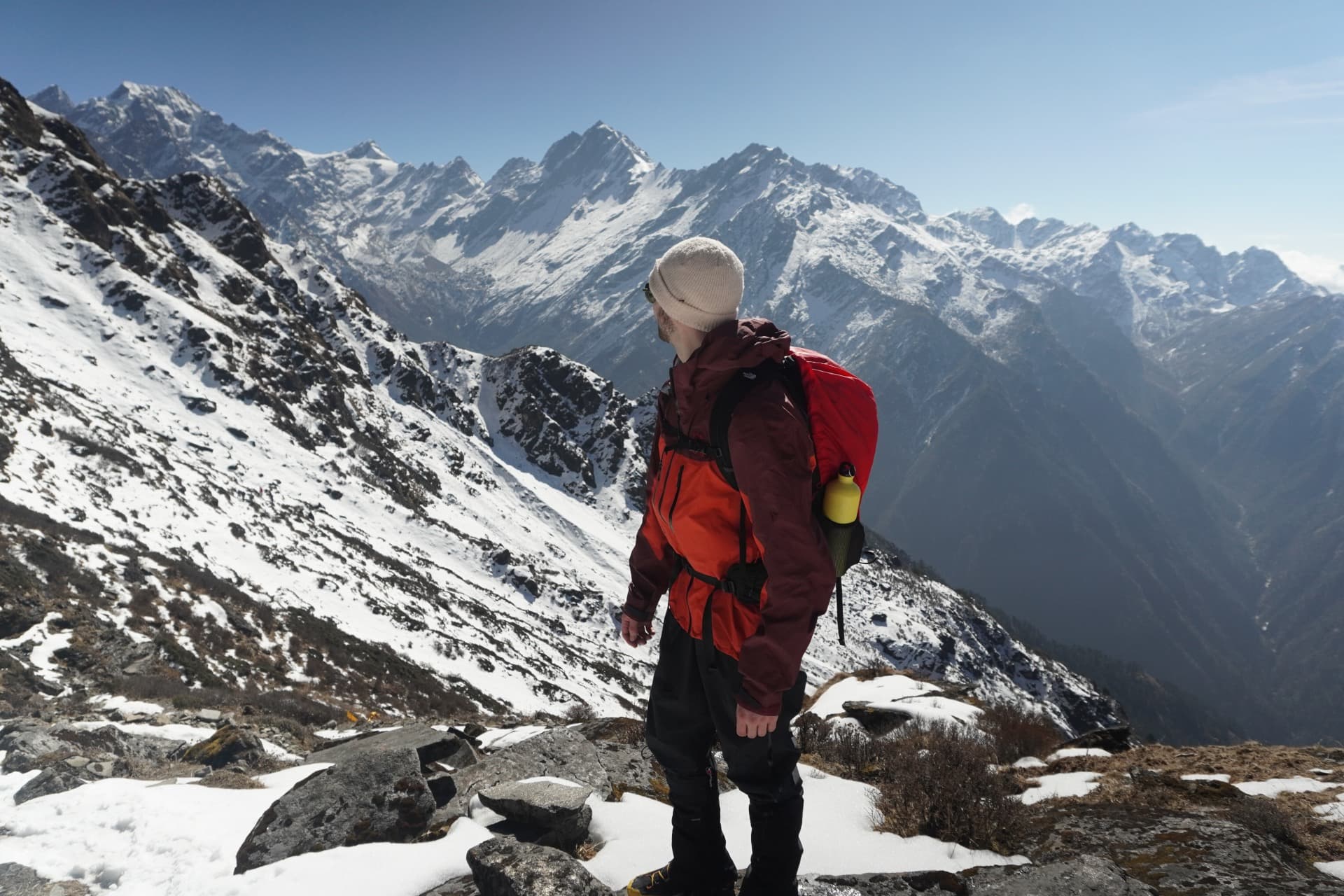
Mera Peak Difficulty: How Hard Is It & What You Need to Know Before You Climb?
People ask this question all the time, on trekking forums, in Kathmandu teahouses, and under YouTube videos. How hard is Mera Peak, really? The mountain has an odd reputation problem. Officially, it falls under Nepal’s “trekking peak” category, a name that sounds almost casual next to Everest or Annapurna. In practice, it is a 6,476 metre Himalayan summit that has turned back fit, well-prepared climbers more times than most brochures admit.
The honest answer sits in the middle. Mera Peak is not a technical nightmare for experienced alpinists. It is not a long walk with a flag at the end, either. This guide breaks down what makes it hard, what does not, and how to judge for yourself if you are ready.
The short version: Mera Peak carries an Alpine Grade of PD, short for Peu Difficile, or “a little difficult” in the French system used across the Himalaya. The technical demands stay modest. You will use crampons, an ice axe, and a fixed rope on the final stretch, but nothing close to real rock or ice climbing. The bigger test is altitude. At 6,476m, oxygen levels sit at roughly 47 percent of sea level, and that single fact decides who reaches the summit more than fitness, technique, or willpower alone.
Mera Peak’s Difficulty Rating, and What It Actually Means
Mera Peak used to carry an Alpine Grade of F, for Facile, the easiest rating on the scale, and guidebooks repeated that for years. The mountain itself changed the conversation. The Mera Glacier has shifted over the past couple of decades. Crevasse patterns have moved; the upper icefall is no longer a clean walk-up, and the final push to the summit has gotten steeper. Most operators and mountaineering bodies now grade the climb PD instead of F. It looks like a small jump on paper, but it reflects something real happening on the mountain, not marketing.
So what does PD mean on the ground? Glacier travel. Crampons and an ice axe as standard kit. At least one stretch near the top is steep and exposed enough that you clip into a fixed line. There, you use an ascender, often called a jumar, instead of climbing it unaided. That’s the extent of it. No rock climbing. No vertical ice. None of the route-finding instinct takes years to build. PD marks the line between “a reasonably fit person can do this with a guide” and “you need a real climbing background to come back down alive.” Mera Peak sits right on that line. It leans closer to the trekking side than most people expect. But it has crossed over enough that calling it a pure walk is no longer accurate.
One more thing worth knowing before you book: Mera Peak is not one summit. There are three. Mera North is the tallest at 6,476m, but almost nobody climbs it. The approach is broken and far more technical than the standard route. Mera Central, at 6,461m, is the one nearly every trekking company sells, including us. It’s what people picture when they say they “climbed Mera Peak.” Mera South, at 6,065m, barely sees any traffic. If a company advertises a Mera Peak summit without naming which one, it’s almost certainly Central.
The Three Things That Actually Make Mera Peak Hard
Altitude: The Real Opponent
Ask anyone who has guided several Mera Peak trips what actually derails a summit attempt. The answer is almost never the crevasses, the final snow slope, or even bad weather on its own. It’s altitude. At 6,476m, you’re well into what mountaineers call the extreme altitude zone, a threshold most agree starts around 5,500m. At the summit, you’re working with something like 47 percent of the oxygen available at sea level. The body does not adjust to that on a fixed schedule.
Acute Mountain Sickness, AMS for short, brings headaches, nausea, dizziness, poor sleep, and a fatigue that feels out of proportion to the effort. It does not care how fit you are. A marathon runner with a resting heart rate in the low fifties can get hit just as hard as someone who rarely exercises. AMS comes down to how fast a particular body adapts to thinner air, not how strong the legs are. This is the whole argument for a slow, staged ascent. It’s probably the single most important decision in this climb. Climbers who push too fast, usually on shorter, budget itineraries that cut rest days, are the ones who end up turning back near the summit. Sometimes they need an evacuation instead.
Physical Endurance: Long Days, Not Just High Days
Most Mera Peak itineraries run between 15 and 21 days, depending on the operator and route, and most of that time is walking. Expect 6 to 8-hour days during the approach through the Hinku Valley, over terrain that’s rugged and uneven without being technical. None of it compares to the final summit push in difficulty. But stack enough long days at altitude, add a daypack, basic food, and cold nights in teahouses or tents, and it wears on you in ways hard to picture until you’re living it.
Summit day is where things get real. You leave the high camp, around 5,800m, somewhere between 1 and 2 am. Depending on conditions and group pace, the round trip can take anywhere from 8 to 14 hours. That means hours of walking in total darkness, temperatures regularly below minus 15°C, and a body that’s probably already running a calorie deficit for a week or more. This is exactly where cardiovascular fitness earns its keep, the kind built over months of hiking, running, or cycling. It’s not the kind that comes from one big training hike a few weeks before departure.
Technical Terrain: Crampons, No Climbing Skill
The technical section of Mera Peak is short, but it’s real. After crossing the Mera Glacier, much of it on a gently sloped, well-trodden track, the route steepens in the final stretch. Estimates vary by source and season, but the summit slope typically sits between 30 and 50 degrees. The very last section, often cited as roughly the final 30 metres, forms a steep snow dome. Most groups ascend it on a fixed rope using a jumar rather than free climbing.
You do not need prior ice climbing experience to handle this. What you need is the ability to walk confidently in crampons on snow and ice. You also need to use an ice axe for balance and self-arrest, and clip into and move along a fixed line without freezing up over the exposure. Most operators run a short refresher session at Khare or base camp to cover this, since a few clients arrive with real glacier experience. On equipment, Mera Peak usually requires nothing more than a B2 mountaineering boot paired with a C2 crampon. That’s a noticeably less technical combination than the stiffer B3 and C3 gear needed for steeper peaks like Island Peak or Ama Dablam. The skill ceiling on Mera stays low. The consequences of getting it wrong, in the cold and thin air at the end of a long expedition, do not.
How Mera Peak Compares to Other Trekking Peaks
|
Peak |
Altitude |
Technical Grade |
Key Technical Feature |
|
Mera Peak |
6,476m |
PD |
30 to 50 degree summit snow slope, with a short fixed rope and jumar section near the top |
|
Island Peak (Imja Tse) |
6,189m |
PD+ |
Steeper ice headwall, roughly 60 to 70 degrees, with 100 to 150m of fixed rope |
|
Lobuche East |
6,119m |
AD-, more technical |
Mixed rock and ice terrain, 300 to 400m of broken fixed rope and a demanding summit pyramid |
Numerically, Mera Peak is the highest of the three, yet most guides call it the easiest from a purely technical standpoint. Island Peak’s headwall is steeper and longer, the kind of pitch where a slip carries real consequences rather than an awkward stumble on a gentle slope. Lobuche East goes further still, mixing rock and ice in a way that rewards prior climbing experience. If the goal is the highest point reachable without committing to real technical mountaineering, Mera Peak is usually the right call. For climbers who already have ice climbing background and want more engagement on the rope, Island Peak or Lobuche East will feel more rewarding, and considerably harder.
Summit Day on Mera Peak: What It Actually Feels Like
Grades and statistics only tell part of the story. Here is roughly how summit day unfolds for most groups.
-
Around 1 am to 2 am: wake up at high camp, roughly 5,800m, in temperatures already well below freezing. Boots that were warm by the stove the night before are now stiff. Headlamps go on, and breakfast is whatever you can manage, even with an appetite that altitude has already dulled.
-
The first two to three hours: slow, deliberate walking by headlamp across the glacier and snow. Groups go spaced out or roped depending on the guide’s judgement, with short rest stops every 20 to 30 minutes. Pacing discipline matters more here than anywhere else in the trip. Climbers who start fast, buoyed by adrenaline and cold, often pay for it an hour or two later.
-
The final approach: as the slope steepens toward the summit dome, most groups clip into a fixed line and use a jumar for the last stretch. Progress slows to a handful of steps between breaths, but the technical demand stays low even as the exposure underfoot increases.
-
Sunrise at the top: with good timing and cooperative weather, most groups arrive close to sunrise. Everest, Lhotse, Makalu, Cho Oyu and Kanchenjunga sit visible in a single sweep, a view very few trekking peaks anywhere in the world can match. Time on the actual summit is usually brief, somewhere between 15 and 30 minutes. Photos take some of that time, and the cold takes the rest: standing still at 6,476m in the wind is uncomfortably cold.
-
The descent: often harder than the climb itself. Tired legs, softening snow as the sun rises, and the same long distance back to high camp or, on a more ambitious push, all the way down to Khare. A meaningful share of the injuries and near misses reported on Mera Peak happen on the way down rather than the way up. Fatigue and concentration both slip at exactly the wrong moment.
Mera Peak Success Rate: Why the Numbers Do Not Agree
Search for a single, definitive Mera Peak success rate, and you will find one almost immediately, then three more that flatly contradict it. Some operators advertise success rates above 90 percent. Others, working from Nepal Mountaineering Association summit certificate counts, have calculated figures closer to 25 percent for a recent season. Independent climbers and smaller operators often land somewhere in between, citing 50 to 60 percent as a more realistic average across all itineraries and conditions combined.
The gap stops looking strange once you look at what drives it. A rushed 15-day itinerary with minimal acclimatization days will produce a meaningfully lower success rate than a 19 to 21-day version. The longer version builds in extra nights at altitude, a dedicated rest day around Khare, and a slower approach through villages like Pangkongma rather than the shorter, steeper direct route. Weather plays a role, too. A single poor forecast window can turn back an entire season’s worth of well-prepared climbers. NMA certificate counts likely undercount real success rates as well, since not every climber who reaches the top registers for a certificate afterward.
The one thing that matters more than any single statistic floating around online is this: itinerary design is probably the biggest lever any climber controls for reaching the summit. A longer, better-paced trip with built-in acclimatization days will consistently outperform a shorter, cheaper one, almost regardless of how fit the climbers are on day one.
Is Mera Peak Right for You?
Mera Peak earns its reputation as one of the more beginner-friendly Himalayan summits. The Nepal Mountaineering Association classifies it as a Group A peak, suitable for beginner climbers alongside a qualified guide. That classification does not mean it suits everyone.
A reasonable fit for this climb usually has a solid baseline of cardiovascular fitness and some multi-day trekking experience, prior altitude exposure or not. Patience matters too: enough to move slowly and accept rest days rather than push through discomfort out of pride. Prior high altitude experience, something like an Everest Base Camp trek or a Kilimanjaro climb, is not mandatory. It genuinely helps a body recognise and manage the early signs of altitude stress before they turn serious, though.
Anyone with a history of cardiac or respiratory conditions, very limited hiking background, or a tight, inflexible travel schedule should think carefully before booking. A tight schedule leaves no room for weather delays or extra acclimatization days, so speaking with a doctor first is a good idea. Mera Peak punishes rushed timelines more than almost any other single factor on this list, regardless of how strong or motivated the climber happens to be.
Getting Ready: Training, Acclimatization and Gear
Preparation for Mera Peak splits roughly into three areas: building a fitness base, managing acclimatization once you arrive, and showing up with the right equipment. None of it guarantees a summit, but skipping any of it measurably lowers the odds.
Training, starting three to four months out
-
Build a cardiovascular base through regular hiking, running, cycling or swimming, three to five sessions a week, gradually increasing duration rather than intensity.
-
Add weighted hill walking once a week if possible, carrying a daypack similar in weight to what you will carry on the mountain.
-
Include basic strength training for the legs and core, since stairs, uneven trail and the final summit slope all demand more from stabilising muscles than flat ground does.
-
If you can access a climbing wall, dry glacier or winter skills course beforehand, take it. Even a single day practicing crampon technique and ice axe use will make the refresher session at base camp far less intimidating.
-
Practice multi-day back to back hiking at least once before departure, since recovering enough to walk hard again the next morning is a skill in itself.
Acclimatization, once you are on the mountain
Choose, or ask your operator about, an itinerary that includes dedicated rest days rather than a route that climbs straight through. Hydrate more aggressively than feels necessary, since dehydration mimics and worsens AMS symptoms. Some climbers discuss preventive medication such as Diamox with their doctor before travel. This is a personal medical decision rather than a default recommendation. Where the itinerary allows it, follow the general mountaineering principle of climbing a little higher during the day and sleeping lower at night. And tell your guide right away at the first sign of a symptom, rather than waiting to see if it passes on its own.
Technical Gear to Bring
-
B2 mountaineering boots compatible with C2 crampons, sufficient for Mera Peak’s terrain without the extra stiffness and cost of B3 and C3 gear
-
A general mountaineering ice axe, sized for your height, for balance and self-arrest on the summit slope
-
A climbing harness and a jumar or ascender for the fixed rope section near the summit
-
A four-season expedition-rated sleeping bag suitable for temperatures well below- 20 degrees Celsius at high camp
-
A reliable headlamp with spare batteries for the pre-dawn summit push
-
Insulated mittens or gloves rated for extreme cold, plus a lighter pair for dexterity lower down
-
A heavily insulated down jacket and either insulated trousers or thermal layers built for summit night, rather than general trekking layers
Final Thoughts
None of this is meant to talk anyone out of Mera Peak. It’s meant to set expectations correctly. That’s usually the difference between climbers who turn back disappointed and climbers who stand on that summit at sunrise. The mountain rewards patience and a sensible itinerary far more than raw athletic talent, which is genuinely good news for most people considering it.
If you are weighing up whether this climb is right for you, take a look at our Mera Peak Climbing package. It’s built around exactly the kind of paced, acclimatization-focused itinerary discussed throughout this guide, with full cost, day-by-day detail and gear guidance laid out for you before deciding.
Frequently Asked Questions
About Accessible Adventure
Bringing unforgettable Himalayan adventures to everyone. Our expert guides and carefully curated experiences ensure that everyone can explore the beauty of Nepal, Tibet, and Bhutan.
Learn More