
Your adventure guide is here
Your adventure guide is here
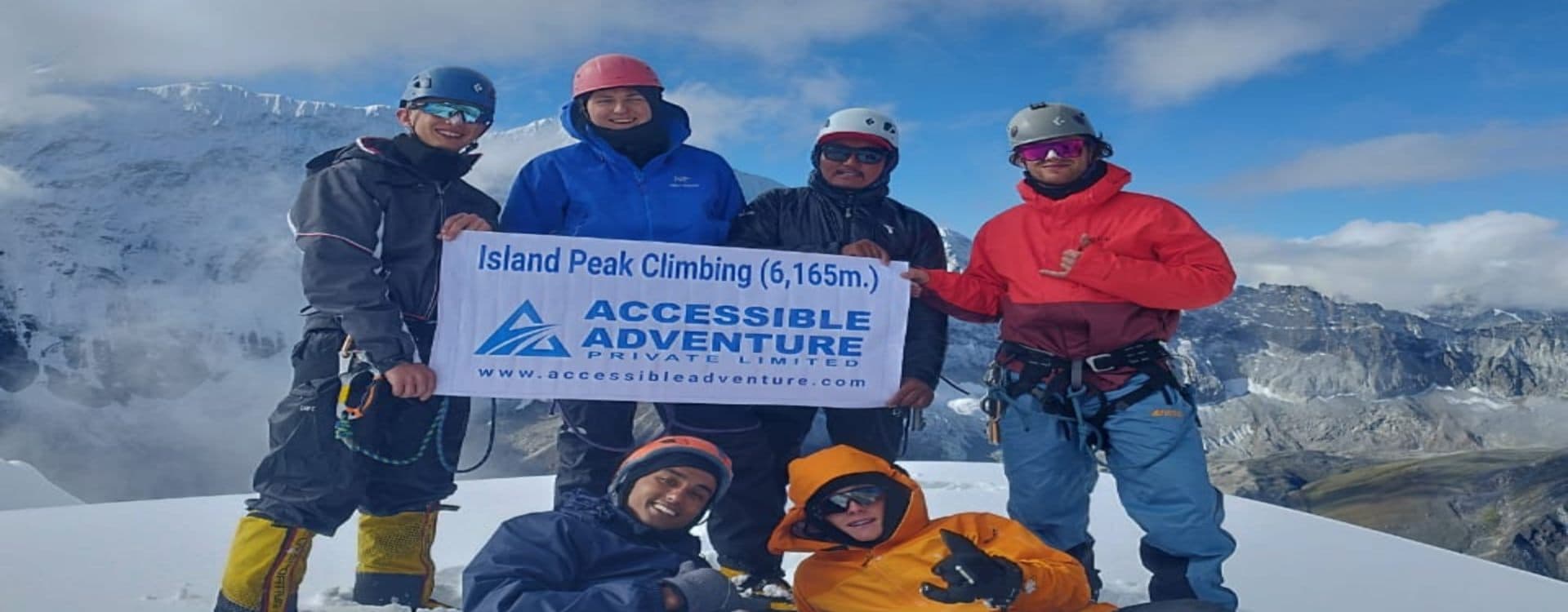
Standing at 6,189 metres in the heart of the Khumbu, Island Peak has built a reputation as the most popular first Himalayan summit in the world. Each year, hundreds of climbers with little to no technical mountaineering experience walk away from its summit having stared across a panorama of Lhotse, Everest, Ama Dablam, Makalu, and Baruntse from a point in the sky that most humans never reach. The appeal is straightforward: Island Peak sits in the middle of Nepal's most celebrated trekking corridor, it requires only basic mountaineering skills that can be learned partly on the mountain itself, and the combined trek and climb finishes with views that rival any summit on Earth below 7,000 metres.
This guide covers everything a serious first-time aspirant needs to know. The mountain's history, physical character, route, technical demands, gear list, permit requirements, costs, best season, acclimatisation strategy, and the actual experience of summit day are all addressed in detail below. By the time you finish reading, you will know exactly what you are getting into and whether you are ready to go.
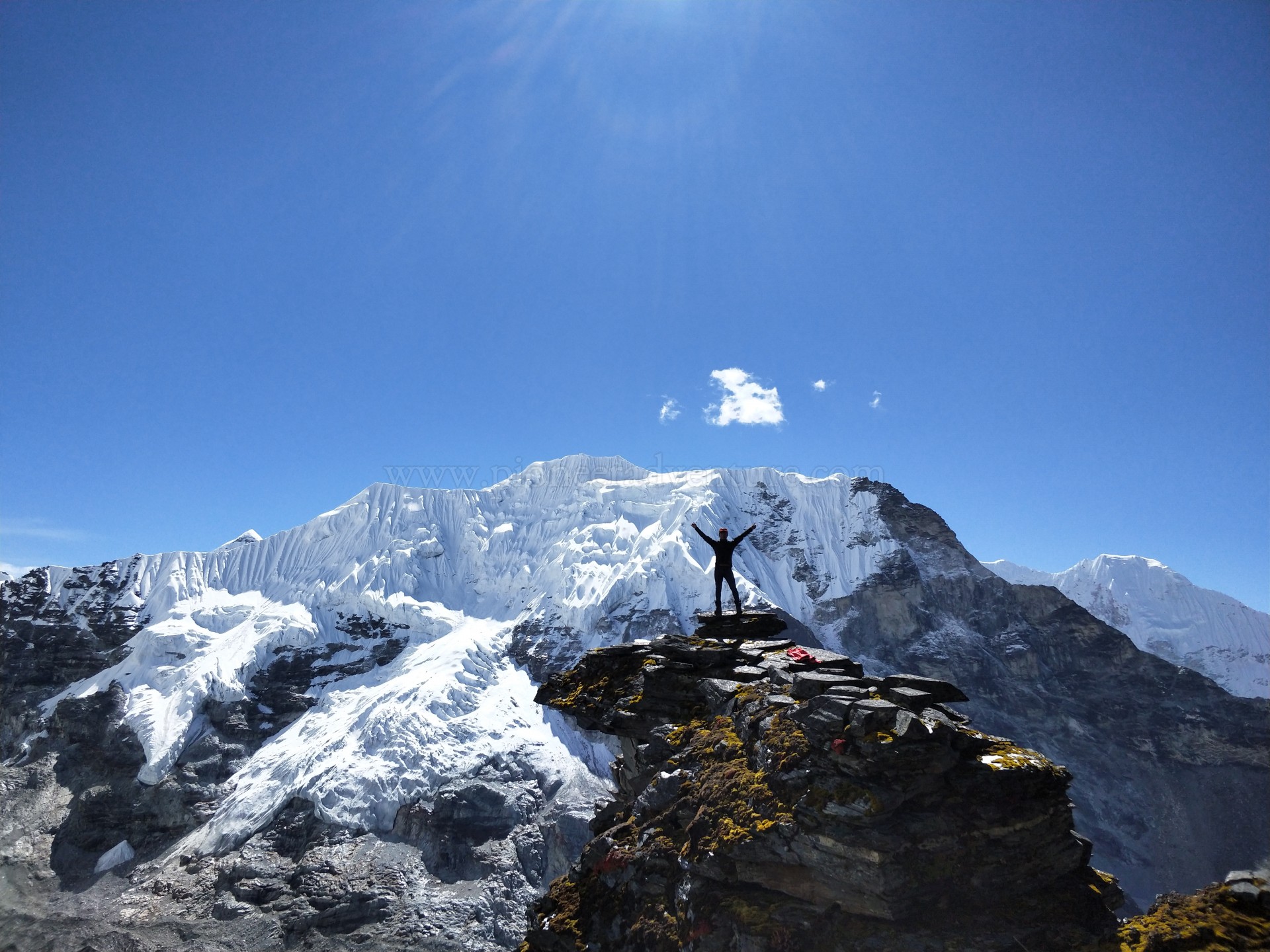
Island Peak, officially renamed Imja Tse by the Nepal Mountaineering Association in 1983, is a mountain in Sagarmatha National Park in eastern Nepal. It sits within the Mahalangur Himalayan range at a latitude that puts it in direct sight of Lhotse Shar's south end, of which it is technically a descending ridge extension. The elevation of the main summit is 6,189 metres (20,305 feet), with a secondary southwest summit slightly lower.
The popular name comes from 1952, when Eric Shipton's British reconnaissance expedition observed the peak from Dingboche and noted that it appeared to rise like an island from a surrounding sea of ice. That image holds up perfectly when you walk through Dingboche today and look east toward the Imja Valley. The official renaming to Imja Tse, after the Imja Glacier and valley below it, never displaced the original name in common usage. Every trekking agency, permit office, and teahouse in the Khumbu still calls it Island Peak.
The southwest summit was first climbed in 1953 as a training exercise for the British Everest expedition, by a team that included Tenzing Norgay, Charles Evans, Alfred Gregory, and Charles Wylie with seven Sherpas. The main summit saw its first ascent in 1956 by Hans-Rudolf Von Gunten and two Sherpas, members of a Swiss team that went on to make the first ascent of Lhotse. Since then, and particularly since the Nepal Mountaineering Association opened it to commercial trekking expeditions, Island Peak has become the most climbed technical trekking peak in Nepal.
The phrase 'trekking peak' in Nepal's mountaineering classification does not mean a peak you can simply hike to. It means a peak classified by the Nepal Mountaineering Association as requiring moderate technical skill and equipment, but not the full expedition-grade logistics of a high-altitude 7,000 or 8,000-metre objective. Island Peak falls comfortably within that definition.
What makes it suitable for beginners is a combination of factors. The technical difficulty is rated PD (Peu Difficile, or Little Difficult) in French Alpine grading, or broadly equivalent to 2B in the Alpine grade system used by the NMA. That rating means the crux sections are challenging but can be navigated safely by someone with sound physical fitness, basic crampon and ice axe technique, and a working understanding of fixed rope systems. All of these skills are introduced and practised at base camp before summit day. The presence of experienced Sherpa guides who set fixed ropes on the headwall and who have completed the route dozens of times adds a significant safety margin.
The other factor is acclimatisation. Island Peak's base camp sits at 5,087 metres, and summit day involves a vertical gain of roughly 1,100 metres over a distance that takes between ten and fourteen hours round trip. The standard itinerary builds up to this altitude over approximately ten to twelve trekking days from Lukla, passing through the Everest Base Camp corridor and visiting Namche Bazaar, Tengboche, Dingboche, and Chukhung along the way. This approach gives the body a gradual and well-spaced acclimatisation profile that compares favourably with more aggressive high-altitude objectives. Most climbers who fail to summit Island Peak do so because of weather or personal health on summit day rather than a lack of technical skill.

The standard expedition begins with a flight from Kathmandu to Lukla (2,860 metres), a mountain airstrip that sits on a narrow shelf above the Dudh Kosi River valley and consistently appears on lists of the most dramatic airports in the world. From Lukla the trail follows the classic Everest Base Camp route north through Phakding, then climbs steeply to Namche Bazaar at 3,440 metres, the main commercial and logistical hub of the Khumbu.
After a mandatory acclimatisation day in Namche, the route continues through Tengboche (3,867 metres), home to one of the most famous Buddhist monasteries in Nepal, then to Dingboche at 4,410 metres. Dingboche serves as the fork point: one branch of the trail continues northwest toward Everest Base Camp via Lobuche, while the branch taken for Island Peak heads east into the Imja Valley toward Chukhung and then Island Peak Base Camp. The Chukhung settlement at 4,730 metres is the last permanent teahouse stop before base camp.
Island Peak Base Camp, known as Pareshaya Gyab, sits at 5,087 metres on a rocky moraine above the valley floor. Most expeditions spend two nights here, using the first for rest and the second for a pre-climb training session in which guides cover crampon use on ice, ice axe technique, jumar (ascending device) operation, and fixed rope clipping procedures. This training session is the single most useful preparation event for first-time climbers, converting abstract gear knowledge into muscle memory.
There are two standard approaches to summit day. The first begins directly from base camp at around 1:00 to 2:00 AM, giving climbers a fourteen to sixteen hour round trip. The second uses an optional high camp at approximately 5,600 metres, reducing the summit day elevation gain by around 500 metres and shortening the round trip to approximately ten to twelve hours. The high camp option requires a higher sleeping altitude, which can affect sleep quality and introduces a slightly greater altitude exposure, but it also preserves energy for the technically demanding sections higher on the mountain. Most operators recommend high camp for less experienced climbers.
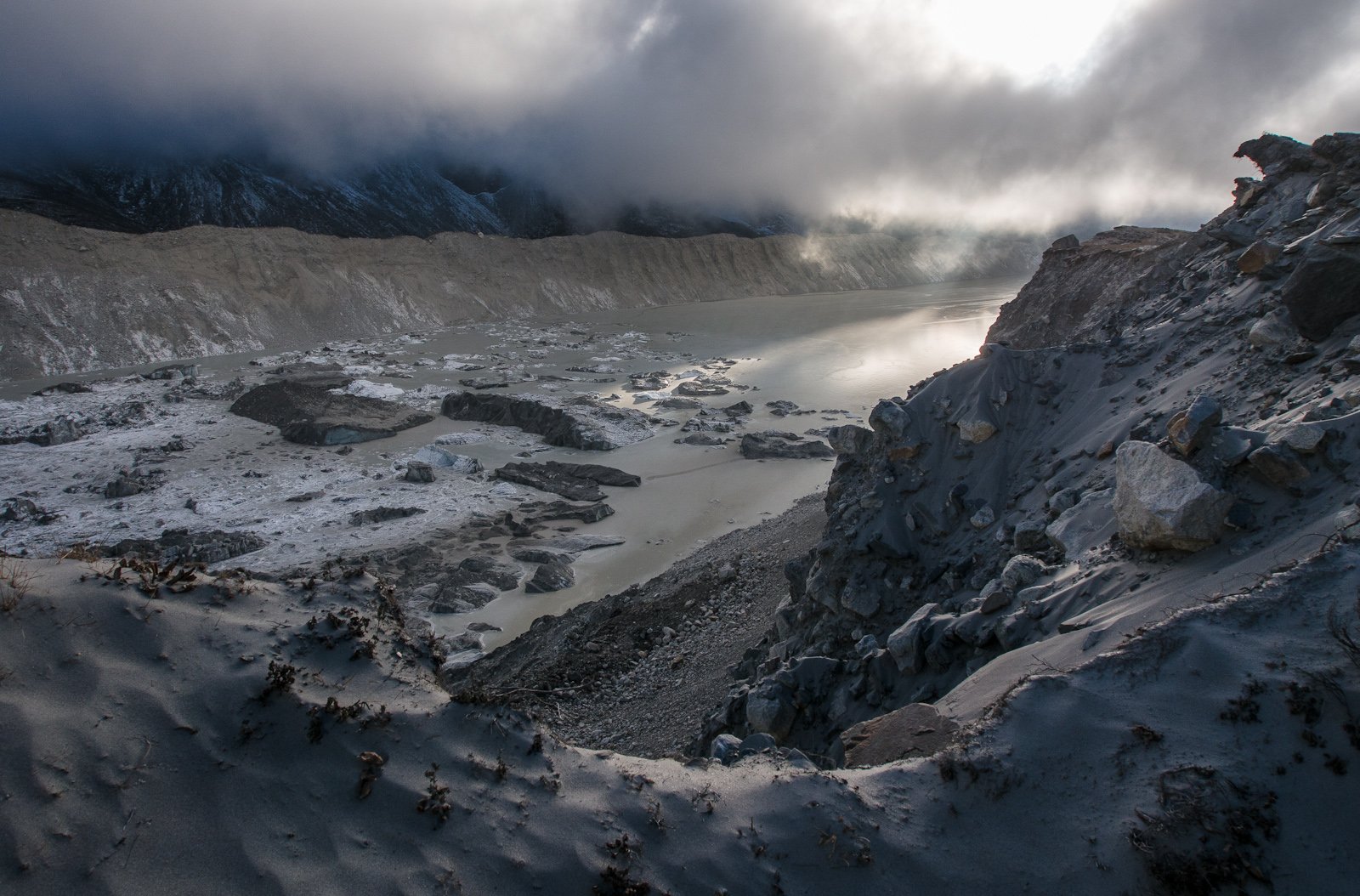
The approach from base camp to the lower glacier is essentially a steep hike over rocky moraine and early glacier terrain. Just above high camp, the character of the route shifts. A series of rocky steps requires moderate scrambling before the terrain transitions fully to glaciated ground and fixed rope systems begin.
The final section of the climb is the technical crux. A nearly 200-metre near-vertical headwall of compacted snow and ice guards the summit ridge. The difficulty of this section varies with conditions: in spring, when the snow is firmer and conditions more predictable, it is a steep but manageable jumar ascent on fixed ropes. In autumn, changing freeze-thaw cycles can create a mix of rock and ice that requires more careful footwork. The headwall's character in any given season depends significantly on how much snow fell during the preceding monsoon and how temperatures have tracked in the weeks before your summit attempt.
Above the headwall, the summit ridge is exposed and narrow, with significant drops on both sides. The traverse to the actual summit point requires focused crampon technique and correct clipping on the fixed lines. The technical challenge here is not physical strength but mental composure: staying methodical and deliberate while altitude, fatigue, cold, and the visual exposure of the ridge all press simultaneously. Most climbers report that the ridge traverse lasts between thirty and sixty minutes and that the summit itself arrives almost as a surprise after the concentration required to cross it.
From the top, the views extend over one of the most concentrated collections of major Himalayan peaks visible from any single vantage point below 8,000 metres. Lhotse's south face fills the skyline to the northwest. Everest is visible, though partially blocked by Lhotse's shoulders. Makalu (8,485 metres, fifth highest in the world) stands clearly to the east. Baruntse, Ama Dablam, Nuptse, Cholatse, and numerous unnamed peaks complete a horizon that takes several minutes simply to survey.
The honest answer to the question of technical prerequisites is that a determined beginner with adequate physical fitness and no previous mountaineering experience can summit Island Peak with good guide support. The qualification matters: 'with good guide support.' Without experienced Sherpas setting fixed ropes, monitoring pace, and managing the logistical complexity of summit day, the climb becomes significantly more dangerous.
The skills you will use on the mountain are: crampon technique for steep ice and mixed terrain, ice axe arrest position and self-arrest practice (covered at base camp), jumar operation on fixed ropes for the headwall, and basic harness management including clipping and unclipping at anchor points while on the ridge. None of these requires years of practice. They require instruction, several hours of hands-on practice, and the mental discipline to apply them correctly under fatigue and altitude at 2:00 AM.
A prior multi-day trek at altitude is strongly recommended, even if not strictly required. Trekkers who have completed the Everest Base Camp trek, the Annapurna Circuit, or a similar multi-week Himalayan route before attempting Island Peak arrive in the Khumbu with an acclimatisation baseline and an understanding of what their body does under sustained exertion at altitude. This prior knowledge is practically valuable on summit day.
Gear for Island Peak falls into two categories: standard high-altitude trekking equipment used throughout the approach, and technical mountaineering gear used only on the climb itself. The approach gear is similar to what any serious Himalayan trekker would carry: waterproof trekking boots (not mountaineering boots), layered clothing system with a down jacket and waterproof shell, trekking poles, a sleeping bag rated to at least minus ten degrees Celsius, a quality headlamp with spare batteries, sunglasses and sunscreen, and a daypack for the trekking sections.
The technical climbing gear required for Island Peak includes: double or single mountaineering boots rated for at least 6,000 metres (these must fit your crampons and provide thermal protection for pre-dawn temperatures that can reach minus fifteen degrees Celsius or below with wind chill), crampons compatible with your boots (twelve-point technical crampons, not hiking anti-balling plates), a climbing harness, a jumar (ascender), locking carabiners (three minimum), a figure-eight or ATC belay device, a helmet, and an ice axe. Fixed ropes on the headwall are set by the lead Sherpa and provided as part of a guided expedition package.
Most of this technical gear is available for rent in Kathmandu's Thamel district and occasionally at teahouses in Chukhung. Renting makes financial sense if Island Peak is a single-time objective. Buying makes sense if you plan to pursue further Himalayan climbing. The one item worth buying rather than renting is mountaineering boots. Boots need to be broken in over multiple weeks of training to prevent blisters on summit day's ten to fourteen hour push, and rented boots in Kathmandu vary enormously in quality and fit.
Three permits are required to climb Island Peak. The Island Peak Climbing Permit, issued by the Nepal Mountaineering Association (NMA), is the primary access permit. The cost structure is seasonal: in spring (February to May) the permit costs approximately USD 250 per person, while the autumn rate (September to November) runs slightly lower at around USD 175 per person. A December to January winter window exists at USD 125, though most operators do not run scheduled departures in these months due to cold and trail conditions. Permit costs are subject to annual revision and should be confirmed with your operator at the time of booking.
The Sagarmatha National Park entry permit costs USD 30 per person and is required for anyone entering the Everest region. The Khumbu Rural Municipality permit, also referred to locally as the Khumbu Pasang Lhamu Rural Municipality permit, costs an additional USD 30 per person and is required specifically for the Khumbu trekking zone. All three permits are arranged through your trekking agency before departure and are checked at multiple points along the route, including Monjo, Namche Bazaar, and Chukhung.
A licensed climbing guide is mandatory for Island Peak. Nepal's mountaineering regulations do not permit independent foreign climbers on any restricted trekking peak. The Sherpa guide is not only a legal requirement but a genuine safety resource: the most experienced guides on this route have summited Island Peak forty or fifty times and know the headwall's condition changes across seasons in detail that no guidebook can replicate.
Total costs for a fully supported Island Peak climbing expedition range from approximately USD 2,200 to USD 3,500 per person for a standard 18 to 20 day itinerary. The range reflects differences in group size (private expeditions cost more per person), operator quality, and the specific services bundled into the package. At the lower end of the range, some packages exclude Kathmandu hotel nights, domestic flight upgrades, or high camp equipment. At the upper end, packages typically include helicopter transport between Kathmandu and Lukla, which eliminates the variable of flight delays at the frequently fog-affected Lukla airport.
Breaking costs into components: the climbing permit runs USD 175 to 250 depending on season. The Sagarmatha and Khumbu permits together add USD 60. A licensed guide earns approximately USD 35 to 50 per day, and a standard 18-day expedition with pre-summit logistics and summit day support typically involves one or two Sherpas. Porter fees run USD 20 to 30 per day. Domestic flights (Kathmandu to Lukla and return) cost approximately USD 180 to 220 per person each way by small aircraft. Teahouse accommodation averages USD 10 to 30 per night depending on altitude and facility standard. Meals during the trek run approximately USD 35 to 45 per day at teahouses. At base camp and high camp, meals are prepared by your expedition cook crew and included in most package prices.
Costs not included in most packages include international flights to Kathmandu, Nepal visa fees (USD 50 for 30 days), personal travel insurance (mandatory and must explicitly cover climbing at 6,189 metres and emergency helicopter evacuation), personal gear purchases or rentals, tips for guides and porters (standard and genuinely meaningful to the people who make the expedition possible), and any personal expenses such as Wi-Fi, battery charging, extra snacks, or alcoholic drinks. A realistic total budget for an Island Peak expedition, including international flights from Europe or North America, typically runs USD 4,500 to USD 6,500.
The two viable climbing windows mirror Nepal's general trekking seasons. Spring runs from March through May, with April and early May considered the prime weeks. Post-monsoon autumn runs from late September through mid-November, with October generally recognised as the most stable single month for both weather and mountain conditions.
Spring has several advantages for Island Peak specifically. Snow conditions on the headwall tend to be firmer and more consistent in April than in autumn, when the monsoon's residual snowfall can leave unpredictable mixed sections. Daytime temperatures are warmer, making the approach trekking more comfortable. The rhododendron forests on the lower sections of the trail bloom through March and into April, which adds a genuinely beautiful dimension to the walk in from Lukla. On the other hand, spring is the busier season for Everest region tourism overall, which means teahouses are more crowded and the Everest Base Camp trail sees higher traffic.
Autumn, particularly October, offers exceptionally clear skies following the monsoon. Mountain visibility reaches its annual peak in October, and the photographic conditions at summit elevation are usually outstanding. Trail conditions have dried from the monsoon by late September and remain good through early November. Temperatures drop faster in autumn than in spring, and by late November the upper sections of the route are genuinely cold at night. Winter climbing from December through February is technically possible on Island Peak but is rarely organised commercially due to the extreme cold at altitude, frequent high winds, and the closure of many upper-valley teahouses and the Mu Gompa lodge in the colder months.
The most common reason for summit failure on Island Peak is not technical inability. It is inadequate physical preparation. Summit day demands ten to fourteen hours of sustained aerobic effort beginning at 1:00 to 2:00 AM, starting at around 5,000 metres or 5,600 metres depending on whether you use high camp, and involving a vertical gain of 600 to 1,100 metres over terrain that shifts from hiking trail to rocky scramble to glacier to near-vertical ice climbing. The body doing this work has been sleeping at altitude for two weeks, eating teahouse food, and is working with roughly half the available oxygen it is accustomed to at sea level. This combination creates demands that general fitness alone does not fully prepare you for.
Training should begin at least three to four months before departure. Cardiovascular capacity is the foundation: four to five sessions per week of running, cycling, rowing, or swimming at progressive intensities builds the aerobic base that altitude depletes. Hiking with a loaded pack of ten to twelve kilograms on weekend long routes of five to seven hours mimics the actual daily demands of the approach more closely than gym cardio. Stair climbing with a pack is particularly useful for preparing the specific muscle groups used on the headwall ascent. Leg and core strength training, including squats, lunges, step-ups, and plank variations, addresses the muscular demands of sustained steep terrain.
If possible, at least one multi-day trek at altitude in the months before the expedition significantly improves your body's efficiency at producing energy with limited oxygen. The Annapurna Base Camp trek, the Langtang Valley trek, or even the three Passes trek in the Khumbu all serve this purpose. Familiarity with crampon and ice axe use before arriving in Nepal, while not essential, shortens the base camp training session and allows summit day to feel less alien.
Alarm goes at midnight or 1:00 AM. The teahouse or tent is cold, and everything takes longer in pre-dawn darkness at altitude. Breakfast is simple and warm: porridge, tea, a boiled egg if the cook is running smoothly. Boots take extra time to lace because hands are already cold. Headlamp beams cut across the moraine as the group forms up behind the lead Sherpa.
The first hour is a hike over rocky glacier moraine, steep enough to demand attention but not technically demanding. Stars are typically brilliant at this hour, and the surrounding peaks are visible only as darker shapes against a dark sky. Crampons go on at the edge of the glacier, which marks the point where the terrain transitions from loose rock to compacted ice and snow. The glacier crossing that follows is the section that catches many first-timers off guard: the surface undulates, crevasses are present, and the footing requires constant attention rather than the rhythmic stride of normal trail hiking.
The rocky gully section above the glacier requires some scrambling, and the transition from hiking posture to climbing posture is the first real physical demand of the day. Fixed ropes begin here. The jumar clips to the rope, and the ascent of the headwall begins. The steepness of this section reads as genuinely vertical from the climber's perspective, though it averages around 55 to 65 degrees depending on conditions. The effort required is significant. Breathing is deliberate and audible. Guides encourage a pace of two or three steps between breaths. The headwall takes between one and two hours depending on conditions and individual pace.
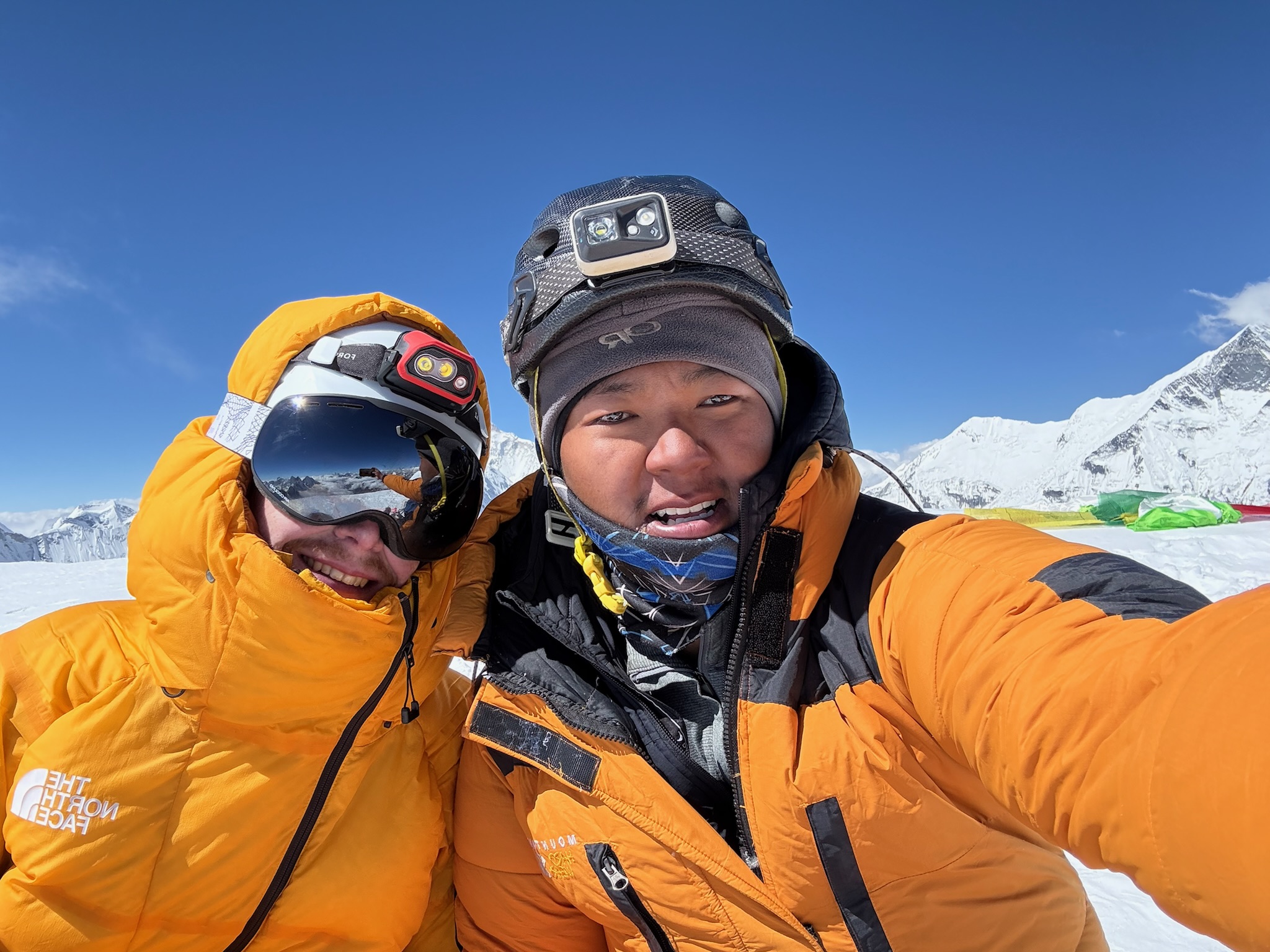
The summit ridge appears above the headwall like a line of light in the early morning sky. Wind is present in a way that was not fully felt lower on the mountain. The traverse requires focus and correct crampon placement on the exposed snow ridge, with fixed ropes to clip through on the most exposed sections. The summit cairn sits at the high point of the ridge. Most climbers arrive between 6:00 and 9:00 AM, which means either first light or full sunrise depending on starting time.
The descent is slower than most people expect. Tired legs on steep ice demand more concentration than tired legs on a trail. The headwall descent on a figure-eight or belay device takes time, and patience is more important than speed. Most groups return to base camp or high camp between noon and 2:00 PM, which is the target window before afternoon weather can develop in the Khumbu. The descent all the way to Chukhung and a teahouse meal that evening is one of the genuinely satisfying conclusions to any physical experience in the mountains.
The altitude profile of the Island Peak expedition is more aggressive than a standard Everest Base Camp trek, primarily because the final days push to 5,600 metres at high camp and 6,189 metres on summit day. Above 3,000 metres, Acute Mountain Sickness becomes a genuine possibility, and above 5,000 metres the distinction between mild AMS and the more serious conditions of High Altitude Pulmonary Edema (HAPE) and High Altitude Cerebral Edema (HACE) becomes medically important.
The standard prevention protocol is the same as for any Himalayan trek: ascend gradually, rest at strategic altitudes, stay well hydrated, and monitor symptoms honestly. The acclimatisation day in Namche Bazaar and the rest day in Dingboche are not optional extras; they are medically necessary components of the acclimatisation ladder. Guides carry pulse oximeters and should be checking blood oxygen saturation regularly from Namche upward. Readings that drop below 85% on rest at any altitude merit a rest day or descent decision.
One altitude-specific risk to note for Island Peak is what happens at the summit. At 6,189 metres, the available oxygen is roughly 47% of what it is at sea level. Climbers who feel reasonably well on the approach often find summit day physically harder than they imagined precisely because the actual summit altitude is a step change above anything encountered during the approach trek. The acclimatisation built during the two-week approach provides real physiological adaptation, but it does not fully compensate for the jump from 5,000 metres at base camp to 6,189 metres at the summit. Acknowledging this gap before summit day, and planning for a slower pace on the headwall than feels natural, is the single most useful mental preparation for the climb.
The most common question asked by climbers researching their first Himalayan summit is the comparison between Island Peak and Mera Peak (6,476 metres, Nepal's highest trekking peak). The answer depends on what kind of challenge you are looking for.
Mera Peak is higher but technically easier. The route to the summit follows gentle snow slopes with no significant glacier crossing and no headwall. The challenge is purely physical: sustained effort at altitude over a longer duration. For climbers whose primary concern is altitude experience and who have no interest in technical glacier work or fixed rope climbing, Mera Peak is the more accessible option. It is graded F (Facile) in French Alpine grading and does not require crampon technique beyond basic level.
Island Peak is lower but technically more demanding. The glacier crossing, headwall, and exposed summit ridge put real mountaineering demands on the climber. For someone who wants their first Himalayan summit to also be a genuine introduction to the mechanics of high-altitude climbing, Island Peak is the better choice. Many experienced mountaineers describe Island Peak as a better preparation for subsequent objectives like Ama Dablam, Baruntse, or Manaslu precisely because the technical skills practised on Island Peak transfer directly to those harder routes. If your ambition extends beyond a single trekking peak summit, Island Peak is the more valuable stepping stone.

The most popular extended itinerary in the Khumbu is the combination of the Everest Base Camp trek with the Island Peak climb, typically run over 18 to 22 days. The EBC portion takes the trail through Namche, Tengboche, Dingboche, Lobuche, Gorak Shep, and to the base camp itself at 5,364 metres, with an optional side trip to Kala Patthar (5,545 metres) for the famous Everest panorama. The return from EBC follows the main trail back to Dingboche, then branches east into the Imja Valley toward Chukhung and Island Peak Base Camp.
The acclimatisation benefit of visiting Everest Base Camp and Kala Patthar before the Island Peak climb is substantial. Reaching 5,545 metres at Kala Patthar acclimatises the body to an altitude close to Island Peak's base camp elevation, which means the final push to summit is approached with a body that has already adapted to the relevant altitude range. Operators who offer the combined itinerary consistently report higher summit success rates than operators running Island Peak alone from a shorter approach. The additional days also provide buffer against weather delays, which are a realistic consideration for any Himalayan expedition.
The quality of your expedition support has a direct, measurable effect on your summit success rate and your safety margin. This is particularly true for Island Peak, where summit day conditions require real-time decision-making on turnaround times, rope management, and acclimatisation assessments that only an experienced and present guide can make reliably.
The key questions to ask any operator before booking: How many Island Peak summits have your head guides completed personally? What is the guide-to-client ratio on summit day? Are fixed ropes set by your team or sourced from another operator? What is your documented policy on turnaround times? Can you provide references from clients who have completed the climb in the last two seasons? An operator who can answer these questions specifically and directly is a different category of service from one whose marketing is polished but whose operational detail is vague.
Local companies based in Nepal and staffed by guides from the Khumbu and surrounding regions carry advantages that are worth weighing seriously. Guides with direct family and community ties to the Everest region know the mountain's conditions across seasons in a way that visiting guides from outside Nepal cannot replicate. The teahouse networks, permit coordination systems, and helicopter evacuation contacts that a Kathmandu-based operator has built over years of operation are directly relevant to how fast an emergency can be managed. At 6,000 metres with deteriorating weather, the logistical quality of the company behind you matters as much as the technical ability of the guide in front of you.
Island Peak remains one of the most remarkable introductions to Himalayan mountaineering that any mountain system in the world offers. The summit is achievable for well-prepared beginners. The approach is one of the great trekking routes on Earth. The views from the top are genuinely extraordinary. And the experience of standing at 6,189 metres after a pre-dawn climb through the Khumbu darkness, crampons on solid ice and the whole arc of the eastern Himalaya visible in every direction, is the kind of thing that does not fit neatly into a word count. It simply has to be done. Join Island Peak Climbing Trip with us.
Bringing unforgettable Himalayan adventures to everyone. Our expert guides and carefully curated experiences ensure that everyone can explore the beauty of Nepal, Tibet, and Bhutan.
Learn More