Why Choose Everest Base Camp Trek for Seniors and Kids?
Last updated
The Everest Base Camp Trek for Seniors and Kids takes the classic route to the foot of the world's highest mountain and stretches it into a gentler, 20-day journey built specifically for children, grandparents, and families trekking together across generations. Compared with the standard 12- to 14-day itinerary most operators offer, this version adds two full acclimatization days at Namche Bazaar and Dingboche, a quieter side trek to Khumjung for a softer altitude gain, and a built-in contingency day near the end of the trip, all while keeping daily walking hours noticeably shorter on most days. The best seasons remain the same as the standard route: pre-monsoon, from March through May, and post-monsoon, from September through November, when trails are driest, and mountain views are most reliable.
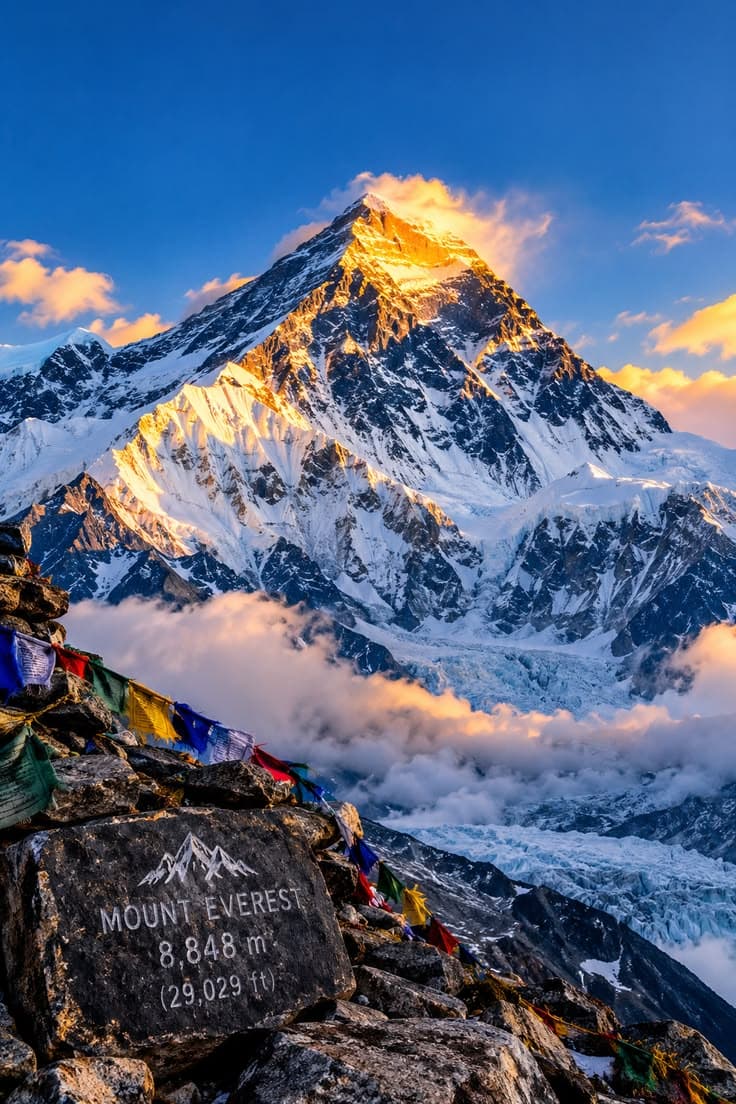
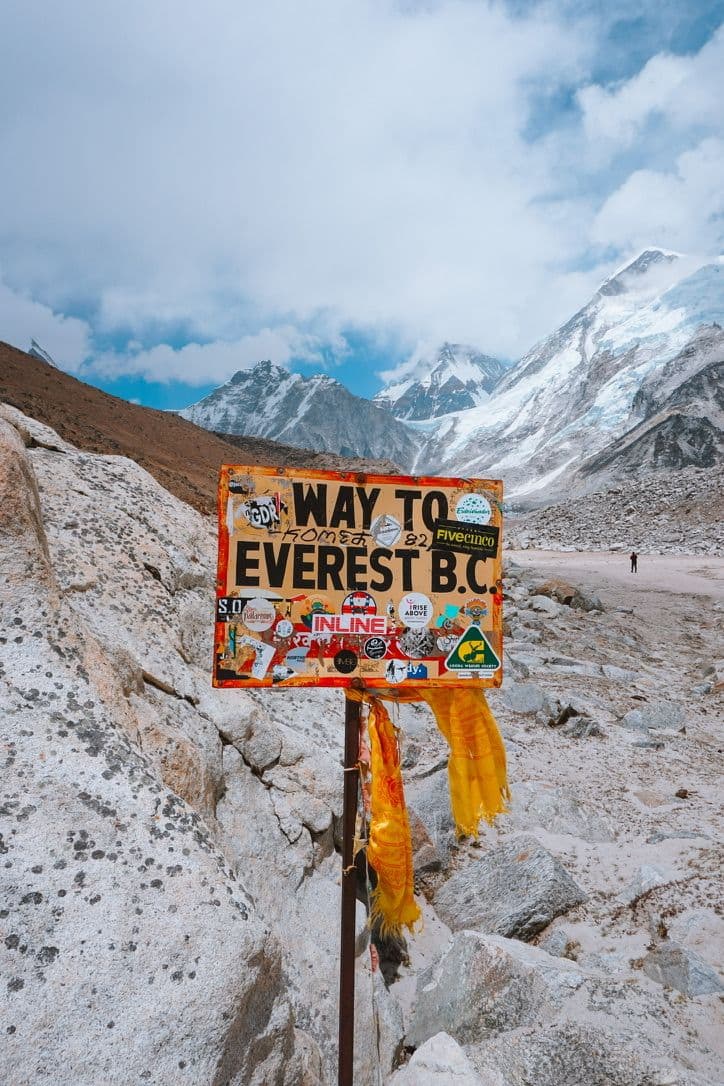
Over the full 20 days, the route passes through Lukla, Phakding, Monjo, Namche Bazaar, Khumjung, Tengboche, Dingboche, Lobuche, and Gorak Shep, before reaching Everest Base Camp itself at 5,364 metres and a sunrise side hike to Kala Patthar at 5,545 metres, the closest and clearest view of Everest anywhere along the route. Every overnight stop on this itinerary earns its place twice over, chosen for genuine acclimatization value as much as for scenery, since the entire pacing philosophy behind this trip rests on giving bodies of every age the time they actually need to adjust.
This is not simply the standard trek walked more slowly. The extra days are placed deliberately, based on where altitude-related risk actually concentrates along the route, and the itinerary treats family dynamics, not just individual fitness, as something worth planning around from the outset. A nine-year-old and a seventy-year-old grandparent face genuinely different physical challenges on this trail, but both share one thing in common: neither benefits from being rushed by a schedule built for a twenty-five-year-old solo trekker.
What follows below covers everything worth knowing before booking a family trip of this scale. The day-by-day itinerary comes first, followed by a deep look at why the pacing works the way it does, the region's history and the Sherpa culture that shapes every village along the trail, training and packing guidance broken down by age group, a full look at costs and permits, and a detailed answer to the safety questions that matter most when the trekkers in your group span two or three generations.
Why This 20-Day Itinerary Suits Seniors and Children
A handful of deliberate design choices separate this itinerary from a standard Everest Base Camp package, and each one exists because a faster, adult-paced version genuinely does not suit every trekker. None of these choices are cosmetic. Each one responds to a specific, well-documented risk or comfort issue that shows up differently in children and older adults than it does in a fit thirty-year-old moving through the Khumbu on a two-week schedule.
Twenty days, not twelve. Eight days longer than the twelve-day standard route, this schedule gives seniors and children real rest and recovery time at every stage rather than treating rest as something to be squeezed in around the walking. The extra days are not simply added at random points. They sit precisely where the body needs them most: right after the first serious altitude gain into Namche, and again before the push into the true high alpine zone above Dingboche. This matters because altitude-related illness does not scale evenly with elevation. The jump from roughly 3,400 to 4,400 metres carries meaningfully more physiological stress than the same vertical distance covered lower down the valley, and this itinerary responds to that reality rather than ignoring it.
Two full acclimatization days are built into the schedule at Namche Bazaar, 3,440 metres, and Dingboche, 4,410 metres, with a gentle side trek to Khumjung, 3,790 metres, adding a further, low-effort altitude gain between them. Both rest days follow the well-established mountaineering principle of climbing high and sleeping low, meaning the day's activity still involves modest upward movement, just enough to trigger the body's acclimatization response, followed by a return to sleep at a lower, safer altitude for the night. This is meaningfully different from simply staying still for a day, which offers far less acclimatization benefit than a short, deliberate excursion higher followed by a descent to sleep.
A dedicated contingency day sits near the end of the trip specifically as a buffer against Lukla's often unpredictable flight schedule, so nobody has to rush toward an international departure while still hoping a delayed domestic flight sorts itself out. Anyone who has read even a handful of Everest Base Camp trip reports knows how often this exact scenario becomes the single most stressful part of an otherwise successful trek, and building the buffer in from the start removes that particular source of anxiety for families who already have enough to manage.
Guides on this itinerary carry first aid training specific to pediatric and geriatric trekkers, not simply general wilderness first aid, since altitude sickness looks different in a child than in an adult and a senior's cardiovascular response to altitude carries its own distinct risk profile. A guide trained only in the standard adult presentation of acute mountain sickness may miss the early, largely behavioral signs a nonverbal or reluctant-to-complain child shows, and may equally underestimate how quickly blood pressure and heart rate can shift in a senior trekker managing a pre-existing cardiovascular condition. Training for both populations specifically, rather than relying on one generic protocol, is a meaningful difference in practice, not just in marketing language.
Full porter support means every trekker's main pack travels separately, so both seniors and children walk with nothing more than a light daypack. This single detail does more for trip comfort than almost anything else on this list. A ten-year-old or a seventy-year-old carrying even a modest overnight pack across uneven, rocky terrain for six hours a day faces a meaningfully different trip than the same person walking with only water, snacks, and a camera.
Extra time is deliberately built in at Tengboche Monastery, Khumjung's monastery, and the Sherpa villages along the way, favoring slow cultural immersion over covering distance quickly. This is not simply padding for its own sake. Slower mornings and longer stops in villages give both children and seniors more recovery time between walking sessions, while also turning the trip into something richer than a straightforward physical challenge.
Finally, a clear descent and turnaround protocol is written into every itinerary from the outset, so if one family member reaches their limit, it does not have to end the trip for everyone else in the group. Families trekking together across generations worry, reasonably, about what happens if grandpa's knees give out at Dingboche or a child develops a headache that won't resolve with rest. Having an answer to that question settled before departure, rather than improvised in the moment, changes the entire emotional tone of the trip for everyone involved.
A Brief History of the Everest Base Camp Trail
Understanding a little of how this trail came to exist adds real depth to walking it, and it is worth pausing on before diving into the day-by-day itinerary. The route trekkers follow today did not begin as a tourist trail at all. It began as a supply and exploration route tied directly to the earliest attempts on Everest itself.
The first Everest expeditions to approach from the Nepal side, rather than the Tibetan side used by earlier British attempts, came in 1950 with the Houston–Tilman expedition, followed in 1951 by a reconnaissance led by Eric Shipton. That early groundwork laid the foundation for what would become, over subsequent decades, the classic trekking route. Colonel James O.M. Roberts went on to found Mountain Travel Nepal in 1964, the first commercial trekking company anywhere in Nepal or, for that matter, in Asia, effectively inventing the modern concept of the guided Himalayan trek.
The event that transformed this region from a remote mountaineering objective into one of the most recognized trekking destinations on Earth came in 1953, when Tenzing Norgay, a Sherpa mountaineer originally from the Khumbu region, and Sir Edmund Hillary of New Zealand became the first two people to stand on the summit of Mount Everest. Tenzing had already come remarkably close the year before, in 1952, accompanying the Swiss climber Raymond Lambert to within roughly 800 vertical feet of the then-unclimbed summit before turning back. When Tenzing and Hillary succeeded the following year as part of the British expedition led by Colonel John Hunt, the achievement made global headlines and permanently changed the trajectory of this entire valley.
Expeditions had already used staging camps near the foot of the Khumbu Glacier before 1953, since a reliable base near the mountain's foot meant not hauling every piece of equipment the full length of the Khumbu Valley on each supply run. After the successful summit, that area became what is known as Everest Base Camp, and the site has served that same staging function for climbing expeditions ever since. Hillary, in particular, went on to spend decades giving back to the Sherpa communities that had supported his climb, an involvement that trekkers encounter directly on this route. The Khumjung School he helped establish in 1961, and the nearby Khunde Hospital both remain active today, visible reminders of a relationship between a foreign mountaineer and a local community that outlasted the headline-grabbing summit by more than fifty years.
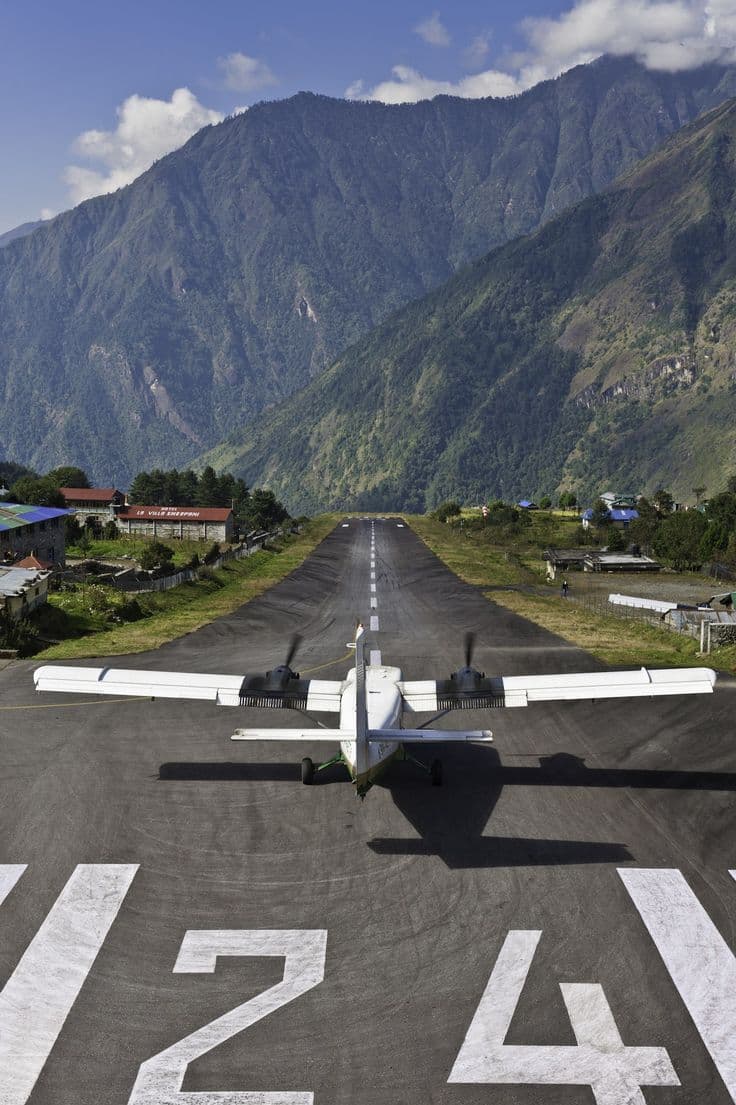
Perhaps Hillary's most transformative practical contribution to this trail, however, came in the form of an airstrip. Before Lukla's airport existed, trekkers and expedition supplies alike had to travel overland from Jiri, a journey of six to eight additional days each way compared with flying directly into the Khumbu. Hillary helped fund and organize the construction of a short airstrip on farmland near Lukla in 1964, dramatically shortening the approach and effectively making the modern, shorter Everest Base Camp itinerary possible for the first time. That airstrip, now formally named Tenzing-Hillary Airport in honor of both men, remains the gateway virtually every trekker on this route passes through today, and it is now widely cited among aviation enthusiasts as one of the most dramatic and demanding commercial airstrips anywhere in the world, owing to its short length, steep approach angle, and dramatic mountainside setting.
Understanding the Sherpa People and Khumbu Culture
The word Sherpa itself means, roughly, people from the east, a reference to the group's origins in the Kham region of eastern Tibet. Historical and genealogical evidence places their migration into the Khumbu roughly five hundred years ago, when Sherpa families crossed the high Himalayan passes seeking a more peaceful home away from conflict in their original homeland. They settled into the valleys and high pastures of what is now the Solu-Khumbu district, bringing with them the Tibetan Buddhist traditions that still shape daily and spiritual life throughout the region today. Today, the Khumbu itself is home to roughly 5,000 Sherpa residents, out of a wider Sherpa population across Nepal counted at more than 100,000 people in Nepal's national census, a relatively small community given how globally recognized its mountaineering reputation has become.
Long before Tenzing Norgay's name became known worldwide, Sherpa guides, porters, and climbers had already established themselves as indispensable partners to foreign mountaineering expeditions. Their reputation took root as early as the first British Everest expedition in 1921, when the skill, physical resilience, and quiet reliability of local Sherpa climbers became widely recognized among Western mountaineers attempting the peak for the first time. That early reputation only grew over the following century. Names like Apa Sherpa, who summited Everest twenty-one times, and Kami Rita Sherpa, who has since surpassed that mark with a record 32nd ascent on 17 May 2026, stand as living testimony to a level of high-altitude endurance and skill that remains, by any measure, extraordinary.
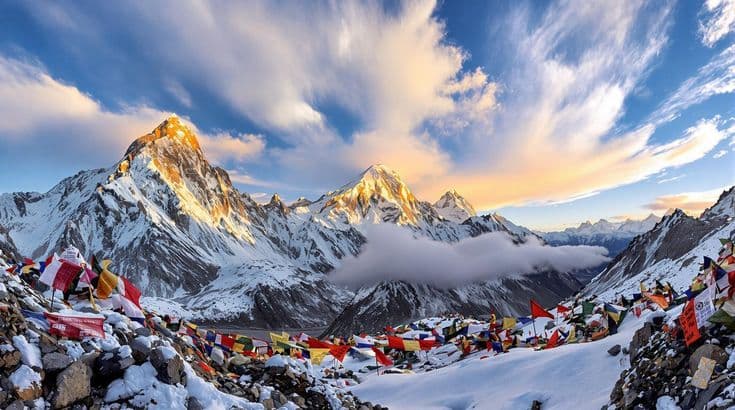
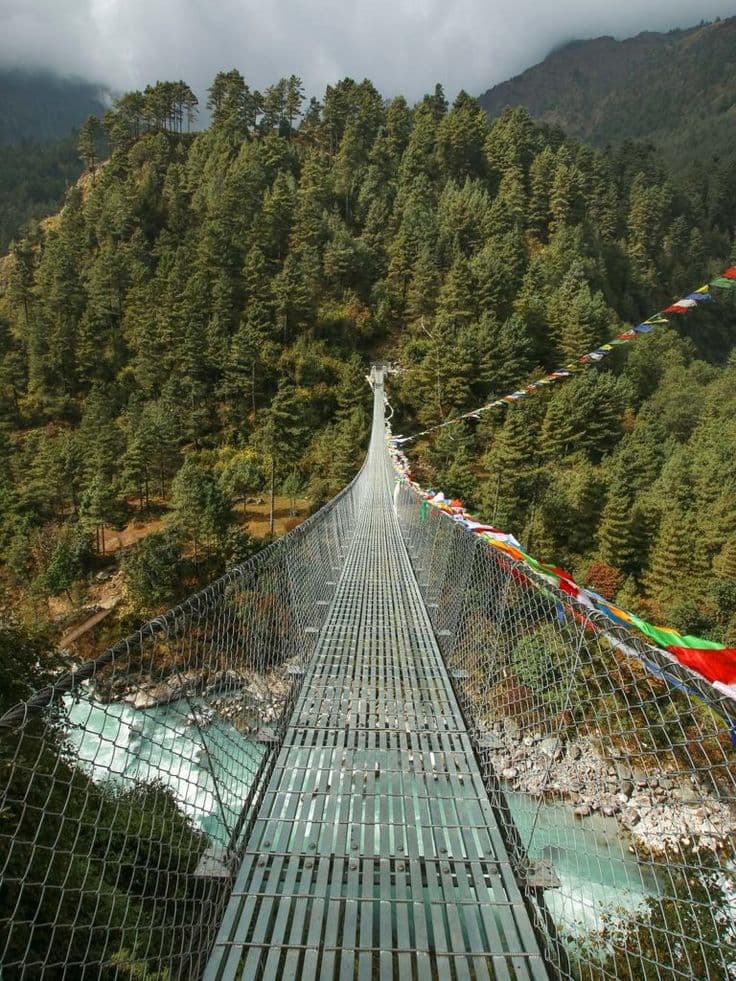
This history is not confined to museum displays or guidebook trivia along the trail. It is woven directly into the landscape trekkers walk through. Mani stone walls, carved with the Buddhist mantra Om Mani Padme Hum, line the trail at village entrances throughout the entire route, and local custom holds that trekkers should always pass them on the left, walking in a clockwise direction, a small but meaningful gesture of respect worth teaching children early in the trip. Prayer flags, strung across bridges and ridgelines in sequences of blue, white, red, green, and yellow representing sky, air, fire, water, and earth respectively, carry prayers outward on the wind with every gust, a detail that tends to fascinate children once it's explained rather than simply observed in passing.
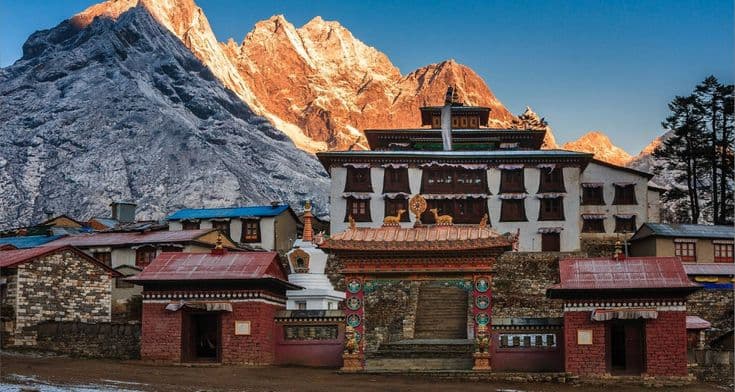
Tengboche Monastery, sitting at 3,867 metres, stands as the spiritual heart of the entire Khumbu region and one of the most significant Buddhist sites trekkers encounter anywhere on the route. Founded in 1916 by Lama Gulu, the monastery has weathered both a major earthquake and, in 1989, a devastating fire, rebuilding after each disaster with support from the Sherpa community and international donors alike. Framed directly by Ama Dablam, Everest, and Lhotse rising behind its courtyard, the monastery's setting is often described as one of the most photographed religious sites anywhere in the Himalayas, and for good reason.
If a family's travel dates happen to align with it, the monastery also hosts one of the most visually striking Buddhist festivals anywhere in the region: Mani Rimdu. This nineteen-day ritual cycle, timed to the ninth month of the Tibetan lunar calendar and generally falling somewhere in October or November, commemorates the victory of Buddhism over the older Bon religious tradition and honors Guru Rinpoche, also known as Padmasambhava, the figure credited with bringing Buddhism to Tibet in the eighth century. While most of the festival consists of private monastic ritual, the public portion, typically three days toward the end of the cycle, opens Tengboche's courtyard to visitors, trekkers, and Sherpa families from across the wider Solu-Khumbu district. The centerpiece is the Chham, an elaborately choreographed sequence of masked dances performed by monks in vivid costume, depicting a symbolic battle between enlightenment and the forces that oppose it. Trekking families whose itinerary happens to overlap with these public festival days, generally in the autumn trekking window, often describe it as the single most memorable cultural moment of their entire trip, considerably outweighing the effort of timing a departure around it. Exact dates shift year to year with the lunar calendar, so anyone hoping to catch it should confirm the current year's schedule well before booking.
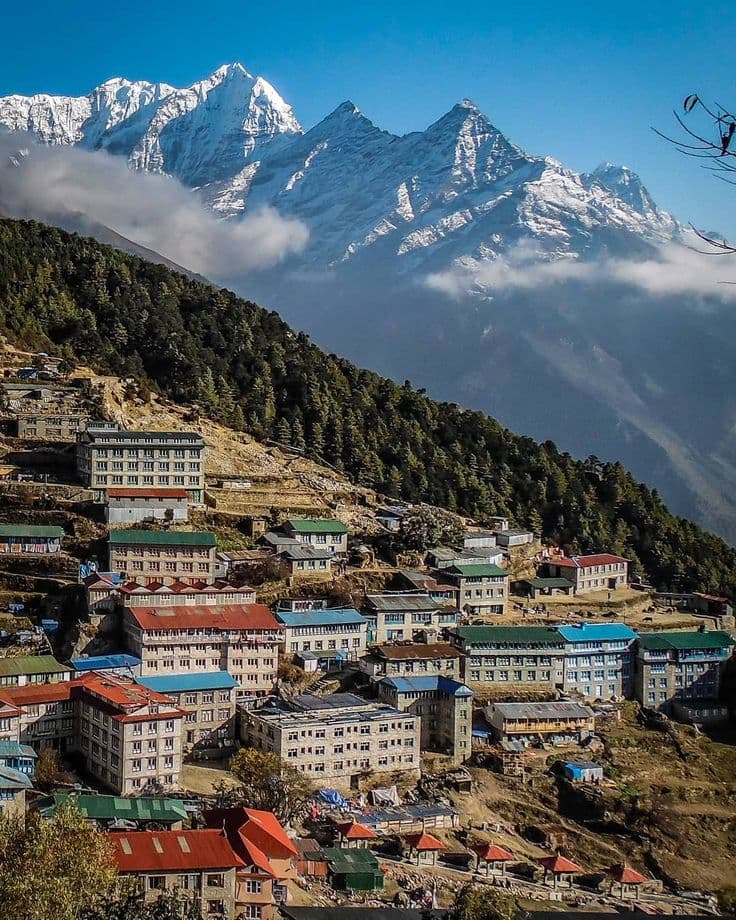
Beyond Tengboche, the village of Khumjung carries its own layered history worth knowing before passing through. Its monastery is locally said to house a relic believed by some to be a yeti scalp, a detail that reliably captures children's imagination on the trail. Just as significant, though considerably less mythical, is the Khumjung School, founded in 1961 with Sir Edmund Hillary's direct support and still educating local children today, alongside the nearby Khunde Hospital, another of Hillary's lasting contributions to the community that hosted his historic climb. Namche Bazaar itself, the largest Sherpa settlement in the entire Khumbu and the unofficial capital of the region, has functioned for generations as a trading hub connecting Tibetan traders crossing high mountain passes with lowland Nepali merchants, a role it continues to play today in a somewhat more tourism-oriented form, complete with bakeries, gear shops, and a genuinely excellent Saturday market.