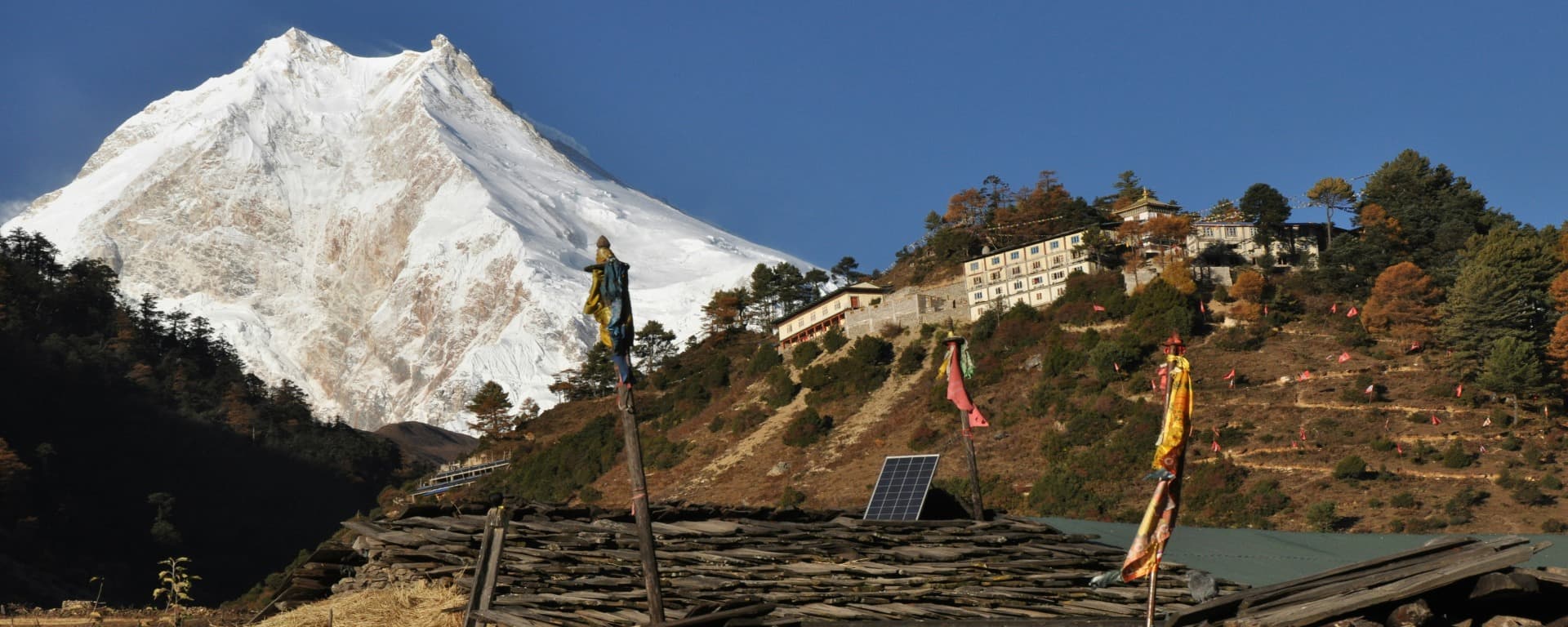
Why Choose Rapid Manaslu Circuit Trek?
Last updated
The Manaslu Circuit is one of Nepal's least-visited yet most rewarding high-altitude treks. It loops around Mount Manaslu, the world's eighth highest peak at 8,163 metres, threading through the remote Gorkha district along the Budhi Gandaki River valley. Unlike the heavily trafficked Everest and Annapurna routes, this corridor still feels genuinely wild. Terraced fields give way to dense rhododendron forests, which thin out into boulder-strewn moraines and eventually the wide, wind-scoured plateau approaching the Larkya La Pass at 5,106 metres. The nine-day rapid itinerary compresses a route that standard groups complete in fourteen to eighteen days, making it ideal for experienced trekkers who are physically prepared and want maximum mountain immersion in a shorter window.
The trail passes through a remarkable string of settlements, Jagat, Deng, Namrung, Lho, Samagaon, Samdo, and finally Dharapani, each one a living record of the Nubri and Tsum people whose culture sits at the crossroads of Nepali hill tradition and Tibetan Buddhism. Prayer walls carved with the mantra Om Mani Padme Hum line the paths between villages. Ribung Gompa in Lho and the ancient monastery above Samagaon are among the oldest surviving religious sites in the entire Gandaki zone. On the descent from Larkya La you drop into the Dudh Khola valley and eventually join the Annapurna Circuit trail at Dharapani, giving the route a pleasing sense of completion. Every elevation band from subtropical river gorge to glacial high camp is crossed within the nine days, which is part of what makes the schedule both demanding and uniquely varied.
This package is designed for people who want a structured, supported adventure with nothing left to chance. We handle every permit, every jeep transfer, and every night's accommodation so that your energy stays where it belongs, on the trail. Whether your goal is to stand on Larkya La and look across a frozen ocean of Himalayan peaks or to sit quietly at dawn in a courtyard while the Manaslu massif turns gold, this trek delivers. Contact us to check departure dates and secure your spot.
Seven Reasons to Choose the Rapid Manaslu Circuit Trek
1. One of the Remotest Major Treks in Nepal
The Manaslu Conservation Area did not open to international trekkers until 1992, roughly two decades after the Everest and Annapurna regions. As a result, the infrastructure is lighter and the crowds are a fraction of what you encounter on those iconic routes. In peak autumn months the trails see only a few hundred trekkers per week compared to several thousand on the Annapurna Circuit. This translates directly into a more personal experience: you share tea house dining rooms with a handful of travelers instead of long queues, and the local people you meet have not been overexposed to tourism. The landscape has a rawness to it that more accessible treks have gradually lost.
2. Crossing the Larkya La Pass, A Genuine High-Mountain Achievement
At 5,106 metres, Larkya La is the central challenge of this trek and the moment most trekkers describe as the high point of their Nepal experience. The crossing begins in the dark, usually between 3 and 4 in the morning, so that you reach the top before the afternoon winds build. From the prayer-flag-draped cairn at the summit you can see Himlung Himal (7,126 m), Cheo Himal (6,820 m), Kang Guru (6,981 m), and the enormous bulk of Annapurna II (7,937 m) filling the southern horizon. The descent into Bimtang, across scree and residual snow, takes several hours and finishes in a broad glacial meadow ringed by peaks. Few physical accomplishments in non-technical mountaineering come close to this.
3. Authentic Nubri and Tsum Cultural Corridor
The upper Budhi Gandaki valley is home to the Nubri people, a Tibetan-speaking community whose religious and social life has changed relatively little over the past several centuries. Villages like Samagaon and Samdo were historically trading posts on the trans-Himalayan salt route connecting Nepal with Tibet, and that heritage is visible in the flat-roofed stone architecture, the chortens and mani walls at every trail junction, and the gompas that anchor community life. Spending two nights in Samagaon, as the itinerary requires for acclimatization, gives you genuine time to explore the village, visit Pungen Gompa, and talk with locals rather than just passing through.
4. Rich Natural Diversity Across Every Elevation Zone
The trek descends to roughly 1,340 metres at the start and climbs past 5,000 metres, passing through five distinct ecological zones. Sub-tropical forest along the lower Budhi Gandaki holds langur monkeys and a wide range of birds including the Himalayan monal pheasant, Nepal's national bird. Higher up, oak and maple give way to stands of silver fir and rhododendron, spectacular in flower during March and April. The alpine scrub zone around Namrung and Lho supports Himalayan tahr and musk deer. Above 4,000 metres the terrain transitions to moraine and glacier, with snow leopard tracks occasionally reported near Pungen Glacier. This is one of Nepal's richest wildlife corridors outside the Terai national parks.
5. Acclimatization Built Into the Schedule
The rapid itinerary is not simply a compressed version of the standard route. The rest day in Samagaon (Day 5) is a non-negotiable part of the schedule and is positioned to give your body adequate time at 3,530 metres before the big push to Dharamsala at 4,460 metres and then over the pass. The daily elevation gains are calibrated against the broadly accepted guideline of not sleeping more than 500 metres higher than the previous night once you are above 3,000 metres. This approach, combined with an early start on the pass day, gives fit and prepared trekkers a strong safety margin. We monitor every trekker's health through the journey and our guides carry pulse oximeters.
6. Fully Managed Logistics in a Restricted Area
The Manaslu region is a government-designated restricted area, which means independent trekking is not permitted. Every visitor must be part of a registered group of at least two and must be accompanied by a licensed trekking guide. Three separate permits are required, the Manaslu Restricted Area Permit, the Manaslu Conservation Area Permit (MCAP), and the Annapurna Conservation Area Permit (ACAP). We handle every piece of paperwork and take care of the checkpoint procedures at Jagat and subsequent control posts along the trail. For trekkers who are unfamiliar with Nepal's permit system, this removes a significant source of confusion and ensures there are no delays at the start of the trek.
7. Local Expertise, Fair Employment Practices, and Responsible Tourism
Our guides are all certified by the Nepal Mountaineering Association and hold wilderness first aid qualifications. Many grew up in mountain communities and have personal connections to the Gorkha region, which gives their cultural commentary a depth that outsider guides cannot replicate. We use family-run tea houses at every stop rather than group camps, which channels spending directly into the local economy. Our porters are employed on fair-wage contracts that exceed the minimum set by the Trekking Agencies Association of Nepal, and each porter carries no more than 20 kg in line with the Porter Protection guidelines. Sustainable tourism is not a marketing term for us, it shapes every operational decision we make.


