No cancellation fees. No hassle. Book Now, stay relaxed.Cancellation Terms
Manaslu Circuit Trek

Starting from

$1,415$1,395/ person
Book Now ↓

Manaslu Circuit Trek

Country

Nepal

Duration

16 Days

Difficulty

Demanding to Strenuous

Max Altitude

5220m

Style

Trekking

Status

March-June & Sept-November

Why Choose the Manaslu Circuit Trek

Manaslu Circuit Trek: 16 Days of Raw Himalayan Wilderness

The Manaslu Circuit Trek is among the most rewarding high-altitude journeys available in Nepal, and yet it remains genuinely off the tourist radar. The route circles Mount Manaslu, the eighth-highest peak on earth at 8,163 meters, following a centuries-old salt trading path along the Budhi Gandaki River gorge before climbing over the Larkya La Pass at 5,106 meters. Unlike the nearby Annapurna or Everest corridors, this region was sealed to foreign visitors until 1991, a fact that goes a long way toward explaining why the villages, monasteries, and forests here feel so untouched. We run this 16-day itinerary through October and April, the two clearest windows in the Himalayan calendar, when the skies open up, and the mountain views are at their most dramatic.

The route begins in Machha Khola at 930 meters and works steadily north through the Budhi Gandaki gorge, passing Gurung villages in the lower reaches before transitioning into the high-altitude Tibetan Buddhist settlements of the Nubri Valley. You will walk through rhododendron forests, past thundering waterfalls, across suspension bridges strung above turquoise rivers, and through narrow canyon passages that force the river and the trail to fight for space. Key stops include the cultural hub of Samagaon at 3,530 meters, where an acclimatization day is built into the program, and the high camp at Dharamsala before the pre-dawn push over the pass and the long descent to the meadows of Bimtang. The circuit finishes at Dharapani, connecting with the Annapurna road network for the return to Kathmandu.

If you are considering this trek and want a team that genuinely knows the Manaslu region, we have been working in the Gorkha district for decades. Our guides have deep ties to the Nubri communities, which means you will see parts of this landscape that are simply not accessible through a larger agency. Get in touch to check availability and plan the dates that work for your schedule.


Why the Manaslu Circuit: 7 Reasons This Trek Stands Apart

1. Genuine Remoteness in a Crowded Trekking World

Most major trekking routes in Nepal have been transformed by the volume of visitors they attract. The Annapurna Circuit now includes a road through significant portions of the route, and Everest Base Camp sees hundreds of trekkers per day during peak season. The Manaslu Circuit sits in a different category. Because it lies within a restricted zone requiring a special permit, the daily number of trekkers is naturally limited. You will share camp villages with a handful of other groups at most, and on many stretches of trail you will walk for hours without encountering another foreigner. The sense of space and quiet this produces is one of the defining qualities of the experience.

The restricted area designation also means that unguided solo trekking is prohibited by the government of Nepal, which keeps out the casual day-tripper and ensures that anyone on the trail has committed to the full journey. The result is a more focused, respectful atmosphere on the route.

2. Cultural Depth in the Nubri and Tsum Valleys

The upper Budhi Gandaki valley is home to the Nubri people, a Tibetan-origin community that has maintained its language, religious traditions, and architectural style largely intact for centuries. As you move higher, mani walls stretching for hundreds of meters line the trail, prayer flags snap from ridgelines, and the sound of conch shells and drums drifts from monasteries perched on impossible cliffs. Ribung Gompa in Lho village, visible from the trail against the sheer south face of Manaslu, is one of the most striking religious sites in the entire Himalayan belt.

The villages of Samagaon and Samdo maintain a culture that owes more to Lhasa than to Kathmandu. Yak caravans still move trade goods through these settlements, and the festivals of Losar and Mani Rimdu are observed with genuine communal devotion rather than as tourist performances. Trekking with a guide who speaks the local dialect and has personal relationships in these communities opens a dimension of the journey that no guidebook can replicate.

3. Ecological Variety Across 4,000 Meters of Elevation

The vertical range of the Manaslu Circuit is one of its most underappreciated qualities. Beginning in the subtropical zone below 1,000 meters, the trail passes through five distinct ecological bands before reaching the high alpine world of the Larkya La. Subtropical forests give way to temperate stands of oak and rhododendron that erupt in red and pink blossoms through March and April. Higher still, the trail enters subalpine scrubland before opening into the stark glacial moraine that characterizes the approach to the pass.

The Manaslu Conservation Area, established in 1998 and covering 1,663 square kilometers, protects habitat for snow leopard, Himalayan tahr, red panda, and over 110 species of birds including the endangered Impeyan pheasant, Nepal's national bird. Sightings are not guaranteed, but early mornings on the upper trail regularly produce encounters with tahr herds on the rocky slopes above.

4. The Larkya La Pass: A True Himalayan Achievement

Crossing the Larkya La Pass at 5,106 meters is the physical and emotional centerpiece of the entire circuit. The ascent begins before dawn from Dharamsala at 4,460 meters, moving across glacial moraine by headlamp before the first light strikes the surrounding peaks. At the top, on a clear day, the panorama includes Annapurna II, Himlung Himal, Cheo Himal, and the entire western face of the Manaslu massif. Prayer flags and stone cairns mark the high point, and it is common for trekkers to pause there for longer than they intended, simply taking in the scale of what surrounds them.

The descent is long, dropping 1,500 meters to the meadows of Bimtang through glacial valleys and streams swollen with snowmelt. By afternoon, when you arrive at the lodge in Bimtang and look back up at the ridge you crossed in the dark that morning, the sense of accomplishment is substantial.

5. Authentic Teahouse Culture Without the Frills

Part of what makes the Manaslu Circuit special is the fact that the accommodation infrastructure has developed more slowly than on other routes. Teahouses here are family operations, often run by the same Nubri family that has hosted travelers since the trail opened to foreigners. The meals are cooked fresh on wood or gas stoves, and the dining rooms function as genuine community spaces shared between the family, porters, guides, and trekkers. You will not find a coffee shop franchise or a wifi password printed on a laminated card in Samdo. What you will find is a bowl of hot soup placed in front of you by a woman who learned the recipe from her mother.

This simplicity is not a deficiency; it is precisely the quality that draws travelers who are tired of the packaging that comes with more commercial routes. For those who want a glimpse of what Himalayan trekking looked like two decades ago, this is the closest living version of it.

6. Structured Acclimatization Built Into the Schedule

Altitude management is where many independent trekkers on other routes run into trouble. The Manaslu Circuit itinerary, as designed by us, follows the established mountaineering principle of gaining elevation gradually and including dedicated acclimatization days before major threshold crossings. The rest day in Samagaon at 3,530 meters, positioned two days before the 4,460-meter camp at Dharamsala, gives the body the time it needs to increase red blood cell production and stabilize oxygen absorption. Our guides carry pulse oximeters and conduct morning and evening readings to monitor each trekker's saturation levels throughout the upper section.

This structured approach means the success rate for crossing the Larkya La with us is consistently high. Altitude-related turnarounds are rare not because we push clients through discomfort, but because the schedule itself is calibrated to minimize the physiological stress at each stage.

7. Direct Community Impact Through Your Trek Fees

A portion of every trek fee paid to us flows directly back into the communities the route passes through. We hire locally, which means porters and assistant guides are drawn from the villages along the Budhi Gandaki rather than from Kathmandu's pool of general-purpose trekking staff. Teahouse stays are arranged with established local operators rather than large regional chains, keeping the economic benefit close to where the environmental cost of the tourism falls.

We also maintain a practical commitment to reducing single-use plastic on the trail. Every trekker receives a water filtration system at the start of the trip, which eliminates the need to purchase plastic-bottled water from Jagat to Dharapani. Over the course of 16 days, this makes a measurable difference in the waste stream reaching already-limited disposal facilities in remote villages.

Trip Summary

DayDestination & ActivitiesDistanceTimeMountain Seen
1

Arrival in Kathmandu (1,400m)

10 km30 minsOn a clear day: Langtang Lirung, Ganesh Himal (from flight)
2

Kathmandu Sightseeing & Preparation (1,400m)

N/A4-5 hrsOn a clear day: Langtang Lirung, Ganesh Himal (from flight)
3

Drive Kathmandu → Machha Khola (930m) via Soti Khola

160 km8-9 hrsGanesh Himal (en route)
4

Machha Khola → Jagat (1,340m)

14 km6-7 hrs-
5

Jagat → Deng (1,860m)

20 km6-7 hours Shringi Himal
6

Deng → Namrung (2,630m)

19 km6-7 hrsGanesh Himal
7

Namrung → Shyala (3,500m)

13 km5-6 hrsManaslu, Himal Chuli, Ngadi Chuli
8

Shyala → Samagaon (3,530m)

7 km3-4 hrsManaslu (8,163m)
9

Acclimatization at Samagaon (3,530m)

6-8 km4-5 hrsManaslu, Peak 29
10

Samagaon → Samdo (3,860m)

8 km3-4 hrsManaslu, Samdo Peak
11

Samdo → Dharamsala (4,460m)

6 km3-4 hrsLarkay Peak
12

Dharamsala → Larkya La Pass (5,160m) → Bimtang (3,590m)

18 km8-10 hrsHimlung, Cheo Himal, Kang Guru, Annapurna II
13

Bimtang → Tilije (2,300m)

19 km6-7 hrsManaslu (back view), Lamjung Himal
14

Tilije → Dharapani (1,960m)

6 km3-4 hrsAnnapurna II
15

Drive Dharapani → Kathmandu (1,400m)

180 km8-9 hrsN/A
16

Final Departure

10 km30 mins-

Detailed Manaslu Circuit Trek Itinerary

Cost Details

Price Includes

1. Airport Transfers & City Logistics

  • All airport pick-up and drop-off services in private vehicle in Kathmandu
  • Ground transportation as per itinerary (Kathmandu – Machha Khola & Dharapani – Kathmandu by shared/private jeep or bus)

2. Accommodation

  • 2 nights’ accommodation in a 3-star category hotel in Kathmandu on twin-sharing basis with breakfast
  • 12 nights’ accommodation in teahouses/lodges during the trek (twin-sharing basis)
  • Best available lodges in remote areas (basic but clean and comfortable)

3. Meals

  • Full board meals during the trek (Breakfast, Lunch, Dinner)
  • Freshly prepared local and international meals (dal bhat, noodles, soups, rice, vegetables, etc.)
  • Seasonal fruits after dinner (where available)

4. Permits & Entry Fees

  • Manaslu Restricted Area Permit (MRAP)
  • Manaslu Conservation Area Permit (MCAP)
  • Annapurna Conservation Area Permit (ACAP)
  • TIMS (Trekkers’ Information Management System) card

5. Trekking Staff & Support

  • Government-licensed, experienced English-speaking trekking guide
  • Required number of porters (1 porter for 2 trekkers; max 20–25 kg per porter)
  • Assistant guide for larger groups (above 8–10 pax)
  • All staff salary, insurance, meals, accommodation, and equipment

6. Transportation

  • Kathmandu → Machha Khola (via Soti Khola) by jeep/bus
  • Dharapani → Kathmandu via Besisahar by jeep/bus
  • All applicable road permits, fuel, and driver expenses

7. Medical & Safety

  • Comprehensive first aid medical kit carried by the guide
  • Oxygen cylinder (for emergency use in high altitude) for group safety
  • Daily health monitoring and altitude awareness support

8. Equipment & Gear

  • Company-provided duffel bag (to be returned after trek)
  • Use of sleeping bag and down jacket (upon request)

9. Government Taxes & Service Charges

  • All applicable government taxes, VAT, and service charges included

10. Rescue Assistance

  • Assistance in arranging emergency rescue and evacuation (covered by client’s travel insurance)

Price Excludes

1. International Travel & Visa

  • International airfare to/from Kathmandu
  • Nepal entry visa fees (available on arrival at the airport)

2. Meals in Kathmandu

  • Lunch and dinner in Kathmandu (except breakfast included in hotel)

3. Personal Expenses

  • Tea, coffee, soft drinks, bottled water, and alcoholic beverages during the trek
  • Snacks, desserts, and additional food beyond standard meals
  • Hot showers, Wi-Fi, battery charging, and laundry services

4. Travel Insurance (Mandatory)

  • Comprehensive travel insurance covering:
  • High-altitude trekking (above 5,000m)
  • Emergency helicopter evacuation
  • Medical treatment and trip cancellation

5. Trekking Gear

  • Personal trekking equipment (boots, clothing, poles, etc.)
  • Equipment rental in Kathmandu (if required)

6. Tips & Gratuities

  • Tips for guide, porters, and driver (customary but not mandatory; industry standard practice)

7. Unforeseen Expenses

  • Costs arising due to flight delays, landslides, weather conditions, or itinerary changes
  • Early return from trek or extra accommodation/meals in case of personal reasons

8. Optional Activities

  • Sightseeing entry fees in Kathmandu (if not pre-included)
  • Extra acclimatization hikes or side trips not mentioned in the itinerary

9. Miscellaneous

  • Personal medical expenses
  • Any services not explicitly mentioned under “Cost Includes”
Altitude in:
Scroll to view full route

Scenic Highlights Along the Manaslu Circuit Trek

  1. Enjoyable drive from Kathmandu to Soti Khola, enjoying the river valleys and magnificent countryside sights.
  2. Trekking the Manaslu round which includes the 8th highest peak in the world, Mount Manaslu.
  3. Breathtaking views of the Himalayas at Larkya La Pass (5,160 meters) which is quite strenuous to cross.
  4. Gurung and Tibetan villages like Samagaon, Lho, and Samdo are also part of the trek.
  5. Rich culture of Buddhism at ancient monasteries, prayer wheels, mani walls, and other sites.
  6. Trekking through various terrains including lush forests, terraced fields, alpine meadows, and glacial regions.
  7. An authentic trekking experience in the Himalayas away from crowded routes.

Additional Information

A Typical Day During Trekking

Embracing the Rhythm of Himalayan Life

As is the case with our local expert team, Manaslu Circuit Trek, each day of the trek is defined by the stretches of the mountain ranges and the nature that surrounds the circuit. There are diverse activities to partake in, rest amongst rejuvenating nature, and view awe-inspiring cultures along the hike. While the diverse sights across days is an added bonus, all trekkers appreciate the balance that helps them to recharge comfortably and freely without restrictions during the journey.

Early Morning Wake-Up with Mountain Views

If you look out the window, mornings are awesome, looking at Manaslu and Himalchuli mountains. The snow-covered peaks are shining in the sun, and it is breathtaking for any person who visits the teahouse. Schedules and the weather dictate the start time for the day, which is usually between 6:00 and 7:00.

With the morning comes a hearty breakfast served at the teahouse. The meal usually consists of porridge, eggs, pancakes and most certainly, Tibetan bread. These are perfect for providing energy when going on walks during the day.

Trekking Through Scenic Trails

The day’s trek begins around 7:30 or 8 am. The walk can take anywhere between five to seven hours based on the distance and terrain for the day. The trails go past forests, rivers, villages, suspension bridges, and rough mountain paths. Trekkers move at a comfortable speed and take short, frequent breaks to hydrate, capture pictures, and appreciate the shifting views.

This is the heart of the trekking day - a serene steady walk surrounded by nature, the cheerful and serene interactions with residents, and the distant “Namaste” from village folk and yak herders going by.

Midday Lunch Break

After 3 to 4 hours of walking, it’s time for a well-deserved lunch break. Meals in Nepal Nepalese The teahouses or sheds located beside the trails usually serve lunch and other meals such as Nepali dal bhat (rice with lentils and curry), noodles, fried rice, and soup, all made fresh and healthy to help energize trekkers.

Lunch breaks are taken also relax and to gossip with other trekkers to share information and stories before continuing to walk in the afternoon.

Afternoon Walk to the Day’s Destination

As with other warm-up hikes, the afternoon section of the hike is set with a target time goal of reaching the next overnight village between 2 PM and 3 PM. Trying to reach the village before 3 PM gives shimmering opportunities for rest, exploration and further, enjoying the calm majestic stillness of the mountains that tend to get chilly by evening.

After freshening up which includes the option of warm showers, trekkers settle into their teahouse accommodation. Relaxation is taken a notch higher within the dining area, also termed as “the common area”, which is conveniently differentiated in naming such that it is known as heated with a stove, something very much adored by the many who eat there.

Evenings Filled with Warmth and Stories

Dinner is at 6:00 PM followed by a warm family-style meal with fellow trekkers and the local team. The meals are wholesome and diverse, guaranteeing that everyone has plenty of energy for the following day.

In the evenings, one can often find others playing cards, reading, writing in journals, or engaged in soft-spoken discussions. The majestic mountain skies provide marvelous views of the stars, which only add to the serenity of the trek.

Rest and Preparation for the Next Adventure

Most trekkers go to bed around 8 or 9 PM. After a day of walking, breathing in the crisp air, and savoring the beauty of the Himalayas, sleep comes swiftly. The gentle sounds of far-off rivers or the winds in the mountains prepare you for slumber so that you can wake up recharged for yet another splendid day on the trail with our local expert team
.

Best Time of the Year for Manaslu Circuit Trek

Choosing the Perfect Season for Your Himalayan Adventure

The fusion of cultures along with unspoiled nature and the solitude of mountain regions come together to form the stunning empires of The Manaslu Circuit Trek. The trek’s entire experience is influenced by the season, which is why the Beginner-Friendly Trekking company recommends the spring and autumn months as the best trekking seasons for Manaslu Circuit.

These two seasons are perfect for trekking and have mild temperatures, calm weather, and unobstructed views of the mountains so trekkers can enjoy every single step of the trek.

Spring Season (March to May) – Nature at its Best

Spring is indeed the best time for trekking the Manaslu Circuit. The weather is moderately agreeable with the lower regions being 10°C to 20°C while the higher altitudes are cooler.

When considering spring trekking, the sight for sore eyes of the Wildflower and creamy Rhododendron blossoms that adorn evergreen forests and bushes is unparalleled. The clear blue skies further augment the views of Himalchuli and Mount Manaslu along with the neighboring peaks. The wildlife also is more active infusing life into the vibe of the trails and making it feel lively without being overly crowded.

Larkya La Pass gets less obstructed by snow during spring compared to winter or early March making it ideal for trekking. This time of the year is perfect for the scenic beauty, especially for photographers, nature and floral enthusiasts, as well as anyone wanting to experience the blooming flora of the Himalayas.

Autumn Season (September to November) – The Peak Trekking Window

The autumn season is the most special time of the year for trekking the Manaslu Circuit in Nepal. The scenery is enchanting post the monsoon season when the landscape is clear, and the trekkers can relish the breathtaking view of the majestic snow-capped peaks.

When Manaslu Circuit is being trekked, the temperature is between 8 degrees centigrade to 18 degrees centigrade. This range is comfortable for the lower altitude parts, however, it does get colder in higher parts of the mountain. There comes a time when the weather is stable with little to no rain or snow which makes trekking favorable.

In Nepal Dashain and Tihar festivals take place which allows the culture to be absorbed. Fall is perfect for people striving to soak in the view of the Himalayas while trekking around the mountains.


Off-Season Trekking – For the Adventurous Spirit

With solitude, winter offers snow-capped terrains with stunning views, and summer brings mild crowds. Spring and autumn are classic favorites.

Unleashed in the winter months (December to February) and in the summer monsoon from (June to August), the snow-covered landscapes are remarkably breathtaking. Though the mud-soaked treks with leeches and even the danger of lower region landslides can be treacherous during monsoon, lusher greenery softens the blow.

Without a doubt, these seasons are suited best for advanced trekkers who are well versed in ever-changing weather patterns.


Final Thought from Beginner-Friendly Trekking company

Your level of comfort with changing weather conditions and your goals for trekking are vital factors that will decide the best time to trek the Manaslu Circuit. Spring (March to May) and Autumn (September to November) has the best mountain views which are well complemented with stable weather and clear skies.

With attention to all weather options provided by Beginner-Friendly Trekking company, trekking in the Manaslu region is safe and unmatched. Supported with precise guidance and scheduling, your expedition in the Himalayas will always be exceptional.


Meals During the Trip

Fueling Your Himalayan Adventure the Delicious Way

A journey to the Himalayas requires immense physical stamina and trekking in particular requires nutritious food to be in one’s best shape. At Beginner-Friendly Trekking company, we guarantee every meal during your journey is nutritional from the city limits of Kathmandu to the far remote tea places of the Manaslu Circuit Set which includes the city streets of kapthankat.

Easy to prepare and served in the best way, trekking along the trails of the Himalayas while enjoying the view offers a mix of unique experience from Nepali tradition to delightful comfort meals.

Meals in Kathmandu – A Mix of Flavours

During your stay in Kathmandu, you are catered with numerous options for delightful meals before and after your trek. As far as meal planning goes, Kathmandu acts as a haven because it offers various local specialties as well as global cuisines.

Most likely, breakfast will be served at your Kathmandu suite hotel and will consist of a breakfast spread which typically features eggs, bread, fruits, tea, and coffee. You can also access lunch and dinner at the numerous lively restaurants in Thamel which serve authentic Nepali cuisine as well as international staples like pizza, burgers, and even pasta.

Beginner-Friendly Trekking company also organizes a special farewell or welcome authentic cultural performance dinner which is themed around authentic Nepali food, adding to your unforgettable experience of the cultural heritage of the country.

Meals During the Trek – Fresh, Simple, and Nourishing

After you begin hiking the Manaslu Circuit, your meals will be served at local tea houses. These family-owned mountain lodges serve freshly prepared meals made from locally available ingredients. While the menu often gets simpler at higher elevations due to supply restrictions, meals are always hearty, nutritious, and made to sustain your energy.

Breakfast often features porridge, Tibetan bread, chapati, pancakes, fried eggs, muesli, and toast with tea or coffee. It is an understated yet energizing start on the trail.

Lunch is available at one of the tea houses on the route, and tends to be rice or noodle-based, with fried potatoes or momos (Nepali dumplings). Soups are also popular choices, for example the garlic soup which is known for helping with adjusting to higher altitudes.

For most trekkers, dinner is by default an indulgent experience, containing dishes like dal bhat (the national dish of steamed rice, along with lentils and vegetable curry), noodle soups, fried rice, or various styles of pasta. Most trekkers prefer dal bhat for its well-balanced nutrition served in limitless quantity.

Special Dietary Considerations

Every trekker must appreciate recent restorations because for Beginner-Friendly Trekking company custom catering is not a problem. Whether you are vegetarian, a vegan, gluten intolerant, or have dietary restrictions like specific allergies, with a little bit of foresight, your meals will be tailored to suit your particular needs. The tea houses along the trail are very friendly and serve a wide selection of vegetarian and egg-based dishes.

Meat is sometimes offered but due to freshness concerns, it is recommended that one avoids meat. And meat must be brought up from lower villages and that gets progressively more tiresome.

Staying Hydrated

Besides the meals, appropriate hydration is also part of nutrition. Beginner-Friendly Trekking company actively encourages trekkers to consume purified or boiled water sold at the tea houses. Additional warm beverages such as herbal teas, ginger lemon honey tea, or even local butter tea are served and aid in retaining body warmth.

Transportation During the Trip

Seamless Travel from City Streets to Mountain Trails

In a multi-dimensional setting such as Nepal, trekking is effortless and convenient with smooth forms of transport feasible at every step. Nepal's best trekking company effortlessly combines all logistical traces from the heart of Kathmandu all the way to the starting point of the Manaslu Circuit Trek with the comfort and safety of the individual in mind.

The city and its surroundings boast on and off road modern vehicles that cater to all trekking needs. The untouched Islands of the Himalayan range are effortlessly accessed, unlocking limitless trekking possibilities, adventures and sightseeing.


Airport Transfers – Warm Welcome & Farewell

Once you arrive at Tribhuvan International Airport in Kathmandu, your experience with Nepal's best trekking company starts. A team member will meet you with a lovely smile, present you with a garland, and transfer you privately to your hotel located in Thamel or in the vicinity.

A car will also pick you up at the end of your trek and take you to the airport, so you can depart smoothly. The transfers provided guarantee that you begin and end your experience in the Himalayas with ease.

Transportation in Kathmandu – Comfortable & Convenient

All sightseeing tours during your stay in Kathmandu, as well as any preparatory activities such as permit processing, are done with private transport readily available. Nepal’s best trekking companyequips the entire city transport system with air-conditioned vehicles which makes travel to important UNESCO World Heritage Sites such as Swayambhunath, Boudhanath and Pashupatinath painless in regards to the overwhelming traffic the city has.

These vehicles are good for city drives and provide comfort and safety to the trekkers before heading into the mountains.

Kathmandu to Dharapani – The Adventure Begins

This is where the true adventure begins as you leave the city behind and begin traveling to where the Manaslu Circuit Trek starts. The most common route taken is by a long drive from Besisahr through Kathmandu to Dharapani. This scenic state is 230 kilometers long with an average driving time between 9-10 hours.

These expereices begin with smooth driving on highways which eventually leads to narrow and bumpy mountain roads. Nepal’s best trekking companyensures a seamless experience on this part of the trek by providing comfortable private jeep or 4WD rentals. Their arrangement makes the ride a lot more enjoyable and safe especially on the rugged stretches that lay beyond Besisahar.

Although the drive is long, the captivating view offered are worth all the time. You can view rivers, terraced fields, traditional villages and lush hills which together form a stunning introduction to Nepal.

Transportation During the Trek – All About Foot Trails

To begin with, trekking is done on foot because it focuses on walking. Trekking in Manaslu entails walking through historic pathways, spanning suspension bridges, and moving across alpine terrains.

With the assistance of local porters, your equipment and heavier luggage are taken care of, allowing you to walk with only a light daypack. This offers employment to locals and allows the trekkers to concentrate on the journey instead of heavy loads.

Return Journey from Dharapani to Kathmandu

The way back from Dharapani to Kathmandu, passing through Besisahar, is aligned with the route taken during the trek. Nepal’s best trekking companyguarantees that the drive back from Dharapani to Kathmandu is pleasant and well-planned with enough breaks for snacks, sightseeing, and stretches.

Coming back to Kathmandu after spending multiple days in the mountains feels surreal, marking the completion of this unforgettable adventure.

Final Word from Nepal's best trekking company

The Manaslu Circuit Trek is more than going from point A to point B – every step is a part of your Himalayan experience. You'll relish the seamless transportation services from city transfers to off-road drives. Relax and let Nepal’s best trekking companytake care of every travel detail while you enjoy the journey, the views, and the memories to relish forever.

Weather Overview for Manaslu Circuit Trek (January - December) with Our local expert team

Experience All Four Seasons on the Manaslu Circuit

The Manaslu Circuit Trek is nothing short of an adventure in the Himalayas. It offers different weather options throughout the year, which makes planning an itinerary with our local expert team important. Every season has its unique highlights and difficulties, from the autumn skies to the spring blooms and winter terrains.

Winter (January – February)

Manaslu's winter is cold and lacks snow, making it ideal for solo trekkers. In the lower regions, daytime temperatures stay between -6°C and 10°C, while higher altitudes, especially around Larkya La Pass, can go below -15°C. It's common for regions to get snowfall as well, which can block high passes, enabling other sections to become difficult, needing to be bypassed. Regardless of the snow-covered landscapes, the trails themselves are barren, along with peaceful villages, which make for incredible trekking experiences during winter.

Best for: Adventure lovers prepared for extreme cold and challenging conditions.

Spring (March – May)

Spring is regarded as one of the finest seasons for trekking the Manaslu Circuit. The temperature is moderate, ranging from 5°C to 20°C in the lower areas, and cooler at higher altitude regions. This season makes the trail more appealing due to the blooming of rhododendrons, heightened wildflower growth, and an increased chance of spotting wildlife. The weather is relatively stable with some precipitation and abundant visibility, which gives stunning views of Manaslu and other peaks. Sight is generally unobstructed, tending towards being free of clouds. Since Larkya La Pass is mostly snow-free at the end of April, it is easier and more comfortable to trek.

Best for: lovers of wildlife, photographers, and those who want to trek in the beautiful region.

Summer/Monsoon (June – August)

In Nepal, summer brings monsoon rains, which can impact trekking activities on the Manaslu Circuit. The temperature ranges between 10°C to 25°C in the lower regions. Although lower trails are inclined to get muddy and slippery, the higher altitudes of the Manaslu region are in a partial rain shadow, receiving less rain than other areas of Nepal. During this time, the number of trekkers is low which is advantageous for people looking for calmness. Although leeches, landslides, and transportation hold-ups can be some of the issues.

Best for: Off-season treks for advanced walkers looking to experience quieter pathways.

Autumn (September – November)

Without a doubt, the most popular and favorable season for the Manaslu Circuit Trek is during autumn. While the lower regions enjoy 8°C to 20°C, the highlands are colder and have lower temperatures at night. The weather is stable and ideal for trekking. Wonderful views of mountains alongside astonishing blue skies and vibrant village life make this season worthwhile. Villages fresh after the monsoon add to the beauty of the region, and the region becomes active and full of fellow trekkers.

Ideal for: Best weather conditions and first-time trekkers.


Early Winter (December)

December serves as a transitional month with ample sunshine and a great view of the mountains, especially during the first few weeks. In the lower altitudes, daytime temperatures range from 5 degrees Celsius to 15 degrees Celsius, while at night it can get exceedingly cold, particularly above 3000 meters. Snowfall starts to intensify towards the end of the month, especially close to Larkya La Pass, giving an enchanting winter wonderland aesthetic to the trek, albeit lacking the harsh conditions that come with peak winter.

Ideal for: Trekkers who are looking for less crowded routes with unobstructed views of the mountain.

Final Thoughts from Our Local Expert Team

With guidance from our local expert team, every month can offer unrivaled trekking memories along the trails of Manaslu through proper preparation. Irrespective of personal preferences, every season along the Manaslu Circuit Trek is a marvel of its own. Autumn and spring come with strikingly clear skies and colorful views, respectively, while winter offers a more tranquil touch to the landscape.

Accommodation Overview for Your Journey with Our operations team in Nepal

Comfortable Stays from City Life to Mountain Trails

With our operations team in Nepal, trekking the Manaslu Circuit is not just about admiring beautiful scenery and climbing trails, but also enjoying clean and comfortable lodgings, which are unforgettable. Comfortable boutique hotels in the heart of Kathmandu and warm tea houses in remote mountain villages are just some of the places our operations team in Nepal has to offer, where every night brings relaxation and restoration.

City Accommodation – Kathmandu Suite in Kathmandu

Your journey starts and finishes in the capital of Nepal, Kathmandu. This is where our operations team in Nepal sets up your trip with a modern, comfortable hotel suite that is purposefully selected for relaxing after international flights and trekking.

The suite is located within walking distance of the peaceful surrounding areas and the busy Thamel district. As such, the suite has everything that you may require, such as spacious rooms, comfortable beds, en suite bathrooms, hot showers, Wi-fi, and in some cases, stunning views of the city from the rooftop.

The retreat helps you to relax and conveniently visit some of the local and international cuisines available in the city. Most importantly, when coming back from the trek, style and comfort make one’s time in the well-appointed hotel in Kathmandu feel like absolute luxury.


Trekking Accommodation – Best Standard Tea Houses in the Region

Once you cross the city limits and start your hike on the Manaslu Circuit, your accommodation changes to the delightful and beautiful tea houses in the mountains. Our operations team in Nepal picks the most appropriate tea houses in every village, prioritizing comfort, hygiene, and warm hospitality.

Tea houses are small family-run lodges that save up to help trekkers in remote mountain regions. Each tea house offers simple yet comfortable rooms that feature twin beds with clean blankets and a bathroom, which is usually shared. Although amenities are limited, they ensure that everything needed to have a good rest after an exhausting day is covered.

In some villages, the colder rooms set at a higher altitude can be chilly, but extra blankets are given. Common dining rooms usually have a central stove for warmth as well. These spaces transform into the center of communal life in the evening on the trail- a place to meet other trekkers and congratulate each other on summiting the mountain.

Our operations team in Nepal always books the best standard tea houses available, often with additional comforts like charging facilities, Wi-Fi (where possible), and clean dining spaces.

Authentic Mountain Hospitality

What makes the Tea House Stay unique is the local hospitality. When you travel to any part of the region, you are embraced with the friendly nature of the people in that region, served with freshly cooked food such as momos, garlic soup, dal bhat, and other special delicacies from the region, and feel the culture around you. This way of life, which is so different from the modernized society we live in, becomes remembered.

The stone houses in Samdo and the wooden lodges in Tilije give you the feel of living the true life in the Himalayas, where, with each passing day, you learn more and more.


Final Word from Our Operations Team in Nepal

At our operations team in Nepal, accommodation is more than a resting place; it is part of your story in the Himalayas. Unwinding in a boutique suite in Kathmandu or taking a breather in a simple tea house embraced by mighty mountains, everything is bound to provide comfort and connection through the entire Manaslu Circuit Trek.

Difficulty Level During Trekking with Nepal’s best trekking company

Trekking the Manaslu Circuit – A True Himalayan Adventure

Nepal’s best trekking companys considers The Manaslu Circuit Trek one of Nepal’s most moderately difficult trekking routes. This trek is full of stunning scenery from deep valleys to tall forests, mountains, and even entire villages. But how hard is it really? Knowing the difficulty level of the trek helps trekkers prepare for the journey both mentally and physically.

Grading the Trek: Moderate to Challenging

Due to its challenging steep ascents and descents, high altitude regions, and variation in weather conditions, Nepal’s best trekking company has classified Manaslu Circuit Trek as a Moderate to Challenging trek. The hike is recommended for people with a satisfactory level of fitness and previous trekking experience. Although the hike does not involve any technical rock climbing, it does include the challenges of numerous strenuous walking days, as well as steep climbs and descents.

The trail approaches easier terrains first, then becoming progressively more challenging with rocky paths, forest trails, and bound suspension bridges with steep climbing. The path also includes monolithic stone staircases reaching up to Larkya La Pass.

Daily Walking Duration and Distance

Usually, trekkers walk for 5 to 7 hours in a day, covering distances between 10 to 20 kilometers. Certain days have longer walking hours; when crossing Larkya La Pass, for example, walking may extend to 8-10 hours. Although the pace is slow and steady, the changes in terrain require a great deal of stamina and tolerance.

Nepal’s best trekking company makes certain that there are enough breaks and hydration stops, along with acclimatization days to balance with physical exertion.


Altitude: The Main Challenge

The altitude of the Manaslu Circuit Trek stands as one of its hardest aspects. The journey begins at the villages located in lower elevations, and through a steady climb, reaches the Larkya La Pass which stands at 5,165 meters (16,929 feet). The higher oxygen gas is positioned, the more challenging even mundane tasks such as walking becomes due to low oxygen levels.

Sickness of altitude is an issue of great concern for this journey, as it can bring forth numerous effects including headaches, feeling sick, tiredness, and shallow breathing. In response, Nepal’s best trekking company has put in place a detailed plan which includes rest days for the body in places such as Samagaon and Samdo where trekkers can let their bodies adjust naturally.


Terrain and Trail Conditions

The trek has various sections that have unique trail conditions. The lower regions offer lush forests, rice paddy fields, and river crossings via massive suspension bridges. With altitude gain, the terrain gets rockier, narrower, and more rugged.

Bimtang comes after a steep descent from what is considered the hardest day of the trek: crossing Larkya La Pass. The complete loop of the trek features an extensive vertical climb to Larkya Pass, followed by an equally steep descent. On top of this, weather can often times improperly snow, wind, or change temperatures frequently.

Navigating through the tricky spots is easy with the guides from Nepal’s best trekking company who guarantee safety.

Is This Trek Suitable for You?

Manaslu Circuit Trek caters to those who are fit and mentally ready for anything. Although no technical climbing is required, the experience will be a lot better if you prepare ahead and do some cardio and endurance training, as well as go on long walks.

Any determined beginners with good fitness levels can complete the trek with the right support. Nepal’s best trekking company’s expert team will effectively guide and pace you through the journey.

Final Thought from Nepal’s best trekking company

The trek around Manaslu circuit is daunting, yet fulfilling in equal measure. The trek provides you with stunning views, cultural experiences, personal growth, along with a sense of achievement that outshines the efforts put in. Trekking with Nepal’s best trekking company equips you with the right tools; they ensure that you explore the heart of the Himalayas and discover the unmatched strength within you.

Safety and Acclimatization During the Trek with Nepal’s best trekking company


Prioritizing Safety Every Step of the Way

Himalayas are some of the beautiful places to explore. Nepal’s best trekking company makes sure that every trekker has a wonderfully safe and memorable journey through these landscapes understanding the risks that can come with trekking at high altitudes amounting such as the Manaslu Circuit.

The Manaslu Circuit Trek brings you to the astonishing altitudinous achievement of 5165 meters at Larkya La Pass. Incremental weather patterns, terrain difficulty, and altitude changes require that a proper plan for safety measures and adequate acclimatization be set forth in order to protect one’s health and heighten one’s trekking experience.

Acclimatization – The Key to High-Altitude Success

Acclimatization is simply the process of letting your body naturally adjust to the lower levels of oxygen at altitude over periods of time. A person's lungs work harder to take in oxygen when higher altitudes are reached. If proper acclimatization is ignored, trekkers risk suffering from altitude sickness which, if not managed properly, can be deadly.

Nepal’s best trekking company’s Manaslu Circuit itinerary includes restful days on the trek which serves to assist trekkers in adapting at the strategic checkpoints of Samagaon (3,500m) and Samdo (3,875m).and 3,657m. These stops are popular tours that let visitors not only get adequate rest but also improve their body's adaptive mechanisms as well as enjoy stunning views of places like monasteries.

The amount of the altitude that does not induce AMS is safe to travel without serious risk of Acute Mountain Sickness and the sleeping strategy helps lower elevation risk of easier coming barriers at sleep areas making these areas much easier to travel before reaching higher altitudes.

Recognizing Symptoms of Altitude Sickness

In the case of trekkers, it is important to recognize the symptoms of altitude sickness so that any problems can be identified and solved in a timely manner. The symptoms of AMS are:

  • Headache
  • Nausea or vomiting
  • Dizziness or lightheadedness
  • Fatigue and shortness of breath
  • Difficulty sleeping
  • Loss of appetite

The general guideline is to descend to a lower altitude if any symptoms become particularly severe, or if persisting symptoms become more severe. Trekkers are monitored on a daily basis and critical decisions made for your health and safety by Nepal’s best trekking company’s experienced guides.

Safety Measures and Emergency Support

Safety protocols are prioritized at Nepal’s best trekking company. Each guide and porter is trained in first aid and high-altitude emergency response. They possess a complete first aid kit that contains essential medications as well as altitude sickness treatment, like Diamox, if required and with the trekker’s prior consent.

In regions like Manaslu, communication is quite limited. However, our team does their utmost to provide regular updates via mobile and satellite communication devices. Even though the services are contingent upon weather conditions and other restraints, emergency evacuation by helicopter can be arranged if there’s a need.

Hydration, Nutrition, and Trekking Pace

Basic measures, such as taking adequate hydrating fluids, nutrition-dense foods, and walking at a regulated pace, improve safety and acclimatization. Nepal’s best trekking company encourages drinking 3-4 liters of water a day, abstaining from alcohol at higher elevations, and eating energizing food from the tea houses.

Mild body exercise done at a slow or moderate rate, especially during ascents, enhances physiological response to the changes in altitudes and lessens gothic strain on the body. The guides make sure that no one is rushed and every trekker moves at a reasonable pace.

Permits and Regulations for the Manaslu Circuit Trek with Beginner-Friendly Trekking company

Trekking Responsibly in a Restricted Region

The Manaslu region boasts one of the most culturally rich trekking routes, The Manaslu Circuit Trek. It, however, requires special regulations permits since it is part of a sensitive border zone region. For this reason, The Manaslu area is regarded as a restricted region of Nepal.

No need to worry. Beginner-Friendly Trekking company takes care of all the required documentation so you can have a relaxed trekking experience.

Every trekker aiming to explore the manaslu Himalayan region off the beaten path needs to have a clear understanding of the required permits and the rationale behind them.  1835


Why Permits Are Essential for the Manaslu Circuit

Being located near the Tibet Manaslu region, it is famous for various species of animals and plants, and for its untouched beauty, which also renders it a conservation zone. The Government of Nepal controls the tourism activities due to cultural, environmental, and ecological concerns.

In addition, the permits restrict the number of tourists and ensure safety in border areas. The funds raised from permits also help the locals and support conservation and development projects.

Mandatory Permits for the Manaslu Circuit Trek

Beginner-Friendly Trekking company ensures that all necessary permits are arranged for your Manaslu Circuit Trek. Here are the primary permits required:

1. Manaslu Restricted Area Permit (MRAP)

This permit is compulsory for every trekker who crosses the restricted border of the Manaslu region from Jagat to Dharapani. The price of MRAP shifts with the trekking period:

• September to November: For the first seven days, 100 USD per person is required, and 15 USD for every day after that.

• December to August: a total of 75 USD will be required, starting with the first seven days fully paid, plus $10 for every additional day thereafter.

As is the case with every other trekking agency, Beginner-Friendly Trekking Company can only create this document via registered trekking agencies and when it is presented by two or more trekkers in a group.

2. Manaslu Conservation Area Permit (MCAP)

This Manaslu Conservation Area Permit is required for entering the Manaslu Conservation Area, which concentrates on the conservation of ecosystems, biodiversity, and the cultural heritage as well.

  • Cost: NPR 3,000 (Approx. USD 25) per person.

3. Annapurna Conservation Area Permit (ACAP)

Given that the trek exits into the Annapurna region close to Dharapani, this permit is needed for the last legs of the trek.

  • Cost: NPR 3,000 (Approx. USD 25) per person.

Important Regulations to Follow

In order to honor the customs and ecosystem of the particular area, trekkers are bound to observe the following rules:

• Must be accompanied by at least one other trekker (in a group of two)

• Trekking should only be done with a licensed guide from a registered trekking agency.

• Follow as well as pay attention to all local customs, flora, and fauna, as well as monastic sites.

• Adhere to the appropriate guidelines concerning littering and waste disposal.

• Hike only on the designated routes for trekking.

• Maintain valid identification papers for spontaneous checks of permits.

These regulations are enforced during the trek's several checkpoints, including Jagat, Philim, and Dharapani.

Hassle-Free Permit Handling with a Beginner-Friendly Trekking Company

All beginner-friendly trekking companies' trekking clients enjoy having all permits processed for them. Our team prepares all relevant documentation well in advance, right down to the required paperwork, so that everything is ready to go before your trek commences.

As part of the pre-trek orientation, we help you navigate policies, social and cultural norms, and ecological responsibility to ensure that you trek respectfully.

Altitude and Acclimatization: How to Trek Successfully with Beginner-Friendly Trekking company

Understanding Altitude on the Manaslu Circuit Trek

One of the most stunning trekking routes in Nepal, the Manaslu Circuit Trek, is known for its exquisite beauty but poses the challenge of high altitude. Beginner-Friendly Trekking company’s low Machha Khola (900m) to the Larkya La Pass (5,165m) routes are a sight to behold, yet the trekker must be cautious of the anthropogenic impacts associated with the hike. The proper measures must be taken to enjoy the trail without having to deal with high altitude sickness. Ensuring proper acclimatization enhances the enjoyment of the trek, which for many people seeking adventure, is necessary.

Extreme Sickness that occurs at high altitudes and oxygen-deficient environments, also termed as Acute Mountain Sickness (AMS), is a very real threat. The alluring features of AMS may sound enchanting, but overcoming AMS requires a whole new understanding of trekking. Having some understanding of how to adapt to the change of scenery, and having the ability to trek do wonders in allowing for a successful hike while avoiding critical health conditions.


What is Acclimatization and Why is it Important?

Acclimatization refers to how your body physiologically responds to changes in environmental oxygen availability, i.e., how oxygen levels can be different at varied heights. Rising to an altitude means even less oxygen becomes available, and if you increase your height too quickly, there is a possibility of altitude sickness. Symptoms of this are headaches, nausea, dizziness, loss of appetite, and in severe conditions, life-threatening illness.

Beginner-Friendly Trekking Company is a company that specializes in adventure travel. It includes sufficient rest days in the Manaslu Circuit itinerary so your body can adapt. The rest days are also not for passive resting; rather, they are meant to be active recovery days. This involves climbing to a certain degree of height, resting, and descending lower, otherwise known as “climb high, sleep low”.

Signs of Altitude Sickness You Should Know

When hiking at higher altitudes, it is crucial to detect AMS symptoms early to manage it properly. Some of the common symptoms are:

• Headache

• Nausea or Vomiting 

• Dizziness or Lightheadedness

• Fatigue or Weakness

• Trouble Sleeping

• Loss of Appetite

• Shortness of Breath even when resting

The guides at Beginner-Friendly Trekking company closely monitor all trekkers for potential signs of altitude sickness. Proper care and early detection greatly reduces symptom intensity.

How to Acclimatize Successfully

Acclimatization is not a spontaneous process; it is a gradual adaptation that requires steps to be taken and body requirements to be followed.

Rapid ascents put one at risk for putting one at risk for AMS, even if the lower sections seem easy and strength is not an issue. Hydration is critical, so drinking three to four liters of water daily will assist with adjustment and is best. Light, energizing meals will help at altitude as well, without overloading one’s digestion, providing strength.

The beginner-friendly trekking company also arranges key acclimatization days in Samagaon (3,500m) and Samdo (3,875m), where trekkers gain essential acclimatization time while hiking to nearby monasteries and viewing points.

Descending immediately can be done whenever worsening symptoms persist, or bursts of AMS in the body with climbing symptoms require descending. Above all else, beware of the dangers accompanying AMS symptoms when ascending.

Final Safety Tips from Beginner-Friendly Trekking Company

Truly successful treks like the Manaslu Circuit require proper acclimatization. All Beginner-Friendly Trekking company treks feature well-paced itineraries, experienced guides, and rest days at key locations. For your safety, our team carries vital medications and oxygen and ensures constant monitoring throughout the trek.

With the altitude challenges brought on by the prerequisites of trekking in this region, the Beginner-Friendly Trekking company ensures that with the right guidance, patience, and preparation, every moment of the breathtaking landscapes of the Manaslu trek can be fully enjoyed.

Essential Equipment Required During the Trek with Our local expert team

Gear Up for the Manaslu Circuit Trek

The Manaslu Circuit Trek with our local expert team offers unique perks that require extra care to equip properly. This will ensure your journey is comfortable, safe, and enjoyable. The trail takes you through varying landscapes and weather conditions, ranging from warm river valleys to freezing mountain passes. These factors make packing wisely even more important. Properly organizing your equipment helps you stay ready for every challenge the trail presents. Here’s a complete guide to the essential equipment needed for the trek.

Clothing Essentials – Dress in Layers for All Weather

The weather in the Manaslu region is extremely erratic. It can be sunny one moment, and then you can be assaulted with ice-cold gales or snow the very next moment. To ensure comfort, wear multiple layers of clothing that can be adjusted as temperatures change. Keeping sweat away from your skin, the base layer is crafted out of moisture-wicking fabric. An inner fleece or down jacket is warm, and the outer layer should be waterproof and windproof to withstand rain, snow, and strong winds. Trekking shirts, hiking pants, warm hats, gloves, trekking socks, and properly broken-in, sturdy waterproof trekking boots are also essential.

Trekking Gear – Must-Have Equipment for the Trail

Trekking requires comfort and safety, so you need the right trekking gear. Warm sleeping bags (Trekking gear) rated for temperatures down to -10°C are essential for colder regions. Sturdy backpacks measuring 40-60 liters are essential for carrying all your clothes and other essentials. Trekking poles help alleviate knee strain and are effective for long descents. Lightweight daypacks in the 15-25-liter range are essential for daily use, and headlamps are also essential. Early mornings and evenings are the best times to use headlamps in tea houses with limited electricity.

All of the above are crucial tips to help you while trekking. Do not forget to bring UV-protective sunglasses to shield your eyes from glare and sunlight on snowcapped mountain peaks.

Personal Accessories – Small Items with Big Impact

Packing for travel requires forethought to ensure that your trip goes as planned. Staying clean is possible with reusable water bottles, quick-dry towels, and water purification tablets. Sunscreen and lip balm are essential at higher altitudes, especially those with high SPF. Personal toiletries, wet wipes, and biodegradable soap help maintain hygiene. Low-residue energy bars, nuts, chocolates, and electrolyte powders are great for long treks. In remote areas where charging is scarce, a power bank is essential to keep devices charged.

Altitude and Cold Protection – Be Ready for High Elevations

Because the Manaslu Circuit trek goes above 5000 meters, a good thermal base layer is essential, as is acclimatization to high altitude. A buff or neck gaiter protects you from dust, wind, and cold air. High-altitude tea houses can be cold at night or early in the morning, so using foot and hand warmers will make mornings more comfortable. It’s always best to consult with your physician, but it definitely makes sense to take personal medications, along with altitude sickness medications like Diamox.

Important Documents and Travel Essentials

We recommend planning your world expedition while keeping goal-oriented documents and proof handy. Always keep a Nepal visa passport along with your travel documents and other relevant permits like the Manaslu Conservation Area PermitAnnapurna Conservation Area Permit, and Manaslu Restricted Area Permit. For added protection against accidental water exposure, keeping these documents in a waterproof pouch is highly recommended, especially if they are exposed to weather elements such as rain.

Final Gear Support from our local expert team

Our local expert team is always ready to help with gear suggestions, equipment rental, and even the bulky items like sleeping bags and down jackets. All trekkers’ concerns are managed and checked by our team before they hit the trails. If you have the preparation and the right equipment, your Manaslu Circuit Trek transforms from merely a challenge into an unforgettable, comfortable Himalayan experience.

Extra Personal Expenses During the Trip with Beginner-Friendly Trekking company

Understanding Personal Expenses on the Manaslu Circuit Trek

Although the Beginner-Friendly Trekking company includes most essentials, such as accommodation, meals during the trekking period, guides, permits, and transport in their trekking packages, there might be certain extra personal expenses that require prior planning.  Such expenses require tailoring to an individual’s personal lifestyle, needs, and preferences, which is why they are not included in the package price. Understanding these additional costs in advance will help ensure a better budget and prevent surprises during the trip.

Meals and Drinks in Kathmandu

Throughout your trip, the only meal included in the package is breakfast. However, you will not have any problems finding food in Kathmandu, as it offers everything from local delicacies to international cuisine. Choose an eatery that suits your taste and budget, as meals in Kathmandu typically range from USD 5 to USD 15. In addition, the city does not provide free services; you will need to purchase bottled water, soft drinks, coffee, and even alcohol.

Hot Showers and Wi-Fi Charges in Tea Houses

Unlike trekking routes, where most tea houses offer basic services and hot showers for a fee of USD 2 to 5, the same amount is charged for phone and camera charging.

Some tea houses provide Wi-Fi, though speeds are often slow and latency is high. At high tea houses, Wi-Fi access costs USD 2-5.

Bottled Water, Tea, and Snacks

Staying hydrated is essential during the trek. During the trek, tea houses offer water; however, purified or bottled water usually incurs an extra charge, particularly in remote areas. The cost increases with altitude, ranging from USD 1 to USD 4 per liter.

Additional personal expenses that you may incur during the trek include tea, coffee, soft drinks, chocolates, snacks, or energy bars. Due to higher transportation costs, these items are usually sold at a higher price in higher-lying villages.

Tips for Guides and Porters

Tiping is a common practice in Nepalese trekking, often given to show appreciation for guides, porters, and other support staff. Although the amount is at your discretion, there is a rule of thumb to give roughly 10% of the total trip cost, split among the trekking team. At the end of the trek, trekkers usually provide tips in person.

Souvenirs and Shopping

Most trekkers prefer to purchase clothing, handicrafts, and souvenirs from small shops along the trek or in Kathmandu. Items such as prayer flags, local woolen hats, trekking gear, and intricate jewelry will add to your personal expenses. Your spending will vary, but your trekking excursion will be easier with the wide selection of souvenirs available in Kathmandu at reasonable prices.

Personal Medicines and Toiletries

Do not forget to bring your personal medication. Medications that must be purchased individually will incur individual costs and may vary based on availability. Other essentials, such as toilet paper, wet wipes, or toiletries, are not guaranteed to be along the trail, and if they are, they will be sold at a much higher price.

Travel Insurance for the Manaslu Circuit Trek with Nepal’s best trekking company

The Importance of Travel Insurance

Arrange for travel insurance as it forms part of your preparation for Nepal’s best trekking company's Manaslu Circuit Trek. While trekking in the Himalayas, especially in remote, high-altitude areas like Manaslu, there are many unpredictable elements that could potentially disrupt your travel plans. The weather can change dramatically without any notice. You could also get altitude sickness or sustain an injury during the hike. This is exactly the reason why having a reliable travel insurance policy is essential — there must be no doubt about your safety, peace of mind, and financial protection during the trek.

What Should Your Travel Insurance Cover?

Do check especially that your travel insurance policy includes coverage for high altitude trekking on the Manasulu Circuit Trek. Many standard travel insurance plans have some sort of limitation when it comes to trekking beyond a certain elevation. Ensure that your coverage goes up to at least 6000 meters, since that far exceeds the altitude of Larkya La Pass, which is at 5165 meters.

Your insurance must also cover emergency helicopter evacuation. In the remote mountain region of Manaslu, the higher altitudes have no road access, and helicopter transport is often the quickest means of getting a sick or injured trekker from the area to medical services in Kathmandu.

Moreover, your policy is advised to have other medical expenses, such as hospital, medication, or a doctor’s visit, included. It is wise as well to consider cancellation or interruption coverage to safeguard against unforeseen hurdles like bad weather, illness, or emergencies that could be encountered along the way. 

Why Helicopter Evacuation Coverage is Vital

In the event of a medical emergency during a trek in Nepal, helicopter evacuation is one of the costliest options available. If an individual suffers from extreme altitude sickness or injurious conditions, descending at a rapid pace becomes imperative. Depending on the location and altitude, helicopter rescue services in Nepal can range from USD 3,000 to USD 6,000 or even more. These costs can be exorbitant without any form of insurance. These expenses become manageable when covered with insurance. Being covered with insurance gives you peace of mind and instant access to rescue services.

Suggested Insurance Providers

Nepal’s best trekking company does not provide travel insurance services; however, we do advise purchasing travel insurance specifically designed for adventure travel or high-altitude trekking. Some recommended international insurers include World Nomads, IMG (International Medical Group), Global Rescue, Allianz Travel, and Travel Guard. Make sure to carefully read the policy to verify if trekking over 5,000 meters and helicopter evacuation are certainly included.

Moreover, insured treks should be compared with individual plans and the best-suited option selected based on the individual trip’s activities and requirements.

Carrying Insurance Details

Once your travel insurance is confirmed, remember to take both digital and hard copies of your policy document while trekking. Nepal’s best trekking companies recommend that all details pertaining to the insurance policies, including the policy number and the insurer’s emergency contact, must be communicated to our team before the trek. This facilitates fast action and streamlined communication in case any emergency situation arises.

Final Thoughts from Nepal’s best trekking company

Safety and travel insurance are crucial for anyone planning to traverse the Manaslu Circuit Trek, as it safeguards your health and finances in case of any unplanned events. At Nepal’s best trekking company, ensuring comfort and safety for our clients is among our top priorities, and having comprehensive travel insurance means you can enjoy your vacation without a worry in the world. One of the most breathtaking sights are the views offered while trekking in the Himalayas, and with our insurance claim settlement services, you can be worry-free about your safety being all covered.

Preparation for the Manaslu Circuit Trek with Our local expert team

The Importance of Preparation

Here at our local expert team, we make sure all of our clients have all of their permits processed. Our team custom-prepares each client's documentation to ensure all paperwork is completed so everything is ready prior to the trek starting.

During our pre-trek orientation, we assist you in walking through policies, social and cultural etiquette, as well as sustainable trekking, to ensure that your trekking adventure is carried out respectfully.

Physical Preparation for the Trek

Taking on the Manaslu Circuit requires a good level of fitness. It is a daily 5-7-hour trek which has smooth tracks as well as steep rocky descents. Recommended pre-trek cardiovascular exercises include hiking, running, cycling, or swimming 6-8 weeks in advance.

Physical fitness for the trek can be further enhanced through leg, core, and back strength training. To better simulate the conditions of the trek, practice long-distance walking and stair climbing with a daypack. Proper training improves overall stamina and reduces the risk of injury.


Mental Preparation is Equally Important

Exploring "high altitude trekking," as it's referred to, can be both physically exhausting and stimulating to the mind. The weather may shift at any time, which impacts the ability to navigate trails, and the altitude may also affect the speed at which one can travel. Positive reinforcement mentally helps with difficult and tough days.

Calmness, the ability to go with the flow and changing conditions, and perseverance are crucial for conquering challenging treks like Manaslu. Remember that the process of going up a trek isn’t meant to be a competition; rather, it's meant to be savored while maintaining and showing respect for the boundaries of the body’s pace.

Essential Gear and Packing List

Packing properly not only enhances your comfort but also keeps you safe. Since the mountain region's climate changes so quickly, it is best to dress in layers. That allows adding or removing clothes as the temperature varies throughout the day.

A warm down jacket along with moisture-wicking base layers, fleece jackets, thermal inner wear, and water-resistant outerwear make up the essential packing list. Lastly, comfortable trekking pants are also needed. For comfort and support, well-broken-in trekking boots are a must. It is highly advised to use trekking poles as they aid in balance and help reduce knee pressure during descents.

Other important accessories include gloves, thermal hats, sun protection, UV sunglasses, a sleeping bag meant for cold weather, water bottles along with purification tablets, and a headlamp. Our local expert team offers a detailed packing list along with assistance in gear rentals if needed.

Acclimatization Preparation and Health Awareness

To prevent altitude sickness during the trek, acclimatization is critical. Managing altitude sickness is not complex; it only requires drinking adequate amounts of water, eating properly, ascending slowly, and following the guide's instructions. As we have noted, our local expert team’s itinerary is specially crafted with rest and acclimatization days, which is more focused on higher villages like Samagaon and Samdo.

Headaches, nausea, and dizziness often signify altitude sickness. Make sure you notify your guide if you feel any of these symptoms. Don't worry. Rest assured that our guides are trained to deal with such concerns and will take the necessary steps to ensure your safety.

Important Documents and Travel Essentials

Always remember that your passport should be valid for at least six months from the day you plan on starting the trek. Also, don’t forget to arrange insurance covering high-altitude trekking, as well as emergency helicopter evacuation for the Manaslu Circuit Trek.

Our local expert team arranges all necessary permits for your trek and accumulates the Manaslu Restricted Area Permit (MRAP), Manaslu Conservation Area Permit (MCAP), and Annapurna Conservation Area Permit (ACAP), so you won’t have to deal with all the chaos of paperwork.

Final Thoughts from Our Local Expert Team

A pleasant and achievable trekking experience is anchored in preparation. With proper fitness, mental determination, critical equipment, and professional guidance from our local expert team, you're ready to successfully conquer the Manaslu Circuit Trek. Safety aside, adequate preparation also allows you to engage with the unmatched beauty, culture, and adventure offered by the Himalayas.

Essential Equipment Required During the Trek with Nepal’s best trekking company

Gear Up for the Manaslu Circuit Trek

The Manaslu Circuit Trek with Nepal’s best trekking company has its own unique perks which needs extra care to properly equip. This will ensure your journey is comfortable, safe, and enjoyable. The trail takes you through varying landscapes and weather conditions, ranging from warm river valleys to freezing mountain passes. These factors make packing wisely even more important. Ensuring and properly organizing your equipment ensures you are ready for every challenge the trail presents. Here’s a complete guide to the essential equipment needed for the trek.

Clothing Essentials – Dress in Layers for All Weather

Weather in the Manaslu region is extremely erratic. It can be sunny one moment and then you can be assaulted with ice cold gales or snow the very next moment. To ensure comfort, one should wear clothes in multiple layers which can be adjusted upon shifts in temperature. Keeping sweat away from your skin, the base layer is crafted out of moisture-wicking fabric. An inner fleece or down jacket is warm, and the outermost layer should be waterproof and windproof so that it can withstand any rains, snow, or strong gales. Trekking shirts, hiking pants, warm hats, gloves, trekking socks, and sturdy waterproof trekking boots, which have been properly broken in, are also a part of the essential clothing.

Trekking Gear – Must-Have Equipment for the Trail

Trekking involves a lot of comfort and safety which dictates that one has the right trekking gear. Warm sleeping bags (Trekking gear) rated for temperatures up to -10°C are a must for colder regions. Sturdy backpacks measuring 40-60 liters are essential for carrying all your clothes as well as other essentials. Trekking poles help to alleviate strain on the knees and proves to be effective for long descents. Lightweight daypacks measuring 15-25 liters are key to daily use and headlamps are also essential. Early morning starts and evenings are the best times to use headlamps in tea houses where electricity is limited.

All the above are crucial tips that will help you while trekking, do not forget to bring UV-protection sunglasses to protect your eyeballs from being blinded by sunlight and glare from the snowcapped mountain peaks, they offer great protection.

Personal Accessories – Small Items with Big Impact

Packing for travel requires forethought to best ensure that your trip goes as listed. Staying clean can be done with reusable water bottles, quick-dry towels, and water purification tablets. Sunscreen and lip balm are a must for higher altitudes, especially if of high SPF. Personal toiletries, wet wipes, and biodegradable soap help maintain hygiene. Low-residue energy bars, nuts, chocolates, and electrolyte powders are great for long treks. In remote areas where charging becomes a rarity, a power bank is needed to ensure devices remain charged.

Altitude and Cold Protection – Be Ready for High Elevations

Because the Manaslu Circuit trek goes above the 5000 meters’ level, having a good thermal base layer while trekking is essential, as is adjusting to high altitude trekking. A buff or neck gaiter protects you from dust, wind, and cold air. High altitude tea houses can be cold at night or early in the morning, so using foot and hand warmers will make the mornings more bearable. It’s always best to consult with your physician, but it definitely makes sense to take personal medications, along with altitude sickness medications like Diamox.

Important Documents and Travel Essentials

We recommend planning your world expedition while keeping goal oriented documents and proof handy. Always keep a Nepal visa passport along with your travel documents and other relevant permits like the Manaslu Conservation Area PermitAnnapurna Conservation Area Permit, and Manaslu Restricted Area Permit. For added protection against accidental exposure to water, keeping these documents in a damage proof pouch is highly recommended, especially if it involves weather elements such as rain.

Final Gear Support from Nepal’s best trekking company

Nepal’s best trekking company is always ready to help with gear suggestions, equipment rental and even the bulky items like sleeping bags and down jackets. All trekker’s concerns are managed and checked by our team before they hit the trails. If you have the preparation and the right equipment, your Manaslu Circuit Trek transforms from merely a challenge into an unforgettable comfortable Himalayan experience.

Why Choose the Manaslu Circuit Trek Package with Our destination management team

Expertly Crafted Itinerary for Safety and Comfort

Selecting our destination management team as your travel companion for the Manaslu Circuit Trek takes into consideration an all-around, carefully crafted itinerary focused on safety and enjoyment. The Manaslu Circuit is not your everyday trek. It includes challenging treks, high heights, and secluded places. With years of experience in trekking the Himalayas, our destination management team makes sure that the journey is well planned with enough acclimatization, reasonable walking distances, rest days at crucial altitudes, and easy breathing. Every ounce of the trek is designed to give you the highest chance of success while considering your health and safety as top priorities.

Professional Local Guides and Experienced Team

Perhaps the most ideal reason for selecting our destination management teams is due to the competence and unparalleled trekking guides and support staff from the region. Our guides understand the routes, but also hold certificates, are trained in first aid and altitude sickness, and have a great command of the local culture, history, and environment. Moreover, they know the best of the best sites, the most secure routes, and the best way to deal with challenges that may arise during the trek. You will always be taken care of and guided throughout the journey because of our caring porters and ever-smiling team.

Seamless Permit Handling and Logistic Support

Obtaining the required permits for the Manaslu Circuit Trek, like the Manaslu Restricted Area Permit (MRAP), Manaslu Conservation Area Permit (MCAP), and Annapurna Conservation Area Permit (ACAP), can be quite a task. Our destination management team takes care of all the applications, documents, and fees. Airport pickups, hotels, transportation, accommodation in the tea houses, and meals during the trek are all prearranged and professionally managed. All you have to do is enjoy the trek while we take care of all the logistics.

Personalized Services and Small Group Focus

Different from large trekking companies, our destination management team specializes in customized private treks or small group departures. This method guarantees a more personal and flexible experience. Better group attention from the guides, more comfort during the trek, or the change in pace and itinerary to fit one's needs are all possible due to the smaller group size. Adjustments relative to solo travelers, couples, and friends traveling as a group will be made in accordance with their specific interests and preferences.

Authentic Cultural Immersion

At our destination management team, we not only trek the trails but also immerse ourselves in the culture and the people. The Manaslu region is fascinating for its Tibetan culture, medieval monasteries, secluded settlements, and traditional living. Our guides share valuable knowledge about the local customs, historical and religious sites, enhancing your experience. You will not merely traverse the villages; their narratives will be revealed to you.

Commitment to Responsible and Sustainable Tourism

Our destination management team focuses on the sustainable conservation of nature and culture in the Manaslu area. We follow eco-friendly tourism by supporting local shops, employing local guides and porters, and observing local customs. Eco-friendly tourism or trekking with us helps the economy of the region and the environment for future tourists.

Final Thought from Our Destination Management Team

When booking the Manaslu Circuit Trek package with our destination management team, it is not just a trek but rather a wholesome experience of safety, genuineness, personalized service, and Himalayan hospitality. The expert guidance and responsible approach taken within the region ensure that every step is safe, enriching, and memorable. The passionate adventurers escorting you throughout the journey provide ample opportunity to capture stunning photographs. Focus on creating memories while we tend to the logistical details of Nepal’s most magnificent trekking regions.

Frequently Overlaid Topics: Manaslu Circuit 16 Days Trek

Preparation and Fitness

How fit do I need to be for this trek?

A reasonable baseline fitness level is required, defined in practical terms as the ability to walk uphill for 6-7 hours in succession with a daypack of 6-8 kilograms without requiring extended rest stops. Trekkers should begin a structured training program at least three months before departure. Priority training areas include cardiovascular endurance (running, cycling, or swimming 3-4 times per week), leg strength (squats, lunges, step-ups for the steep descents), and long-distance hiking with a loaded pack on weekends. The mental stamina required for day 12, the pass crossing, is as important as the physical fitness.

Do I need previous high-altitude experience?

Previous experience at altitude is beneficial but not strictly required if the itinerary's acclimatization schedule is followed and the trekker is genuinely fit. What matters more than previous altitude experience is an honest self-assessment of fitness level and the willingness to communicate symptoms to guides rather than concealing them. Many successful Manaslu trekkers have not been above 3,000 meters before; very few successful Manaslu trekkers have pushed through altitude symptoms without reporting them.

Should I take Diamox (Acetazolamide) for altitude?

Diamox is a prescription medication that accelerates acclimatization by stimulating faster and deeper breathing, raising blood oxygen levels. It is used by some high-altitude trekkers as a precautionary measure and by others as a treatment when mild AMS symptoms appear. Whether to take it is a decision that should be made in consultation with your own doctor before the trek. Common side effects include increased urination and a tingling sensation in the fingers and face. Diamox is not a substitute for proper acclimatization: even trekkers taking it must follow the itinerary's elevation gain schedule and report symptoms to guides.

What training program is recommended?

A 12-16 week training block covering four areas: cardiovascular base (3-4 sessions per week of 30-60 minutes each, building from easy to moderate intensity), leg strength and stability (2 sessions per week of squats, lunges, step-ups, and single-leg exercises), long hiking days (weekend hikes of 15-20km with 1,000-1,500 meters of elevation gain carrying a 7-10kg pack), and flexibility and recovery (yoga or stretching routines 2-3 times per week to reduce injury risk). By the month before departure, you should be comfortable completing a 20km hike with significant elevation change in a single day without feeling significantly impaired the following day.

Are there age restrictions?

There is no official upper age limit, and we have successfully guided trekkers in their 60s and 70s on the Manaslu Circuit. The relevant consideration is individual fitness and health, not chronological age. Trekkers over 60 are encouraged to have a comprehensive medical evaluation including a cardiac stress test and consultation with a physician familiar with altitude medicine before booking. There is no minimum age, but the terrain and conditions make this unsuitable for young children.


Permits

What permits are required for the Manaslu Circuit?

Three main permits are required. The Restricted Area Permit (RAP) covers the section of trail between Jagat and Dharapani that falls within the restricted zone. During peak season (September to November), the RAP costs USD 100 for the first week and USD 15 per additional day. The Manaslu Conservation Area Permit (MCAP) costs approximately USD 30 and is required for the entire route within the conservation area. The Annapurna Conservation Area Permit (ACAP) at approximately USD 30 is needed for the section beyond Dharapani. A Rural Municipality Entry Permit for the Chumnubri Rural Municipality is also required and covers local infrastructure development costs. We handle all permit applications as part of the standard package.

Can I obtain permits myself as an independent trekker?

The government of Nepal mandates that trekkers in the Manaslu restricted area must be accompanied by a licensed guide and travel in groups of at least two. Solo trekking without a guide is legally prohibited. While it is technically possible to arrange permits independently in Kathmandu, the process requires visiting multiple government offices across the city, and permits are only issued to groups accompanied by a registered guide from a licensed agency. For practical purposes, the permit process is handled through a registered trekking operator.

What documents are needed for permit processing?

Your original passport, multiple passport-size photographs (typically 4-6), and copies of your passport photo page and visa. We collect these from clients during the Day 2 preparation activities and completes the permit submission on your behalf. Ensure your passport is valid for at least six months beyond your intended departure from Nepal.

Can permits be obtained on the trail?

No. All required permits must be obtained in Kathmandu before the trek begins. The first permit checkpoint at Jagat, where the Manaslu Conservation Area Permit is recorded, will turn back trekkers who cannot produce the correct documentation. There is no permit office on the trail.

Are there additional fees or levies at checkpoints along the route?

Yes. Several checkpoints along the Budhi Gandaki valley collect local entry fees or record permit details. These checkpoints at Jagat, Namrung, and Samagaon are staffed by conservation area wardens or local municipality representatives. The fees associated with these checkpoints are covered within the standard permit costs included in our curated package.


Insurance and Visa

What travel insurance do I need?

Your policy must explicitly cover trekking activity at altitudes up to at least 6,000 meters, helicopter rescue and evacuation costs (minimum coverage of USD 10,000 is recommended, as a single flight can cost USD 5,000-8,000), emergency medical treatment and hospitalization in Nepal, and ideally trip curtailment and cancellation. Read the full policy document, not just the summary, before purchasing. Confirm with your insurer in writing that helicopter rescue from the Manaslu restricted area is covered under your specific policy.

Do I need a visa to enter Nepal?

Citizens of most countries require a tourist visa to enter Nepal. Visas are available on arrival at Tribhuvan International Airport in Kathmandu, at land borders from India and China, and in advance from Nepalese embassies and consulates. The standard tourist visa costs USD 30 for 15 days or USD 50 for 30 days, payable in US dollars or equivalent. Citizens of India do not require a visa. Citizens of a handful of countries including some in the SAARC region have different arrangements. Check the current requirements from the official Department of Immigration Nepal website before traveling.

Can I extend my visa if I want to stay longer?

Yes. Tourist visas can be extended at the Department of Immigration offices in Kathmandu or Pokhara at a cost of USD 3 per day for the first 30 days of extension, with subsequent extensions at a higher daily rate. Extensions are generally processed within a few hours on working days.


Guides and Support Staff

What qualifications do our guides hold?

All lead guides hold a current license from the Nepal Tourism Board and have completed the government-certified Trekking Guide Training Program. Senior guides additionally hold Wilderness First Responder certification or equivalent from recognized training organizations including Nepal's own high-altitude medicine training programs run in cooperation with the Himalayan Rescue Association. Our guides are specifically experienced on the Manaslu route, with most having guided the circuit multiple times, and several having personal connections to the Nubri communities of the upper valley.

What is the guide-to-trekker ratio?

For a standard group of up to 8 trekkers, one lead guide and one assistant guide accompany the group throughout. Groups of 9-12 trekkers add a second assistant guide. The lead guide is responsible for daily health monitoring, route navigation, emergency decision-making, and cultural facilitation. The assistant guide supports the group at the rear, ensures no one falls behind, and handles logistics at teahouses. Porter ratios are one porter for every two trekkers, with a maximum load of 25kg per porter including their own personal equipment.

Do porters carry clients' personal luggage?

Yes. Each porter is responsible for a maximum of 25kg including their own kit. Clients pack their main trekking bag, which is carried by the porter (maximum 15kg per client), and carry a smaller daypack containing items needed during the walking day: water, snacks, a rain layer, camera, and any medications. Clear labeling of bags is helpful at teahouses where multiple groups may be staying simultaneously.

What language do guides speak?

All of our lead guides are fluent in English and Nepali. Many senior guides also speak basic Tibetan or Nubri, which is particularly valuable in the upper valley. The ability to communicate directly with teahouse families and monastery monks in their first language rather than through a Nepali intermediary makes a significant practical and experiential difference to the quality of interactions on the upper section of the route.


Accommodation and Facilities

Are private rooms available throughout the trek?

Twin-sharing rooms are the standard arrangement on the Manaslu Circuit, and in most teahouses this means two separate single beds in one room. Fully private single rooms are not consistently available at all stops, particularly in the upper valley where teahouse capacity is limited. If a client requires a private room for medical or personal reasons, we can attempt to arrange this in advance for the lower villages, but availability cannot be guaranteed beyond Namrung. The package price is based on twin-sharing accommodation.

Is hot water available for showers?

Hot showers are available at most teahouses below 3,500 meters, powered by solar or gas heating, for a supplemental fee of 300-500 NPR. Above Samagaon, hot water for washing is typically provided in a bucket, and above Samdo it may be limited to cold water from a stream or tap. A solar shower bag, while not essential, can improve comfort on the upper section if you prefer washing with warm water.

Can I charge devices on the trail?

Most teahouses have solar charging hubs in the dining room, accessible for a fee of 200-500 NPR per device. Power availability is weather-dependent: overcast days reduce solar output significantly. A high-capacity power bank (20,000mAh or larger) is strongly recommended to bridge periods when solar charging is unavailable, particularly during the upper section between Samdo and Bimtang.

Is there wifi on the trail?

Wifi is available at a small number of teahouses in the larger villages including Samagaon and Lho, at a per-use fee. Connection quality and speed are unpredictable and often frustratingly slow. Above Namrung, mobile network coverage from Ncell or NTC becomes unreliable and eventually non-existent. Consider the Manaslu Circuit a largely offline experience and communicate with people at home before Namrung and after reaching Besisahar on the return.


Health and Safety

What happens if I develop altitude sickness on the trail?

The protocol for AMS is straightforward and non-negotiable. If a guide identifies AMS symptoms through daily monitoring or client self-reporting, the first response is a mandatory rest at the current elevation with increased fluid intake. If symptoms do not show clear improvement within 12-24 hours, immediate descent of at least 500 meters is required. The guide makes this decision in consultation with the client but retains the authority to mandate descent in the interest of the client's safety. Emergency oxygen and evacuation support are available through our satellite communication system if symptoms escalate to indicate HAPE or HACE.

Is there a doctor on the trek?

There is no medical doctor on standard Manaslu groups. Our lead guides are trained in wilderness first aid and altitude medicine, carry comprehensive first aid kits, and hold current certifications in AMS recognition and management. For definitive medical care, the nearest facility is the Himalayan Rescue Association post in Pokhara or hospitals in Kathmandu. Helicopter evacuation is the only viable transport option from the upper valley.

What vaccinations are recommended?

The standard recommended vaccinations for travel to Nepal include hepatitis A and B, typhoid, tetanus-diphtheria-pertussis, and rabies (especially for remote trekking where access to post-exposure treatment could be delayed). Yellow fever vaccination is required if arriving from a yellow fever endemic country. COVID-19 vaccination status requirements should be checked against current Nepal government entry requirements before travel, as these change periodically. Consult a travel medicine specialist or your regular physician at least 6-8 weeks before departure.

How do I purify drinking water on the trail?

We provide water purification tablets and a filtration system at the start of every trek. The recommended approach is to use the filtration system for primary purification and add chemical treatment (chlorine tablets) as a secondary step when filling bottles from sources of uncertain quality, particularly in the lower valley. At higher elevations where the water sources are more often direct snowmelt or spring water, filtration alone is generally sufficient. Never drink directly from rivers, streams, or taps without treatment, regardless of how clean the water appears.


Packing and Gear

What is the most important piece of gear for this trek?

A properly rated four-season sleeping bag is arguably the single most critical item. Teahouse rooms are unheated, and at Dharamsala and Samdo the internal temperature of a stone room at night can be -10°C or colder. A bag rated to -15°C provides adequate margin. The second most important item is properly fitted, waterproof trekking boots that have been broken in thoroughly before the trek. Blisters from new boots on day 4 of a 12-day trek are a serious and preventable problem.

Do I need crampons for the Larkya La crossing?

In most conditions during peak season (October-November and April-May), microspikes or flexible traction devices are sufficient for the Larkya La crossing and are considerably lighter and easier to manage than full crampons. Full crampons and an ice axe may be necessary after heavy snowfall or in winter conditions. Your guide will advise on current conditions and required equipment based on the season and recent reports from the pass.

Should I rent gear in Kathmandu rather than buying it?

Thamel has an extensive gear rental market, and renting sleeping bags, down jackets, trekking poles, and other bulky items is a practical option for trekkers who do not want to invest in gear they may not use again. Quality is variable: inspect rented gear carefully, particularly sleeping bags (check the loft and the zipper) and boots (check the sole and waterproofing). High-quality rentals are available from established shops in Thamel at reasonable daily rates. Core items like moisture-wicking base layers, good-quality wool or synthetic socks, and UV-protective sunglasses are worth buying new rather than renting.

What is the maximum weight I can give to a porter?

The maximum weight that we assign to a porter is 25kg including the porter's own personal equipment, which typically accounts for 3-4kg. This leaves approximately 20-22kg of carrying capacity for client luggage per porter. Our standard ratio of one porter per two clients means each client's main bag should not exceed 10-11kg to stay within the porter's safe capacity. A lighter main bag (under 8kg) is always preferable and makes the porter's job more manageable at altitude.


Booking and Payments

How far in advance should I book?

For peak season departures in October and early November, booking 4-6 months in advance is strongly recommended. The Manaslu Circuit's restricted permit system limits the number of trekkers in the area at any time, and popular departure dates fill quickly. Spring departures in April and early May are similarly in demand. Off-peak bookings can often be arranged with shorter notice, but permit availability for the restricted area can become constrained at any time of year if demand increases.

What deposit is required to confirm a booking?

A deposit of 20-30% of the total trek cost is required to confirm a booking and initiate the permit application process. The remaining balance is payable no later than 30 days before the trek departure date. Payment is accepted by bank transfer, major credit cards, and through secure online payment platforms. All prices are quoted in USD; payments in other currencies are accepted at the prevailing exchange rate at the time of transaction.

What is the cancellation policy?

Cancellations made more than 60 days before departure receive a full refund of the deposit minus any non-recoverable permit or administrative fees. Cancellations between 30 and 60 days before departure forfeit 50% of the total trek cost. Cancellations within 30 days of departure are non-refundable. This policy reflects the fact that permits, porter contracts, and teahouse bookings are arranged well in advance and involve commitments to third parties that cannot be easily reversed. Travel insurance covering trip cancellation is strongly recommended for all clients.


Transportation and Logistics

How do we get from Kathmandu to the trailhead at Machha Khola?

The drive from Kathmandu to Machha Khola covers approximately 160 kilometers and takes 8-9 hours by private jeep or high-quality local bus. The first portion follows the paved Prithvi Highway along the Trishuli River; after the turnoff at Arughat, the road becomes unpaved and significantly rougher. Our company uses private 4WD vehicles for this journey, which are more comfortable and reliable than public transport on the unpaved section. The drive is long but passes through attractive rural landscape, and most clients find it a good orientation to the country before the trek begins.

What transport is used for the return journey?

The trek ends at Dharapani, from where a combination of local jeeps and private vehicle covers the road to Besisahar. From Besisahar, the return to Kathmandu follows the Marsyangdi and Trishuli river valleys on a route that takes 6-7 hours. The total drive time on the return day from Dharapani to Kathmandu is 7-8 hours including stops. We arrange all return transport as part of the standard package.

Are there any domestic flights involved in the standard itinerary?

No domestic flights are required or included in the standard 16-day Manaslu Circuit itinerary. The entire journey between Kathmandu and the trailhead is completed by road. In the event of a medical evacuation, a chartered helicopter would be arranged from the relevant point on the trail, which is organized separately through the emergency response protocol and covered by the trekker's travel insurance.

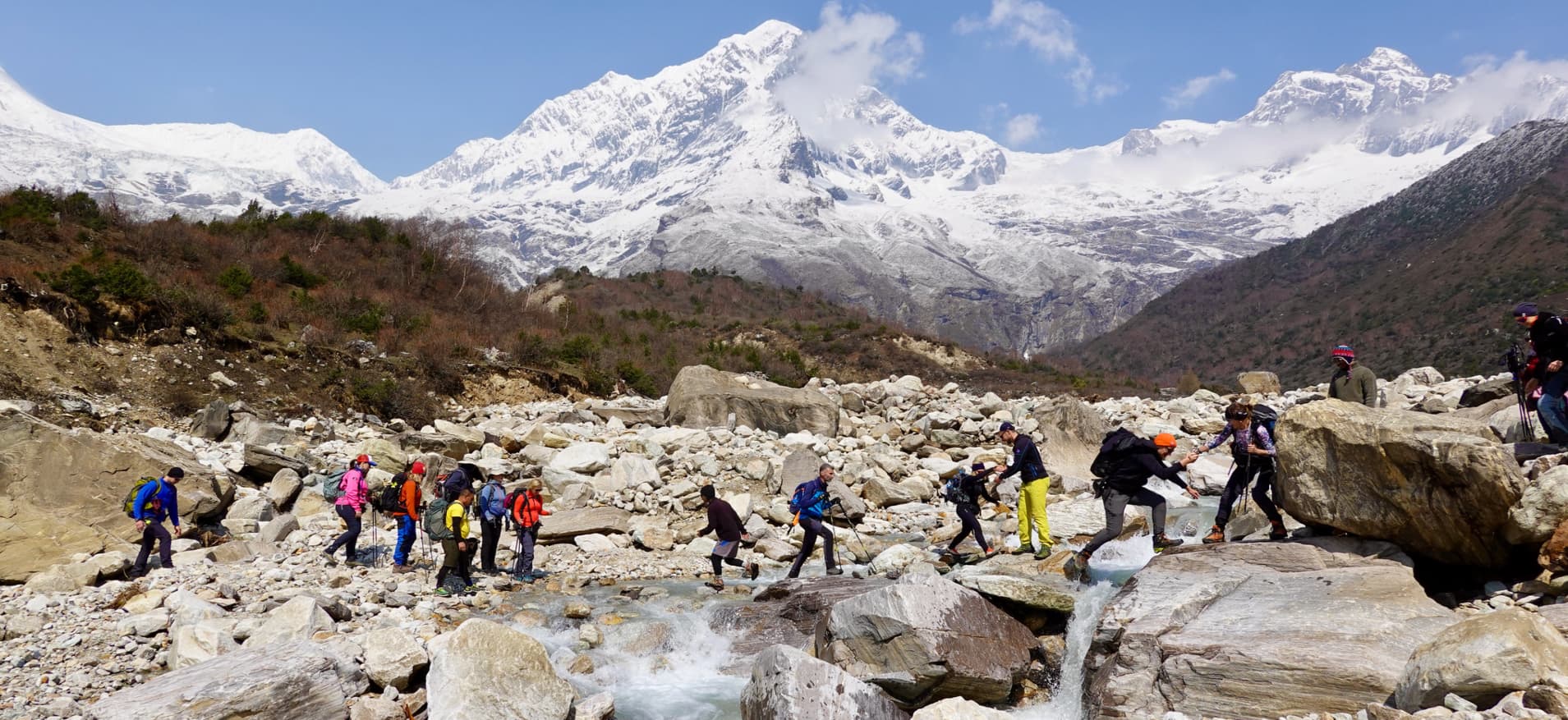
 

Why Trek with Us

Local Expertise That Cannot Be Replicated
Our company is a Kathmandu-based firm with decades of field experience, specifically in the Gorkha district and the Manaslu region. This is not a generalist agency that operates in every corner of Nepal; the Manaslu Circuit and the surrounding Gorkha highlands are the core of what we do. Several of our lead guides were born in the Budhi Gandaki valley or have family connections to the Nubri communities, which translates into something that cannot be found in a guidebook or replicated by an operator based elsewhere: genuine trust and recognition in the villages the trek passes through.
That trust produces practical benefits for our clients. When we arrange accommodation in Samagaon or Samdo, we are calling on relationships built over many seasons with specific teahouse families, not simply booking the first available room in a generic accommodation registry. When a client wants to visit the Ribung Gompa in Lho or the monastery above Samagaon, our guides can arrange introductions to the monks in residence rather than simply standing at the gate. These interactions, made possible by local connection, are often what trekkers remember most clearly when they look back on the experience.

Sustainable Tourism as Operational Practice
The environmental and social impact of trekking in the Manaslu Conservation Area is a real and ongoing concern that the agency takes seriously as a matter of operational policy rather than marketing language. Every member of our porter and guide staff is drawn from the communities along the route, receives a wage that meets or exceeds the standards set by the Trekking Agencies' Association of Nepal (TAAN), and is covered by comprehensive insurance covering altitude illness and accident. We do not use porters who are underequipped for the conditions, and our gear and clothing requirements for support staff are enforced regardless of the season.
The single-use plastic issue on Himalayan trails is well documented and we have taken a practical position on it. Every trekker on our Manaslu program receives a water filtration system and purification tablets at the start of the trek. This provision eliminates the need to purchase plastic-bottled water between Jagat and Dharapani, which over the course of 16 days removes between 30 and 50 plastic bottles from the waste stream of villages that have no municipal waste management infrastructure. We also work with the Manaslu Conservation Area Project's trail maintenance and waste reduction programs, contributing both staff time and a portion of our permit-related revenues to the project annually.

Safety Record and Risk Management
The Larkya La Pass crossing at 5,106 meters is the highest point on the Manaslu Circuit and the stage that carries the greatest risk of altitude-related illness. Our itinerary design, including the structured acclimatization day in Samagaon and the gradual elevation gain through the upper valley, reflects years of accumulated experience managing altitude risk for clients with widely varying fitness levels and acclimatization responses. Our guides monitor every trekker's oxygen saturation and subjective symptoms throughout the upper section of the route, and the decision to descend a client who is not acclimatizing safely is made without hesitation and without pressure from the client or the group.
Our satellite communication system means that in the event of a medical emergency beyond the reach of mobile networks, we can contact rescue services in Kathmandu directly. The evacuation protocols are established and practiced, and our relationship with the helicopter operators who service the Manaslu region means that when a rescue is required, the response time is as short as conditions allow. The requirement for comprehensive travel insurance covering helicopter rescue is enforced without exception: we will not accept a booking from a client who cannot confirm adequate coverage before departure.

Everything you need to know

Frequently Asked Questions About The Manaslu Circuit Trek

Who can Trek

Absolutely, the Manaslu Circuit Trek can be suitable for beginners as long as they possess an adequate level of fitness and mental preparedness for a multi-day trek at altitude. While it is more remote and demanding than some of Nepal’s more popular treks like Annapurna or Everest, beginners with good fitness levels, along with a sense of adventure, will be able to complete the trek without any issues. Beginner-Friendly Trekking company carefully designs the itinerary, enabling proper acclimatization and adequate rest. As a mandatory prerequisite, beginners need to participate in regular walking or hiking exercise or cardio weeks prior to the trek. The support and guidance of our experienced guides ensure that all first-time trekkers are comfortable and safe.

 Larkya La Pass (5,165m) is one of the higher elevations that can go extremely cold, often between the early morning hours when most trekkers set off on their journey. During hiking season, early spring has a temperature of -10°C to -5°C, while feeling a lot colder due to wind chill, and autumn season as well, starting from September to November. In the winter months, January and February, temperatures are known to drop lower than -15°C. One would need chilled weather to stay warm during crossing, and the best way is with thermal wear, gloves, and coats. Beginner-Friendly Trekking company
 makes certain that trekkers are well-informed and briefed about what awaits them at higher altitudes, so there are no risks with severe weather conditions.

The Manaslu Circuit Trek requires the participants to possess moderate to good fitness levels. Although straining as a professional athlete is not necessary, walking for about 5 to 7 hours a day on rough, steep, and uneven surfaces is a requirement. Participants should also expect long ascents, steep descents, and the physically demanding task of crossing the Larkya La Pass which is located at 5,165 meters. Pre-trek preparation is also essential and can be achieved by engaging in pre-trek customized hiking, jogging, cycling, and stair climbing for several weeks prior to the event. Apart from that, having the right attitude to suit the ever-changing trail conditions, weather conditions, and walking at a sluggish yet constant pace will provide both an enjoyable experience while achieving trekking goals.

Maintaining a high caloric intake is not optional on a trek at this altitude and duration. At elevations above 3,500 meters, the body's baseline metabolic rate increases as it works harder to oxygenate the blood, and the energy expenditure of 6-8 hours of uphill walking on top of that is substantial. The teahouses along the Manaslu route serve meals that are designed around this reality, with the staple Dal Bhat providing a combination of complex carbohydrates, protein, and micronutrients that is hard to improve on for sustained mountain activity.

Breakfast options at most teahouses include Tibetan bread, a fried flatbread that is a regional specialty of the Nubri culture, served with yak butter and honey; oat or tsampa barley porridge with hot milk; boiled, scrambled, or omelette eggs; and hot drinks including milk tea, black coffee, or hot chocolate. For lunch and dinner, Dal Bhat remains the most reliable and nutritious choice, with the unlimited-refill policy that most teahouses observe meaning you can consume as many calories as the exertion of the day demands. Alternatives include chow mein (fried noodles), thukpa (noodle soup), momos (steamed or fried dumplings), and basic pasta dishes. Above Samagaon, the range of available ingredients narrows as supply logistics become more difficult, and a flexible attitude toward the menu is recommended.

Our guides strongly recommend a predominantly vegetarian diet above 3,500 meters. Meat carried by porters at this altitude travels without refrigeration, and the risk of gastrointestinal illness from undercooked or poorly stored protein is real. Vegetable curries, lentil soup, eggs, and noodle dishes are all safe bets throughout the trek. Staying hydrated is equally important: a minimum of 3-4 liters of water per day is needed at altitude, and the provision of water purification tablets and a filtration system with every our company group eliminates the need to purchase plastic-bottled water on the trail.


Manaslu Circuit Trek Departures

Select Departure Date

Trip duration: 16 Days

May - Jun 2026

May 2026

Su
Mo
Tu
We
Th
Fr
Sa
1
2
3
4
5
6
7
8
9
10
11
12
13
14
15
16
17
18
19
20
21
22
23
24
25
26
27
28
29
30
31

June 2026

Su
Mo
Tu
We
Th
Fr
Sa
1
2
3
4
5
6
7
8
9
10
11
12
13
14
15
16
17
18
19
20
21
22
23
24
25
26
27
28
29
30
Your Trip
USD 1,415SAVE $20
USD 1,395/ person

Best Price Guaranteed

2-3 People
USD 1,395/ Person
4-7 People
USD 1,365/ Person
8-11 People
USD 1,355/ Person
12-15 People
USD 1,335/ Person
16-28 People
USD 1,315/ Person

Speak to an Expert

Laxmi Malla
Hari Kumar Shrestha
Himal Shrestha
Shiva Kumar Shrestha
UR Ghale

Himal Shrestha

Director 🇳🇵

Meet Our Expert Guides

Shiva Kumar Shrestha

Shiva Kumar Shrestha

Managing Director & Senior Guide

20 years of experience

I am an experienced and knowledgeable Senior Guide who has accompanied countless travelers throughout their time spent hiking in Nepal. Beginning my working life in 2004 as a porter, I am now a government-licensed trekking guide in Nepal with many years of experience. I was born and raised in the mountainous region of Dhading, and as a result, I have an in-depth understanding of the region's history, traditions, culture, and festivals. I have extensive experience trekking in the Everest, Annapurna, Langtang, Manaslu, and Dolpo regions.
Deepak Gurung

Deepak Gurung

Trekking Guide

12 years of experience

I have more than ten years of experience directing hikers across the high terrain of the Nepal Himalaya. I was born and grew up in the Gorkha highlands, which has given me profound awareness of the mountains and the way of life of the people who live in them. I have led numerous expeditions to Everest Base Camp and other locations in the Everest and Annapurna ranges. I received training from the Nepal Academy of Tourism and Hotel Management (NATHM) as a Trekking Guide. I am especially skilled at directing groups of senior citizens and families with children.
Ramsaran Shrestha

Ramsaran Shrestha

Senior Trekking Guide

19 years of experience

Anyone who spends some time with me will eventually recognize me for the respectful and knowledgeable gentleman that I am. I started working as a hiking guide at the end of the nineties. Since 2004, I have been one of Nepal's Best Trekking Company's employees, and I currently have a position as one of the company's senior trekking guides. I am one of the most experienced, competent, and professional trekking guides, and I speak English fluently. I have traveled with trekking groups on an uncountable number of Nepal's trails.
Meena Karki

Meena Karki

Trekking Guide

13 years of experience

I am from the Kaski district in the Annapurna region of Nepal. Trekking has been my passion since childhood as I grew up seeing trekkers and hikers stepping up the trails for trekking adventures. Following my dreams, I took female trekking guide as my profession and now I have more than a decade of experience in this field. I have been to Everest, Annapurna, Langtang, Mustang and most of the trekking regions numerous times. With in-depth knowledge of routes, culture, and history, I ensure your trekking adventure is extra special.
Prakash Gurung

Prakash Gurung

Trekking Guide

8 years of experience

I am a young and enthusiastic guide with enough knowledge in guiding the Himalayas. Having sound experience in the trekking sector, I bring rich experience and readiness to assist trekkers with professionalism and dedication. I respect not only my own culture but also those of other communities. My unwavering commitment has been an enormous boon to the organization's ability to function smoothly. I recently received my license from the Ministry of Tourism Hotel Management tourist training center and have a certificate for providing first aid at high altitudes.
Ram Hari Dhamala

Ram Hari Dhamala

Trekking Guide

11 years of experience

I am a field member of Nepal's best trekking company with more than a decade of experience working in the field of travel and tourism. I am certified as a trekking guide and was brought up among the wondrous sights and sounds of Mother Nature in the picturesque town of Dhading. The rolling landscape complete with mountains, valleys, and rivers has always piqued my interest. Because of my deep love for the outdoors, I decided to pursue a career in tourism. My disposition is cordial and upbeat, and I am responsible and experienced.

Similar Packages

Now Offering 100% Private Treks

Explore Nepal's breathtaking trails at your own pace with our exclusive private treks. No strangers, no rushed schedules—just you, your adventure, and complete flexibility. Enjoy personalized itineraries, expert guides, and a safety-first approach designed for unforgettable experiences.

Tailor-Made Itineraries

Plan your trek exactly how you want it. Choose destinations, duration, and activities that suit you.

Dedicated Guide & Porter

Enjoy expert guidance and personal assistance every step of the way.

Safety & Health Focus

We ensure proper acclimatization, medical support, and emergency readiness.

Flexible Scheduling

Pick your own travel dates and move at a pace that suits your adventure style.

Privacy & Comfort

Ideal for couples, families, and friends who want a fully private experience.