No cancellation fees. No hassle. Book Now, Cancellation Terms
Trekking RegionsTrekking Routes+13
19 min readMustang Region Nepal: The Last Forbidden Kingdom
May 11, 2026
19 min
560 views
About Mustang Region
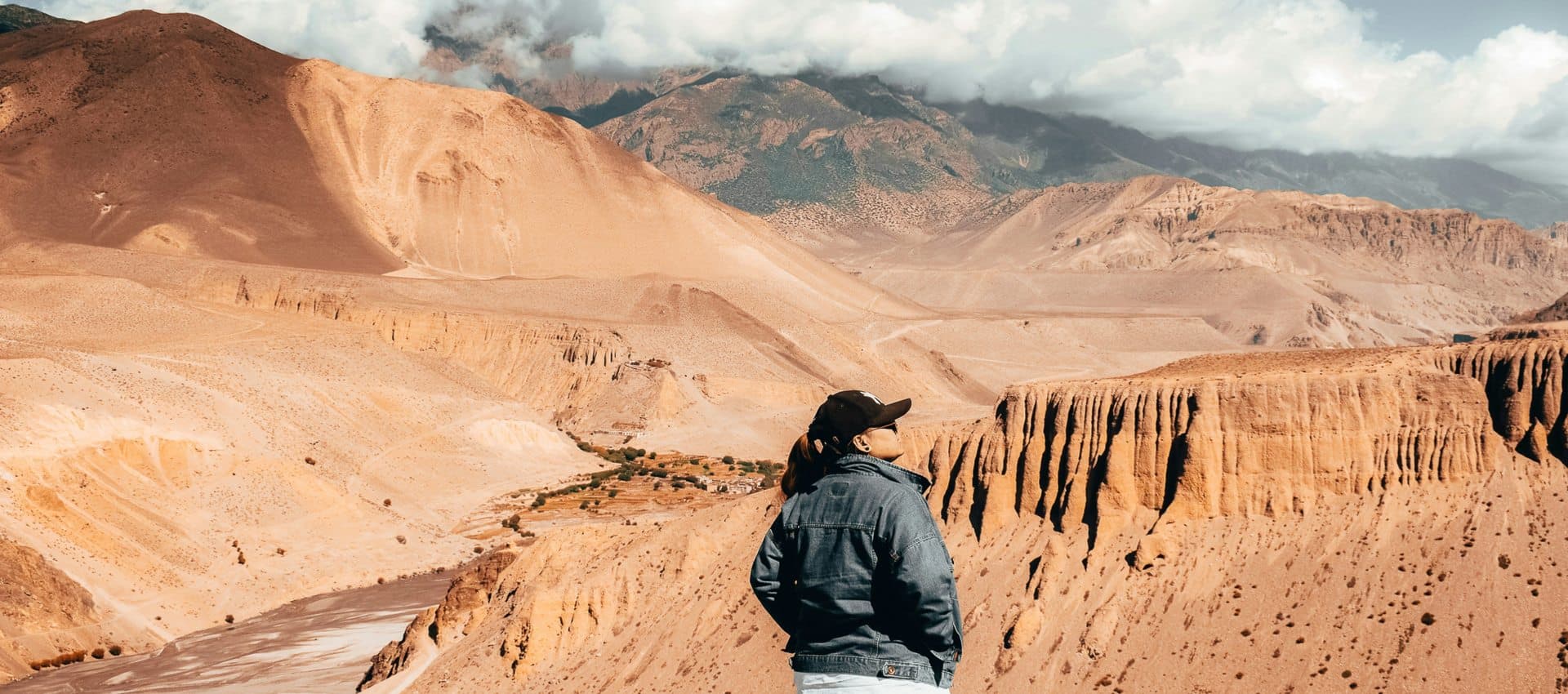
There is a moment, somewhere between Kagbeni and Lo Manthang, when the landscape stops feeling like Nepal. The green terraced hillsides have long since vanished behind you. The air is thinner, drier, and carries a dusty warmth that surprises first-time visitors. Ahead, the earth turns shades of ochre, rust, and deep burgundy, ancient sediment carved into cliffs that look like they belong on another planet. Prayer flags snap and flutter in the relentless wind. A line of yaks moves slowly across a plateau. Somewhere in the distance, the white smear of a monastery clings to a cliffside. You are in Mustang, and you will not forget it.
This remote district sits in north-central Nepal, wedged between the soaring peaks of the Annapurna and Dhaulagiri massifs to the south and the vast Tibetan Plateau to the north. Politically, it belongs to Nepal. Culturally and historically, it has always leaned toward Tibet, in its architecture, its people, its language, and its spiritual life. The Kali Gandaki River, one of the deepest gorges on earth, cuts right through the region, forming a dramatic corridor between two of the world's highest mountain ranges.
Mustang divides naturally into two zones. Lower Mustang, which includes the popular trekking gateway of Jomsom and the medieval village of Kagbeni, is relatively accessible and sees a steady stream of trekkers and pilgrims heading toward the sacred Hindu temple of Muktinath. Upper Mustang, on the other hand, is a different story entirely. For decades after Nepal opened to foreign visitors, the former kingdom of Lo remained firmly closed. It was not until 1992 that the Nepalese government allowed limited access, and even then, only with strict permit conditions and controlled visitor numbers. That exclusivity has preserved something extraordinary: a living culture that has changed far less in the last five centuries than almost anywhere else in the Himalayan world.
The landscapes here are raw and theatrical. Wind-sculpted canyons, ancient cave complexes carved into cliff faces, whitewashed villages with flat-roofed mud-brick houses, walled medieval towns, gompas (Buddhist monasteries) draped in crimson and gold. Mustang is genuinely unlike anything most travelers have ever seen. And yet, in recent years, a paved road from Jomsom reaching toward Lo Manthang has begun to change the character of the region faster than many locals or conservationists are comfortable with.
If you have been thinking about going, the time is now. We offer dedicated Mustang treks, from the accessible Lower Mustang circuit to the full Upper Mustang trek to Lo Manthang, complete with permit assistance, experienced local guides, and itineraries crafted to show you the very best of this irreplaceable corner of the world.
History
The Kingdom of Lo, the ancient name for Upper Mustang, was founded in the 14th century by a Tibetan warrior-chieftain named Ame Pal. He consolidated power over the region and established Lo Manthang as his walled capital, a city that still stands today, and still has a king, at least in title. For centuries, Mustang thrived as a trading hub sitting directly on the salt route between Tibet and the lower Himalayan valleys. Salt, grain, wool, and other goods moved through its narrow mountain corridors, and the kingdom accumulated both wealth and cultural sophistication.
Artistically and spiritually, Mustang reached its zenith between the 14th and 17th centuries. The monasteries and cave temples built during this era contain some of the finest Buddhist murals in existence, artworks comparable to what you might find in Tibet itself, but far less affected by the cultural destruction of the 20th century. When China occupied Tibet and later unleashed the Cultural Revolution, countless monasteries across the plateau were ransacked or destroyed. Mustang, tucked behind its mountain walls and under Nepalese sovereignty, was largely spared.
The 20th century brought its own complications. For a period during the 1960s and early 1970s, Mustang became a base of operations for Tibetan resistance fighters backed by the CIA, a chapter of Cold War history that is still only partially understood. After Nepal ended the resistance program under Chinese diplomatic pressure in 1974, Mustang settled back into its quiet remoteness.
Then came tourism. The 1992 decision to open Upper Mustang came with a steep price tag: the restricted area permit cost $700 for the first ten days (it has since been revised but remains one of Nepal's most expensive trekking permits). The government justified the cost as a conservation measure, limiting visitor numbers while generating revenue for local communities. It worked, more or less. Mustang retained its character in ways that more heavily trafficked trekking regions did not.
The road, though, is another matter. Completed in stages over the past decade, the rough jeep track from Jomsom to Lo Manthang has made the region accessible to motor vehicles for the first time in history. On one hand, this has brought medicine, goods, and economic options to communities that previously relied entirely on horses and their own feet. On the other hand, it has brought dust, noise, and a shift in the social fabric that many in Mustang are still processing. Trekking here while the trails still retain their soul is, genuinely, something to prioritize.
Habitat and Points of Interest
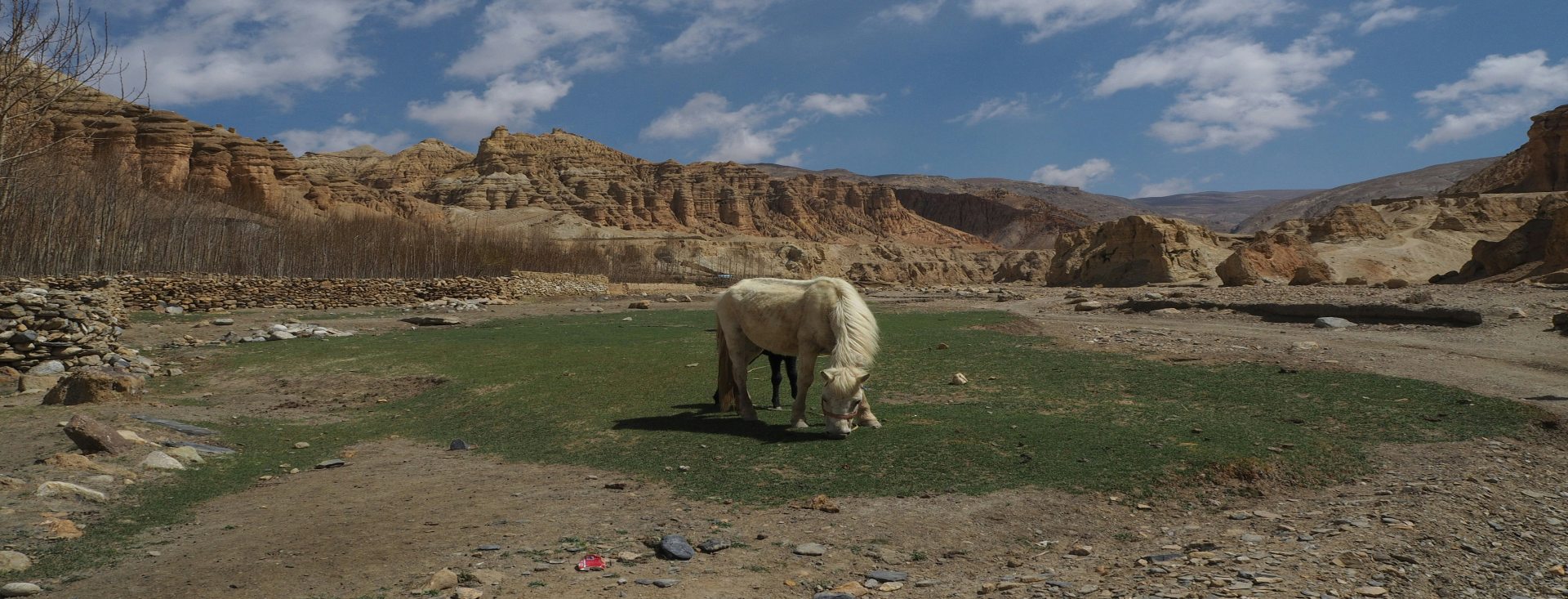
Mustang sits in a high-altitude rain shadow, shielded from the monsoon by the Annapurna and Dhaulagiri ranges. This makes it one of the driest places in Nepal, with a landscape more akin to the Tibetan Plateau than the lush middle hills. The Kali Gandaki Valley runs like a spine through the entire region, and the villages, monasteries, and points of interest cluster along and above this ancient river corridor.
Geographically, you can think of Mustang in three rough tiers. The southern gateway zone around Jomsom and Kagbeni sits at roughly 2,700–2,900 meters. The middle reaches, including towns like Chele, Syangboche, and Ghiling, climb to around 3,500–4,000 meters. And the high northern plateau around Lo Manthang and the Tibetan border sits above 3,800 meters, with surrounding passes and viewpoints reaching much higher.

The People
The people of Mustang are known as the Loba (sometimes spelled Lo-pa or Lhopa), though this general term covers several sub-groups with slightly different dialects and customs depending on their village. Their language is a dialect of Tibetan, and their culture, from dress to religion to architecture, is almost entirely Tibetan Buddhist in character.
Life here has traditionally revolved around farming (barley, buckwheat, mustard), animal husbandry, and trade. The harsh conditions have always demanded cooperation, and Mustangi communities have a strong tradition of collective labor and mutual support. Women often manage households and businesses while men are away on trade or herding routes. Polyandry (one woman married to multiple brothers) was historically common as a strategy to keep family land undivided, though it is rarer today among younger generations.
The hospitality in Mustang is genuinely warming. Tea-house owners in Lo Manthang will invite you in from the cold with butter tea and dried yak cheese before you have even asked for anything. The warmth is real, not performed for tourists. These communities have been receiving travelers, pilgrims, traders, wanderers of various kinds, for centuries. They are comfortable with outsiders in a way that feels natural rather than commercial.
In recent years, some families have diversified into tourism-related income, running guesthouses and teahouses, working as guides and horse handlers, or selling handicrafts. The balance between economic development and cultural preservation is a live and sometimes tense conversation in Mustang today.
Lo Manthang
The walled city of Lo Manthang is the beating heart of Upper Mustang. Walking through its single entrance gate for the first time is an experience that is hard to describe without reaching for cliches, so we will just say this: it looks like a medieval city that was never demolished. Because it wasn't. The whitewashed walls encircle a compact warren of mud-brick houses, narrow lanes, chortens (Buddhist stupas), and courtyards. The Royal Palace, a multi-story structure that has been home to the kings of Lo for over 600 years, dominates the skyline.
The city has four major monasteries: Thubchen Gompa, Jampa Gompa, Chodey Gompa, and Chyodi Gompa. Thubchen and Jampa, both dating to the 14th and 15th centuries, are UNESCO-supported restoration projects containing extraordinary wall murals. The colors are still vivid, even after centuries, deep reds, lapis blues, earthy golds. The restoration work done here, often by local craftspeople trained in traditional techniques, is one of the quiet success stories of Himalayan heritage conservation.
The current king, Jigme Dorje Palbar Bista, no longer holds official political power (Nepal abolished its monarchy in 2008, and the Lo kingdom followed in 2008 as well, at least officially), but he is still deeply respected as a cultural and spiritual figurehead. If you visit during festivals, you may well see him presiding over ceremonies in full traditional dress. It is a glimpse into a world that feels genuinely ancient.
Muktinath Temple
Technically in Lower Mustang, just above the town of Ranipauwa, the Muktinath temple complex is one of the most sacred sites in all of Nepal. It draws both Hindu pilgrims and Buddhist devotees, which tells you something about how spiritual traditions in this part of the world have always coexisted and overlapped. For Hindus, Muktinath is one of the 108 Divya Desams (sacred Vishnu temples) in the world. For Tibetan Buddhists, it is a significant Dakini site associated with liberation.
The main temple complex sits at 3,710 meters and includes a pagoda-style shrine, 108 water spouts from which pilgrims bathe (this is, as you might imagine, a bracing experience given the altitude and temperature), a sacred flame fed by natural gas seeping through the rock, and a series of smaller shrines and monasteries. The blend of Hindu and Buddhist iconography is fascinating and, for many visitors, genuinely moving. People come here from all over South Asia, some on foot after weeks of walking. The devotion on display is something you do not encounter at tourist attractions.
Tilicho Lake
On the edge of Mustang's southern boundaries, accessible via a route from the Annapurna Circuit, Tilicho Lake sits at 4,919 meters above sea level, making it one of the highest lakes in the world. It is a stunning, glassy, turquoise body of water ringed by snow peaks and, for much of the year, partially frozen. The hike to Tilicho is demanding and requires acclimatization, but the views from the lake shore, particularly of the Annapurna massif reflected in the water on a calm morning, are the sort that stay with you for years.
We include Tilicho Lake as an optional extension on several of our Mustang and Annapurna itineraries. It is not to be rushed.
Luri Gompa and the Cave Temples
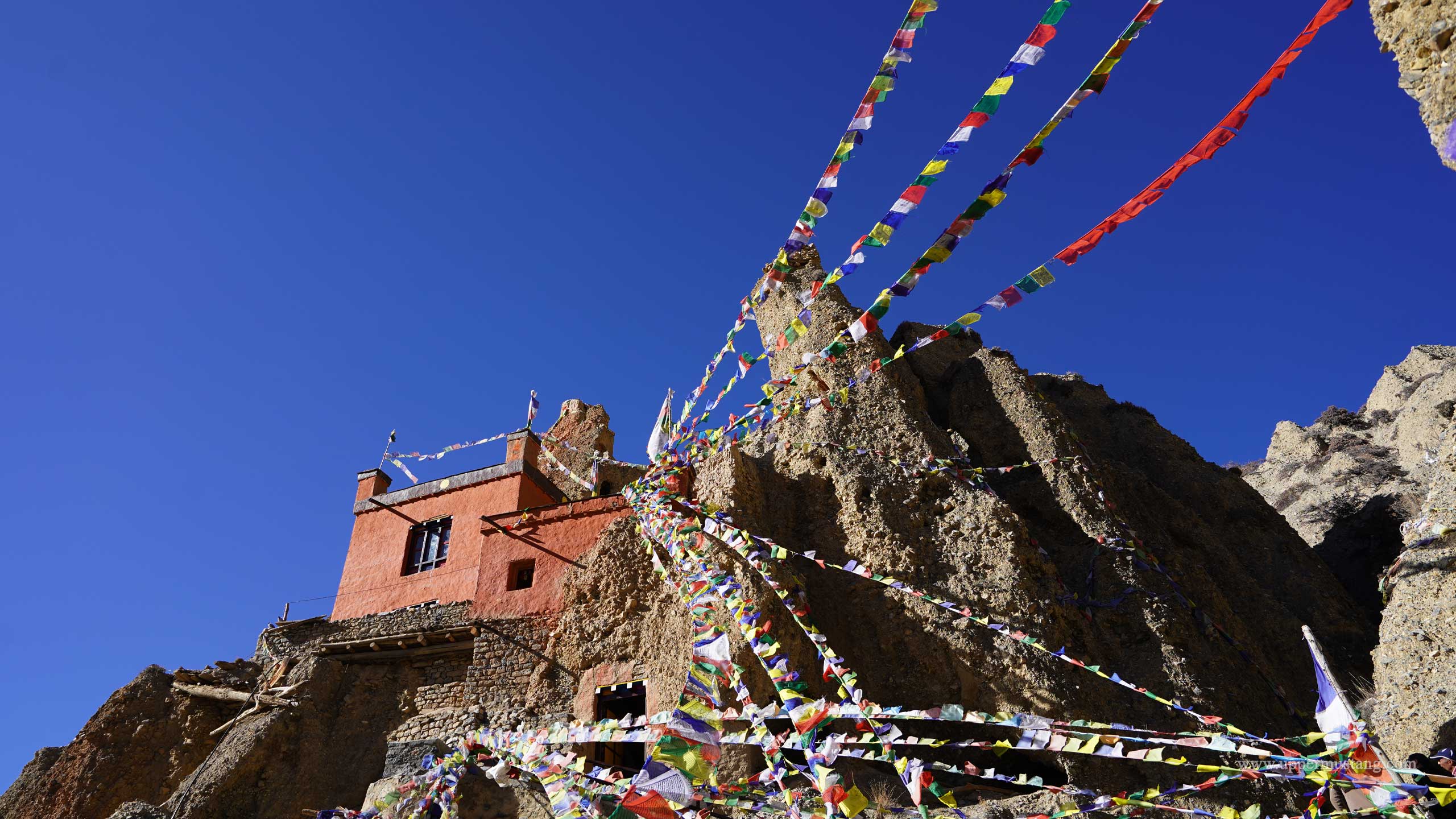
One of the lesser-visited but most extraordinary sites in Upper Mustang is Luri Gompa, a cave monastery built into the face of a cliff above the Narshing Valley. The cave itself is small, the access trail tricky, and the approach takes you through some of the most surreal landscape in the region. But inside, you will find 14th-century murals in near-perfect condition. There are also thousands of smaller cave openings throughout Mustang's cliff faces, ancient dwellings, meditation retreats, and burial sites dating back 2,000 to 3,000 years. Archaeologists are still piecing together the full story of who lived in them and why.
The caves give Mustang an almost otherworldly quality, as if the cliffs themselves are full of secrets. And they are.
Jomsom: Gateway to the North
Most Upper Mustang treks begin in Jomsom, the regional headquarters of Mustang district. It is a small, functional town straddling the Kali Gandaki River at 2,720 meters, with a domestic airport that connects it to Pokhara (on days when the notorious afternoon winds allow flights to operate). The town has decent guesthouses, a few restaurants, ATMs, and the Mustang Eco Museum, which is worth an hour of your time for the context it provides on local culture and geology.
From Jomsom, the route north passes through Kagbeni, a beautifully atmospheric village with a landmark red-painted monastery, before entering the restricted area of Upper Mustang proper. You will need your restricted area permit checked at Kagbeni before proceeding. We handle all permit arrangements as part of our Upper Mustang packages, so you can focus on the walk.
Biodiversity and Landscape
Mustang's position in a deep rain shadow creates conditions quite unlike the rest of Nepal. Annual rainfall in Lo Manthang is less than 300mm, comparable to some of the drier parts of central Asia. The vegetation in Upper Mustang is sparse and largely low-growing: thorny shrubs, drought-adapted grasses, and the occasional wild rose. Willows and poplars cluster around villages where there is reliable water. Buckwheat fields add brief splashes of pink and white in late summer.
Lower Mustang, particularly around Jomsom and the Thak Khola valley, is lusher. Apple orchards are a significant local industry, and the apple products (juice, brandy, dried fruit) from this area are famous throughout Nepal.
The wildlife, while not abundant, is genuinely special. Snow leopards inhabit the higher terrain and are occasionally spotted on dawn treks, though patience and luck are both required. Blue sheep (bharal) are more reliably seen, moving in herds across steep rocky terrain. Himalayan wolves, Tibetan foxes, and pikas are also present. Birdwatchers will find lammergeiers (bearded vultures) riding the thermals above the canyon walls, along with chukar partridges, red-billed choughs, and a variety of raptors.
The geological spectacle might be the most dramatic element of all. The layered sedimentary cliffs of Upper Mustang record millions of years of geological history in their stripes of red, purple, yellow, and grey. The entire region was once the floor of an ancient sea. The Kali Gandaki Gorge, cutting between Annapurna (8,091m) and Dhaulagiri (8,167m), is one of the deepest gorges on the planet. Standing at the valley bottom and looking up at those peaks is a vertigo-inducing exercise in scale.
Best Time to Visit
Mustang's weather patterns are fundamentally different from the rest of Nepal, and this is one of its great advantages for trekkers.
Spring (March to May) is arguably the finest time to visit. Temperatures are climbing, the air is clear, wildflowers appear around the lower villages, and the entire region feels like it is coming back to life after winter. Days are warm and pleasant at altitude, though nights remain cold. April is peak season for the famous Tiji Festival in Lo Manthang, a three-day masked dance ceremony celebrating the mythological defeat of a demon threatening the kingdom. If you can time your visit for Tiji, do it.
Monsoon (June to August) is where Mustang really distinguishes itself. While the rest of Nepal is drenched and many trekking routes become slippery or disrupted, Mustang sits in its rain shadow and stays relatively dry. Summer is actually a legitimate trekking season here, the temperatures are comfortable, the trails are quieter, and the valleys turn a surprising green. Some years bring more cloud and occasional rain than others, but in general, Mustang in summer is a hidden gem for trekkers avoiding the monsoon.
Autumn (September to November) brings crisp, clear air, excellent mountain visibility, and cooling temperatures. This is the second major trekking season, and Lo Manthang is at its most visually striking with the harvest underway. Barley fields glow golden before the cut, and the quality of light is exceptional for photography.
Winter (December to February) is cold and quiet. Temperatures at Lo Manthang can drop well below freezing at night, and some teahouses close. High passes on side routes may be snowbound. That said, the low visitor numbers and the stark beauty of the snow-dusted landscape appeal to a certain kind of traveler who doesn't mind packing an extra layer or three.
For most visitors, we recommend spring or autumn as the sweet spots, with late spring or early summer a fine choice if you want to combine the Tiji Festival with good trekking conditions. Check our Best Time to Visit Nepal page for a broader seasonal overview of the country.

Culture and People
Buddhism in Mustang is not a background feature. It is the architecture, the daily schedule, the social structure, the art, and the moral framework through which most Mustangi people understand their lives. Prayer wheels are built into village walls so that passing residents can spin them as they walk by. Mani stones (flat rocks carved with Buddhist mantras, primarily "Om Mani Padme Hum") line the trails. Every village has at least one gompa, and many have several. Monks and nuns are a visible and respected part of community life.
The annual cycle of festivals connects spiritual observance with agricultural rhythms in ways that reflect centuries of adaptation to a demanding environment. Tiji in Lo Manthang (May) is the largest and most photographed. Yartung, a horse festival held in various villages in August, is another favorite with visitors, full of riding competitions, music, and celebration. Local lo-rgyus (traditional songs) and dance performances at festivals are genuinely joyful occasions, and if you are lucky enough to be invited to observe or participate, accept without hesitation.
The physical fabric of Mustangi villages is distinctive and beautiful. Houses are multi-story mud-brick constructions, whitewashed and flat-roofed, with small windows to conserve heat. Rooftop juniper branches are burned as incense during religious observances. Chortens and prayer poles mark the entrances to most villages, and the layout of Lo Manthang's walled city follows cosmological principles laid down by its 14th-century founders.
Language is a living link to Tibet. The Loba dialect, while distinct from standard Tibetan, is mutually intelligible with it, and older residents often also speak a smattering of Nepali. Among younger people who have attended school in Jomsom or Pokhara, Nepali and sometimes English are increasingly common. This linguistic shift is one of the subtler but significant ways the region is changing.

Things to Do
Upper Mustang Trek (The Classic) The full Upper Mustang trek runs approximately 12–17 days depending on your itinerary and pace, covering roughly 170–200 km of trail from Jomsom to Lo Manthang and back (or one-way with a jeep return). The restricted area permit is required ($500 USD per person for 10 days, with additional fees for each extra day). We manage all permit paperwork and logistics, provide experienced local guides, and offer both teahouse and camping versions of the route.
Lower Mustang and Muktinath Trek A more accessible option running 5–7 days, covering the Kali Gandaki Valley between Jomsom and Muktinath. No restricted area permit required. Great for first-time Nepal trekkers or those with limited time who want a genuine taste of the region.
Tiji Festival Trekking Package We offer a specialized Upper Mustang trek timed to arrive in Lo Manthang for the three-day Tiji Festival in late April or May. Accommodation must be booked well in advance for this period. One of the most remarkable cultural experiences in all of Nepal.
Horseback Trekking Much of the historical travel through Mustang was done on horseback, and you can still do it this way. We arrange horse-supported or horse-riding treks through Upper Mustang for those who want a different pace or have limited trekking capacity.
Mountain Biking The dirt roads and tracks of Lower Mustang offer some memorable mountain biking, particularly the descent from Muktinath toward Jomsom along the Kali Gandaki. We can arrange bike hire and guided cycling day trips from Jomsom.
Cultural Immersion and Monastery Visits Any of our Mustang treks include planned visits to key gompas, but we also offer slower, more deliberately cultural itineraries that spend extra time in Lo Manthang's monasteries, arrange meetings with local monks, or include homestay nights in villages away from the main teahouse circuit.
Photography Expeditions The light in Mustang, particularly in the golden hours, is extraordinary. The combination of dramatic geology, ancient architecture, and vivid cultural life makes it one of Nepal's finest destinations for serious photography. We can tailor itineraries around optimal light and timing for specific subjects.
Mustang is not going to wait forever. The road will continue to bring change. The younger generation will continue to make different choices than their parents. The political and economic pressures on remote Himalayan communities are real and not going anywhere. What exists right now in Lo Manthang, in Luri Gompa, in the windswept lanes of Kagbeni, is precious and finite.
We have been bringing travelers to Mustang for years, and our connection to the region runs deep. Our guides are local, our approach is respectful, and our itineraries are built around genuine experience rather than just putting kilometers under your boots. When you walk through the gate of Lo Manthang's ancient walls with us, you will understand why people come back to this place again and again.
Get in touch with us to start planning your Mustang journey. Whether you have ten days or twenty, whether you want to trek hard or take it slow, whether you are drawn by the culture, the landscapes, the festivals, or simply the feeling of standing somewhere genuinely remote and rare, we will build you a trip that delivers it. Mustang is waiting. And it is worth every step.
About Accessible Adventure
Bringing unforgettable Himalayan adventures to everyone. Our expert guides and carefully curated experiences ensure that everyone can explore the beauty of Nepal, Tibet, and Bhutan.
Learn More