Standing at 6,476 meters on Mera Peak's summit, five of the world's fourteen eight-thousanders fill the horizon in a single, sweeping view; Everest, Lhotse, Makalu, Cho Oyu, and Kanchenjunga stand together in a panorama that asks you to turn your head left to right, just to register the full scale of what surrounds you. This is not the kind of view you reach by cable car or scenic road. You walked and climbed every meter of it across roughly two weeks in one of Nepal's quieter, more remote mountain valleys.
Mera Peak is the highest officially designated trekking peak in Nepal. It sits on the Nepal Mountaineering Association's Group A list at a marketed altitude of 6,476 meters. It occupies the Hinku Valley, east of the main Everest trekking corridor. Its approach is quieter and considerably less trafficked than the trails that initially fan out from Namche Bazaar. The peak has three distinct summits: Mera North at 6,476 meters is the true high point; Mera Central at 6,461 meters is the most commonly climbed on guided expeditions; and Mera South at 6,065 meters is the lowest. Most operators target Mera North or Mera Central depending on conditions and team ability.
This guide covers every practical dimension of planning a Mera Peak expedition: the actual route and what the trail looks like day to day, what the climb genuinely costs, every permit required, how to prepare physically, what to bring, and what summit day is honestly like. Whether you are researching this peak for the first time or finalising dates for an upcoming departure, what follows is the information needed to arrive prepared, realistic, and ready.
Mera Peak sits within the Solukhumbu district of northeastern Nepal, close enough to the Everest massif to share the same sub-range but far enough from the main trekking corridor to feel genuinely distinct. The mountain belongs to the Mahalangur Himalaya, which is the same sub-range that contains Everest, Lhotse, and Makalu. Its snowy ridge is visible for much of the Hinku Valley approach, growing steadily larger as the days pass.
The first recorded ascent of Mera Central took place on May 20, 1953, by Colonel Jimmy Roberts and the Sherpa climber Sen Tenzing. This was just days before Hillary and Norgay made history on Everest to the northwest. Roberts had been part of the British support expedition before turning his attention to the then-uncharted Hinku Valley. That historical coincidence captures something true about Mera: the mountain sits quietly in the orbit of the world's most famous summit, offering something the bigger peaks cannot, which is a high-altitude, genuinely achievable climb at an impressive elevation.
Mera North, at 6,476 meters, is the true summit and the one that gives the peak its marketed altitude. Mera Central, at 6,461 meters, sits slightly lower and is the target on most guided itineraries because its approach from the standard glacier route is well-established and consistently reliable. Mera South, at 6,065 meters, sees fewer climbers and is typically combined only with specialist or extended itineraries. The standard climbing permit issued by the Nepal Mountaineering Association covers all three summits under the same peak designation.
The most compelling argument for climbing Mera Peak rather than a lower, simpler objective comes down to the summit view and what it delivers at a genuinely accessible altitude. There are hundreds of viewpoints in Nepal with mountain panoramas, but standing at 6,476 meters with Everest, Lhotse, Makalu, Cho Oyu, and Kanchenjunga all visible at once is an experience with a different quality. The scale of the view is physically humbling in a way that photographs fail to reproduce.
Beyond the summit view, the Hinku Valley approach gives the expedition a character that the busier Khumbu trails do not offer. The main Everest Base Camp corridor handles many thousands of trekkers during peak season. The trail south from Lukla through the Zatrwa La and into the Hinku Valley sees only a small fraction of that number. Villages like Kothe and Thangnag are genuine, quiet Sherpa settlements rather than teahouse towns built around tourist traffic. The solitude and pace of the approach are a meaningful part of what makes the expedition feel different from a more crowded objective.
The non-technical character of the standard route is also a real advantage. Mera does not require lead climbing, complex ropework, or multi-pitch glacier navigation. The core skills needed, crampon use, roped glacier walking, and ice axe handling, can be taught on the mountain with a competent guide. This positions Mera Peak at a genuinely accessible point on the mountaineering spectrum without reducing it to a simple walk. The PD grade on the Alpine scale means the easiest technical category above straight trail walking, but that technical grade does not capture the physical and physiological demands of spending time at altitude above 5,800 meters.
The standard Mera Peak climbing route runs through the Hinku Valley, accessed via Lukla. A well-designed itinerary runs sixteen to eighteen days from Kathmandu to Kathmandu, and the route unfolds in four distinct phases.
The journey starts with a 30-minute mountain flight from Kathmandu, or in peak season from Manthali/Ramechhap airport, to Lukla at 2,800 meters. Lukla is the Tenzing-Hillary Airport, famous for a runway that ends at a steep drop. The flight is short, spectacular, and weather-dependent. Delays at both ends are common enough that building buffer days into the overall schedule is standard practice among experienced operators.
From Lukla, the trail turns south rather than north. The first two trekking days gain altitude through forest to Chutanga at roughly 3,475 meters, then climb to the Zatrwa La pass at 4,600 meters. This pass is the physical and symbolic gateway from the main Khumbu valley into the Hinku. The ascent is steep and can carry snow in any season. The descent drops to Thuli Kharka at around 4,300 meters, where the Hinku Valley spreads out below. From the pass, on a clear day, the distant summit profile of Mera is visible for the first time.
The next section follows the Hinku Valley northward over four to five days, passing through Kothe at 4,182 meters and Thangnag at 4,356 meters before reaching Khare at 5,000 meters. The valley is genuine wilderness. The vegetation thins progressively, the river carries visible glacial sediment by Thangnag, and the upper valley walls close in as the altitude increases. Khare is the final teahouse settlement on the route and the base from which the technical climbing section begins. A full acclimatization day here includes glacier orientation and basic crampon training.
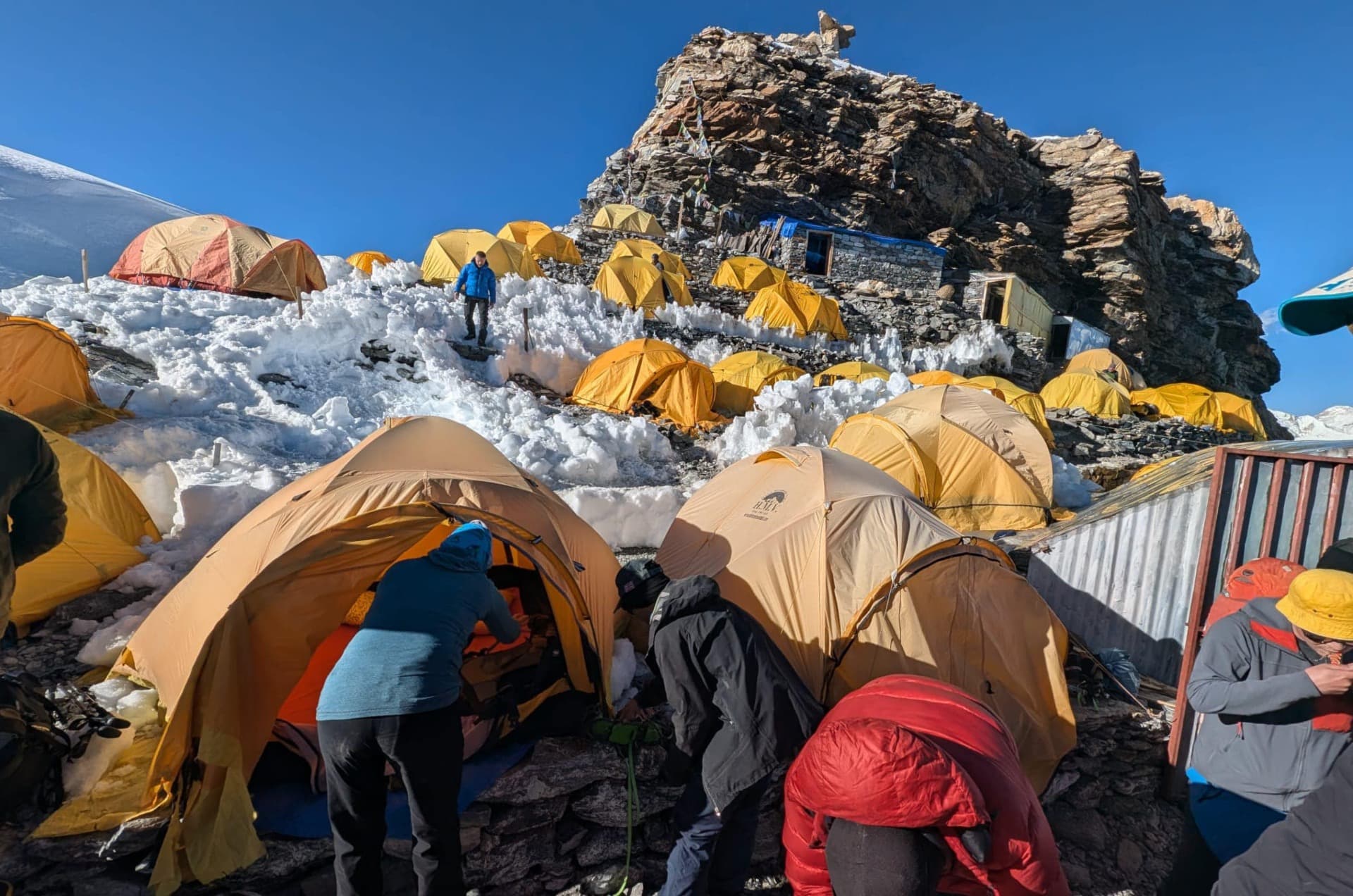
From Khare, the route ascends to Mera Peak Base Camp at approximately 5,360 meters and then to High Camp at around 5,800 meters. High Camp is established on exposed terrain near the glacier and is a tented camping setup. Summit day begins between 2 and 4 AM with a pre-dawn departure across the Mera Glacier. The climb from High Camp to the summit gains approximately 700 meters over four to eight hours, following a broad snow slope with fixed ropes on steeper or more exposed sections. The technical grade is PD (Peu Difficile), the lowest technical category. The descent on summit day continues all the way back to Khare, making it a twelve to fourteen-hour commitment from start to finish.
The climbing calendar on Mera follows Nepal's two main trekking windows, with meaningful differences in cost, conditions, and competition for summit slots.
Spring is the most popular season for Mera Peak, and April is the strongest single month. Weather patterns stabilize across the Himalaya through March and reach a consistent, predictable rhythm by April, when daytime temperatures at lower altitudes hover between 10 and 15 degrees Celsius and the upper mountain snow is consolidated and firm underfoot. The rhododendron forests in the lower approach valleys bloom through April, making the early trekking days genuinely beautiful. Spring NMA permits cost USD 250 per person at current rates (revised September 2025). The primary trade-off is cost: spring is the most expensive season for both permits and package prices.
Autumn is the second major window and arguably the best for summit views. The monsoon that runs through the summer months scrubs the atmosphere clean, and October in particular delivers some of the clearest air of the year over the Himalaya. Long-range visibility from the summit is at its best in October and early November. Night temperatures at High Camp drop to minus 15 degrees Celsius or colder, requiring a more serious sleeping bag than spring, but daytime conditions are excellent. Autumn NMA permits cost USD 125 per person, making the season significantly cheaper than spring. October is also the busiest month on Nepal's trekking trails generally, so the Lukla approach sees more traffic than in other seasons.
Summer climbing exists and comes with the cheapest permit rate, currently USD 79 per person. The trade-off is the monsoon, which brings heavy rainfall to the approach sections from Lukla to the Zatrwa La, makes the pass crossing slippery and potentially hazardous, and creates persistent mist that frequently obscures the summit view. A small number of experienced operators run monsoon departures for those seeking solitude and lower costs, but this season requires a higher tolerance for wet conditions and limited visibility. It is not recommended for first-time high-altitude climbers.
Winter is generally not recommended. Temperatures at High Camp regularly fall below minus 20 degrees Celsius with wind chill, the Zatrwa La accumulates serious snow and ice that creates a dangerous crossing, and the logistical demands of supporting a climbing team in the Hinku Valley through the coldest months are considerable. Permit costs are USD 79 per person, but the overall expedition cost does not drop proportionally because of increased equipment and staffing requirements. A small number of specialist operators run winter expeditions, but they are not appropriate for climbers without significant prior cold-weather mountaineering experience.
Total expedition cost is one of the most searched topics around Mera Peak, and it is also the area where the most confusion arises. Package prices quoted online range from under USD 2,000 to over USD 4,000 for what looks like the same trip. Understanding what drives those differences is essential for making a good decision.
Three permits apply to the standard Hinku Valley route. The NMA climbing permit is the most significant: USD 250 per person in spring, USD 125 in autumn, and USD 79 in winter or summer (rates effective September 1, 2025). The Makalu Barun National Park entry fee costs approximately USD 30 per person for foreign nationals. The Khumbu Pasang Lhamu Rural Municipality permit adds approximately USD 20 per person. Total permit costs range from around USD 175 in off-season to approximately USD 300 in spring.
The Kathmandu to Lukla flight costs approximately USD 190 to 220 per person each way. In peak season, many airlines divert Lukla-bound flights to Manthali/Ramechhap airport, adding a 2.5-hour road journey before boarding. Flights are weather-dependent and delays are common, which is why building buffer days into the schedule is standard practice. A single delayed return flight can add USD 100 to 200 in unplanned hotel and meals costs.
A licensed trekking guide costs approximately USD 30 to 50 per day. A professional climbing Sherpa for the summit section adds a further USD 250 to 300 for the dedicated climbing period. Porter wages run at approximately USD 20 to 30 per day. For a sixteen-day expedition, guide and porter costs typically account for USD 600 to 1,000 of the package price.
Teahouse lodging in the Hinku Valley is basic but functional, typically a few dollars per night per person when paying independently. Within a package, accommodation from Lukla to Khare is included. The camping section from Khare through High Camp requires full camping equipment: dome tents, sleeping mats, kitchen crew, cook tent, and dining tent. All of this is provided by the operator and is included within a standard package price.
A comprehensive, well-supported guided expedition with a reputable operator costs between approximately USD 2,700 and USD 3,500 per person for a sixteen to eighteen-day itinerary in spring or autumn. The lower end of that range typically covers teahouse groups where several climbers share guide and porter resources. The higher end reflects smaller, more personalised expeditions. Budget packages below USD 2,000 often cut corners on guide experience, equipment quality, or both.
Personal expenses on the trail, covering hot showers, Wi-Fi, battery charging, bottled drinks, and personal snacks, add approximately USD 10 to 20 per day depending on usage. Travel insurance is separate from all packages and is non-negotiable. A policy covering mountaineering to at least 6,500 meters with helicopter rescue typically costs USD 150 to 400 depending on the duration and origin country. A helicopter evacuation from the Hinku Valley without insurance costs USD 4,000 to 7,000 out of pocket. The all-in total budget for most climbers, including package, permits, flights, insurance, and personal spending, lands between USD 3,500 and USD 5,000.
Three separate permits are required for the standard Mera Peak climb via the Hinku Valley, and none of them can be obtained independently. All permits must be arranged through a registered, NMA-affiliated trekking agency before the expedition departs Kathmandu.
1. Nepal Mountaineering Association Climbing Permit
This is the primary permit and the most significant in cost. Mera Peak is classified as a Group A trekking peak. Current seasonal NMA rates (effective September 1, 2025) are: USD 250 per person for spring (March to May), USD 125 per person for autumn (September to November), and USD 79 per person for winter and summer seasons. The permit is issued for a specific climbing window and is non-transferable. Permits are checked at route checkpoints and must be carried at all times.
2. Makalu Barun National Park Entry Permit
The standard Hinku Valley route runs through the Makalu Barun National Park. The entry permit costs approximately USD 30 per person for foreign nationals and around USD 15 for SAARC nationals. This permit covers access to the protected area encompassing the Hinku Valley and its surroundings.
3. Khumbu Pasang Lhamu Rural Municipality Permit
This local permit covers the jurisdiction that includes the Lukla gateway and the surrounding area. It costs approximately NPR 2,000, which is roughly USD 20 per person. It is obtained through the agency before departure.
Note that if the Everest Base Camp variant of the Mera Peak route is used instead of the standard Hinku approach, the Sagarmatha National Park entry permit replaces the Makalu Barun permit, and the local area permit requirement may differ. A good operator will confirm exactly which permits apply to the specific route being used.
The summit route on Mera Peak is not technically complex, but the physical demands across sixteen to eighteen days are real and should not be underestimated. Trekkers who arrive having done occasional hiking at low altitude almost always struggle above Khare, where the altitude makes every step noticeably heavier. Those who arrive with a genuine aerobic base tend to find the experience genuinely rewarding rather than simply surviving each day.
The most useful training for this kind of expedition is sustained aerobic work over several months, not a crash fitness programme in the weeks before departure. Long hikes with a loaded daypack, carried on consecutive days to simulate back-to-back demands, are the most directly transferable form of preparation. The specific muscles used on steep, uneven terrain at altitude are different from what a gym programme develops in isolation. Running, cycling, and stair climbing all build the cardiovascular base that the expedition draws on, but combining them with actual loaded hiking is important.
Start structured training at least three to four months before departure, gradually increasing weekly load. The goal is not athletic peak performance but resilience: the capacity to walk six to eight hours on consecutive days, carry a daypack at altitude, and still have enough left for a twelve-hour summit day at the end of the expedition.
Prior altitude experience is not a requirement but provides a meaningful advantage. Trekkers who have been to 3,500 meters or higher, whether in the Alps, on Kilimanjaro, or on other Nepal treks, tend to acclimatize more predictably. The guide team provides hands-on glacier training at Khare before the summit push, so prior climbing experience is genuinely not necessary. But cardiovascular fitness cannot be taught in a day, and it is the factor that most consistently determines whether a first-time climber reaches the top or turns back below the summit.
The gear list divides naturally into two categories: trekking equipment for the approach days and climbing-specific equipment for the glacier section above Khare.
Waterproof, ankle-supporting hiking boots (well broken in, not new)
Thermal base layers, top and bottom (at least two sets)
Insulated mid-layer fleece and down jacket (rated to at least minus 10 degrees Celsius)
Waterproof shell jacket and trousers
Trekking trousers (two to three pairs) and long-sleeve shirts
Warm hat, neck gaiter or buff, and liner gloves for the approach days
Trekking poles (adjustable, lightweight)
Daypack of 25 to 35 liters with rain cover
Sleeping bag rated to minus 10 degrees Celsius for teahouse nights
High-SPF sunscreen (SPF 50 or higher), UV-blocking sunglasses, and a wide-brimmed hat
Mountaineering boots that accept crampons: this is different from standard hiking boots and is the single most important personal item for the summit section
Crampons compatible with your mountaineering boots (12-point, step-in or hybrid binding)
Ice axe (can be rented in Thamel, Kathmandu)
Climbing harness and two locking carabiners
Climbing helmet
Sleeping bag rated to at least minus 20 degrees Celsius for High Camp nights
Heavy insulated gloves or mittens for the summit push
Glacier goggles for summit day wind and glare
Headlamp with fresh batteries and a spare set (pre-dawn starts require reliable lighting)
High-capacity power bank for camping sections where teahouse charging is unavailable
All climbing hardware can be rented from reputable gear shops in Thamel for those who find it impractical to bring items from home. If renting crampons, confirm in advance that they are compatible with the boots being used, since a mismatched binding on summit day is a serious problem.
Summit day is the most physically and mentally demanding day of the entire expedition. Understanding what it genuinely involves helps climbers arrive at High Camp with the right expectations and the right mental preparation.
The wake-up call at High Camp comes between 1 and 3 AM. Inside the tent, temperatures will be well below minus 10 degrees Celsius, and the air outside is colder still. Breakfast is deliberately light and easy to digest: hot tea or coffee, a little porridge or bread, and water. Assembling layers carefully in the tent, fitting boots, and attaching crampons outside the vestibule are tasks that take longer than expected at that altitude and at that hour. The rope team gathers in the dark, the guide runs a final equipment check, and the ascent begins.
From High Camp at 5,800 meters to the summit at 6,476 meters, the climb gains approximately 700 meters over four to eight hours depending on snow conditions and team fitness. The first section traverses the glacier at a moderate angle. Footing on firm morning snow with crampons is secure but demands consistent attention. The guide manages the pace deliberately, slower than most first-time climbers expect, because the sustainable pace at this altitude is genuinely slow. Fixed ropes are in place on steeper or more exposed sections near the top.
Above 6,000 meters, the thin air changes the experience. The sensation is not pain but a pervasive heaviness, a need to pause more frequently, to take deliberate breaths, and to trust the guide's pace rather than pushing ahead. This is the mental challenge of the summit push: staying present, focusing on individual steps rather than the distance remaining, and communicating any discomfort clearly and immediately.
The summit view on a clear morning is the reward that organises everything preceding it. The five visible eight-thousanders create a panorama that most climbers describe as genuinely overwhelming. Time at the top is kept short because of cold and wind at that altitude, and the descent begins promptly. The team descends from the summit back through High Camp and continues all the way down to Khare on the same day, a long finish to the hardest day of the expedition. Arriving at Khare to warm food and tea after a successful summit remains one of the clearest memories that returning climbers consistently report.
Mera Peak is genuinely one of the strongest options for a first high-altitude summit in the Himalaya. The technical barrier to entry is low, the summit success rate with a good operator is high (in the range of 85 to 92 percent for properly acclimatized climbers in good weather), and the route is well-established with reliable guide support.
What the beginner-friendly label does not convey is the physiological reality of spending multiple days above 5,000 meters. Altitude sickness is not selective based on athletic history or prior trekking experience. The acclimatization day at Khare is built into the itinerary for a specific reason, and skipping it or rushing the ascent schedule significantly increases the risk of a serious altitude-related illness. First-time climbers who follow the itinerary, communicate symptoms to their guide, and do not try to push past fatigue or headache signs almost always summit successfully. Those who do not follow that guidance are the ones who turn back or, in serious cases, require evacuation.
Choosing the right operator is more important on Mera Peak than on standard trekking routes. The remoteness of the Hinku Valley means that poor decision-making by an inexperienced guide team has consequences that are difficult to reverse. We work exclusively with climbing guides who have completed Mera Peak multiple times, who hold current NMA certifications, and whose safety record we can verify. This is not marketing language; it is the practical distinction between expeditions that go well and those that do not.
Accommodation on the Mera Peak expedition runs through three distinct categories as the route gains altitude.
In Kathmandu, a comfortable tourist-standard hotel in the Thamel area handles the pre and post-expedition city nights. En-suite bathrooms, reliable Wi-Fi, and hot water are standard at this level of accommodation.
Along the Hinku Valley from Lukla to Khare, accommodation is in family-run teahouses. These lodges offer simple twin-sharing rooms, communal dining areas with wood-burning stoves, and shared bathroom facilities. Hot showers are available at most lodges for a small additional fee. The teahouse standard improves significantly at Khare, which has the most developed lodge infrastructure in the Hinku Valley given its role as the base for all Mera Peak expeditions.
Above Khare, all accommodation is by camping. The operator provides dome tents for two people, sleeping mats, a cook tent, a dining tent, and a toilet tent at Base Camp and High Camp. Climbers are responsible for their own sleeping bag, rated to at least minus 20 degrees Celsius for High Camp conditions.
For climbers with ambitions beyond Mera, the expedition provides specific experience that transfers directly to more demanding objectives. Glacier travel, high-altitude camping, expedition rhythm across multiple weeks, and the physiological experience of sustained effort above 5,500 meters are all directly applicable to peaks like Ama Dablam (6,812m), Baruntse (7,129m), or eventually Manaslu (8,163m).
Many experienced Nepal operators specifically recommend Mera Peak as a first objective for climbers considering six and seven-thousander goals. The relatively low technical barrier means the expedition focuses on acclimatization, endurance, and expedition logistics rather than technical skill development, which is a useful way to understand how one's body behaves at extreme altitude before taking on routes where technical errors also become part of the risk profile.
The NMA summit certificate issued after a successful Mera Peak ascent is recognised across Nepal's peak climbing system. Some operators and mountaineering programmes look at prior Himalayan summit experience when assessing applicants for higher-grade peaks, and a verified Mera North or Mera Central summit on record serves as meaningful evidence of altitude competence.
Nepal's regulations require that all climbers attempting permitted trekking peaks travel with a registered agency and a licensed guide. The practical reasons for this go well beyond regulatory compliance.
The Hinku Valley is remote. There are no roads, no helicopter landing zones on the high camps, and no mobile coverage for most of the route. A guide who knows the route intimately, who understands the typical crevasse patterns on the Mera Glacier, who can read the weather specific to the Hinku Valley microclimate, and who knows when to push and when to stop is not a luxury. That knowledge base is the primary safety margin available to any climbing team in this environment.
Our Mera Peak climbing guides are NMA-certified professionals with multiple Mera summits to their names across different seasons. They carry pulse oximeters to monitor oxygen saturation daily above 3,500 meters, emergency oxygen for critical situations, and comprehensive first aid kits. Their decision-making on summit day, whether to proceed, to slow the pace, or to turn the team around, is always made with safety as the primary consideration. A guide who will tell a client to turn back when the situation demands it is a better guide than one who pushes a team to the top regardless of conditions.
We work with the same core guide team across seasons, meaning their familiarity with the route, the logistics, and the common challenges is current and detailed. For a first-time high-altitude climber, that experience differential is the most valuable thing a good operator provides.
We have guided climbers to the Mera Peak summit across multiple seasons and understand both the logistical complexity and the personal significance of this kind of expedition. Our guide team for Mera Peak consists of NMA-certified professionals with direct, repeated experience on the mountain's standard and alternative routes, and our itineraries are built around realistic acclimatization schedules rather than compressed timelines designed to reduce trip cost at the expense of summit success rates.
Whether you are making a first serious inquiry about Mera Peak or are ready to confirm departure dates, we are available to answer questions, provide current permit and cost information, and help design an itinerary that fits your schedule and fitness level. Reach out directly to begin the conversation. The summit is achievable with the right preparation and the right team, and we are here to help make that happen.
Bringing unforgettable Himalayan adventures to everyone. Our expert guides and carefully curated experiences ensure that everyone can explore the beauty of Nepal, Tibet, and Bhutan.
Learn More